Divorce – Not Everyone Can Accept The Teaching Of Jesus

But He said to them, “All cannot accept this saying, but only those to whom it has been given: For there are eunuchs who were born thus from their mother’s womb, and there are eunuchs who were made eunuchs by men, and there are eunuchs who have made themselves eunuchs for the kingdom of heaven’s sake. He who is able to accept it, let him accept it.” (Matthew 19:11-12)

Divorce – Not Everyone Can Accept The Teaching Of Jesus

Divorce was a subject Jesus did not hesitate to discuss when pressed by the Pharisees about the teaching of Moses’ law. The aim of the Jewish leaders was not to find some truth about marriage and divorce but to entrap Jesus in a legal quagmire of doctrinal inconsistencies. Some Pharisees came to Jesus and tried to trap him with a question of whether a man could divorce his wife for any reason. Appealing to the law, Jesus took the Pharisees back to the Garden of Eden, showing that God had created Adam and Eve and that the marriage bond was created in that union. What God had joined together was not to be separated.

The first answer Jesus gave the Pharisees was the law of marriage. God intended for the man and woman to be married to one another and remain faithful to their union. In the creation, the Father established the law of marriage as a binding covenant. There were going to be challenges in marriage. One of the purposes of Satan coming to the garden was to bring division between the woman and the man. He has succeeded throughout the ages as marriage is ignored as a divinely established covenant. The philosophy of human wisdom is that marriage is not sacred and sexual immorality and divorce are accepted norms. Men and women fight and argue and are unfaithful to one another and Satan smiles. The devil has won a victory when the marriage is dissolved and the partner’s divorce, but God hates divorce.

After Jesus answered the Pharisees, a second question was given: the trap the religious leaders had hoped for. They knew what Jesus would answer whether a man could divorce his wife under the Law of Moses. Hearing Jesus answer correctly, they pressed the Son of God to explain why Moses would say in the law that a man could give his wife a divorce and send her away. This was a misrepresentation of the true nature of the law, but Jesus did not flinch. He put the blame squarely upon the hearts of men who had hardened themselves against the pattern of God’s will. Moses permitted divorce because of the people’s hard hearts, but from the beginning – IT WAS NOT THE WILL OF GOD! The Son of God then declares that divorce can only be granted for one reason and one reason alone: infidelity. He further commands that any marriage ending in divorce for any other reason than sexual immorality is sinful. Whoever divorces his wife and marries another commits adultery. The only exception is for the cause of sexual immorality.

The teaching of Jesus stunned the disciples. Their response to what Jesus said about marriage and divorce left them speechless. They responded that if what Jesus said was true, it would be better for a man and woman to remain unmarried. The eternal consequences of marriage and divorce had never been considered as serious as Jesus taught when questioned by the Pharisees. Jesus knew what He taught would not be popular to a world craving self-satisfaction. Divorce was common in the days of Jesus and it is common in the world today. What men fail to see is the teaching of Jesus has not changed. Not everyone would accept the will of God two thousand years ago and sadly, the teaching of Jesus on marriage and divorce is not readily accepted today.

Jesus knew not everyone would believe His teaching on divorce. There is only one reason for divorce. Incompatibility is not a reason, falling out of love is not a reason, not liking one another is not a reason; in the eyes of God the only reason for divorce is sexual immorality. Not everyone will accept this teaching, but it does not change the will of God. There are many lives turned upside down because of divorce. It will take the courage of a devoted man or woman to follow the will of God; and in some cases, the person may have to remain unmarried the rest of their life. What is that compared to the eternal destiny of those who refuse to accept the teaching of Jesus? Divorce is a tragedy of sin. From the beginning God made man and woman to be united as one. What God has joined together, let no man dare to separate.
Posted in Uncategorized | Leave a comment

Pilate’s Wish

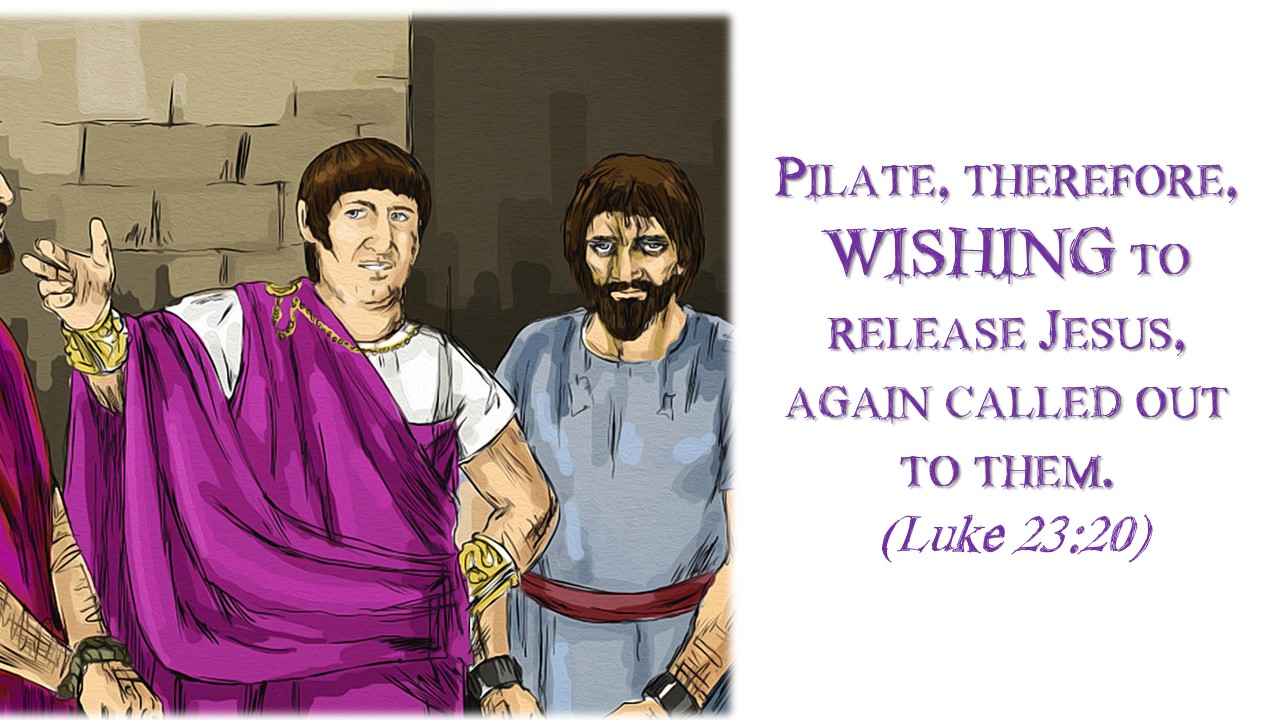
Pilate, therefore, wishing to release Jesus, again called out to them. (Luke 23:20)

Pilate’s Wish

The trial of Jesus was a travesty of Jewish and Roman law. Multiple laws of the Jewish canon were ignored and rejected as the scribes, elders, and High Priest brought charges against Jesus to condemn Him to death without any evidence of wrongdoing. Pilate was faced with the legal presumptions he was pressured to follow when the Jews brought Jesus to his court. The accusers of Jesus moved the crowds and Roman court to condemn Jesus because He was perverting the nation, refusing to pay taxes, and calling Himself a king. All of this was a lie, but it fulfilled the eternal plan of God to show the hatred of the human nature and the murderous lengths humanity will go to kill a fellow human being.

Pilate was the final authority to condemn Jesus to crucifixion. The Romans allowed the Jews to execute their own citizens by stoning, but the Jewish leaders wanted no blood on themselves. They knew if they could convince the Roman court to condemn Jesus to crucifixion, their hands would be washed clean of an innocent man’s blood. Pressuring Pilate to condemn Jesus, the crowds shouted for His crucifixion. Pilate examined Jesus on multiple occasions and sent him to Herod to be questioned, but Jesus was brought back to the judgment seat of Pilate. He could find no fault in Jesus and desired to release Him. Trying to appease the crowd, Pilate said he would scourge the man from Nazareth and then release him. Scourging was a horrific punishment that would bring a man near death. The Jews refused. They shouted the more to crucify Jesus.

The will of God was being accomplished in the death of Jesus. Everything about the trial of Jesus was a travesty of justice, but the travesty of the event brought justice to the world. Jesus was going to die for sinful man. The crowds were filled with hatred and envy, shouting to kill the Galilean. Roman law could not protect an innocent man because Pilate was too cowardly to stand for what was right. The world stood at the brink of destruction as the Son of God was nailed to a cross and died. But through the act of hatred, love conquered the world and salvation was given to all men. In the middle of the story stood a man wishing to do the right thing – but he could not do it.

There are eternal realities about the death of Jesus as demanded by the providential law of God, but the people involved in the death of Jesus reflect the struggles men have with themselves. The crowds were filled with hatred. There was fear in the hearts of the disciples. The Jewish leaders pressed their hatred to kill a man. Pilate stood in a place of authority wishing to do the right thing. Because he did not do the right thing – he did the right thing. He wanted to release Jesus. He desired to let Jesus go home. But he did not release Jesus. He failed. Many like Pilate wish to serve God but lack the courage to face the crowds of hatred, doubt, and fear. Wishing to obtain eternal life will never happen. Salvation does not come from a wish but from commandment-keeping. Jesus told His disciples in the sermon on the mount the only people who will be saved are those who do the will of God. That is not wishing for salvation. To be saved requires doing the will of the Father. Pilate wished and then he died. His wishes changed after death, but it was too late. Do not let death overtake you while you wish to live right and serve God because one day will come when there is nothing to wish for.

Posted in Uncategorized | Leave a comment

Serving The Chief Shepherd

The elders who are among you I exhort, I who am a fellow elder and a witness of the sufferings of Christ, and also a partaker of the glory that will be revealed: shepherd the flock of God which is among you, serving as overseers, not by compulsion but willingly, not for dishonest gain but eagerly; nor as being lords over those entrusted to you, but being examples to the flock; and when the Chief Shepherd appears, you will receive the crown of glory that does not fade away. (1 Peter 5:1-4)

Serving The Chief Shepherd

Leadership within the church of Christ is established by the authority of scripture. When Jesus built His church, the Holy Spirit inspired men to write down the organizational structure of how the leadership of the church of God would be established. Men have corrupted the pattern of leadership through the ages, but the Biblical design has remained intact. Jesus is the only head of the church and within each local congregation of saints are men called elders, pastors, shepherds, and bishops. These men are specifically qualified leaders who have definitive traits outlined in Paul’s letters to Timothy and Titus. Along with their wives, elders have certain qualities that God commands. The work of a bishop is an exhausting, intense, and untiring activity of shepherding the flock of God.

Peter was not only an apostle and preacher of Jesus Christ, but he also served as a shepherd of a local congregation. This would prove Peter was married (Mark mentions his mother-in-law; Paul confirms it) and had children. The apostle writes in his first epistle to encourage his fellow elders to be strong in the face of opposition and to continue to guide the church through the turbulent times of the early church. There was a need for strong leadership as the Christians faced increased persecution. Peter exhorts his fellow elders to be shepherds of the flock of God, caring for the members as a shepherd tends his sheep. Shepherding was a difficult and sometimes dangerous job. A shepherd would have to feed his sheep, protect the flock, and seek out the lambs that strayed. There was a constant watch for the danger of predators and thieves. Elders were not cowboys or CEOs – they were men who smelled like their sheep.

The work of the bishop was a love devoted to the cause of Christ. Peter reminds his fellow elders that serving the congregation is not by a grudging heart of necessity but a heart willing to sacrifice for the needs of the flock. Some men seek leadership to gain prestige and power. This is not the kind of man who will shepherd the family of God. There must be a love for God and a deep love for the brethren to seek their well-being. A shepherd of the church sacrifices his life in service of the congregation. Peter warns the elders not to lord over those entrusted to them. It is easy to take on an attitude of a ‘boss’ instead of a shepherd. The greatest work an elder can do is to lead by example. Cattle are driven – sheep are led. Shepherds call out their sheep by name and the sheep follow them because they trust their voice.

Serving as an elder is exhausting work. Peter encourages his fellow elders to act with diligence and faithfulness; not for anything they may gain from the experience but for the realization that one day each man who served as a shepherd will stand face to face before the Chief Shepherd. Elders will be held to a stricter judgment because of their responsibilities. Standing before the Chief Shepherd is a humbling thought to consider. Serving the local congregation will bring many blessings but not so great as to be in the presence of Jesus Christ and hear the words, “Well done, good and faithful shepherd.” May God raise up more men and women who live before Him in such a manner they can show forth the light of Christ in service to the Chief Shepherd.

Posted in Uncategorized | Leave a comment

Nothing But A Footstool

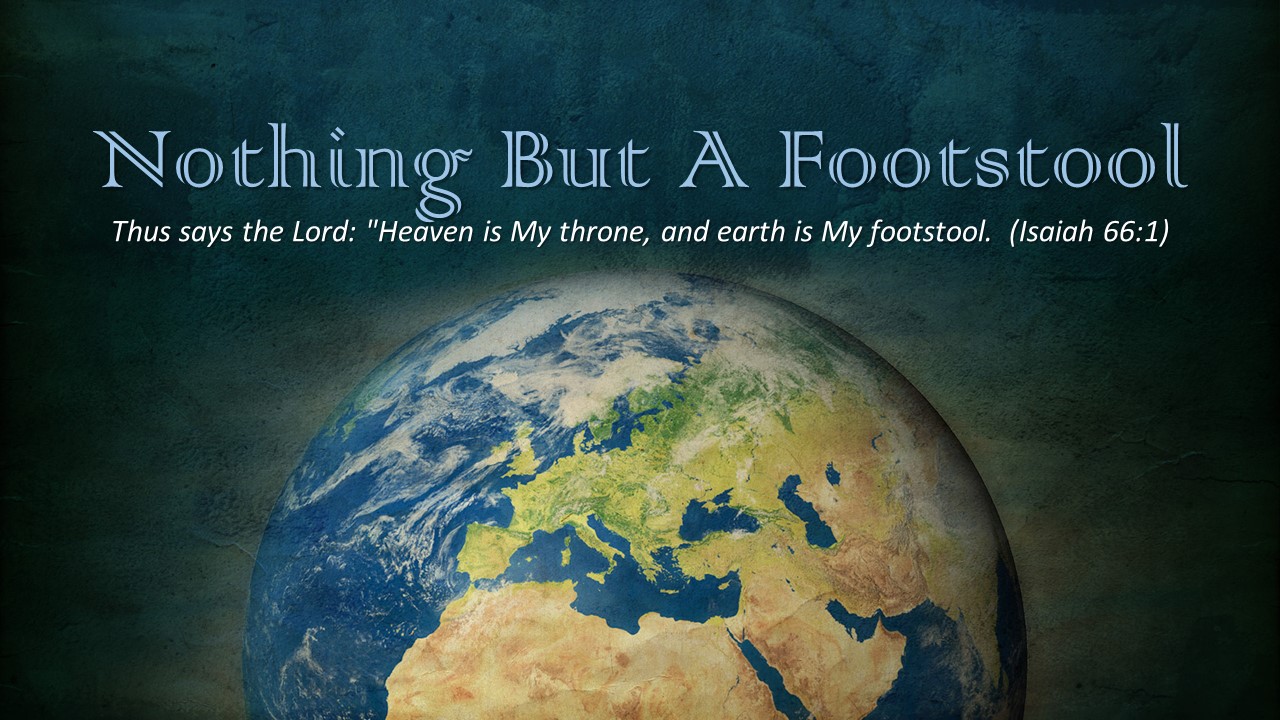
Thus says the Lord: “Heaven is My throne, and earth is My footstool. Where is the house that you will build Me? And where is the place of My rest? For all those things My hand has made, and all those things exist,” says the Lord. “But on this one will I look: on him who is poor and of a contrite spirit and who trembles at My word. (Isaiah 66:1-2)

Nothing But A Footstool

The earth is one of nine planets in the solar system traveling around the sun. It would take about a million earths to fit inside the sphere of the sun. The equatorial circumference of the earth is 24,902 miles. Traveling an average speed of 66,00 miles per hour, the earth moves around the sun in 365 days, 6 hours, 9 minutes, and 9.54 seconds. The earth stays about 93 million miles away from the sun. Walking around the circumference of the earth would take 345.85 days of continuous walking (which is impossible for him to do). The earth is huge compared to the size of a man. Astronauts have witnessed the earth from space, but only half can be seen at one time. The area of the earth is 196,940,400 square miles, with 71% covered by water and only 29% by land. About 5,100,00 square miles of land is in Antarctica, which is too cold to be settled.

A footstool is a low stool for resting the feet on when sitting. The function of the footstool is either as furniture or support used to elevate the foot. It is a secondary piece of furniture that serves more a function than a necessity. At its best, a footstool is a small, insignificant but useful tool to rest a foot upon. To this figure, the Lord draws attention to the expanse of the earth where all men dwell. The angels are bemused by the pride of man as the earth is a vast place for men to inhabit and yet it serves as nothing more than a footstool in the presence of God. There is no comparison to the magnitude of the Lord God and the existence of a man. God can hold the universe in His hand. A man can barely hold a clump of dirt in his.

Perspective helps men identify the vastness of God’s existence and the puny efforts of humankind to exalt themselves above their station. Isaiah declares the earth is nothing more than a footstool to God. The earth is not unimportant to the Lord God, but the immense feeling of grandeur men feel of their place on earth is nothing compared to the whole world being a place for God to rest one foot. How can a man be filled with pride when there is nothing to boast about? Heaven is the throne of God and earth is His footstool. One of the most significant accomplishments of human wisdom is the International Space Station. There are times the reflection of the ISS can be seen by the naked eye on a dark sky. What can also be seen are the trillions of stars surrounding the small reflected light that God holds in His hands. And lest man boasts in his wisdom, the Lord has a name for every star.

Understanding the place of man begins by knowing how big God is. The Lord did not only give the universe to declare how great He is but to remind man how small he is. Earth is nothing more than a footstool. The heavenly look down upon the human race as ants upon a small hill in the middle of a vast field. There is no comparison. Heaven is the place of the glory and majesty of the One who created the earth and placed it three rocks away from the sun. As a faint blue dot in a universe of blackness, God sent His Son to His footstool to save its inhabitants. Thank God for His love. Praise God for His power. Bow in the presence of the one who is so incredibly huge, the expanse of the earth is nothing more than a footstool.

Posted in Uncategorized | 1 Comment

Oholah And Oholibah

Their names: Oholah the elder and Oholibah her sister; they were Mine, and they bore sons and daughters. As for their names, Samaria is Oholah, and Jerusalem is Oholibah. (Ezekiel 23:4)

Oholah And Oholibah

Ezekiel was a prophet among the people of God taken captive by Babylon in 597 B.C. Four years earlier, Ezekiel had been called into the prophetic ministry to warn the people of the impending destruction of Jerusalem. In 586 B.C., Jerusalem fell and the Temple of God was destroyed. The book of Ezekiel is based on two themes: the first warned the Jews the sinfulness of Judah had reached the point of God’s judgment; the second, after the fall of Jerusalem, a message of hope for the remnant to be restored. In the final section of part one, Ezekiel shows the full measure of God’s wrath against the people’s wickedness and refusal to repent and turn to God.

Using the language of a parable, Ezekiel introduces two sisters born of the same mother. Their names were Oholah and Oholibah. Oholah was the older of the sisters. The story of the two sisters was a tragic tale of sexual immorality and bearing children in their harlotry. Immediately, Ezekiel identifies the sisters as Samaria (Oholah) and Jerusalem (Oholibah). Samaria was the capital of the northern ten tribes and was destroyed by the Assyrians in 722 B.C. One hundred thirty-six years later, Jerusalem would suffer the same fate at the hands of the Babylonians. Throughout the prophetic literature leading up to the destruction of Samaria and Jerusalem, God reminded Israel they were His bride. The prophet Hosea was a graphic illustration of the whoredom Israel had committed against her husband, the Lord God. As the Jews felt the sting of bondage, Ezekiel weaves a story of the two sisters reminding them of what happened to their northern sister and what would happen to them if they did not repent.

Oholah played the harlot in Egypt and Assyria. Israel had gone after the gods of the Egyptians and the Assyrians and worshiped the lust of immorality of the nations around her. God sent His prophets to warn the people but to no avail. None of the kings of the northern kingdom were righteous. Prophets like Elijah and Elisha pleaded with the rulers and the people to repent. They refused. God brought the “lovers” of Israel to her borders and they destroyed her. Assyria was an ally of Israel and then became her destroyer. Judgment came upon Oholah by the people she entrusted her life with.

As the young sister, Oholibah should have learned from her older sister’s lessons. She lusted for the lovers of Assyria more than her older sister. The Babylonians came to her as treasured lovers and she indulged all the pleasures of whoredom with foreign nations. Like her older sister, Oholibah suffered betrayal from her lovers. The Babylonians came against Israel as an invading horde with chariots, wagons, and war-horses. Judah was destroyed with great fierceness. They were left naked and bare. Refusing to see the folly of her older sister, Jerusalem suffered the same fate. The cup of horror and desolation served against Samaria fell upon Jerusalem with greater wrath. Judah had forgotten God and cast Him behind her back. They bore the iniquity of their lewdness and spiritual prostitution.

Oholah and Oholibah are alive and well today. The lessons from the two sisters should remind the world that God has not changed His view of sin and rebellion. There are still those who desire to live like Oholah and Oholibah, oblivious to the coming judgment of God and His wrath. Ezekiel warned the people of the Lord’s penalty for sin and the people refused to listen. Sin does not change in translation or time and lessons from the two sisters should be taken to heart. Both sisters were judged. God will judge. Oholah characterizes the world and the church can be described by Oholibah. She will suffer the same fate when the church tries to live like the world. Ezekiel’s message is a lesson for today.

Posted in Uncategorized | Leave a comment

PG-13 And The Heart

He has said in his heart, “God has forgotten; He hides His face; He will never see.” (Psalm 10:11)

PG-13 And The Heart

In 2021, Disney released the movie “Free Guy” by 20th Century Studios rated PG-13. A bank teller discovers that he’s actually an NPC inside a brutal, open world video game. It is a fantasy movie about a popular video game where one of the characters takes on “artificial life” characteristics with the storyline following his exploits. The movie is rated PG-13, where parents are strongly cautioned as inappropriate for children. Before 1984, the ratings went from PG to R without any distinctions. PG-13 was created to sell more movies without the serious impact of an R rating. However, there is a misguided notion that PG and PG-13 are suitable for anyone concerned for righteousness.

Free Guy (rated PG-13) has 29 scenes of sex/nudity in one form or another (tame compared to what would be found in an R movie). There are 119 instances of language throughout the movie: 32 vain references to deity; 17 words of crude language/humor; 1 ethnic/social slur; 27 words of cursing; 37 words of profanity; and 5 words of vulgarity. Without filtering software, the movie is laced with ungodly language throughout the movie – and it’s only a PG-13. Disney is not the wholesome family production it was known for. This is undoubtedly driven by the dollar. The world is becoming increasingly indulgent with the acceptance of immoral behavior as common. This is not a surprise as the world has been filled with the decadence of sinful behavior since Adam and Eve walked out of the garden.

It is sad that movies must fill their coffers with the indulgence of the immoral and acidic language of the world. Young people are drawn to movies like Free Guy, with many parents either unaware or not caring what their children hear. This movie is not the only example of the prolific saturation of what is found on the magical screens of television, computers, and smartphones. It is difficult to find entertainment that must not first be scrubbed with intense filters to allow viewing. There are times that the entertainment is still unworthy of watching with the filters.

What is more tragic is the abundance of Christians who engage in entertainment laced with language – especially the use of God’s name in vain – with no compulsion or regret. They argue that what they hear on the screen is no different than being in the world. That person is a fool who believes the lie that so easily pervades the consciousness of the body of Christ.

The psalmist makes an observation about the wicked. It is the wicked heart that believes that God is not watching, and He has closed His eyes. They mistakenly believe the Lord does not see and hear what is being played on the screen. What foolishness. How often does it take for God’s name to be vilified before the Lord gets angry? One of the hallmarks of the commandments of God has always been (before the Law of Moses) that His name will not be taken in vain. He will not let that person go unpunished. Do not be fooled to believe that as long as a person does not use God’s name in vain, they will not be held accountable. That is a foolish lie. The wicked pretend God does not listen – but He does.

There has never been a time that sin has not dominated the world. The world has been under the sway of unrighteous language since the garden. God does not intend for His people to leave the world but to learn to live in the world. There are choices that can be made and must be made. Walking through Walmart and hearing foul language may not be controlled, but what we choose to watch is entirely under our control. The fool will not make a distinction. Godly hearts will make a choice and make a decision. God will not forget; He will not hide His face and He will not close His eyes.

Posted in Uncategorized | Leave a comment

Choosing Friends

The righteous should choose his friends carefully, for the way of the wicked leads them astray. (Proverbs 12:26)

Choosing Friends

A friend is someone who remains close even when times are difficult. The wise man said a friend is always loyal and becomes like a brother. To have friends, one must himself be a friend who will make a person genuinely wealthy. Friends are the sweetness of a man’s soul giving hearty counsel. Like iron that sharpens iron, friends will hone the character of their fellow man. David and Jonathan were great friends. Jesus had close friends. Paul had men and women who were dear to him in his ministry of teaching the gospel of Christ. The joy of friends is the endearment of sharing the joys and sorrows of life. When the days are bright, friends warm the heart. As days of darkness overwhelm, a true friend will comfort and console. To have a friend is one of the most valuable commodities a man can possess.

With all the good things that can be said about friends, the influence of a friend can also be the worst thing that can happen to a person. The kind of friends a man gathers around him will influence the type of person he will become. Friendship is a close bond that seeks recognition and respect. God gives the warning of choosing friends to know some friends will not bring out the best in a man’s life. Having a friend is not always a good thing. Some people have no interest but their own and will use anyone for their purpose. They will fain friendship to gain the trust and then use that person to their destruction. Choosing friends takes wisdom. It takes courage to refuse those who desire to be friends that will not lead to righteousness.

There are many reasons why friends are chosen. Common interests draw people together. There may be connections within groups where friends draw close to one another. A common goal can create a circle of friends. The question the Christian must ask is if the friends that are in their life are there for righteous reasons or unrighteous. A wise man will choose his friends carefully. If a friend is chosen, who is wicked, the likelihood of the wicked causing the righteous to stray increases. When someone seeks out unrighteous friends, they are not seeking friendships based on doing the right thing. God is not at the center of their life. Wicked friends follow the paths of unrighteousness and will lead their friends along the same paths.

Choosing friends is not an easy task. There is a single virtue that is constant in seeking out friends. This is different than associates that become part of life as friends are closer than a brother and more influential than casual acquaintances. Having a friend is a person or persons that have a great deal of influence on the heart of the Christian. The most important question about choosing a friend is whether that person will help or hinder the Christian from being saved. Having friends is an integral part of life, but when those friends are not helping to live righteous lives, they are will hinder the growth of spirituality. Everyone wants to please their friends. God warns that choosing the wrong friends can have serious consequences. The rule is simple: The godly give good advice to their friends; the wicked lead them astray. You’ve got a friend indeed – but what kind of friend?

Posted in Uncategorized | 1 Comment

Saved And Then Lost

But I want to remind you, though you once knew this, that the Lord, having saved the people out of the land of Egypt, afterward destroyed those who did not believe. (Jude 5)

Saved And Then Lost

The children of Abraham had been in a foreign land in bondage and oppression for four hundred years. God had promised Abraham He would deliver the people from Egypt. When the time came for the deliverance of His chosen people, God raised up Moses to be the one to bring the Hebrews to the land promised Abraham. The Lord showed His glory with wonders and signs in the land of Egypt, and in the Red Sea, and the wilderness forty years. Through the power of God, Israel was saved from Egyptian bondage. The Passover was a test of the people’s faith and they were obedient to the word of the Lord. Everything God commanded them to do, they obeyed. As the Egyptians approached the people standing by the Red Sea, the people’s faith was emboldened to walk through the sea on dry land. God saved the people from Egypt by His mighty hand.

After the miracle of the Red Sea, the Hebrews came to the Wilderness of Shur, where there was water but so bitter they were unable to drink it. The Lord told Moses to throw a tree in the water and it became sweet. Shortly afterward, God provided manna to feed the people and once again provided abundant water at a place they named Massah and Meribah. The Amalekites attacked the Hebrews and the Lord gave them complete victory. Arriving at Mount Sinai, the Hebrews became a nation with God giving them a law. Everything was going well for Israel and God delivered them from every trial. The Lord saved the people out of the land of Egypt, but their hearts turned away from Him.

Salvation from Egypt did not save the people in the wilderness. The signs and wonders the people saw in deliverance from Pharoah did not keep them from disobeying the commands of God. At Sinai, the people demanded a god to lead them and Aaron made the golden calf. When the people came to Canaan at Kadesh-Barnea, they rebelled against the Lord again. Sadly, the deliverance from Egypt did not save them. The people God saved from Egypt were the same people the Lord destroyed because they did not believe. They saw the power of the Lord but it did not save them. The forty years of wandering destroyed everyone twenty years and above and these were the same people God had saved from Egypt. Only Joshua and Caleb were saved from this destruction.

Faith alone did not save the Hebrews. Deliverance from Egypt did not save Israel. God’s power did not instill saving faith as the people continued to rebel against Him. The Lord saved the people out of the land of Egypt and then He destroyed those who did not remain faithful. Jude makes the point that salvation did not come only by the power of God. The angels who did not keep their proper domain, God punished. Faith alone has never saved anyone, including the demons – who believe and tremble. Jesus manifested the power of God and the Jews rejected Him and killed Him.

One of the most prominent doctrines of modern theology is salvation by faith only and, once saved, always saved. The Bible never teaches that God will save those who refuse to obey Him. All the wonders and signs the Hebrews saw did not change their hearts and God destroyed them. If the Lord will destroy His own people because of unbelief, He will punish those who refuse to follow His word. Remember the Israelites. God saved the people out of the land of Egypt and afterward destroyed those who did not believe. That is the gospel of Jesus Christ.

Posted in Uncategorized | Leave a comment

Beaten In Church

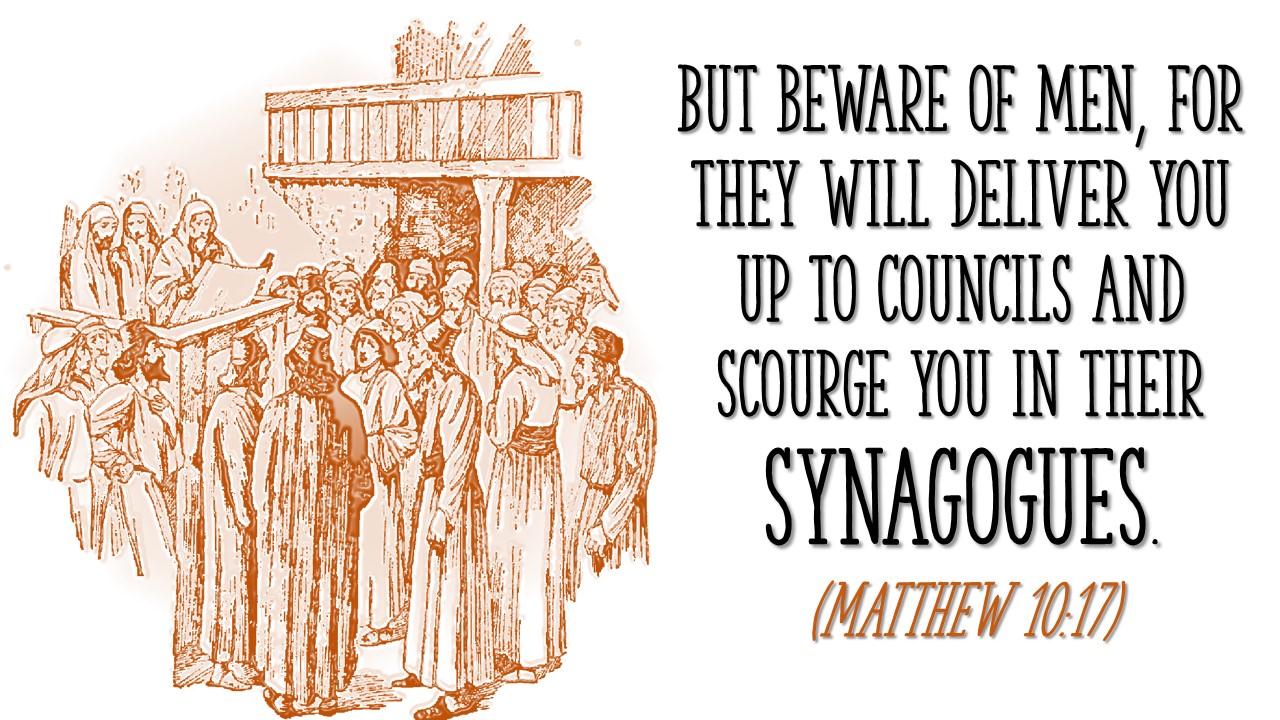
But beware of men, for they will deliver you up to councils and scourge you in their synagogues. (Matthew 10:17)

Beaten In Church

Synagogue worship developed during the captivity in Babylon as the Jews were unable to go to Jerusalem and worship at the temple. The Babylonians had destroyed both the city and the temple and the remnant of the people of God were captive slaves. By the time of Jesus, the synagogue remained a central part of Jewish worship, with weekly assemblies to listen to the reading of the law and the prophets. It was the custom of Jesus to attend every Sabbath and read from the scrolls. Many cities had more than one synagogue, including Jerusalem. Depending on the synagogue’s size, each had various officers who attended to the ministry of prayers, readings, laws, and teaching of children. A group of Jewish leaders called elders presided over the synagogue. A synagogue would have a ruler (one or more) and a servant or minister who would see to the lighting of the worship place and keep the building clean. The minister would also be charged with wielding the whip to punish those found guilty of disobedience.

The power and influence of the synagogue had become so prominent in the days of Jesus many believed in Jesus, including some of the Jewish leaders. Still, they wouldn’t admit it for fear that the Pharisees would expel them from the synagogue. Jesus tells His disciples the day will come when resistance to the teaching of Jesus will bring them into the synagogue to be beaten. To be beaten like a criminal in the presence of the local synagogue would have brought incredible shame to the family. Jesus warns that many will face the disgrace of their names being brought before the rulers of the synagogue and, as friends and family watch, to be scourged. The law prohibited more than forty lashes, so the whip used for scourging had three thongs of leather with bone or lead. Thirteen lashes would be counted, leaving the scourging to thirty-nine lashes. The Romans had no such law and did not limit the scourging to a number.

Following Jesus would bring the shame of beatings in the synagogue. Paul recounted how he punished the followers of Jesus in every synagogue, compelling them to blaspheme. He witnessed the followers of the Way being beaten in the synagogue. The early disciples used the synagogue as a place to teach the gospel of Christ. It was a dangerous place to show the Jews the covenant of Christ. In the city of Corinth, Paul reasoned every Sabbath in the synagogue and persuaded both Jews and Gentiles. Facing opposition, Paul left the synagogue and taught at the house of Justus, whose house was next door to the synagogue. Crispus, the ruler of the synagogue, believed along with his household and many Corinthians. Persecution would come a year later when Sosthenes, the ruler of the synagogue, was beaten before the judgment seat.

The faith and courage of the first century Christians is a remarkable story of how devoted they were to the teaching of Jesus Christ. Their belief that Jesus was the Christ helped them to face the inevitable persecution of those who would not believe. The synagogue was supposed to be a place of worship and reflection on the word of God and it became a rallying cry to stand for Jesus Christ. These saints were beaten in the synagogue because of what they believed. A modern version would be as if one were beaten in church. How would the church fare today if men were beaten for believing Jesus was the Christ or the Bible was the only true word? What will be the condition of the church in time to come when a bold stand against the immoral values of a world brings severe consequences of the law against it? How many Christians will be willing to be beaten in church for God? Jesus told His followers that life for them would be a cross-bearing life. That lesson has not changed.

For many, it will be difficult to be beaten in church because they never attend. The worse persecution they face is if the internet is slow. Others are too busy with work, recreation, and leisure to be where the Lord commands. The faithful will endure the ridicule of a world increasingly discontent with the faith of those who hold fast to Jesus Christ. When the Bible is taught in its divine force, the world will react. Will you be where you should be on the first day of the week – even if it means you might be beaten and scourged? Be faithful. Serve God. Obey His word. Endure and overcome.

Posted in Uncategorized | Leave a comment

Confident Of Better Things

But, beloved, we are confident of better things concerning you, yes, things that accompany salvation, though we speak in this manner. (Hebrews 6:9)

Confident Of Better Things.

The Hebrew letter is a difficult and challenging book. Persecution had imposed a heavy toll on the early Christians, with some giving up their faith in Christ. Comparing the covenant of Christ with the Law of Moses, the writer advocates the better faith is in Christ Jesus. There is a dire warning for those who would turn aside from the holy commandment of renewing them again to repentance. This was a serious problem. With all the warnings and cautions, a note of hope and encouragement rang through the message. There were dangers in the church of apostasy but the writer had confidence in his audience they would not give up their faith, remaining faithful to the end as they sought their eternal homeland.

Exhortation is an important part of the Christian life. When hearts are filled with discouragement and despair, a word of hope can make a difference. With all the Hebrew Christians faced, the writer wants them to know his utmost confidence they would do the right thing. People need to hear that kind of message. For all the problems in the church and the challenges that are endured daily, the people of God must know they can overcome any trial of life. It is hard to accept that some who named Jesus as Lord could turn away and lose their soul but it was a real possibility. The apostasy could be so permanent nothing could bring them back. This is harsh language and difficult to accept. As the writer follows up this sharp discourse, he reminds the Hebrews of his confidence in their faith. He knows they will not be overcome by doubts. His belief is strong in their faith.

Not only are the Hebrews told they would remain faithful, but the writer also tells them he believes they are meant for better and greater things in the kingdom. It is one thing to be told you will face obstacles with courage and faith, but extending that hope to so much more that is possible is invigorating. These Hebrews were placed in the kingdom of God for such a time to excel, abound, extend their influence, and grow in their faith. They needed to know they were special. Their faith was not wasted. God was aware of their work and labor of love. He knew the trials they faced and commended them for remaining faithful. The Hebrews ministered to the saints and were filled with good works towards others. And they could do more.

There is a lot of work to be done in the kingdom of God and saints need to be encouraged to excel in their talents beyond what they are doing. They need the confidence others have in them to be purposed for greater things. There is always a better work that everyone can contribute to the work of the Lord. Often, a little word of encouragement is all that is needed. Even if no one tells you they see better things in you, know that God has that desire for you to excel more and more and grow in His grace. There is always so much more that can be done if we but try. God sees the work of His saints and knows their labor. His desire is for the kingdom of His Son to be filled with encouraging hearts longing to do more to bring lost souls to salvation. God is confident of better things concerning you.

Posted in Uncategorized | Leave a comment