Spiritual Leadership In The Church

Paul and Timothy, bondservants of Jesus Christ, To all the saints in Christ Jesus who are in Philippi, with the bishops and deacons: Grace to you and peace from God our Father and the Lord Jesus Christ. (Philippians 1:1-2)

Spiritual Leadership In The Church

Over the centuries, the wisdom of human pride has attempted to change the organizational structure of the Lord’s church. The apostles would be shocked at how churches of men have established spiritual leadership far from the pattern of the New Testament. Roman Catholicism began the march of apostasy by creating an incredible hierarchy of man-made organizations corrupted by the whims of carnality. The Protestant response has followed the same pattern of apostasy as men changed the leadership of the church to represent a false narrative of authority. There is a pattern given by the Holy Spirit showing the world the spiritual leadership of the local church that is divine in nature, simple in construction, and complete in the organization.

Jesus is the head of the church, and no man can take that role from Him or usurp a role of authority through Him. The church’s spiritual leadership is found in men called pastors, bishops, elders, overseers, and shepherds. They have the authority of Christ to exercise oversight of the local church alone. Each man (plural) chosen to serve as a pastor must be of a certain character, as Paul outlined to Timothy and Titus. These are spiritual men shepherding the flock and overseeing the local church. In the New Testament, there was always a plurality of men who led the church in the work of the Lord. As spiritual leaders, elders guide the affairs of the church by the authority of the word of God.

Deacons are spiritual leaders in the church as men who must have certain qualities (similar to those of an elder) that separate them as spiritual leaders. The work of deacons is found in the meaning of the word describing a servant’s heart. Elders have targeted characteristics that must be met before they serve as elders. Deacons have spiritual qualities that set them apart to serve in the spiritual leadership of the church. The local congregation comprises men who live spiritual lives doing spiritual work to further the kingdom of Christ.

Preachers must be spiritual leaders. Paul instructed Timothy and Titus to bear the characteristics of spiritual leadership in the quality of their life to lead by example in word, conduct, love, spirit, faith, and purity. A servant of the Lord must not quarrel but be kind to others, able to teach and learn patience with difficult people. There is much work for the evangelist to do in the work of the church and his spiritual leadership is key to church growth. The shepherds of the church working in tandem with the work of the deacons and the preacher will bring about growth to the flock of God.

In the early church, the apostles chose seven men to care for the widows of the Jerusalem church. These were spiritual leaders with a vital task of church growth. The seven needed to be men of good reputation, full of the Holy Spirit and wisdom, and men willing to take on the work given to them by the apostles. The word of God spread, and many people were converted to Christ through the work of the First Century spiritual leaders working together to teach the lost, care for the needy, and build up the saints’ faith. This pattern must be followed today for the growth of the church.

Many others are spiritual leaders in the church when men take on the role of leading singing, offering public prayers, serving on the Lord’s table, and teaching Bible class. These roles cannot be filled with those who are not spiritual or devoted to the Lord. Women are spiritual leaders when they teach the young people in Bible classes and support their husbands, who serve as shepherds, deacons, preachers, and teachers. Paul illustrated the work of the church by what every part does its share. Spiritual leaders in the church have different roles and – for some – specific requirements that must be met. Everyone must strive to be a spiritual leader in their home and use their talents to be spiritual examples within the church’s work. The church will grow when everyone sees their potential for leadership in the spiritual work of the kingdom of Christ.


Posted in Uncategorized | Leave a comment

Our Precious Things Are Useless

Those who make an image, all of them are useless, and their precious things shall not profit; they are their own witnesses; they neither see nor know, that they may be ashamed. Who would form a god or mold an image that profits him nothing? Surely all his companions would be ashamed; and the workmen, they are mere men. Let them all be gathered together, let them stand up; yet they shall fear, they shall be ashamed together. (Isaiah 44:9-11)

Our Precious Things Are Useless

Idolatry is as old as the world. Worship is innate in men, but the object of worship is a choice. Whom men choose to revere determines the character of the man. There are only two choices when it comes to worship: man will worship himself or acknowledge a higher being and worship Him. Pride does not allow a man’s heart to accept the will of his Creator to direct his steps and his ways because there are restrictions prohibiting desired lusts. If a man subjects himself to the will of God, he is not free to live as he chooses. To placate the guilt of denying the eternal God, the wisdom of man creates his own totem to form in his own desire. The result of idolatry is rooted in the greatest of follies when men create their own gods to fall down and worship, and man must deliver their gods.

Israel was destroyed because of idolatry. Isaiah warns the people of God to reject the gods of men returning to the one true God. A logical approach to idolatry shows how useless idol worship can be. A man cuts down a tree to build a fire and warm himself and uses the same tree to carve an image that becomes his god. The idol does not speak and has no understanding, and yet man worships their precious creation. Idolatry is the greatest of follies for the vanity it creates in the void of human wisdom. Man’s pride will not allow him to admit what he holds in his hand is a lie. What is precious to him is what he has created with his own hand. Man creates his god instead of accepting that God created mankind for worship.

There are many places throughout the world that still worship idols. Great carvings stand in temples worshipped by people who carry home small idols to treasure in their homes with daily worship. To the Christian mind, this is folly. What is remarkable is that while it is easy to see the foolishness of falling down to an idol, one of the greatest problems in the church is found in those who allow the trappings of the world to become their idols of choice. No child of God would believe that falling down to an idol of Buddha would be acceptable before God and yet fill their hearts with the pride of materialism in the kinds of homes, cars, boats, and recreational equipment they possess. An idol is anything considered precious that takes the heart away from God.

It does not have to be a carved image of a creature to be an idol. A job can be an idol that takes precedence over service to God. Living in lovely homes and driving certain vehicles can become the heart’s idolatry. Pride exalts the spirit to trust in the riches of life. Idolatry is alive and well in modern-day America. Those who make treasures of earth their gods worship things that are useless and vain. A man and woman will spend all their life gaining stuff and leave all their stuff when they die. What is sad is they never laid up treasure in heaven. Jesus calls them fools. All the things of life profit nothing. What is precious is lost. Souls are destroyed. Eternity is filled with idol worshippers who sit in torment and darkness and have given up everything for something worthless.

God created man for His glory. All men are formed by the hand of the Lord. The Creator demands His creation honor Him through worship, acknowledging the one true God. Do not be fooled into believing idol worship is only bowing before a carved image. Look around you. There may be more idols than you know. What is more precious – your eternal soul or the useless trinkets of a wasted life? They shall be ashamed together.

Posted in Uncategorized | Leave a comment

Thank You For The Hard Times

My brethren, count it all joy when you fall into various trials, knowing that the testing of your faith produces patience. (James 1:2-3)

Thank You For The Hard Times

Life can be a difficult journey filled with sadness, heartache, trial, and despair. Sin is the agency that has brought such misery to the world. Adam and Eve enjoyed perfect peace without disease and heartache when they were in the garden. It seems impossible to imagine a world so void of the pressures of life that everyone endures. The great consequence of sin brings death, and with death the disease of the body and the corrupt hearts of sinful men. Humanity lives under the daily burden of trouble, and there is no relief. Hard times are real times, and life is often measured by how far apart these troubled times are and to what level the soul sinks in the despair of the tragedy of life. Jesus did not come to take the troubles of the world away. He came to allow men to know how to be thankful for the hard times.

It must not be overlooked that when hard times come, Jesus experienced the same burdens. The Son of God took on human flesh, which was a remarkable change from his state of deity. Jesus had to learn to walk like all children must learn, and He grew up with toothaches, skinned knees, and the maladies of childhood. Somewhere in the thirty years of His earthly life, his adopted father, Joseph, died. This filled the heart of Jesus with great sadness. There is no doubt before Jesus began His ministry, He stood at the graves of many people and wept. As His mind grew in the knowledge of the Father’s word, He saw the misery of sin and its burden on the hearts of men. Jesus experienced hard times in His life as Satan sought to tempt Him with the lust of the flesh, the lust of the eye, and the pride of life. What made a difference in the life of Jesus was He used the hard times to draw Him closer to His heavenly Father.

If the author of the book of James is one of the half-brothers of Jesus, he would know more than most the impact of hard times in the life of Jesus. Writing to the saints scattered abroad, he begins his letter by exhorting the people of God to rejoice in their trials. James reminds the disciples when troubles of any kind come upon them; they were to consider it a time of joy. That seems counter to how most view hard times. Yet, the spirit of the Christian recognizes that while hard times are not desired, they can be fruitful for building up the godly character. Faith tested is faith triumphant. The purpose of hard times can be used to produce an enduring heart of faith in God. Facing hard times becomes bearable when the character of life is understood. The Christian knows that sin is at the heart of the world’s misery. They also know that God offered His only begotten Son as the remedy for the difficult days of life. Solomon declared in the book of Ecclesiastes that life is hard and life is never fair. The realization for the child of God is that life is short, and God is eternal.

The Lord does not look at the hard times of a man’s soul without compassion. There are many who have carried heavy burdens of sorrow in their lives. What is found in the child of God is the solace of God’s love to be thankful for the hard times to increase their strength, will, and purpose in life to serve God. Blaming the Lord for hard times is accusing the wrong person. Thanking God for the hard times is knowing the love of the Father. No one wants heartache in life, but when it comes, increasing faith and trust in God will be the eternal salve to calm the storms, ease the pain, and find joy in the place of sadness. Thank you, God, for your love. I pray dear God, when I awaken to hard times, I will harden my faith in you to allow your grace to give me peace.

Posted in Uncategorized | Leave a comment

When A Man Thinks He Is Wise

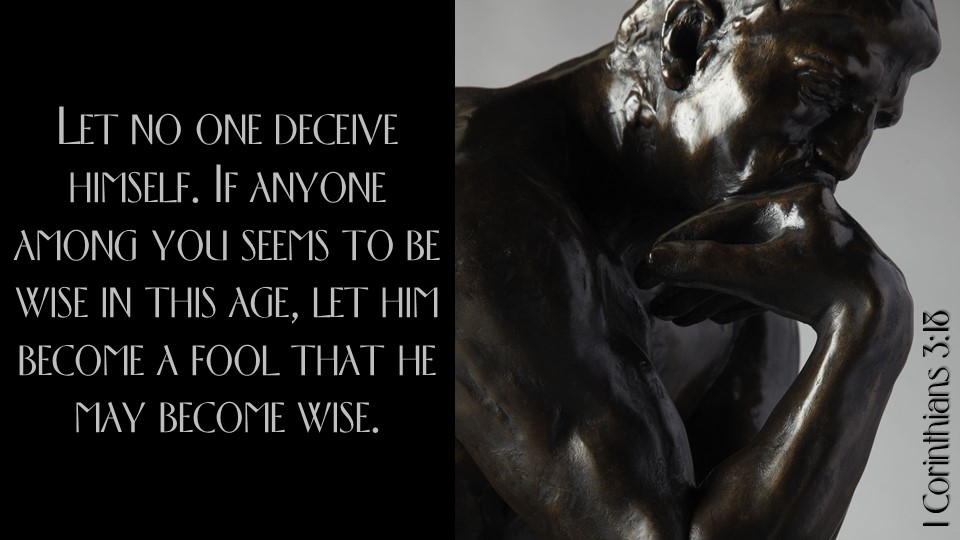
Let no one deceive himself. If anyone among you seems to be wise in this age, let him become a fool that he may become wise. For the wisdom of this world is foolishness with God. For it is written, “He catches the wise in their own craftiness”; and again, “The Lord knows the thoughts of the wise, that they are futile.” (1 Corinthians 3:18-20)

When A Man Thinks He Is Wise

Pride is one of the triads of foolish mistakes all men make when they look at themselves in the mirror. Charles C. Colton wrote, “Of all the marvelous works of the Deity, perhaps there is nothing that the angels behold with such supreme astonishment as a proud man.” The apostle Paul reminded the carnal hearts of the Corinthians that their division of human wisdom was folly compared to the majesty of Jehovah God. Wisdom is much sought out worldwide as men seek to exalt themselves beyond measure. The world’s knowledge has built great monuments, achieved remarkable accomplishments, unlocked secrets of the unknown, and explored the vast universe as no generation before. There is much for human wisdom to boast but compared to the wisdom of God, there is not even a comparison at the atomic level. God’s wisdom is so far above the foolishness of human wisdom.

Men deceive themselves when they boast of their wisdom. Great men declare monumental truths. In every age, the wisdom of the world seeks to exalt itself above the nature of the Divine. And in every generation, the exaltation of human wisdom fails – without exception. The greatest wisdom a man can possess is when he sees himself as the fool that he is compared to the Creator and Maker of the world. What can man create or accomplish that can apex the work of God? Where has the vaulted wisdom of humanity made the plight of man one whit better than the smallest fragment of divine wisdom? Could the Shakespearean wisdom of man create the divine story of Jesus of Nazareth? What principles of human wisdom can find greater worth than the pages of holy writ?

Eliphaz the Temanite was correct when he answered Job that God’s and man’s ways are not the same. God can frustrate the plans of humanity, defeat their schemes, make void the counsels of human wisdom, and do so without any effort. The wisdom of the world is nothing but foolishness as the Divine potter forms the clay to His will. When can man make himself taller than God? The psalmist answers the highest thoughts of men are fruitless and vain. When a man thinks himself wise, he becomes a fool.

The wisdom of the world seeks to destroy the wisdom of God. For two thousand years, the world has rejected the final revelation of the Lord as useless. The Bible represents the complete mind of God revealed to all men for every generation in every place. Nothing can compare to the message of the sixty-six books of divine knowledge filling God’s heavenly library. Anything written by men is foolish and empty. There is only one divine truth, and that is contained in the Bible and the Bible alone. Adding to the divine word will fail. Taking away from the word of God will fail. All men will fail when they embrace the wisdom of the world over the knowledge of God. In the end, men are found to be foolish and God divine.

Posted in Uncategorized | 1 Comment

The Nethinim

Now the rest of the people—the priests, the Levites, the gatekeepers, the singers, the Nethinim, and all those who had separated themselves from the peoples of the lands to the Law of God, their wives, their sons, and their daughters, everyone who had knowledge and understanding— these joined with their brethren, their nobles, and entered into a curse and an oath to walk in God’s Law, which was given by Moses the servant of God, and to observe and do all the commandments of the Lord our Lord, and His ordinances and His statutes. (Nehemiah 10:28-29)

The Nethinim

There is little known about a class of people called the Nethinim, which appear in the post-exilic books of Ezra and Nehemiah. Hebrew tradition suggests that Ezra wrote the books of 1 & 2 Chronicles, which reference the Nethinim. Appearing only eighteen times in scripture, the Nethinim are included with the priests, Levites, gatekeepers, and singers of temple worship. The function of the Nethinim was the menial tasks of servitude in helping the priests and Levites carry out their work. These were the lowly servants doing the common labor jobs in temple worship. Someone had to do the undesirable jobs, and the Nethinim were tasked with the work.

The Bible tells the stories of great men like Noah, Abraham, Moses, David, and Isaiah. Families like the sons of Jacob fill the pages of holy writ. Everyone knows the stories about the flood, the Hebrews crossing the Red Sea, God giving the commandments to Israel, and the conquest of Canaan. David’s courage before Goliath is imprinted in the minds of everyone. Great prophets like Elijah, Elisha, and Jeremiah stir the souls of the people of God with power and victory. The return of Israel from bondage, the building of the temple, and the rebuilding of the walls of Jerusalem complete the story of the people of God in the Old Testament. In the midst of all these great stories are a people called the Nethinim that God chose to preserve in the divine record. Their work was menial, hard, and lowly, but God knew them, and He kept their name for all generations to read and take note of.

Nothing escapes the eyes of the Lord. Without the divine record, the Nethinim would have never been known. Their knowledge in the world is firmly established in the record of God’s word. The work they did was not glorious or rewarding. It is doubtful that many Hebrews aspired to grow up and become a Nethinim. There were probably as many Nethinim who longed to be a Levite, priest, or someone of notable character. The lot of Nethinim was to serve, and God took note. Reading the Bible always brings fascinating revelations, especially when the nuggets of God’s hand strike across a page with a simple reference to the Nethinim. Who were they, and what was their story? So little is known about them, but after 2500 years, their names are still on the lips of those who read the books of Ezra and Nehemiah.

There are a lot of Nethinim in the church today. They may not have the more visible works in the church or names to be remembered. What is a joy to find are the quiet servants working in the kingdom doing what they can to help. It may be menial jobs of cleaning the building, printing and preparing class material, setting the Lord’s Supper in its proper place, working the vast array of electronics to carry the message to the world, mowing the grass, or sweeping off the sidewalks. There are many Nethinim that take food to the needy, help others make their doctor appointments, write cards and letters to the downtrodden, and show the glory of God by finding their place in the assembly every time the doors are open. God remembered the work of the Nethinim through the ages and knew the names of all His faithful who quietly go about their work in the kingdom. These modern-day Nethinim will not have their names listed in the Bible, but they do have their names written in the Book of Life. God knows who you are. Thank you.

Posted in Uncategorized | 1 Comment

In The Face Of Trial, God Was With Him

And the patriarchs, becoming envious, sold Joseph into Egypt. But God was with him and delivered him out of all his troubles, and gave him favor and wisdom in the presence of Pharaoh, king of Egypt; and he made him governor over Egypt and all his house. (Acts 7:9-10)

In The Face Of Trial, God Was With Him

Joseph is a story of incredible virtue with amazing courage to face life’s most difficult trials. The story of Job is examined for the enormous burden placed upon a man of God, but Joseph faced his reality at the age of seventeen. He was the favored son of a doting father, born into wealth and privilege and destined for greatness. Before Joseph could find his day in the sun, he had to face the darkest trials any man must face. Jacob sent his beloved son to check on the older brothers when they turned on him, wanting to kill him. Reuben interceded before the murderous plan could take place, but while he was gone, the brothers sold Joseph to a caravan of slave traders bound for Egypt.

The hatred of the brothers of Joseph came from their envy of him. He was the favored son and considered blessed because of certain visions and dreams he had received. They hated him so much that they could not speak peaceably to him. When the brothers found Joseph coming to them in Dothan, they planned to kill him and see what became of his dreams. Reuben interceded, hoping to return Joseph to his father. While the elder brother was gone, Joseph was sold for twenty shekels of silver, and Joseph was taken to Egypt.

Life for Joseph was hard and difficult. The journey to Egypt was an arduous journey chained as a slave before being sold on the slave market as a piece of flesh. His work at Potiphar’s house was demeaning and humiliating. Joseph kept his faith in God, believing the Lord had a plan for his life. In time, he showed his fidelity to honesty and was placed in charge of the household. After Potiphar’s wife tried to seduce the young man and failed, she accused him of attempted rape, and Joseph was cast into the king’s prison. He languished again in dark days, but faith helped him rise above his trials. He was in charge of the prison and had free reign to oversee the king’s prison.

One day, two prisoners were brought into the prison. The butler and the baker of Pharaoh had displeased him and were put into the prison where Joseph was. The butler and baker each had a dream, and Joseph was able to tell them the interpretation. As determined by the word of the Lord through Joseph, the butler was restored, but the baker was hanged. Joseph had begged the men to remember him and find a way to release him, but after two years, the butler had forgotten what Joseph had done. The butler remembered the man in prison when Pharaoh had a dream and could not determine its meaning. Joseph explained the dream to Pharaoh and, as a reward, was released from prison and made second in command of all of Egypt.

It was more than twenty-two years from when Joseph was sold by his brothers, and he walked out of the Egyptian prison. For much of his early life, Joseph lived under the dark cloud of trials that would have broken most men. But God was with Joseph. The blessings of the Lord overshadowed the heart of Joseph, who walked each day in his darkness, trusting in the will of his heavenly Father. Joseph would later recount to his brothers how he saw all that happened to him as the working of God in his life. Those dark days of trial made Joseph a stronger man because he trusted in the will of the Lord. Joseph’s trials were not easy, and he did not enjoy them. What makes the story of Joseph victorious is he never gave up on God, and God never gave up on him. Dark days come. Trust the Lord. There is always a bright day when the heart trusts in the power of God.

Posted in Uncategorized | Leave a comment

Teaching False Doctrine

And certain men came down from Judea and taught the brethren, “Unless you are circumcised according to the custom of Moses, you cannot be saved.” (Acts 15:1)

Teaching False Doctrine

The early church had to bridge a difficult challenge of doctrine. When the Lord appeared to Abraham to establish a divine covenant, circumcision was the sign of the bond between God and the children of Abraham. Under the Law of Moses, circumcision was required without exception. To be cast out of the favor of the Lord was to be uncircumcised. Every male child was circumcised on the eighth day. When Jesus was eight days old, He was circumcised and named Jesus, the name given by the angel before He was conceived in the womb. Only the Jews were required to be circumcised as recipients of the Law of Moses. Gentiles who proselyted into the Jewish faith were required to be circumcised, but only if they were willing to be subject to the Mosaic Law. Outside of the Law of Moses, circumcision was not required.

Jesus came to bring Jew and Gentile together as one. The Gentile was justified by faith, and the Jew found justification under the law. Both avenues of salvation could not take away the stain of sin. In the death of Jesus, the Son of God reconciled Jew and Gentile together through His blood, thereby establishing the gospel of Christ as the means of salvation. In the early church, many Jews could not let go of circumcision as a means of salvation. The controversy heated up to where many were teaching that without circumcision, there could be no salvation. This doctrine of salvation by baptism and circumcision was false teaching without God’s authority. For the Jew, circumcision was the sign of the covenant, and many were unwilling to accept that God had taken it out of the way. Circumcising a child on the eighth day was not a sin; binding circumcision as a means of salvation was a sin.

The controversy over circumcision illustrates the problem that faces the church in clarifying the reality of false doctrine. Binding law where the Lord never bound is sinful. Teaching doctrines that are not according to the gospel of Jesus Christ is false doctrine. Adding to the word of God is forbidden. The early Jews tried to bind circumcision as a covenant of grace that God never allowed. Paul never taught the necessity of circumcision for salvation because it was not true. He asked Timothy to be circumcised because the Jews in the region knew Timothy’s father was a Greek. Titus was not required to be circumcised. Convincing the first-century Jew that circumcision was unnecessary was a stern message to accept. It became equally hard to remind many of the Jews that teaching salvation by circumcision was false.

Satan tries hard to destroy the souls of those seeking after the Lord. He spins a web of false doctrine to convince the unprepared soul to believe in something untrue. The result is the soul is lost. Teaching false doctrine has eternal consequences. Accepting a false dogma can bring about eternal ruin. One of the greatest tools in the arsenal of the devil is to convince men he does not exist and that there is no such thing as false doctrine. He has effectively created a ‘religious world’ with as many beliefs as Breyers Ice Cream. Everyone gets to choose and pick what church they want to be a part of and how to believe the Bible. In a world of religious diversity, there is no unity among believers in Christ. Churches bear different names by followers who wear distinctive names accepting doctrines not found in the word of God. And no one seems to believe false doctrine is real.

The early church faced the false doctrine of salvation by circumcision. There are many teachings today that are untrue. The eternal result of false doctrine is false hope and a false promise. There is one truth, and that truth must come from the pages of God’s word. Men may say that a difference in interpretation is a blessing from God, but that is the siren voice of the deceiver who placates the unsuspecting soul to accept what is clearly false. Does it matter what a person believes as long as he is honest? There were none so honest as the Jews who said that they could not be saved unless a man is circumcised – and they were wrong. Do not believe something because of what a man says or what you have believed all your life. Believe what God says and demand nothing less.

Posted in Uncategorized | Leave a comment

What You Know Perfectly

But concerning the times and the seasons, brethren, you have no need that I should write to you. For you yourselves know perfectly that the day of the Lord so comes as a thief in the night. For when they say, “Peace and safety!” then sudden destruction comes upon them, as labor pains upon a pregnant woman. And they shall not escape. (1 Thessalonians 5:1-3)

What You Know Perfectly

The expectation of a child is an incredible experience. For nine months, the child grows inside the womb in a marvelous and wonderful way. There are the initial signs of pregnancy, some good, some bad. The woman’s body begins to change as it adapts to the miraculous birth process. As the child grows to full term and begins to move around with little kicks and hiccups, the wonder of the new birth intensifies. One of the certainties of pregnancy is the uncertainty of when birth will occur. Doctors will make predictions of when the child is to be born, but the timing of birth is unknown. And then it happens. Pain begins to set in, and birth begins unexpectantly, suddenly, and forcefully. There is no turning back. Without warning, a child enters the world.

Before the advent of modern medicine, birthing was not as predictable. It came suddenly, and it came with pain. Lots of pain. The cycle of life has continued unabated since Adam and Eve witnessed the birth of the first human being and called his name, Cain. Nothing has changed the process in its simplest form as life comes through the avenue of birth. God created woman to be the only agency that birth can happen in the human condition. The apostle Paul uses a woman’s pregnancy to show the sureness of another great and unexpected event – the second return of Jesus Christ.

There have been myriads of pundits who have declared they know when the Lord will return. In the centuries since the resurrection of God’s Son, men have tried to determine the time of Christ’s return. All have failed because Jesus said that He does not know. If the Son of God does not know when He is to return, how futile a man to exalt himself above Christ. The coming of Jesus will be like a woman with child who cannot know the moment of birth. Interestingly, Paul tells the saints at Thessalonica they knew perfectly when the day of the Lord would be. He does not suggest they knew of the timing of the return since two thousand years have passed and the Lord has yet to return. The Thessalonians knew perfectly that the coming of the Lord was without warning.

In the analogy of pregnancy, everyone knows perfectly well that the day of birth comes suddenly, like a thief in the night. When a person least expects a child to be born, labor starts. The saints knew that Jesus would come without warning. There will be no sixth sense like the animals possess when something cataclysmic is about to happen. Even the animals will not know when Jesus returns. The certainty of the coming of Christ is uncertain, making the knowledge of His unexpectant coming a certainty. When everyone lives in a manner that all is well and nothing can change the world, that is when the Lord comes. They will say everything is peaceful and secure, but then disaster will fall on them because they were unprepared for the coming of the Lord. A pregnant woman knows her day of delivery will come, and that day is certain. She will not know when that day comes, but she lives every day with the evident knowledge that day will happen.

Christians must impregnate their hearts with the reality that Jesus Christ will return one day, and that day will be sudden and without warning. A woman prepares for her day of delivery. The child of God prepares his life to accept the day when the Lord returns. There is a sense in which the Lord returns more often than many know. God will destroy the world one day, and everything known to man will be gone. Jesus will return, and judgment will be given. However, the day of the Lord also can be described as the day of death when the final chapter of life is written. Death is unexpectant and final. Every man and woman should live for the coming of Jesus Christ, but they must also live for the reality of the coming of death. Both will happen, and both will have eternal consequences. Regardless of whether the Lord comes today or death takes life – be ready. The times and seasons of life are known to all men. You know perfectly well the day of the Lord will come as a thief in the night.

Posted in Uncategorized | Leave a comment

Confidence In The Saints

Now I myself am confident concerning you, my brethren, that you also are full of goodness, filled with all knowledge, able also to admonish one another. (Romans 15:14)

Confidence In The Saints

There are many traits desired for the children of God, and Paul illuminates three of those in his letter to the saints in Rome. While the letter is a heavy, doctrinal treatise of difficult subjects directed toward justification by faith in the atoning work of Christ, the apostle finishes his letter with strong admonitions to offer one’s life as a living sacrifice to God. Included in his final thoughts are three commendations that should frame the life of every Christian. Paul is confident in the Roman saints to exhibit three characteristics that will help build up the local church and help saints grow in Christ. It is important to identify a sense of confidence in others to exhort them to keep the faith. Many things are seeking to discourage the spirits of God’s people. Satan knows that if he can cause despair in the hearts of the saved, he can have sway in their lives. Paul would have none of it. He was confident in the Roman Christians. In his letter, he told them he was persuaded and convinced they could be examples of faith. The Roman saints needed to know that Paul had that kind of trust in their measure of faith. Emboldened by this courageous spirit, the church in Rome could abound in good works.

Paul uses three admonitions to strengthen the faith of the Christians. He knew they were full of goodness. The saints in Rome were kind, benevolent, and ready to do the work of the Lord with love. There was a spirit of unity in the Roman church because of the goodness they had for one another and their concern for others. The gospel spread to the household of Caesar as a direct result of the goodness of the Roman brethren. Paul does not commend the brethren because of their goodness but how full they were to show goodness to all men. The world is dark and foreboding, with little kindness and goodness shown to one another. One of the hallmarks of the Christian faith is the goodness that fills the hearts of its people. The world needs to see a congregation filled with love, goodness, benevolence, and concern. Individual Christians in a community can do much to bring people to Christ when they show goodness at the workplace, in stores, in the neighborhood, and in family life.

Secondly, Paul commends the Roman saints for being filled with all knowledge. He did not suggest they did not need more knowledge, but they were known as ‘people of the book.’ It was evident in the Roman church that the saints loved God’s word and thrived upon its precepts and principles. The spirit of devotion was fully evident in their knowledge of the truth. They continued to hunger and thirst for the word of God. Paul’s letter was a tough discipline of divine law, but these saints had proven themselves worthy of taking his letter and making themselves better because of it. Paul wrote a challenging book in the Roman letter, but he had confidence in how the brethren would receive his letter. There was a time the Lord’s church was known as people of the book who knew much about its content. Sadly, that no longer seems to be the case. One of the great needs in the church is for the members to be filled with all knowledge. The Roman church must be a pattern for the modern church to follow.

Finally, Paul commends the Roman saints for their love for one another. He commends their spirit of admonishing one another. Being filled with goodness and all knowledge, the saints showed the love of God with their love for another. At the end of his letter, Paul mentions thirty-five saints who had encouraged and exhorted him. He knew how important those relationships of congregational unity are to the cause of Christ when brethren dwell together in harmony. The church in Rome was made up of people who did not get easily offended by others. They enjoyed helping one another grow in Christ, building one another up in the faith, and sharing the gospel with others. If there was a need for correction, the saints accepted the admonition gracefully. Teaching was done in love, and the acceptance of instruction was received with love. The Roman church was a spiritual bastion of goodness, knowledge, and love. Something we should all strive for.

Posted in Uncategorized | Leave a comment

Seek The Lord

Glory in His holy name; let the hearts of those rejoice who seek the Lord! Seek the Lord and His strength; seek His face evermore! (Psalm 105:3-4)

Seek The Lord

God created man in His image to be near Him and to draw men to Him. As a loving Father, the Lord God longs to be with His creation and fill him with all the divine blessings of mercy, grace, and love. When God formed man from the dust of the ground, He breathed into his nostrils the breath of life. Man was alone in the garden, and the Lord created the woman. Eden was a paradise with every need of Adam and Eve fully met and overflowing. Nothing was lacking. The seasons change the face of the earth with each passing year as the sun, moon, and stars dominate the heavens. Life is a cycle put in motion by the hand of God to give humanity all they need to be happy and find joy.

Through the grace of God, the Son of God came to earth to become a humble servant. Jesus lived as all men sharing in the fleshly body, experiencing all the trials and temptations of the carnal spirit. He brought healing to untold multitudes and instilled a spirit of devotion to those who would follow His Father. Unjustly, Jesus was rejected by the Jews and killed on a Roman cross. Jesus never sinned. He never failed in His relationship with His Father. Jesus finished the work God sent Him to do. Through the power of the resurrection, God promised that salvation would come to those who believed Jesus was the Christ, the Son of God. Luke records the story of the acts of the apostles where thousands obeyed the gospel call of the resurrection message. After two thousand years, the same story and the message of hope are found in Jesus Christ.

The Son of God came to earth to open the way of salvation to all who would come. It is here that the real story of humanity begins. God has always provided a means of salvation, whether in the days of Noah, Abraham, Moses, or the prophets. Jesus came to open the doors of eternity to those who would accept His blood as the sacrifice of redemption. The Bible declares the whole counsel of God without reservation. What is lacking and why so many souls have not accepted God’s saving grace is they refuse to seek the Lord. God has provided everything a man needs to be saved, but without the heart of the man seeking the way of the Lord, there can be and will be no salvation.

Salvation does not come without seeking. The glory of the name of God is when hearts rejoice in seeking after His will—seeking after God means to search for Him and to seek to do His will. It is not a passive activity where God will come to man. It is man that must come to God. There is nothing left for God to do than what He has done. Truth and righteousness will only come to those who seek the Lord and His strength and seek the face of God. A spirit of longing moves the heart to seek after God. If a man is apart from God, it is man that has moved, not God. Seek the Lord and find the blessings of eternal life. Refuse to seek Him, and He will refuse you.

Posted in Uncategorized | Leave a comment