

Now as he thus made his defense, Festus said with a loud voice, “Paul, you are beside yourself! Much learning is driving you mad!” But he said, “I am not mad, most noble Festus, but speak the words of truth and reason. For the king, before whom I also speak freely, knows these things; for I am convinced that none of these things escapes his attention, since this thing was not done in a corner. King Agrippa, do you believe the prophets? I know that you do believe.” Then Agrippa said to Paul, “You almost persuade me to become a Christian.” And Paul said, “I would to God that not only you, but also all who hear me today, might become both almost and altogether such as I am, except for these chains.” (Acts 26:24-29)
An Almost Christian Is Not A Christian
The apostle Paul had some remarkable opportunities in his life. Before he became a Christian, he was the power behind the first intensive persecution of the early church. By God’s grace he learned the truth of Jesus Christ and became the driving force for the success of the early church. His preaching took him in many corners of the Roman Empire teaching intellectuals, fishermen, scribes, religious leaders, women gathered by a river and often leading Roman officials. He could touch the hearts of the common people and make uncomfortable governors and kings. Felix, governor of Judea and Agrippa the king had an audience with the man from Tarsus learning firsthand the powerful testimony of the gospel of the King of Kings. Paul was unashamed to speak clearly and direct to these men of power. Standing before a throng of Roman officials, the apostles declared plainly the story of Jesus Christ moving Agrippa and Festus to imprint immortal words upon the pages of God’s word.
King Agrippa was a ready audience for Paul. He was an expert in the customs of the Jews knowing the nature of the Hebrew doctrine. Weaving the testimony of his own conversion, Paul appeals to the heart of Agrippa to believe Jesus as Christ the Son of God. Festus listened closely moved by the words of Paul. It was the governor who first could not hold back his feelings as he shouted with a loud voice Paul was mad. The heart of Festus could feel the truth of Paul’s words. Truth and reason tore through the mantle of the governor’s heart with the clarity of a burning sun. A remarkable thing happened when Paul turned to Agrippa and directly asked him if he believed the prophets. The chained prisoner addressing the King with such a direct and challenging question struck deep in his heart. Paul answered for Agrippa bringing home the message of truth. The king was moved. His heart was conflicted because he knew Paul was telling the truth. With all the testimony and the evidence that Jesus was the Son of God, Agrippa cowardly replied that Paul almost persuaded him to become a Christian. Sadly, the governor and king left never to become a child of God. Almost but lost.
No one is saved by getting close to heaven. Eternal life is given to those who are saved; not almost saved. A person who is drowning can almost be saved but they will be lost. Believing in Jesus Christ alone does not save. The demons believe and they tremble (unlike many today) yet they are doomed to destruction. On the day of Pentecost, Peter told the multitudes to repent and be baptized for the remission of sins. Repenting alone would not save. The eunuch from Ethiopia saw water but until he was immersed, he was lost. Cornelius was a devout man who feared God with all his household, giving alms to the people and praying to God always. He was lost although he was a religious man. It was not until Peter came and baptized them they became Christians. Paul’s conversion did not happen on the Roman road to Damascus. It came about three days later when Ananias came to him and said, “Why are you waiting? Arise and be baptized, and wash away your sins, calling on the name of the Lord.” Waiting did not save Paul. Obeying did.
There are many ‘almost Christians’ in the world today. Those who believe in Jesus Christ and are moved like Festus and Agrippa are on the right road but have not been washed in the blood of Jesus. Almost obeying the gospel is being totally lost. Obedience requires fulfilling the will of God in every way. Satan has successfully convinced the religious world that faith alone will save; being a good person will save, works alone will bring redemption and a myriad of lies that make a lot of ‘almost Christian’s convinced they are saved – when they are not. Paul declared to King Agrippa that he wished he would obey the gospel of Christ fully. The apostle was not an ‘almost Christian.’ He had obeyed the word of God granting him salvation by the grace of a loving and merciful God. The moment he became a child of God was when Ananias lifted him from the waters of baptism. He was a Christian through and through.
 Now it came to pass, afterward, that He went through every city and village, preaching and bringing the glad tidings of the kingdom of God. And the twelve were with Him, and certain women who had been healed of evil spirits and infirmities–Mary called Magdalene, out of whom had come seven demons, and Joanna the wife of Chuza, Herod’s steward, and Susanna, and many others who provided for Him from their substance. (Luke 8:1-3).
 Therefore David blessed the Lord before all the assembly; and David said: “Blessed are You, Lord God of Israel, our Father, forever and ever. Yours, O Lord, is the greatness, the power and the glory, the victory and the majesty; for all that is in heaven and in earth is Yours; Yours is the kingdom, O Lord, and You are exalted as head over all. Both riches and honor come from You, and You reign over all. In Your hand is power and might; in Your hand it is to make great and to give strength to all. Now therefore, our God, we thank You and praise Your glorious name. But who am I, and who are my people, that we should be able to offer so willingly as this? For all things come from You, and of Your own we have given You. For we are aliens and pilgrims before You, as were all our fathers; our days on earth are as a shadow, and without hope. O Lord our God, all this abundance that we have prepared to build You a house for Your holy name is from Your hand, and is all Your own.” (1 Chronicles 29:10-16)

 Therefore, though I might be very bold in Christ to command you what is fitting, yet for love’s sake I rather appeal to you–being such a one as Paul, the aged, and now also a prisoner of Jesus Christ–I appeal to you for my son Onesimus, whom I have begotten while in my chains, who once was unprofitable to you, but now is profitable to you and to me. I am sending him back. You therefore receive him, that is, my own heart, whom I wished to keep with me, that on your behalf he might minister to me in my chains for the gospel. But without your consent I wanted to do nothing, that your good deed might not be by compulsion, as it were, but voluntary. For perhaps he departed for a while for this purpose, that you might receive him forever, no longer as a slave but more than a slave–a beloved brother, especially to me but how much more to you, both in the flesh and in the Lord. (Philemon 8-16)
 In the house of the righteous there is much treasure, but in the revenue of the wicked is trouble. (Proverbs 15:6)
 But without faith it is impossible to please Him, for he who comes to God must believe that He is, and that He is a rewarder of those who diligently seek Him. (Hebrews 11:6)
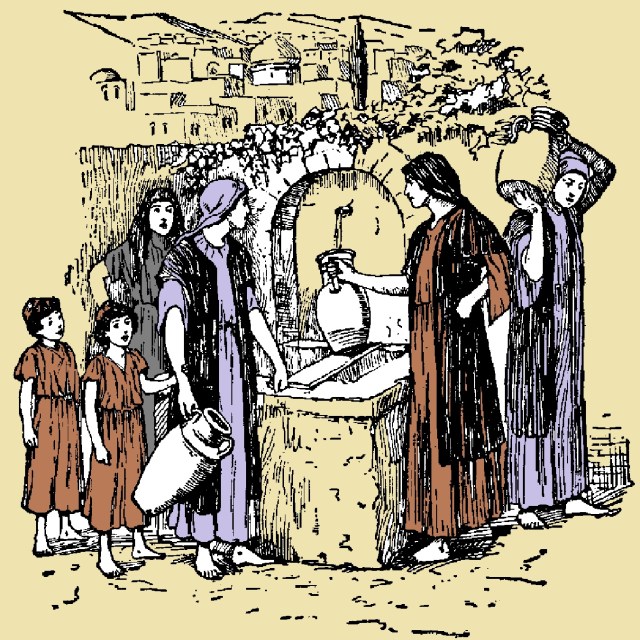
 And many of the Samaritans of that city believed in Him because of the word of the woman who testified, “He told me all that I ever did.” So when the Samaritans had come to Him, they urged Him to stay with them; and He stayed there two days. And many more believed because of His own word. Then they said to the woman, “Now we believe, not because of what you said, for we ourselves have heard Him and we know that this is indeed the Christ, the Savior of the world.” (John 4:39-42)
 Then all the tax collectors and the sinners drew near to Him to hear Him. And the Pharisees and scribes complained, saying, “This Man receives sinners and eats with them.” So He spoke this parable to them, saying: “What man of you, having a hundred sheep, if he loses one of them, does not leave the ninety-nine in the wilderness, and go after the one which is lost until he finds it? And when he has found it, he lays it on his shoulders, rejoicing. And when he comes home, he calls together his friends and neighbors, saying to them, ‘Rejoice with me, for I have found my sheep which was lost!’ I say to you that likewise there will be more joy in heaven over one sinner who repents than over ninety-nine just persons who need no repentance. (Luke 15:1-7)
 The Heaton File