Building, Praying, Keeping, And Looking

But you, beloved, building yourselves up on your most holy faith, praying in the Holy Spirit, keep yourselves in the love of God, looking for the mercy of our Lord Jesus Christ unto eternal life. (Jude 1:20-21)

Building, Praying, Keeping And Looking

There are simple jewels found throughout scripture that impress upon the heart the simple plan of God’s redemption. Jude writes a little over six hundred words with a message of encouragement and hope in the promises of God. He reminds the saints of the mercy and justice of God and that all those that oppose truth will be punished. The influences of a corrupt world would always seek to destroy the faith of the saints. Diligence to the faith must be necessary. Near the end of his short message, Jude outlines four pillars of the disciple’s faith.

Courage comes from building faith in the heart. Faith resulted from hearing God’s word and embedding the nuggets of the divine will in every part of life. The strength of the Christian would come from the holy faith delivered to the saints. Jude reminds his brethren of the common salvation enjoyed by those who trusted in the will of the Father. There were those in the church of Christ that came in among the brethren seeking their own sensual desires to deny the only Lord God and Jesus Christ. Building up a strong defense of faith was necessary to combat the apostates who sought to undermine the church of God. The carnality of human wisdom brings division from those who grumble, complain, and live only to satisfy their own desires by bragging about their own lusts. Building up in the most holy faith comes from daily pursual of the divine word to know how to answer and defend the teaching of God.

Knowledge must be reinforced with an abundant prayer life. Not only must the saints build themselves up in the most holy faith, but they also need to pray in the power of the Holy Spirit. The gift of the Holy Spirit is given to every person who obeys the gospel of Christ and, through the Spirit, is able to defend the gospel and attack apostasy. Prayer is pleading the promises of God. The saint who spends time building themselves in the faith will find as a natural response the need to spend time in prayer in the Holy Spirit. Prayer is the Gatorade of a body building itself to be ready to battle against the devil’s wiles. Without prayer, there will be no strength in the war against evil. Prayer is the second pillar of God’s grace that will embolden the Christian to be strong in the faith.  

Building oneself up in the faith and praying in the Holy Spirit must be followed by a heart willing to serve the will of the Father. Jude writes the need to keep oneself in the love of God. There is no doubt about God’s love and abundant, eternal, and providential care. The Christian must maintain and keep himself in the love of God by showing his life as one obedient to the will of the Father. It is the individual’s choice to keep himself in Christ or reject the promises of God. Salvation is a volunteer action. Man must choose to obey God. There will never be a time God will force Himself on the heart of an individual. Remaining in God’s love is the individual’s action to follow the common salvation delivered to all men.

The final exhortation of Jude is for the Christian to look for the coming of Jesus. How often this spirit is lacking among the citizens of the eternal kingdom. Life becomes so frantic and filled with the pursuit of earthly things rather than seeing the real blessing found in what God has promised in the world to come. Looking for the mercy of Jesus Christ unto eternal life frames everything in life by a single thread. Life on earth is preparing for life in heaven. The Christian builds himself up in the most holy faith, prays without ceasing in the Holy Spirit, keeps himself in the love of God, and spends his life looking for and longing for the coming of the Son of God.

Building, praying, keeping, and looking are four things every Christian must do. When the heart turns to these four elements of Christian living, life will take on a greater meaning. Do not neglect one over the other. All are essential. Follow the four-point plan, and you will not be the same person one year from now.
Posted in Uncategorized | Leave a comment

The Journey To Jerusalem

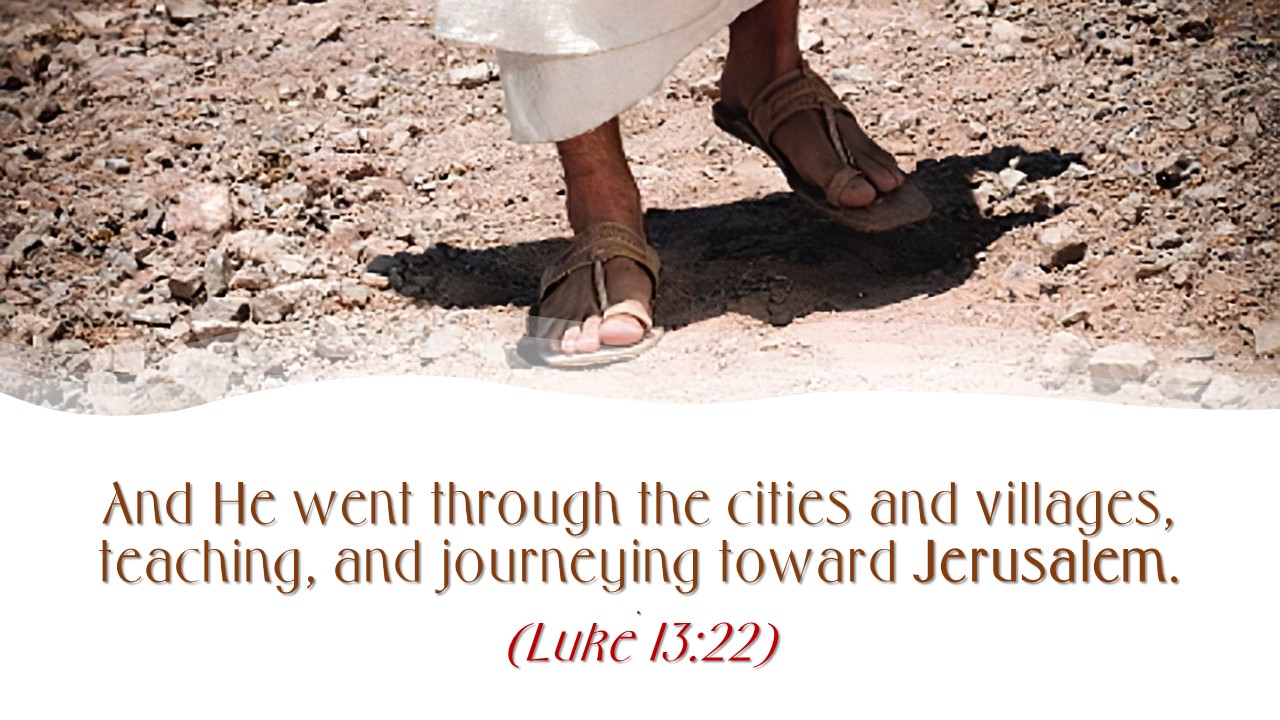
And He went through the cities and villages, teaching and journeying toward Jerusalem. (Luke 13:22)

The Journey To Jerusalem

The ministry of Jesus was beginning to come to an end. There would be more people to heal, stories to tell, and preparation with His disciples, but Jesus knew the purpose He came to earth was drawing near. His heart began to turn towards the city of Jerusalem and how He would be delivered to the Romans and mocked, insulted, spit upon, scourged, and then killed. Jesus knew the fate awaiting Him. There was never a doubt about His purpose. At the beginning of His ministry, it seemed a far-off time when His death would come, but now, the shadow of the cross began to lay heavy upon His heart. Jerusalem was the place He would be arrested, unjustly tried, and nailed to a cross. He had seen men crucified and knew the horror of the worst manner of death imagined by the human heart. Jesus knew how He would die. He knew where He would die. His hour was coming soon, and He continued to journey to Jerusalem.

As Jesus went through the cities and villages, He taught the people the message of God’s love and grace. Elements of the sermon on the mount were no doubt recounted in the hearing of the expectant crowds. They listened intently to the power of authority Jesus exhibited in His teaching. Jesus entered the cities and villages, gathered people around Him, and taught the coming of the kingdom of God. His work was not diminished by the knowledge of what would happen in Jerusalem. He knew what the Father had planned for Him in Jerusalem. There was never a hesitant chord of fear in the life of Jesus as He taught the people and journeyed to Jerusalem. The steps of Jesus were sure and purposed for the ministry of sacrifice. He continued to teach the people.

The example of Jesus is remarkable for His composure, knowing what awaited Him in Jerusalem. Drawing strength from His Father, Jesus committed Himself to complete the will of the Father in every way. Souls needed to hear about the kingdom. The parables of the great supper, the lost sheep, lost coins and lost sons needed to be told. Lepers would be healed, and blind men given sight. Lazarus would be raised from the dead. Children are brought to Jesus to be blessed by the Son of God. A rich ruler will come seeking eternal life and go away empty-handed. Jesus went through the cities and villages teaching as He made His way to Jerusalem and a place called Golgotha.

Faith is found in the courage of the heart to face what is known and continue to serve the Father. Jesus never backed away from His tireless work of teaching. He was teaching to the point of death. On the cross, He taught the people and the man crucified beside Him about God’s forgiveness and love. The moment Jesus stopped telling the world about the Father was when He breathed His last. Persecution from the Jewish leaders did not stop Him. Discouragement did not hinder Him. The crowds screaming for His death did not weaken His resolve. Jesus turned His face to Jerusalem to save the world from darkness, and He died on a cross. We must never back away from teaching the gospel of Christ when the world turns away from God. The opportunity to show the light of Christ is brighter in darker days. As we march toward our inevitable death, may we teach in the cities and villages and keep our pace brisk toward the eternal shores.

Posted in Uncategorized | Leave a comment

Sleeping Beauty Is Woke

Do you not know that the unrighteous will not inherit the kingdom of God? Do not be deceived. Neither fornicators, nor idolaters, nor adulterers, nor homosexuals, nor sodomites, nor thieves, nor covetous, nor drunkards, nor revilers, nor extortioners will inherit the kingdom of God. (1 Corinthians 6:9-10)

Sleeping Beauty Is Woke

Princess Aurora, also known as Sleeping Beauty (Briar Rose), is a fictional character who appears in Walt Disney Productions’ 1959 feature film Sleeping Beauty. The story revolves around the rescue of the princess from the evil plans of Maleficent, who seeks to kill the young Aurora. Three fairies (Flora, Fauna, and Merryweather) take Aurora and raise the child in a secret place for sixteen years. Returning Aurora to the palace at the age of sixteen, the evil Maleficent charms Aurora into pricking her finger, putting her in eternal sleep. Earlier, Aurora met a young man in the woods who was actually Prince Phillip, who she was to marry. Phillip had gone to the cottage in the woods to find Aurora but was captured by the minions of Maleficent and held hostage in the Forbidden Mountain. When Maleficent leaves the mountain, the three fairies release Prince Phillip and give him a magical “sword of Truth and shield of Virtue; both believed to be weapons of righteousness that will triumph over evil.”

Maleficent discovers Phillip has escaped and tries to stop the prince from reaching the castle. When her minions fail to stop the prince, Maleficent turns herself into a fire-breathing dragon that Phillip must fight. The prince is cornered on a cliff and loses his shield. Finally, in a final desperate moment, Phillip throws the magical sword into the heart of the dragon’s chest, killing Maleficent. The story ends with the fairy tale ending of ancient lore that at one time had in its underlying principles of truth, virtue, and righteousness. Maleficent has risen from the dead more powerful than she was in Sleeping Beauty.

The year 2022 has brought about a new picture of the once family-friendly world of Walt Disney. In 1959, principles of righteousness were openly discussed in a cartoon. Now the movie Lightyear bursts upon the consciousness of American society with open lesbian agendas displayed in the animated movie. The sword of Truth and the shield of Virtue is now replaced with the dispossessed, defiled flag of the rainbow agenda of a supposed woke society furiously plunging headlong into a hedonistic (decadent) world. Disney is forcing the agenda of the homosexual world into the consciousness of a society that once honored and respected God and the Bible. It will not come as any surprise if the movie Sleeping Beauty is not recast one day into a story of Aurora and Flora being lovers.

What is happening in the world is not a new agenda but an old song with the same verse and the same author. In the days of Noah, the homosexual agenda was just as popular (if not more so) than any other time. When God destroyed the cities of Sodom and Gomorrah and the cities of the plain, it was punishment against the immoral nature of human wisdom. Jesus Christ, the Son of God, condemned sexual immorality. Paul wrote a letter to the saints at Corinth who lived in the midst of the immoral world of homosexuality. He was clear in his demonstration of God’s wrath and His mercy. Sexual immorality, including adultery, homosexuality, pedophiles, etc., will be judged by God without mercy. John, the apostle, will write in the Revelation that all sexual immorality will be condemned in the lake of fire. Paul also wrote about the mercy of God to forgive those who repent of the sin of adultery and homosexuality. Some at Corinth had changed their lives. God is full of wrath, and He is full of grace.

Parents who allow their children to engage in the movie Lightyear are accepting the homosexual agenda of the Disney Company and the minority agenda of those who are debased in their minds and bodies. If there was a time for parents to stand with the sword of Truth and the shield of Virtue, it is now. The real sword of truth is found in the armor of God. Parents need to tell their children about that armor and prepare them for the battle they face as young adults. If parents ignore the agenda of the movie Lightyear, they will reap the whirlwind with their children who are convinced there is nothing wrong with same-sex love. May God raise up strong and devoted parents who will not fall prey to the woke world of sin.

Posted in Uncategorized | Leave a comment

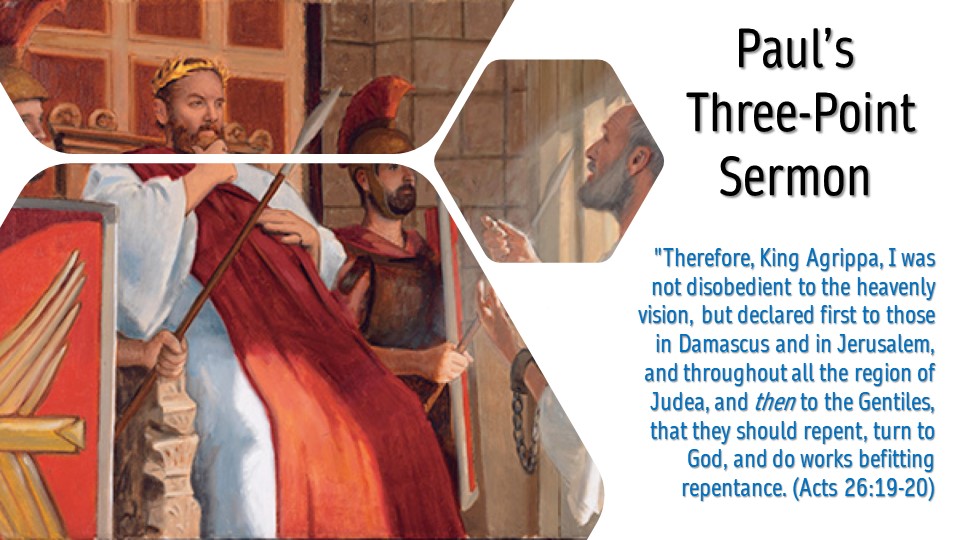
Paul’s Three-Point Sermon

Therefore, King Agrippa, I was not disobedient to the heavenly vision but declared first to those in Damascus and in Jerusalem, and throughout all the region of Judea, and then to the Gentiles, that they should repent, turn to God, and do works befitting repentance. (Acts 26:19-20)

Paul’s Three-Point Sermon

When Paul defended the charges against him before King Agrippa, he recounted his early life, conversion, and early work of preaching the gospel of Christ. Immediately upon his obedience to the will of the Father, Paul began to preach the risen Christ and Jesus the fulfillment of the prophecies. He began dismantling the Law of Moses as the covenant of God’s people, showing the church’s nature where all men would be saved. His message was a simple three-point plan when Paul preached first in Damascus and then Jerusalem, Judea, and to the Gentiles. Paul preached the gospel of Christ and demanded repentance, turning to God, and a willing heart to obey the commands of God.

The sermon Paul preached was not new but one as old as the earth. Jesus Christ was the focus of the preaching, but the message has always been the same that men need to change their lives, turn their hearts to the will of God and do what the Lord commands. This message contains grace, mercy, love, forgiveness, obedience, and salvation. Never before has an answer been found as great as the risen Son of God in the history of the human struggle. In the early days of the earth, Noah preached that all men must repent, turn to God, and keep His commandments. The Law of Moses was based on the same principles. When Israel refused to repent, turn to God, and obey the commands of the Lord, they were destroyed. Jonah went to the Gentiles and preached the same message. Jews and Gentiles were obligated to change their lives, seek the Lord and follow the will of God to be saved. Under the covenant of Christ, salvation is given to those willing to repent, turn to the Lord and keep His word.

Repentance has always been the first word of the gospel. The gospel before Christ was everything a man needed to know to be saved. In Christ, the gospel is found in the blood of Jesus Christ. Peter and the apostles preached the first gospel to the devout Jews of Jerusalem, beginning with repentance. No man can come to God who does not admit his sin, accept his failure and seek the grace of God. Skipping step one nullifies anything that comes after it. If a man turns to God and keeps the commandments of the Lord without repentance, he has not obeyed the plan of salvation. Repentance begins to empty of a man of self. Taking a cross in the name of Christ is the cost of serving the Son of God.

Turning to God is a life change, a life decision, and a life emptied. It is impossible to serve God and serve the mammon of the world. Without complete surrender to God, there can be no forgiveness. Friendship with the world must end when a man obeys the gospel. Paul preached throughout the Roman Empire a shocking message of devotion not to the pagan gods of men, but to the one true God. Idolatry has always been popular because it allows a man to worship his god and keep living a hedonistic lifestyle. Christianity is rejected because it requires singular devotion to one way, one truth, and one life. Modern religion has successfully mixed the spirit of religion with the carnality of the world attracting millions. You can accept Christ as your Savior today and live like you want the other six days without regard to authority. Turning to God requires all of a man’s soul to belong to the Lord.

After a man repents and turns to the Lord, he must obey the will of the Father. The greatest lie perpetrated on the world today is the doctrine that works do not save a man. Paul taught that salvation comes from those who do works befitting repentance. Why would the apostle Paul preach works if works will not save a man? Paul and the early disciples never preached that works alone would save a man any more than faith alone would save. The Bible never teaches salvation by faith alone. Paul preached salvation through the works a man will do who repents and turns to the Lord by the grace and mercy of God. Too many lost souls have their ticket punched for eternity and do nothing – believing it’s a free ride. Jesus’ death was not free, and while the measure of eternal life is the free gift of God, it will cost the disciple a life of works befitting his changed life. Those invited to the vineyard of the Lord must work in the vineyard. Faith without works is dead. Paul had three points in his sermon. The point of the sermon was to point the soul in the direction of the only hope a man has: repent, turn to God and do works befitting repentance. Are you willing?

Posted in Uncategorized | Leave a comment

Jeroboam’s Folly

Then it shall be, if you heed all that I command you, walk in My ways, and do what is right in My sight, to keep My statutes and My commandments, as My servant David did, then I will be with you and build for you an enduring house, as I built for David, and will give Israel to you. And I will afflict the descendants of David because of this, but not forever.’ ” (1 Kings 11:38-39)

Jeroboam’s Folly

The final days of king Solomon were nothing like his beginning days. When Solomon became king of Israel, his heart was loyal to the Lord. He was granted wisdom above all others by the grace of God and became the wisest man that lived. Tragically, his heart turned away from the Lord, and he filled Israel with the worship of pagan gods. Through the influence of his many foreign wives, Solomon introduced Israel to Ashtoreth, the goddess of the Sidonians, Chemosh, the god of the Moabites, and Milcom, the god of the people of Ammon. Near the end of Solomon’s reign, Ahijah the prophet met with Jeroboam, the son of Nebat, in a field. Jeroboam was a mighty man of valor whom Solomon had made officer over all the labor force of the house of Joseph. Ahijah promised Jeroboam that God would take the kingdom out of the hand of Solomon and give ten tribes to Jeroboam and one tribe to the son of Solomon. This would not happen until the death of Solomon.

Ahijah tells Jeroboam the division of the kingdom was the will of the Lord. Jerusalem would be preserved through the one tribe as a covenant to David made long before. Jeroboam would become ruler of the ten tribes, and whatever his heart desired would be his. But then Ahijah gives Jeroboam a command that he must walk in the ways of the Lord, do what is right in the sight of God, and keep the statutes and commandments of the Lord. Blessings come with responsibilities. If Jeroboam would be faithful to the Lord, God would bless him with an enduring house as he gave David. Everything was given to Jeroboam by the hand of God to reign over the ten tribes and to prosper.

Hearing that Solomon was going to kill him, Jeroboam fled to Egypt, where he remained until the death of Solomon. Rehoboam became king in the place of his father, Solomon. Hearing that Solomon had died, Jeroboam returns to Israel and, along with the people, pleads with Rehoboam to lighten the heavy taxation his father had placed on Israel to fund his extravagant lifestyle. Rehoboam refused and made the burden harder upon the people. The people called Jeroboam back to be their king and began ruling over the ten tribes that had broken away from Jerusalem.

The folly of Jeroboam was forgetting the promise of God. Ahijah, the prophet, had foretold that Jeroboam would rule over the ten tribes and urged him to be faithful to the Lord. Jeroboam immediately rejected the word of the Lord. He set up golden calves in the cities of Bethel and Dan, made shrines on the high places, and made priests from every class of people. Jeroboam changed the feast days corrupting the word of the Lord. The legacy of Jeroboam would last two hundred years, and Israel would be destroyed by the Assyrian Empire, never to be heard from again. All the kings (without exception) after Jeroboam were corrupt, evil, and immoral.

Jeroboam was given an opportunity to do good and follow the will of the Lord. Ahijah assured him the kingdom would be given to him, but then Jeroboam turned his back on God. He knew God had given him the kingdom and failed to acknowledge the Lord. It is sad when God blesses people, and rather than give glory to God for their blessings; they turn their backs on God. The world is a beautiful place the Lord has given to men to enjoy and prosper, yet most men reject that God had anything to do with it. God loved the world so much that He gave His only begotten Son, and the world rejects Jesus. Even among the people of God, the blessings of God are received with distrust and dishonor by those who turn their backs on God. The Lord blesses His people, and they reject Him. Jeroboam’s folly is turning away from the blessings of God.

Posted in Uncategorized | 2 Comments

God Is Faithful

God is faithful, by whom you were called into the fellowship of His Son, Jesus Christ our Lord. (1 Corinthians 1:9)

God Is Faithful

The church of God at Corinth was a church full of problems. Paul had to address many challenges the Corinthians faced, from division, carnality, worldliness, immorality, marital problems, feminism, idolatry, abuse of the Lord’s Supper, apostasy, and many more. There was a lot to say to the church at Corinth. The list of problems grew with each paragraph Paul penned. His mind was filled with trying to sort out the individual and collective challenges needing correction and to do so with a spirit of love, gentleness, and the firmness of God’s discipline.

Paul begins his letter by thanking the church and commending them. Knowing the uphill battle they faced as the apostle unpacked each problem, Paul reminds them of a singular truth that would be the basis of each argument he makes to persuade them. The Lord had not rejected Corinth. Paul begins his letter with the affirmation they were still in a covenant relationship with God, and he wants them to start at that point of reference. He reminds them God is faithful. They had been called into the church by His grace through the gift of His Son. God was still in fellowship with the church. To fix the problems, the brethren need inspiration. God is faithful was their motivation.

No other church recorded in the New Testament faced as many hurdles as the Corinthian church. It was probable that many wrote the church off as a failure. God did not give up on Corinth. Paul did not lose hope for the possibilities found in the Corinthians. He knew they had the heart to change and make corrections. Knowing that God is faithful is the beginning point for any exercise for a change. Repentance begins at the faithful throne of God. A change of heart can only be created by those minds who believe change is possible and that God is always faithful to those who seek Him. The longsuffering of God is without measure. He will always be faithful for His faithful. The Corinthians faced the daunting task of making severe corrections in their lives and had to believe that God was faithful to accept them.

The first epistle to Corinth was not the only letter Paul wrote to the church. There was a second letter preserved, and the hope of God’s faithfulness is found in this letter. The church did repent. There were changes made. Hearts were sorrowed. Lives were touched. The gospel of Christ spread in the city of Corinth because the saints of Christ lived with the knowledge that God is faithful. People who do not live with the hope of faithfulness languish in despair and are unwilling to change. The early Christians embraced the protective care of God’s faithfulness as a part of their lives. Drastic changes had to be made, and these corrections were possible because of the simple idea that God is faithful.

It is easy to become discouraged either as an individual or a congregation. Personal problems challenge the soul attempting to dampen and despair the heart. Sin is a failure, but it is not the end. It is easy to focus on all the bad without acknowledging that level of faith retained in the heart of a Christian. Congregations can face uncertainty like Corinth and find themselves facing problems never imagined. The faithful heart will know that regardless of how the world responds or the challenges faced on a congregational level, try to dishearten the joy of serving Christ; God is still faithful. He has assured His people that He will never forsake them and He will never leave them. God is faithful. Hang on to that thought, and it will take you through the day – and for the rest of your life.

Posted in Uncategorized | Leave a comment

Faith And Trials

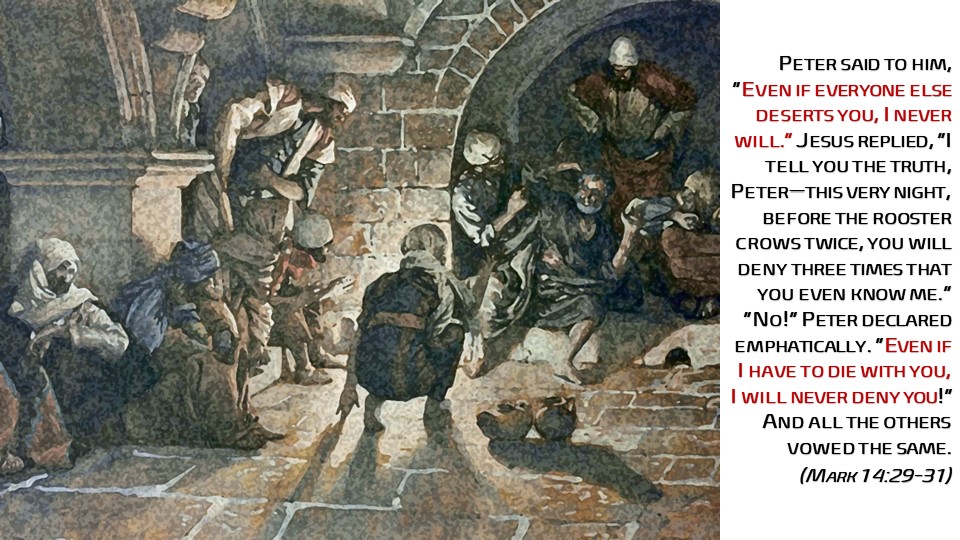
Then Jesus said to them, “All of you will be made to stumble because of Me this night, for it is written: ‘I will strike the shepherd, and the sheep will be scattered.’ “But after I have been raised, I will go before you to Galilee.” Peter said to Him, “Even if all are made to stumble, yet I will not be.” Jesus said to him, “Assuredly, I say to you that today, even this night before the rooster crows twice, you will deny Me three times.” But he spoke more vehemently, “If I have to die with You, I will not deny You!” And they all said likewise. (Mark 14:27-31)

Faith And Trials

Jesus knew His hour had come for His death, and He tried to prepare the disciples for what they did not know would happen. After eating the Passover meal, Jesus instituted the commemoration of His death, burial, and resurrection. He talked of His body and blood, but how much the eleven understood the significance is unknown. Jesus warns His apostles of something that would happen that night that would test their faith, and they would all fail. None of the men could imagine what was about to happen. Jesus was the miracle worker who walked on water, raised the dead, healed all diseases, and showed Himself to be the Son of God. None of the eleven could think Jesus would be dead in less than 24-hours. Their faith was innocent and naïve. The testing of their faith was about to be pushed to the limit.

Peter heard the words of Jesus and how everyone was going to desert Jesus at His greatest need. This confused Simon, and he reacted as his fellow apostles would respond. Nothing would happen to Jesus, and they would not allow harm to come to their Lord. Peter resounded confidently, and even if everyone forsook Jesus, he would not. Nothing would keep him from defending his Lord. Peter would prove this later when he takes up a sword against the mob. Jesus kindly rebukes the son of Jonah, telling him that night Peter would deny Him three times before the rooster crowed. Peter was incensed. There was no way he would deny Jesus. He affirmed without reservation that he, Simon, the son of Jonah, would never betray his Lord and would gladly die with Jesus. Bold words and courageous faith. Jesus knew that Peter would fail.

After the arrest in the garden, Jesus is taken to stand before the Jewish council. Peter follows closely behind but not too close. As the mob takes Jesus away, a servant girl recognizes Peter as a disciple of Jesus and asks him about it. Peter denies it. A second time, he is pointed out as a disciple of Jesus and denies it again. The third time, Peter is accused of being a follower of the man under arrest and vehemently denies knowing Jesus. The rooster crows, and the heart of Peter is convicted. Jesus turns and looks at Peter, and the lowly fisherman knows his guilt. Peter goes out and weeps bitterly. He said he would die with Jesus, and now he has denied knowing the man from Nazareth.

Peter’s trial of faith ended with despair. He believed himself valiant to defend the honor of Jesus and, by words, was willing to die with Jesus if it came to that. When the time came, and they arrested Jesus, Peter was nowhere to be found. His faith had failed him, and he ran away. Standing accused as a follower of Jesus and in the presence of Jesus, Peter denies his Lord three times. It is a tragedy that will haunt the apostle. For three days, he grieved as Jesus was dead and sealed in the tomb. But then Sunday came. Jesus arose, and Peter saw his Lord face to face. Later, Jesus would ask Peter three times if he loved Him, and Peter’s faith still wavered. The test of faith still measured weakness in the apostle.

The story of Peter unfolds in the book of Acts as Luke describes the work of the early church. Peter delivers a stirring speech convicting three thousand of their guilt. He goes on to do great work for the Lord in the kingdom of God. Peter opens the door of salvation to the Gentiles by God’s grace as he preaches to Cornelius and his household. Faith grows stronger every day, and the courage of Peter manifests itself in his work, his love for truth, and his dedication to the cause of Jesus Christ. Peter denied Jesus before the cross, but after the cross, Peter never denied his Lord again. The two epistles of Peter tell of a man of great faith and courage. Peter spends a lot of time talking about those who suffered for Christ. He encourages his fellow saints to rejoice in suffering for Christ. His faith struggled, but his courage grew. Jesus told Peter he would die a martyr’s death, and history points in that direction. Tradition tells that Peter was crucified and that when the time came for his death, he asked to be crucified upside down so as not to die in the manner of his Lord and Savior, Jesus Christ.

Today, faith can be weak, but with daily courage, faith can find victory in Jesus Christ. Peter denied Jesus but grew in faith and never again denied Him. Faith is something that must grow through trials and failures and challenges and victories. Peter’s faith became so strong he was willing to die for Jesus. No rooster crowed on that day. If there were, they were drowned out by the trumpets from heaven and the voices of the angels heralding the courage of Simon, son of Jonah.

Posted in Uncategorized | Leave a comment

Sin Is Owned By Self

Amaziah was twenty-five years old when he became king, and he reigned twenty-nine years in Jerusalem. His mother’s name was Jehoaddan of Jerusalem. And he did what was right in the sight of the Lord, but not with a loyal heart. Now it happened, as soon as the kingdom was established for him, that he executed his servants who had murdered his father the king. However he did not execute their children but did as it is written in the Law in the Book of Moses, where the Lord commanded, saying, “The fathers shall not be put to death for their children, nor shall the children be put to death for their fathers; but a person shall die for his own sin.” (2 Chronicles 25:1-4)

Sin Is Owned By Self

Amaziah was the eighth descendent of Solomon to sit on the throne of David as king of Judah. His father, Joash, was seven when he became king, and Amaziah was born in the fifteen year of his reign. Most of the reign of Joash followed in the way of the Lord as long as the high priest, Jehoiada, lived. At the death of Jehoiada, Joash turned his heart away from the Lord, and he was killed by his own servants, Zabad and Jehozabad. Amaziah was twenty-five years old when he became king and would rule over Judah for twenty-nine years, following in the way of the Lord. The Holy Spirit notes the heart of Amaziah was not loyal to the Lord.

It was not uncommon when a king began to rule to remove all those who opposed him. The great-grandfather of Amaziah, Jehoram, killed all his brothers and many of the princes of Israel. After Jehoram died by the hand of the Lord, his wife Athaliah usurped the throne for six years after killing all the royal heirs of the house of Judah. Joash, the son of Ahaziah, was hidden by his sister for six years while Athaliah reigned over the land. When Amaziah began to rule, he executed the servants who had murdered his father, the king. Joash had turned his heart away from the Lord. When a small army of Syrians came against Judah, God allowed the Syrians to punish Joash and Judah for forsaking Him. Joash was severely wounded in the battle, and his servants killed him in his bed.

Amaziah punished the men who killed the king in accordance with the Law of Moses. The family of Zabad and Jehozabad did not suffer any harm, as would often be the case. God had written in the Law of Moses that parents must not be put to death for the sins of their children, nor children for the sins of their parents. Those deserving to die must be put to death for their own crimes. Sin is accountable from individual guilt, and the Lord only holds the individual responsible for his sin. A parent can be an evil parent, but the child will be judged by his or her choices. An evil child will not be held as a judgment against the parent. Adam and Eve were not guilty of Cain’s sin. God judges each person as an individual who is solely accountable for their own sin.

Human nature wants to deflect guilt to someone other than the one guilty. Society is blamed for the decisions people make. Parents are held in disdain for the conduct of children. Blame is given for sinful actions to everyone except the one that God sees. There is an influence that society has on people, and parents can neglect their children, but the Lord will not acquit someone because of the sins of another. In the case of the family of Achan (conquest of Jericho), they were all culpable and guilty and deserved the wrath of God. The lesson from Amaziah is that each person will stand before the Lord with every person that has lived on the face of the earth and will be standing alone before a righteous God. You are responsible for yourself.

Posted in Uncategorized | Leave a comment

I Am Gabriel

And the angel answered and said to him, “I am Gabriel, who stands in the presence of God, and was sent to speak to you and bring you these glad tidings.” (Luke 1:19)

I Am Gabriel

Angels are the messengers of God found throughout the Bible. The first time an angel is spoken is when Hagar is in the wilderness after running away from the cruelty of Sarah. God sent the Angel of the Lord to comfort her and instruct her to return to Abraham, where she would have a son, Ishmael. The angel would appear a second time to Hagar when she and Ishmael are cast out, showing them a place to get water. When Jacob left home after receiving the blessing of his father Jacob, he had a dream of angels ascending and descending a ladder reaching into heaven. An angel appeared to Jacob when he dwelt in Haran and told him to return home. Moses saw the burning bush, and the angel of the Lord spoke to him. When the Hebrews were crossing the Red Sea, an angel of the Lord stood between them and the ensuing Egyptian army. God promised to send His angel before Israel to defeat their enemies and guide them to the promised land.

An angel of the Lord stood before Balaam as he sat on his donkey. In the early days of Israel, during the period of Judges, an angel of the Lord spoke to all the children of Israel, warning them not to make a covenant with the people of Canaan. Gideon was threshing out wheat when the angel of the Lord enlisted him in the work of being a judge over Israel. The birth of Samson was announced by the angel of the Lord to the wife of Manoah. God’s judgment for David’s sin of numbering Israel was carried out by an angel with a plague killing seventy thousand men. David saw the angel, and so did Ornan the Jebusite. Elijah the prophet, was sustained by the care of an angel. An angel of the Lord killed in the camp of the Assyrians one hundred and eighty-five thousand men. Angels delivered Hananiah, Mishael, and Azariah from the burning furnace and Daniel from the lions’ den. An angel talked with the prophet Zechariah.

During the ministry of Jesus, an angel would stir the waters of the pool called Bethesda. After the stirring of the water, whoever stepped in first was made well of whatever disease he had. An angel of the Lord released the twelve apostles after being arrested, telling them to go and preach the words of life. An angel gave Philip and Cornelius instructions. When Herod killed James the apostle and arrested Peter, an angel delivered Peter from prison. Paul was comforted by the presence of an angel.

The Bible is filled with stories of angels doing the work of the Lord. There are many misconceptions about angels that persist despite what the Bible says. Angels are never referred to as women but only as men. None of the angels who appeared to men are said to have wings. The angels in Ezekiel are mentioned with wings, but these are in a vision in the heavenly realm. The Ark of the Covenant had cherubim spread out and covered the mercy seat with their wings. Angels were messengers of God to carry out His will. Two angels are named in scripture: Michael, the archangel, and Gabriel. The scriptures never refer to Gabriel as an archangel. Gabriel appeared to three people in scripture: Daniel, Zacharias, and Mary.

Twice in the story of Daniel, Gabriel appears to explain the vision of the ram and the goat and to give assurance of the seventy-week prophecy. Gabriel appeared on the right side of the altar of incense and announced to the priest Zacharias that he and Elizabeth would have a son in their old age. Gabriel tells Zacharias to name the child John. When the birth of Jesus was announced, Gabriel came to Mary, while Matthew only says an angel of the Lord appeared to him. Six months after the appearance to Zacharias, Gabriel was sent by God to tell Mary she would have a son and she would call his name Jesus. Gabriel was an angel tasked with bringing good and comforting news, while Michael the archangel seems to be the angel of wrath and war. The most poignant scene of scripture is when the Son of God was bowed down in great sorrow in the Garden of Gethsemane, and the Father sent an angel to strengthen (invigorate) Jesus. God sends a comforter to comfort His Son. Gabriel stood in the presence of God. Thank God for Gabriel.

Posted in Uncategorized | Leave a comment

When The Trumpets Blow

And the Lord spoke to Moses, saying: “Make two silver trumpets for yourself; you shall make them of hammered work; you shall use them for calling the congregation and for directing the movement of the camps. When they blow both of them, all the congregation shall gather before you at the door of the tabernacle of meeting. But if they blow only one, then the leaders, the heads of the divisions of Israel, shall gather to you. When you sound the advance, the camps that lie on the east side shall then begin their journey. When you sound the advance the second time, then the camps that lie on the south side shall begin their journey; they shall sound the call for them to begin their journeys. And when the assembly is to be gathered together, you shall blow, but not sound the advance. The sons of Aaron, the priests, shall blow the trumpets; and these shall be to you as an ordinance forever throughout your generations. When you go to war in your land against the enemy who oppresses you, then you shall sound an alarm with the trumpets, and you will be remembered before the Lord your God, and you will be saved from your enemies. Also in the day of your gladness, in your appointed feasts, and at the beginning of your months, you shall blow the trumpets over your burnt offerings and over the sacrifices of your peace offerings; and they shall be a memorial for you before your God: I am the Lord your God.” (Numbers 10:1-10)

When The Trumpets Blow

The Hebrews that came out of Egypt numbered 603,550 men from twenty years old and above who were able to go to war in Israel. Adding the women, children, and other adults, the Israelites numbered more than a million souls. As they moved from place to place, they separated into twelve tribes, each in order positioned in specific areas around the tabernacle. It would be a daunting task to move a few million people in an orderly fashion from place to place. On the day the tabernacle was raised up, a cloud covered the tabernacle during the day and as a cloud of fire at night. The movement of the people was determined by whether the cloud remained above the tabernacle. At the command of the Lord, they remained encamped, and at the command of the Lord, they journeyed. Everywhere the Hebrews traveled, they did so by the will of the Lord.

When it came time to move the people, God instructed Moses to make two silver trumpets of hammered work. These trumpets would be used for calling the congregation and directing the camps’ movement. When both trumpets were blown, the congregation of Israel gathered at the tabernacle entrance. If one trumpet is used, only the leaders or heads of the tribes will meet with Moses at the tabernacle. There would be a sound that told the congregation to move, and the tribes on the east side of the tabernacle (Judah, Issachar, Zebulun) would move first. At the second signal, the tribes camped in the south (Rueben, Simeon, Gad) would break camp and move. The tribes on the west side of the tabernacle (Ephraim, Manasseh, Benjamin) would follow, and bringing up the rear would be the tribes on the northern side of the tabernacle (Dan, Asher, Naphtali). The key to all of this movement was the blowing of the trumpets.

There was a distinction made when blowing the trumpets to gather the people and the advancement. Only the sons of Aaron, the priests, were allowed to blow trumpets. When the people went to war, an alarm would be sounded. During the day of the appointed feasts and at the beginning of months, the trumpets were to be used over the burnt offerings and the peace offerings. The two trumpets were used to move the people, call the nation to war, and to show honor to the Lord over the sacrifices. Moses forged the two silver trumpets with hammers according to the word of the Lord and would be used during the forty years of wandering to direct the movements of the whole nation of Israel.

The word of the Lord guided the Hebrews from Egypt to Canaan, and using two silver trumpets, the people rose up or remained in place. Different sounds meant different things, and there was an order to how the people moved from place to place. God understood the challenge of moving the nation as a people walking through the land would take direction and obedience on their part. When it came time to leave Sinai, the cloud was taken up from above the tabernacle of the Testimony. The two silver trumpets were blown to sound the advance, and the tribe of Judah led the people out from the Wilderness of Sinai. The other ten tribes followed in accordance with the sound of the trumpets. For the next forty years, whenever the people heard the trumpet, they obeyed.

When it came time to move, the people obeyed the trumpets. It may have been inconvenient and untimely for them, but when the trumpets were blown, they packed their possessions and prepared to move in the orderly fashion required by the word of the Lord. The tribe of Naphtali was always last, and the tribe of Judah was always first. The word of the Lord declared when the nation would move and how they would move. Any deviation from the commands of God was met with a penalty. When the trumpets blew, it was time to act because the trumpets were the sound of the word of God.

There are no silver trumpets today, but the principle remains the same. Jesus came and established His church and ordained spiritual silver trumpets that are in place for a purpose and design. The silver trumpet of baptism is the only way sins are washed away. There are many examples of God’s pattern of the New Testament church like the silver trumpets: assembly of the saints on the first day of the week, the Lord’s Supper, prayer, meditation on the word of God, thanksgiving, benevolence, church discipline, the role of women, elderships, teaching the lost, and a host of sounds that call the people of God to obey the word of the Lord. If a man is not listening to the trumpet of the Lord, he will miss the blessings given by God. Listening to the trumpets demands immediate attention and obedience. When the word of the Lord sounds, the answer is, “Here am I, Lord. What do you desire?” Listen for the trumpets of God. Respond. Obey. One day another trumpet will sound, but then it will be too late. Live each day following the sounds of the trumpet of the Lord so that when He returns and blows the trumpet of God, salvation is given.

Posted in Uncategorized | Leave a comment