The Centurions

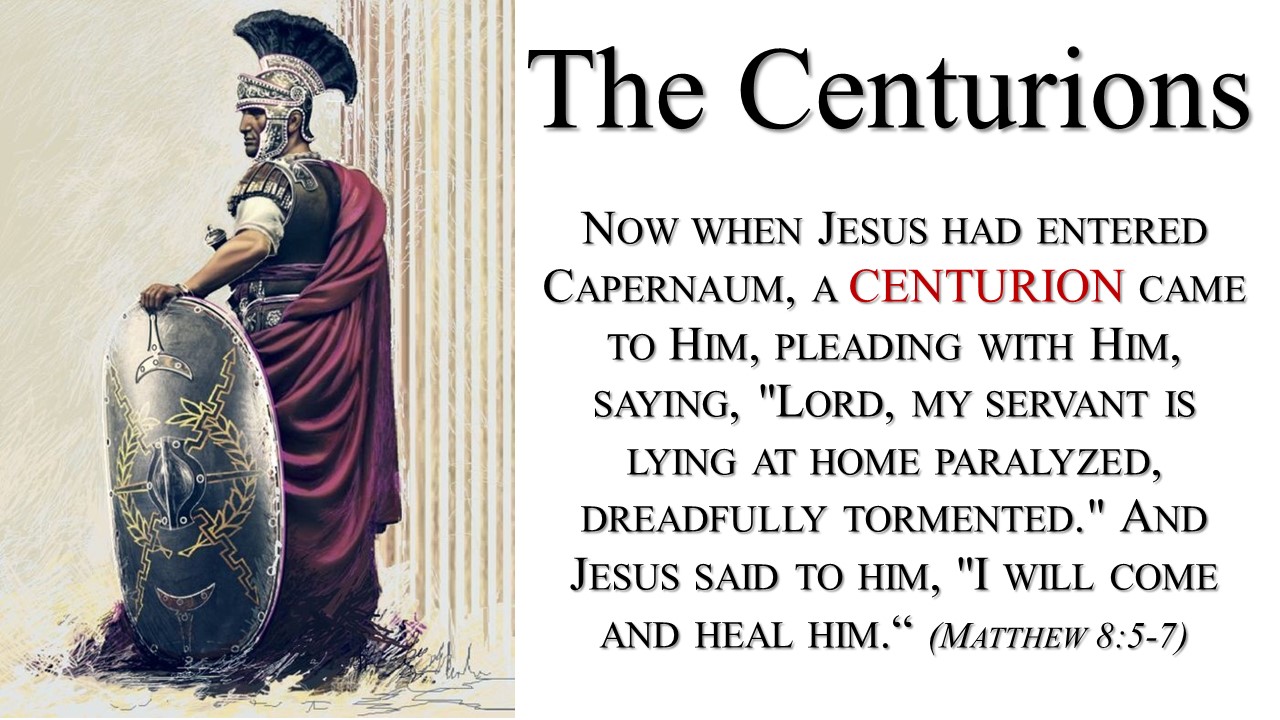
Now when Jesus had entered Capernaum, a centurion came to Him, pleading with Him, saying, “Lord, my servant is lying at home paralyzed, dreadfully tormented.” And Jesus said to him, “I will come and heal him.” The centurion answered and said, “Lord, I am not worthy that You should come under my roof. But only speak a word, and my servant will be healed. For I also am a man under authority, having soldiers under me. And I say to this one, ‘Go,’ and he goes; and to another, ‘Come,’ and he comes; and to my servant, ‘Do this,’ and he does it.” (Matthew 8:5-9)

The Centurions

Certain men stand out in the Bible narrative, deserving notable observation for their place in the divine story of revelation. Great men like Abraham, Moses, Joshua, and David are obvious choices for telling the storyline of God’s plan to redeem man. One group of men not so likely to be visible on the pages of holy writ are soldiers of the Roman army. Rome came to power before Jesus was born and ruled the world with an iron fist for nearly one thousand years. God described the Roman Empire as an empire of iron. The Roman army was the premier fighting force of its age, brutally and totally subjecting nations to its power. No one could stand before the army. Throughout the story of Jesus and the early church, centurions become a visible story of God’s redeeming grace and mercy. A centurion was a Roman officer in charge of one hundred men with sixty centurions in a legion. Their role was vital to the success of the Roman army.

When Jesus entered Capernaum, a centurion came to Him, pleading with Him to heal a servant that was very dear to him. The servant was sick and on his deathbed. Symptoms of the servant’s sickness were paralysis and terrible pain. This grieved the Roman officer, who came to Jesus believing the man from Nazareth could heal him. The centurion’s faith was remarkable because he believed Jesus could heal the servant without coming to his home. Jesus only had to speak the word, and the centurion knew his servant could be healed. The faith of the Gentile moved Jesus to say He had not seen such faith among His own people. There was a deep faith in the heart of the Roman army officer to accept – unlike many among the Jewish leadership – that Jesus of Nazareth was a man of divine power. Because of the centurion’s faith, the servant was healed that very hour.

The story of Jesus ends at Golgotha, where the Roman government has carried out the execution of three criminals. Roman soldiers were specialists in the art of crucifixion. Jesus and the two thieves were put under guard by the Roman army to carry out the scourging of the victims, including the mocking and torment of the accused and the long process of crucifixion. A centurion was placed in charge of carrying out the will of Pilate. Jesus was scourged under the watchful eye of the centurion. The cross was placed on the back of Jesus, and He carried His cross to the place of execution with the centurion leading the procession as the authority of the Roman Empire. When Jesus was brought to Golgotha, the centurion carefully examined the process of nailing Jesus to the cross as his soldiers had done many times before. After Jesus and the two thieves were secured to their crosses, they were lifted up between heaven and earth to die a miserable and horrible death. As the men slowly died, the centurion watched over the proceedings as the four soldiers divided up the final earthly remains of the man from Nazareth.

Most men cursed and pleaded for mercy as the torture of the cross killed them. This was not the case with Jesus. The man from Nazareth was in agony and unbearable pain but showed a calm and deliberate spirit of compassion and forgiveness. As Jesus died, He etched on the heart of the seasoned Roman soldier a message of hope and love. When Jesus died, and the earthquake moved the earth, the centurion said, “Truly this was the Son of God.” The centurion knew the man in the middle was a righteous man. Joseph and Nicodemus would late come and ask the centurion for the body of Jesus, and he would grant their request. What thoughts went through the mind of the centurion as his soldiers took the body off the cross and he watched the two nobles carry away the dead body of Jesus? The scriptures do not tell what became of the centurion but hope lives he saw the light on that dark day.

Nearly seven years have passed since the death of Jesus, and another centurion comes to the story of God’s redemption for the world. The early church thrived under persecution, with thousands obeying the gospel. Through the work of the Holy Spirit, the church began with three thousand devout Jews being added to the church. For the next few years, the focus of evangelism was only to the Jews, but the day of the Gentile was coming. It began in Joppa when the apostle Peter received a vision that would change his life and the world. In the vision, the Lord showed Peter that the kingdom’s keys would be offered to men considered unclean. A centurion in Caesarea had sent servants and a soldier to bring Peter to his home to teach them the words whereby they could be saved. Peter comes to the house of Cornelius and, by the grace of God, opens up the door of the kingdom to the Gentile world. Cornelius was a Roman officer attached to the Italian Regiment. He was a good and just man and well respected, but Cornelius was a lost man. God’s grace brought salvation to his household. The world was an open field to teach the gospel, and it all began with a Roman centurion.

A centurion was charged with the scourging of Paul to determine the cause of a riot in Jerusalem, but when Paul told the centurion of his Roman citizenship, Paul was released. When a plot was discovered that some of the Jews were going to kill Paul, he informed a centurion of the plot, and Paul was taken to Caesarea under heavy guard. Later, Paul appealed to Caesar to hear his case and was put under the guard of a centurion of the Augustan Regiment named Julius. The trip to Rome was quite eventful, and Julius succeeded in bringing Paul to Rome. Centurions played a large part in the story of Jesus and the early church. Unlikely participants but important to the story.


Posted in Uncategorized | Leave a comment

Jesus And The Woke Movement

And He answered and said to them, “Have you not read that He who made them at the beginning ‘Made them male and female,’ and said, ‘For this reason a man shall leave his father and mother and be joined to his wife, and the two shall become one flesh’?” (Matthew 19:4-5)

Jesus And The Woke Movement

It seems incredulous a discussion of how many sexes there are is considered a controversial subject on college campuses or anywhere for that matter. Recently, a professor at the University of Southern Maine was challenged by graduate students for saying that “two biological sexes exist.” One student commented the professor’s statement felt like a “personal attack.” Whether the personal attack was offensive to a boy or girl is not known; the boy or girl is uncertain which DNA he or she possesses as identity traits. This comes on the heels of politicians being unable to define what a woman is. In short, the world has an identity crisis at the biological and spiritual level, destroying common sense and needing awareness of the Creator.

One of the consequences of a godless world is the acceptance of absurdity. Refusing to recognize the male and female does not remove the reality that, in all things, there are only two sexes. An elephant has a bigger brain than most humans because he knows there are two sexes of animals. It is not likely the world will ever see a transgender elephant because even the animals know their Creator. At the core of the so-called “woke” generation is the rejection of God and the Bible. The world’s agenda to debate the issue of the sexes shows the depth of ignorance and refusal to recognize a basic understanding of science at the biological level. Following the science would discard any discussion of how many sexes there are in the world.

Jesus said God made a male and female. He should know – He was there when it happened. Moses recorded the creation of the creatures of the water and the birds, saying that God created them “according to the kind” and said these creatures were to be “fruitful and multiply,” suggesting a means to procreate. This was said of the land creatures also. Then God created the man and woman or male and female. When the Lord brought Eve to Adam, the first man (male) said that what he gazed upon would be called “Woman” (female) because she was taken out of man (male). God also told the man and woman to multiply and established the means to procreate in biological certainty. Later, Moses writes that Adam knew Eve, his wife, and she conceived and bore Cain and said, “I have acquired a man from the Lord.” Jesus refers to this story to affirm there are two sexes: male and female. He also suggested the only way a child is born is by a male and female. The pundits of the woke generation deny how they themselves entered the world.

Refusing to believe there are only two sexes does not change the natural law established by the Lord in the beginning. What it does is deny the presence of an eternal being. Calling a male a female does not change the fact. Biologically, God has established specific organs that can only be found in either a male or female. A man who identifies as a woman still has a prostate, and a woman can believe she is a man, but she still possesses ovaries. Why? God made male and female for a reason and with a design that cannot be changed. There are two absolutes in life: no one has a choice in their birth, and no one can change death. Conception determines the sex of the child, and when a man or woman dies, they die the same sex they were born. Denying this does not change God’s law.

The world is clearly turning further away from God in the constant human experiment of man becoming his own god. The conclusions remain the same as it has from generations past. Human wisdom is made the fool, and the folly of denying two sexes is the noise of feeble men (and women) who show themselves to be the stupidity of common sense. Have you not read that God made them male and female at the beginning, and the only way children are born is by a father and mother? Nothing man says or believes will change that. Nothing!

Posted in Uncategorized | Leave a comment

Glorify God In Your Body

Or do you not know that your body is the temple of the Holy Spirit who is in you, whom you have from God, and you are not your own? For you were bought at a price; therefore glorify God in your body and in your spirit, which are God’s. (1 Corinthians 6:19-20)

Glorify God In Your Body

As the Creator and Savior, the Lord God desires His children to glorify Him in every part of their lives. Worship has been central to the relationship between God and man. Cain and Abel understood the need for worship when they offered their gifts to God. Abraham worshipped God throughout his life as he built altars for the Lord. The Law of Moses established for the Jews a pattern of worship governing the lives of the Hebrews. Jesus told the woman at the well His Father sought those who would worship Him in spirit and truth. The early church thrived in worship as they assembled in praise of the Father. Glorifying the Lord is found in every part of worship, but it is not contained within the walls of a building.

Paul wrote to the saints in Corinth, urging them to refrain from the practice of sexual immorality so common among the Corinthians. The world accepted fornication and adultery, but the Christian could not defile his body with the lust of the flesh. Paul explained the body was the temple of the Holy Spirit. It mattered what the Christians did with their body. Sexual immorality sinned against the body that was to be used for the glory of God. Worship was not only the praise of God through the spirit but the way the body is used in everyday life. What is striking about the appeal of Paul is to consider the body as part of the glory that must be given to God.

It is easy for some to ignore the counsel of the Lord concerning the body. The argument is made that it does not matter what a person does with his or her body. To glorify God is to sing the right songs in the right spirit, take of the supper properly, and offer prayers in the appropriate pattern; but there is more to glorifying God than what is done in public worship. The greatest example of glorification to the Father is what Christians do with their bodies. This includes how a body is dressed, whether it glorifies God or not (most often, it does not). The subject of modesty has been placed on the back burner of insignificance because judgments cannot be made about what is modest and what is not. God said to glorify Him in the body and the way some women dress, God is not the one being glorified.

Glorifying God in the body comes from the speech of the Christian. Do the words that proceed from the mouth give honor to God? Crass jokes, filthy language, angry outbursts, and gossip do not glorify the Lord when His people follow the ways of the world. Drunkenness is not only a sin, but it abuses the body that is to be used for the glory of God. Smoking does not glorify the body. Some tattoos do not give glory to Jesus Christ. There are many things the world does with the body that is without control, but the Christian learns to buffet his body to bring it under subjection for the glory of God. It matters to God what His people do with their bodies.

Jesus died to save men from sin, and when He died, He purchased the bodies of His disciples to be used for the glory of His Father. Paul clearly reminds the Corinthian saints their bodies belonged to God and their bodies had been bought at a price. He reminds them their bodies do not belong to them but to the Lord. God must be glorified in the body so the world can see the consecration of a pure life; not only in spirit worship but also in the example of the body. How is God glorified in your body – it matters to the Father.

Posted in Uncategorized | 3 Comments

Like A Corinthian

Do you not know that the unrighteous will not inherit the kingdom of God? Do not be deceived. Neither fornicators, nor idolaters, nor adulterers, nor homosexuals, nor sodomites, nor thieves, nor covetous, nor drunkards, nor revilers, nor extortioners will inherit the kingdom of God. And such were some of you. But you were washed, but you were sanctified, but you were justified in the name of the Lord Jesus and by the Spirit of our God. (1 Corinthians 6:9-11)

Like A Corinthian

When Paul wrote his letter to the Corinthian church, he was writing with a backdrop of a city and empire filled with sexual immorality. Corinth was the seat of government for Southern Greece and a city of great wealth. It was noted for its opulent, immoral, and brutal habits of the people. Paul was not unaware of the challenges the New Testament Christians faced as they lived in the midst of such immorality. Living a holy life in the midst of such unbridled lust was not an easy task. Paul mentions a list of sins that show the depth of spiritual darkness pervading the city. If the list is connected to certain brethren at Corinth, it included those who indulged in sexual sins of fornication, idolatry, adulterers, homosexuals, and sodomites. This list of sins would be indicative of the nature of a place like Corinth.

The immorality of Corinth was so great and well-known to behave in an immoral manner was called “behaving like a Corinthian.” Corinth was home to the temple of Aphrodite, the Greek female god of love that “employed” thousands of prostitutes. Corinth became well-known for bad sexual behavior. To live “like a Corinthian” meant to become a drunk often or to visit prostitutes. Imagine a church of God in this city and the challenges faced to keep a moral compass for the saints who had to live in the midst of such putridity. Paul’s letter to Corinth was a stern letter to write as the apostle knew the darkness the people of God faced.

Throughout the letter to Corinth, the apostle addresses the many problems that impacted the church. One of the things he never suggested was for the saints to leave Corinth. He wanted them to learn to shield themselves against the onslaught of immorality. Warning them of the consequence of sin, Paul reminds the Christians those who practice such immorality will damn their souls. The church existed in a place where immorality was visible, constant, and accepted. It would take great courage to keep pure hearts in such a world. At every turn, sexual immorality was rampant from the common man to the courts of Rome. The child of God must rise above the filth of the world and remain clean.

There is an increasing movement in this country for the acceptance of the vocal minority of those who accept same-sex morality. The LBGTQ movement’s agenda has placed the morally degrading act of homosexuality and its multicolored offspring in every part of society. There are few commercials that do not include some form of the same-sex agenda, including selling house paint, dating sites, insurance, and generic commercials. It is impossible to watch television without being bombarded with the obvious. The subliminal hints of Satan’s minions fill the minds of the worldly to the point of oversaturation. It will probably not get better but will continue to drive headlong to the pits of darkness and despair. The people of God need to prepare for a greater battle of living in the city of Corinth.

Jesus died to remove God’s wrath, but He did not remove sin. It is clear the mission of the adversary. The devil is to fill the world with his insidious and malevolent doctrine of sexual immorality. Sadly, many of God’s people will be taken hostage by the roaring lion, who will destroy their souls with pornography, acceptance of homosexuality, and sexual immorality in all forms. Learning to live in a dark world is to keep the light burning in our lives and homes and for the church to remain apart from the world. It may not be possible to turn the pages of history to a time when the word of God measured morality, but there is no excuse not to stand for truth. There will be days of conflict, and more vocal opposition is coming. In our misguided, woke world, it becomes more militant to stand against righteousness and truth. The child of God will stand for truth. Protect the family. Do not allow the symptoms of a dying world to bring death to your family.

Posted in Uncategorized | 1 Comment

Accepting The Grace Of God With Joy

Now the apostles and brethren who were in Judea heard that the Gentiles had also received the word of God. And when Peter came up to Jerusalem, those of the circumcision contended with him, saying, “You went in to uncircumcised men and ate with them!” … When they heard these things they became silent; and they glorified God, saying, “Then God has also granted to the Gentiles repentance to life.” (Acts 11:1-3,18)

Accepting The Grace Of God With Joy

The relationship between Jews and Gentiles during the early church period was a volatile and caustic feeling of distrust and prejudice. It was forbidden by law for a Jewish man to keep company with or go to one of another nation. Eating with someone outside the Hebrew covenant was unheard of. No self-respecting Jew would consider going into the home of a Gentile and sitting down to a meal to enjoy their company. It was not done. Jesus spoke to a woman at a well in Samaria, and she was shocked. He would talk to her, a woman, and that a Jew would have anything to do with a Samaritan. When the kingdom of God began at Pentecost, three thousand devout Jews became the first Christians. It would be more than five years before the door of the kingdom would be open for non-Jews. Peter was promised that he would receive the keys of the kingdom by Jesus. The first lock was turned at Pentecost in Jerusalem, and the second lock was opened in a home in Caesarea.

Peter was staying in Joppa with a friend named Simon, who lived by the sea and was a tanner. Thirty miles north of Joppa was the city of Caesarea, the capital of the Roman province of Judea. Caesarea was also the seat of the governors or procurators and the headquarters of the Roman troops. The Roman centurion of the garrison was a man named Cornelius. He was a devout, God-fearing man who gave generously to the poor and prayed regularly to God. By the grace of God, Cornelius was instructed by an angel to send for Peter. Cornelius was a religious man, but he was not a saved man. The angel told the centurion that when Peter came, he would tell him words by which he and all his household would be saved. Obeying the heavenly command, Cornelius sends for Peter. A few days later, Peter came to the house of Cornelius. It was an awkward meeting at first. Cornelius met Peter and bowed down at his feet, and worshiped him. Peter forbade Cornelius telling him God had revealed that there was no partiality among men in salvation.

When Peter left Joppa, he took with him six men to accompany him. Peter reminded Cornelius that a Jewish man was not to keep company with someone from another nation. However, God had shown the apostle that all men must come to the gospel, including the Gentiles. After Peter preached the word to those in the household, they were baptized for the remission of their sins. What a remarkable experience for Peter to baptize Cornelius and his household – Jews are baptizing Gentiles. After the baptism, Peter and his company stayed for a few days. That would have also been awkward as Peter and his companions experienced eating and sleeping in the house of a Gentile. The spiritual discussions must have been rich.

Hearing of what Peter did in Caesarea, the apostles and brethren in Jerusalem were upset and concerned. When Peter came up to Jerusalem, his fellow Jews contended with him about what he had done in Caesarea. The Christian Jews were very upset at Peter and demanded an explanation. They criticized him for going into the home of a Gentile. There was no small dispute about the matter as they disagreed with any Jew going into the house of Cornelius, a Roman centurion. Peter found himself before a disagreeable audience who could not fathom the incredulous actions of a man like the apostle Peter. The anger was palpable. Peter was in a great deal of trouble as the Jewish brethren demanded an explanation of why he went into uncircumcised men and ate with them. The one question that was not asked was about the baptism of Cornelius and his household. Because of their prejudice, the apostles and brethren could only see Peter eating with Gentiles.

Peter explained how the vision had come to him in Joppa. Three men came from the house of Cornelius, imploring him to go with them. He could have refused, but the Holy Spirit assured Peter the Lord wanted him to accompany the soldier and two servants of Cornelius, and he obeyed. Peter related how the baptism of the Holy Spirit came upon Cornelius and his household, as with the twelve apostles at Pentecost. He could not argue with the divine plan of God. Seeing this as divine approval from the Lord, Peter baptized Cornelius and his household in water. When the brethren heard of how Peter had come to the house of the Roman centurion, they did not argue with Peter or condemn him. Some brethren could lay a charge of hypocrisy against Peter for his actions. The anger of the brethren could have continued to fuel the flames of controversy. But none of those things happened. What happened next was as remarkable as the baptism of the Gentiles.

Hearing the story as told by Peter, the brethren who began the inquiry with disbelief and anger rejoiced and glorified God that the gospel was to be taken to the Gentiles. They did not respond with controversy and did not argue any fine points of law about whether it was lawful to preach the gospel to the uncircumcised. The acceptance of the Gentile was an incredible leap for the Jewish Christians who had remained separate from those of the uncircumcised all their lives. Now the church of Christ would be filled with Jews and Gentiles sitting next to one another singing, praying, taking the same bread and fruit of the vine, and growing in Christ together. What a joy in the spirit of unity when brethren come together under the same canopy of God’s grace.

The gospel of Jesus Christ is not just for a particular group of people based on ethnicity, skin color, language, nationality, gender, or economic status. Peter opened the door for all men to come to know the saving grace of God. It does not matter if they have rings in their noses and tattoos on their body or if they come from another nation. The Muslim needs the gospel of Christ. A Jew needs the true Messiah. The religious neighbors who follow churches established by men need Christ. Prostitutes, homosexuals, murderers, and criminals of all types need the gospel. Jesus died for all men to bring all men to Christ – even Cornelius and his household of Gentiles. Look around. Everyone needs Christ. Rejoice when a sinner is turned to the Lord.

Posted in Uncategorized | Leave a comment

Euodia And Syntyche

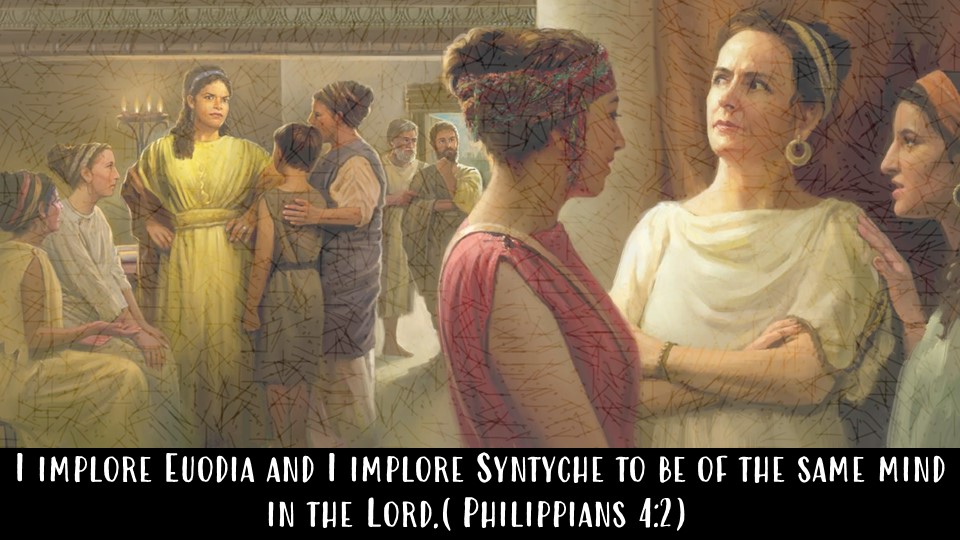
I implore Euodia and I implore Syntyche to be of the same mind in the Lord. (Philippians 4:2)

Euodia And Syntyche

Reading someone else’s mail is difficult when there is little information to substantiate the circumstances of the letter’s content. The epistles of Paul to the churches are, in effect, reading the apostle’s correspondence to many disciples, of which little or nothing is known. When Paul wrote to the saints in Christ Jesus who were in Philippi, he concluded his letter with a warning toward two Christian women who seemed to be at odds with one another. Euodia and Syntyche are among a host of names in his short letter, and Paul exhorts them to settle whatever disagreement between them. What that problem is, the apostle does not elaborate, but whatever it was, Euodia and Syntyche knew what Paul was writing about.

The apostle commends the women as those who labored with him in the gospel. Again, there is no reference to what they did in scripture. Paul saw Euodia and Syntyche as valuable partners in the work of the kingdom. In whatever capacity they found themselves, the two women had excelled in their assistance to Paul in his work of preaching the gospel. While the role of the woman is limited in the work of the church, it does not suggest that women have no place in the furtherance of the gospel. The Holy Spirit names Euodia and Syntyche as saints useful to the kingdom of God. If not for the pen of Paul these names are mentioned, history would have overlooked and forgotten these names. God knew who they were and how valuable they were to the gospel.

Brethren do not always get along with one another. Like sibling rivalry, disagreements arise that create problems. Paul did not punish the women but implored them to settle their differences. He called them out in a letter read before the church at Philippi. This letter would be distributed to other churches who would read of the disagreement between Euodia and Syntyche. For two thousand years, disciples of Christ have read of the story of these two women and wondered what the problem was. Their actions have had far-reaching effects among the people of God. It is hoped (and expected) they were able to settle their differences, and their efforts blessed the work of the church.

The church is made up of people who can be at odds with one another for various reasons. Euodia and Syntyche are not unusual participants in the kingdom of God. Paul and Barnabas had a strong disagreement, but they did not hamper the work of the kingdom because of their differences. Each took another with them and got busy in the work of the kingdom. John Mark disappointed Paul when he did not remain with the missionary group on the first mission of the apostle but was later commended as useful to Paul. Euodia and Syntyche needed to settle their differences and get busy in the work of the church – and most likely, they did. The church suffers when people allow grievances to create a party spirit of division. Harmony is found when brethren who do not agree to come together to be of the same mind. The work of the Lord is larger than any petty difference.

It would have been embarrassing for Euodia and Syntyche to hear their names read before the church in Philippi. Paul took the opportunity to implore these two sisters to be of one mind publicly. It saddened the heart of the apostle to know of their troubles, but he had confidence they would find acceptance and love toward one another. The church in Philippi was blessed to have women like Euodia and Syntyche. Let us all be of the same mind so the work of the Lord will not suffer. There is much to do, and the Lord needs all hands on the plow. Let us put aside those things that hinder the gospel and let us all be of the same mind in the Lord.

Posted in Uncategorized | Leave a comment

The King Who Had It All

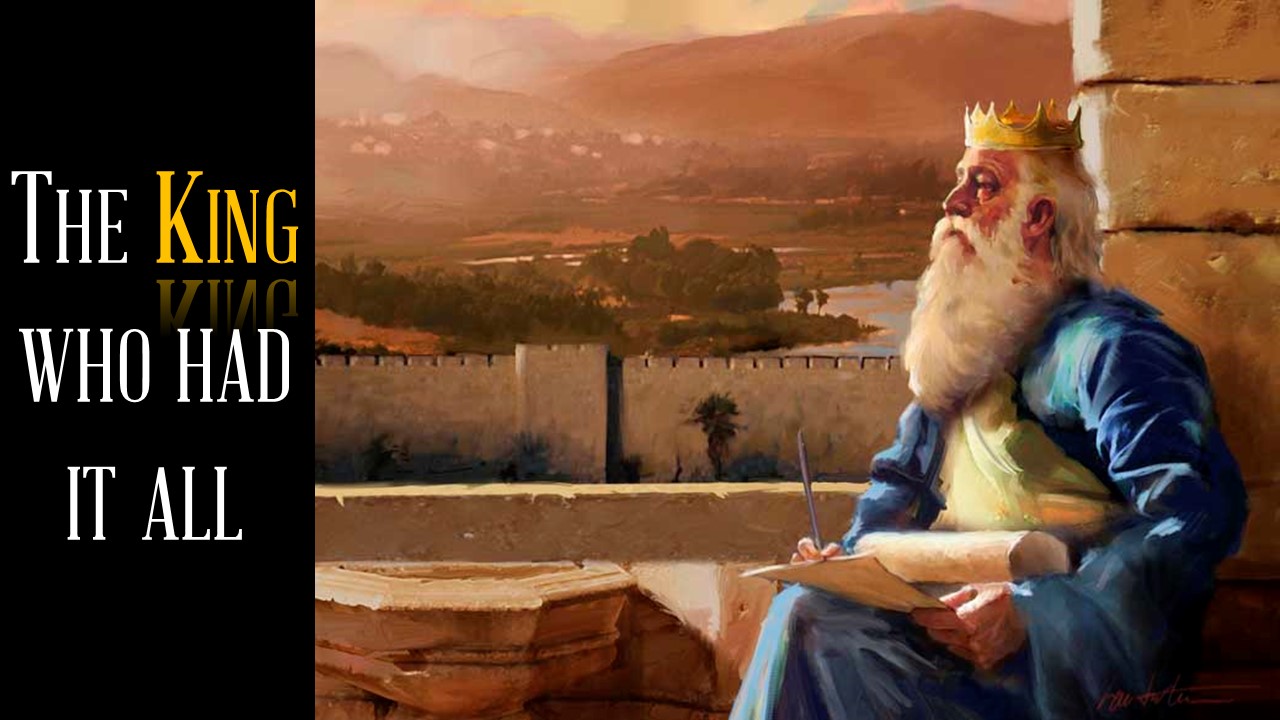
So King Solomon surpassed all the kings of the earth in riches and wisdom. And all the kings of the earth sought the presence of Solomon to hear his wisdom, which God had put in his heart. (2 Chronicles 9:22-23)

The King Who Had It All

Solomon is known historically as the richest man who lived and the wisest among men. None surpasses the amount of his wealth, and no man takes on the mantle of knowledge as the son of David. During the reign of Solomon, silver was as common in Jerusalem as stones. Silver was counted as nothing in the glory days of Israel. All of the drinking vessels were pure gold. There were so many gold vessels that silver was considered a useless metal. The Queen of Sheba visited Solomon with a great entourage bringing many gifts for the king. She pressed him with hard questions, which he easily dismissed with remarkable wisdom. When she spoke with Solomon, and she saw all of his wealth and power, she remarked that half of his greatness of wisdom was not told to her. The Queen of Sheba was overwhelmed by the incredible blessings of Solomon.

The Queen of Sheba acknowledged the blessings of Solomon came from the Lord. She could see how the God of Solomon had delighted in him and set him on his throne to be king. Israel was loved by God to establish justice and righteousness. Solomon’s great wealth and power were testimony more to the Lord God than Solomon’s. All of his wealth came from the Lord. The unlimited wisdom of Solomon came from God. No man was blessed as Solomon, and it was clear to the Queen of Sheba that God was a powerful and benevolent Lord. What she witnessed in the kingdom of Solomon was beyond anything she had ever seen. The life of Solomon was a testimony to the Lord.

With Solomon’s wisdom, power, and wealth, the king had it all. He was at the pinnacle of success because of the blessings of God. His life was a testimony to the Lord, and the Queen of Sheba acknowledged the benevolence of the God of Solomon as greater than any on earth. But King Solomon loved many foreign women, and his wives turned his heart after other gods. A man blessed beyond measure by the Lord God turns his heart away from the source of every blessing. Solomon went after Ashtoreth, the goddess of the Sidonians, and after Milcom, the abomination of the Ammonites. The man the Queen of Sheba saw as the greatest among men became a despot of evil and did not wholly follow the will of the Lord God. Solomon had it all and had nothing. He had wisdom, but his wisdom could not keep his heart from turning away from God. The king had the greatest wealth on earth and could not find happiness. His success led him astray, allowing the influence of his affluence to destroy him. The Lord was angry with Solomon because his heart had failed him. God gave one man the greatest riches of the earth with the greatest power and, in the nature of men, proved that man is a failed creature. Solomon was a king who had it all and had nothing because he did not have God. Men seek wealth, fame, pleasure, and wisdom; it means nothing when the Lord is not in the heart. Solomon was rich, and yet he was poor. The poorest man had nothing, but he was eternally rich if he had God. What do you have? Rather – whom do you have? All that is in this world will perish. Possessing God will never perish. If you want to have it all, seek the Lord.

Posted in Uncategorized | Leave a comment

The Sword In Mary’s Heart

The Sword In Mary’s Heart

In a small village of Galilee, the angel Gabriel came from the Heavenly Father to tell a young maiden incredible news that would change her life and the destiny of mankind. Joseph and Mary were newly wed, unaware of the remarkable change that would take place. Gabriel tells Mary she will have a son by the Holy Spirit, and He will be called Jesus. Nine months after Joseph and Mary travel to Bethlehem of Judea to register for the census, Jesus is born. In accordance with the Law of Moses, the infant son is circumcised on the eighth day and called Jesus. Thirty-two days later, when the days of her purification according to the Law were completed, Mary traveled with her husband and newborn son to Jerusalem to present Jesus at the temple.

There was a man in Jerusalem named Simeon who had been promised by God he would not see death until he had seen the Lord’s Christ. When Joseph and Mary entered the temple, Simeon knew the child they held in their arms was the promised Messiah. He took Jesus in his arms and blessed the young child as the salvation of the world. Joseph and Mary marveled at the words of Simeon. After blessing the young couple, Simeon turns to Mary and tells her words she will never forget. The Child he held in his hand would change the world, but Simeon warns Mary that a sword would pierce her soul because of this little boy’s life.

The early life of Jesus is shadowed under a cloud of unknowns. When Jesus is a few years old, men from the East visit the family, and Joseph and Mary travel to Egypt soon after. After a few years, the family returns to Nazareth, where Jesus will grow into manhood. The son of Mary grows like any other child and enjoys the company of his stepbrothers and stepsisters. Contrary to the doctrine of Roman Catholicism, Joseph and Mary have other sons and daughters. Jesus grows up with siblings. The gospel writer Luke tells of one story when Jesus was twelve years old and amazed the Temple’s scholars. Nothing is known of the next eighteen years of the life of Jesus. There is one certainty that never escapes the mind of Mary – her eldest son is the Son of God.

Of all the people that have lived on the face of the earth, none lived with the absolute certainty that Jesus was the Christ, the Son of the Living God, as Mary did. Jesus was born of a virgin, and Mary was that virgin. She knew who Jesus was. The sword that would pierce her heart was watching her little boy grow into adolescence and then become a young man. Many were the struggles of her eldest son as he lived a perfect life battling the temptations of Satan. Did His siblings understand how unique their elder brother was? How did Mary deal with her grief in losing her beloved when Joseph died? Did she implore God for intercession? At the age of thirty, Jesus began His ministry. He taught the people He was the Son of God; while many believed and followed Him, many more did not. Mary saw the persecution of the Jewish leaders who hated her son, and she remained silent. When Nazareth rejected their hometown son, what did Mary say?

The greatest sword that pierced the heart of Mary was when the final day came that she must have known was coming. Her son was condemned to die at the hands of the Romans. As a mother, she would not have been far from her son as they condemned him and made him carry his cross. Mary watched as they nailed her son to a cross. She grieved in her heart as they lifted her precious little boy up on that cross and saw the agony and pain in his face. Mary remained silent as her soul was ripped with the sword of grief seeing her son’s suffering. She could have cried out, telling the people who He was, but she did not. When Jesus took those precious moments on the cross to tell his mother his love for her and ask John to care for her, could her heartbreak any more? Then Mary saw her son die. The sword had taken its greatest toll.

Simeon told Mary a sword would pierce her soul, and it did – often. Mary took that sword, and the last record of the mother of Jesus was when she assembled with the first disciples of the New Testament church. One can only imagine the role she must have played in the early church and the stories she could tell of her son. A sword pierced her heart all her life, but her sword of grief led her to the kingdom of God and the glory of her son, who was the Son of God. Mary’s faith was an incredible example of eternal love. A mother’s love comes with a sword. Thank you, Mary.

Posted in Uncategorized | Leave a comment

Choose Friends Carefully

After this Jehoshaphat king of Judah allied himself with Ahaziah king of Israel, who acted very wickedly. And he allied himself with him to make ships to go to Tarshish, and they made the ships in Ezion Geber. But Eliezer the son of Dodavah of Mareshah prophesied against Jehoshaphat, saying, “Because you have allied yourself with Ahaziah, the Lord has destroyed your works.” Then the ships were wrecked, so that they were not able to go to Tarshish. (2 Chronicles 20:35-37)

Choose Friends Carefully

During the time of the divided kingdom, Judah was ruled by good kings and evil kings. This was in contrast to the northern tribes of Israel, who endured two hundred years of evil kings. The first two kings of the southern kingdom of Judah were wicked. After the death of Solomon, Rehoboam, his son, did evil in the sight of the Lord, as did the son of Rehoboam, Abijam. After the short rule of Abijam, Asa, his son, ruled for forty-one years and was a good king, followed by the reign of Jehoshaphat. Like his father, Asa, Jehoshaphat was a good king seeking to please the Lord during his twenty-five-year reign. He carried out the religious reforms of his father and was blessed by the Lord to establish his kingdom. The Holy Spirit said of the king that his heart took delight in the ways of the Lord. Jehoshaphat was one of the great kings of Judah.

As good a king as Jehoshaphat was, he had one character flaw that plagued him his whole time as king. He did not distinguish the kind of people he aligned himself with. To his credit, he made peace with the northern tribes of Israel, but Ahab was the king he made peace with. Sealing the covenant of peace, the son of Jehoshaphat, Jehoram, married the daughter of Ahab and Jezebel. Ahab’s daughter, Athaliah, was a wicked woman who would lead her husband to walk in the way of the kings of Judah and rule as an evil king. Her son, Ahaziah, reigned for one year before Jehu assassinated him. Athaliah took the throne and killed all the male members of the house of David except for Joash, who was hidden by Jehosheba. Jehoshaphat could not have realized the impact of his alliance with Ahab that brought about so much evil in Judah.

During the reign of Ahaziah, king of Israel, Jehoshaphat allied himself with the king of Israel. Ahaziah acted very wickedly. The influence of Ahab and Jezebel was strong with the wife of Ahaziah, and the land was filled with the worship of Baal. Jehoshaphat wanted to establish a naval fleet at Ezion Geber, a port on the Red Sea (Gulf of Akabah), to go to Tarshish. The prophet Eliezer prophesied against Jehoshaphat for his alliance with Ahaziah. The ships were wrecked, and the planned navy was lost. Jehoshaphat chose the wrong people to align himself with, and the Lord punished him. It would seem the choices of Jehoshaphat influenced his son Jehoram who killed all his brothers to obtain their wealth.

The type of people chosen to be friends or allies strongly influences the good character of God’s people. Examples abound throughout scripture with the consequences of choosing evil companions that corrupt the good morals of the righteous. There are many examples of the good influences wielded by those who embrace the company of other godly people. The gospel of influence is measured by the kinds of people surrounding the Christian’s friendship. Choosing friends must be done with the greatest care of deciding if that association will help one reach heaven or cause the heart to serve the world. Friends have a powerful sway on the heart of the Christian. Choose wisely and with a great deal of prayer. Your soul may depend on it.

Posted in Uncategorized | Leave a comment

The Spirit Of Bondage

For you did not receive the spirit of bondage again to fear, but you received the Spirit of adoption by whom we cry out, “Abba, Father.” (Romans 8:15)

The Spirit Of Bondage

Freedom is the voice of those who seek to find happiness and joy in life. All men are made free with the ability to choose the course of their lives. Sadly, many become enslaved by their fellow man and, worse, enslaved by their own desires. Slavery is a negative subject that brings many emotions to the surface with repugnance and abhorrence, yet it is common in most people’s lives. There are movements decrying the slavery of men upon others, but what about the personal slaveries that bind men to the deceptive allure of pleasure? The spirit of bondage is the strongest of temptations trapping the soul into slavery of passion, drugs, desire, and uncontrolled habits.

The spirit of bondage is a tool of the devil to take the hearts of God’s people away from Him. It can become a lifelong struggle against chemical addiction, robbing life of health and happiness. Addictions to pornography trap millions of people. Uncontrolled spending by hoarders that cannot stop buying ruins lives. Gambling destroys countless lives every year. The “anonymous” clubs flourish from a harvest of souls enslaved to the spirit of bondage. God does not desire His people to be coupled to the slavery of sin but to find peace and happiness in the Spirit of adoption. True slavery is measured by the type of master that controls the spirit. Enslaving the soul to the flesh’s pleasures always brings heartache and ruin. Seeking happiness in drugs can end in destroying the body and then death. Financial ruin comes from those who cannot stop flittering away the family income.

One of the greatest addictions has become the cell phone. Smartphones have made a population of ‘unsmart’ people who cannot exist without media fixes from myriad apps that tantalize and tease the mind to want more. Children are neglected as parents consume their time staring at the tiny screens. Marriages become loveless as the love of the smartphone ruins the relationship. Young people cannot communicate with others. The spirit of bondage has taken over the souls of God’s people who lack self-control. Worship services cannot be completed without checking the phone. How many Christians can leave their cell phone in the car and go for more than an hour without checking Facebook? The excuse often is the phone is used with a Bible app, and while that is true, can that person honestly say they have never checked other media during worship?

There are many addictions that take the heart away from God. The need to disconnect to reconnect with God is needed now more than ever. Drug use was a prevalent temptation of choice, but now the sophisticated drug of use is the electronic media; known as the spirit of slavery. When the child of God cannot control – cannot control their desires, it becomes sinful. Self-control is one of the hallmarks of the Christian character. The lack of self-control is the lack of devotion to God. Allowing the spirit of bondage to consume the heart will destroy the soul. The Christian is not called of Christ to be enslaved to the bondage of fear. Christians are called to Christ to be people of God who received the Spirit of adoption by whom they cry out, “Abba, Father.” They cry out “allegiance” to the Father. Do not let the spirit of slavery consume the soul. Set yourself free from that which binds you – be free in Christ.

Posted in Uncategorized | Leave a comment