Be Careful How You Stand

Therefore let him who thinks he stands take heed lest he fall. (1 Corinthians 10:12)

Be Careful How You Stand

All men are the same. They have been the same since Adam and Eve. Centuries have changed technologies, but at the end of the day, everyone will find themselves in the same dilemma as the generation before. It is easy to look at a culture one thousand years removed and call it primitive compared to the modern, civilized world. The manner of living may have changed, but the nature of the heart has not. Modern families live in air-conditioned homes with indoor plumbing, refrigerators, freezers, internet, smartphones, and drive machines that offer more comfort than most homes. Instead of hunting for food, provisions are prepackaged in plastic at the local store.

The nature of man is what is unchanging. Struggles with sin and righteousness are as old as Adam and Eve. The Egyptians who built the Great Pyramids battled with sin. In the Americas, the natives of the land were either righteous or unrighteous. The battle with sin afflicts the souls of every person in every culture through all generations. There is no difference in how the modern man battles the lust of the flesh, the pride of life, and the lust of the eyes than his predecessors’ generations removed.

Paul argued to the saints at Corinth that Israel of old struggled with sin and, sadly, lost the battle often. The Hebrews that came out of the Egyptian bondage through the Red Sea were tempted with the same wiles of the devil as the modern Corinthians. They all drank the same spiritual drink and ate the same spiritual food. For most of them, God was not well pleased and died in the wilderness. The stories of old serve to illustrate the unchanging nature of men and the battle with sin. Paul used an example nearly fifteen hundred years old to prove a point to the Christians of his day. Lusting after evil is not a new phenomenon. Sexual immorality has plagued the soul of man since Adam and Eve were expelled from the garden. Temptation is the lot of all men, unchanging and undeniable.

The revelation of God’s word reminds every generation of men that sin is a constant problem, and God is the only answer. A man can believe he is a modern soul who does not have the issues of those who lived before him because he is a nobler, stronger, vigilant, and watchful person than his ancestors. The remarkable irony of this kind of mind is the poisonous sin of pride has already condemned him. He thinks he is standing righteous before God because he is a better person than those before him. The warning is for those who believe they stand without fear to prepare to fall badly. It is easy to read about the failures of the Israelites and think that could never happen today. That is the warning Paul gives to the proud heart.

Sin will topple the strongest and destroy those who trifle with its power. A man who thinks he stands without temptation has begun to fall. Paul assures the saints God will not allow them to be tempted beyond what they are able to bear, but they must be warned they will be tempted. Satan has never taken a day off since he deceived the woman to eat the forbidden fruit. He is not impressed with the trinkets of a new generation, but he is deadly serious about damning souls to a lake of fire and brimstone. Having the courage to stand and withstand the wiles of the devil can only be done through the power of God. Stand firm, but stand with the courage to know how easy it is to fall. When you fall, you will only be defeated if you fail to rise again and fight. Stand up, stand up, for Jesus. Have courage. Stand strong.
Posted in Uncategorized | Leave a comment

Refusing To Accept Blame

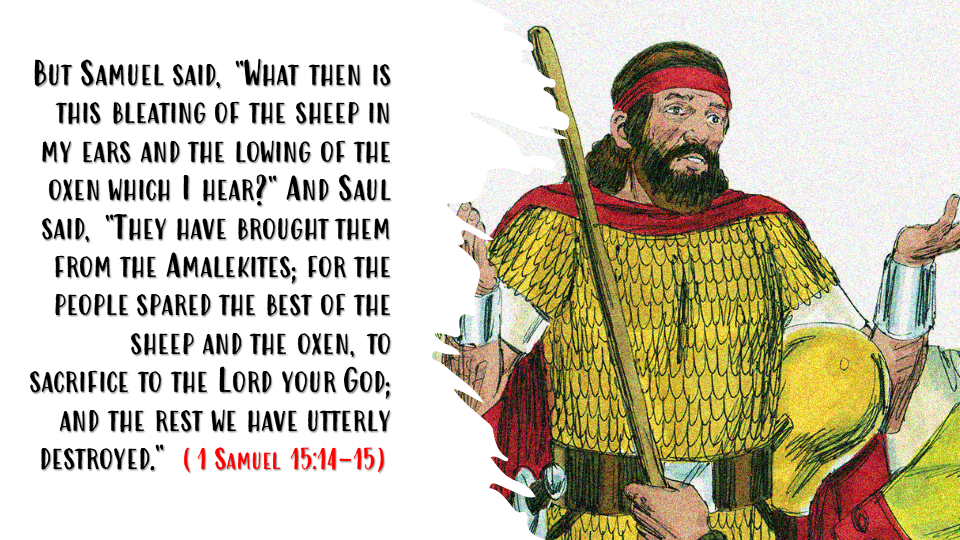
But Samuel said, “What then is this bleating of the sheep in my ears and the lowing of the oxen which I hear?” And Saul said, “They have brought them from the Amalekites; for the people spared the best of the sheep and the oxen, to sacrifice to the Lord your God; and the rest we have utterly destroyed.” (1 Samuel 15:14-15)

Refusing To Accept Blame

King Saul was the first king of Israel. He was tall and handsome and the son of Kish, whose great-grandfather was a mighty man of power. Samuel the prophet was disappointed the people desired a king, but the Lord assured him it was in keeping with the divine plan. The reign of Saul did not begin well as Saul took it upon himself to offer a sacrifice as he impatiently waited for Samuel. This was against the commandment of the Lord, and Samuel rebuked the king for his unlawful act.

Sometime later, Samuel came to Saul and told him to punish Amalek for what he did to Israel when he ambushed the people of God when they came up from Egypt. Samuel instructed the king to utterly destroy all that they had and not to spare anyone. This demanded killing man and woman, infant and nursing child, ox, sheep, camel and donkey. Saul was to destroy all the Amalekites, sparing nothing and no one. The king gathered his army of two hundred thousand foot soldiers and ten thousand men of Judah and attacked the city of Amalek. He took Agag, king of the Amalekites alive and utterly destroyed all the people with the edge of the sword. The best of the sheep, oxen, fatlings, lambs, and all that was good was spared. Saul was unwilling to destroy them. Everything despised and worthless, he destroyed.

The word of the Lord came to Samuel, regretting He had made Saul king. Saul had refused to obey the voice of the Lord by sparing Agag and all the good things. Samuel comes to Saul, and the king acts as if everything he has done has glorified the Lord and that he has done the commandment of the Lord. The prophet asks the king what the bleating of the sheep and the lowing of the oxen means. Saul immediately turns the blame upon the people, telling Samuel the people brought the flocks from the Amalekites. It was the people that spared the best of the sheep and the oxen. Saul suggests what the people were seeking was to glorify God and do a good thing to spare all of the best of the flocks. The animals could be used for sacrifice to the Lord. He reminds Samuel all of the rest had been destroyed.

Saul was to blame, and he turned the blame on everyone but himself. He was king, and his decisions spared Agag and the best of the flocks. As the leader of the people, he should have taken ownership of his failure to obey the word of the Lord. He alone had decided to disobey what Samuel had told him to do. Worse, he would not accept blame for what he had done, charging the people for what had happened and explaining away his actions by glorifying the Lord. As the leader of the people, he stood above accusations of blame in his eyes. He was only seeking the good of the nation.

What Saul believed in his heart did not change the word of God. Blaming others instead of accepting the blame for his own actions did not change the word of God. Leadership fails when those in authority deflect responsibility for their actions. After Saul died in battle, David became king of Israel. When David sinned with Bathsheba and Nathan the prophet came to him, David did not follow in the steps of Saul. He could have blamed Bathsheba. David could have excused his actions away, suggesting the wars had weakened his spirit. There were many whom David could lay the blame for his failure. David took responsibility for his actions. So David said to Nathan, “I have sinned against the Lord.” That is true leadership.

Failures become greater failures when men refuse to acknowledge and accept blame. Deflecting the blame is the greatest weakness of leadership. Accepting responsibility is the greatest strength of leadership. Men of God who excelled were men who faced their own failures with courage. Saul blamed everyone but himself and lost everything. Samuel told Saul the problem was in the heart of the king, who allowed pride to distort the truth. Saul was a better man when he was little in his own eyes. David accepted his failure and became a greater man. Refusing to accept blame does not glorify God.

Posted in Uncategorized | Leave a comment

They Knew Jesus As A Young Man

The Jews then complained about Him, because He said, “I am the bread which came down from heaven.” And they said, “Is not this Jesus, the son of Joseph, whose father and mother we know? How is it then that He says, ‘I have come down from heaven’?” (John 6:41-42)

They Knew Jesus As A Young Man

One of the great problems the people had with Jesus was to see past His humanity and understand His divinity. This was especially true for the people who lived in the town of Nazareth. Jesus was born in Bethlehem of Judea but grew up in Nazareth. Joseph and Mary lived in Nazareth when the angel told them of the conception of the Son of God. After going to Bethlehem for the census in the days of Caesar Augustus, the family remained for just over two years. Being warned by an angel Herod sought the life of Jesus; Joseph and Mary fled to Egypt, where they stayed until the death of Herod. Returning to Israel, Joseph took the family back to Nazareth, where he worked as a carpenter.

Nazareth was in the secluded valley of lower Galilee, north of the Plain of Esdraelon. It was in Nazareth Jesus attended the local synagogue, learned the trade of the carpenter, and increased in wisdom and stature and favor with God and man. Joseph and Mary would welcome four brothers and at least two sisters to the family of Jesus. Life in the small village of Nazareth was filled with daily chores, trips to Jerusalem (eighty miles) to the Temple, and working in the carpenter’s shop. In a small community, everyone knows everyone; and everyone knows Jesus.

Jesus did not begin His ministry until he was thirty years old. The people of Nazareth watched the son of Mary grow from adolescence to teen years and then manhood. What they never saw was disrespect, mischievousness, dishonor, or anything that marred the character of Jesus. He never disobeyed his parents or disrespected the Roman government. His life was perfection – in the literal sense. To say Jesus lived a blameless life is factual. No one in the community could bring any charge against Jesus for any reason, small or large. Everyone knew the kind of man Jesus had become.

When Jesus began His ministry, He taught the people with authority. At the age of twelve, He shocked the religious leaders at the Temple. Now, He was going through the regions of Judea, Samaria, and Galilee with thousands of people following Him. Multitudes flocked to Him to be healed of every disease known to man. Jesus raised the dead. He fed thousands of people with almost nothing. His teachings struck a responsive chord in the hearts of the common man and anger in the minds of the Jewish leaders. Jesus was a man to be reckoned with.

Following the feeding of more than five thousand people with five barley loaves and two small fishes, the multitudes flocked to Him again, seeking the abundance of the food enjoyed the day before. Jesus began to show the purpose of His mission was not to feed the belly but the soul of men. The Jews complained about the teachings of Jesus, suggesting they knew Him as the son of Joseph and Mary whom they knew and He could not have come down from heaven. It seems they could not see the forest for the trees. Standing before them was a man they knew, and a sinless life of three decades did not help them see the incredible man that stood before them.

Blindness comes in many forms. Most men see what they want to see, refusing to see what they do not want to see. The people of Nazareth and the Jews did not want to see the man they knew from Nazareth as the Son of God. They failed to remember the unusual son of Mary was perfect. If they could have stopped to think about the past thirty years in the life of the carpenter’s son, they would have seen who He really was. His life was a testimony to the will of the Father. They thought they knew Jesus, but they did not. Do you know the Jesus of scripture?

Posted in Uncategorized | Leave a comment

Which Ones?

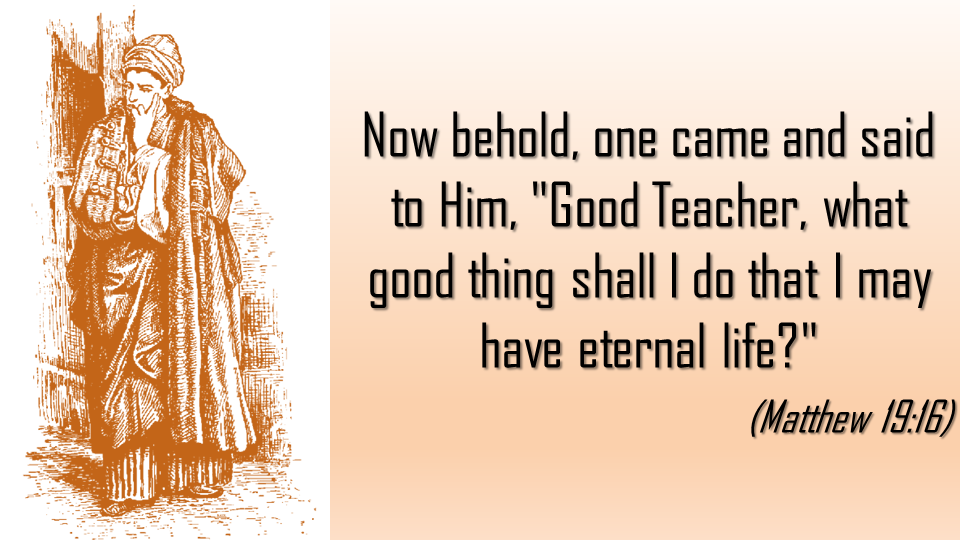
Now behold, one came and said to Him, “Good Teacher, what good thing shall I do that I may have eternal life?” So He said to him, “Why do you call Me good? No one is good but One, that is, God. But if you want to enter into life, keep the commandments.” He said to Him, “Which ones?” Jesus said, ” ‘You shall not murder,’ ‘You shall not commit adultery,’ ‘You shall not steal,’ ‘You shall not bear false witness,’ ‘Honor your father and your mother,’ and, ‘You shall love your neighbor as yourself.’ ” (Matthew 19:16-19)

Which Ones?

Jesus was asked many questions in his life, and none was so telling as the conversation with a rich young ruler seeking eternal life. The heart of the man was honest in seeking how to find eternal life. There is no greater aspiration of life than to know what will happen after death. The young man came to the right source for his answer. Jesus was the Son of God, and if the question could be answered directly, it would come from Him. The man commends the character of Jesus by calling Him a good teacher, but Jesus deflects the accolade to show He was only seeking the Father’s will. Jesus answers the question of eternal life with the simple answer given to men from the beginning of time. Obedience has always been the hallmark of those who are faithful to the Lord. If the man wants to enter into eternal life, he must keep the commandments of God.

There is no more straightforward manner to answer the question of eternal life than keeping the laws, testimonies, statutes, and commandments of the Lord. God commanded Adam and Eve not to eat the fruit from the Tree of Knowledge of good and evil. Satan attacked the word of God, suggesting Eve could ignore the word of God. Spiritual death was the consequence. Moses delivered the law to the Hebrews with the preamble of the Ten Commandments to codify the will of the Lord. The Holy Spirit inscribed the Ten Commandments on stone as a guide for the people with the full intention that all ten commandments would be followed.

The young man’s question to Jesus of which laws to keep would be as if a man read the Ten Commandments and asked which part of the Ten Commandments were required to be followed. Why would God give ten laws without the expectation that all ten laws were to be kept? The Ten Commandments were not the Ten Options! Israel was to keep all ten commandments plus the various laws in the Law of Moses. There was never an option of the law allowing the picking of which laws were favored and which were not. God expected Israel to keep the whole law fully. Asking Jesus which laws were required was an effort to find loopholes in the word of the Lord to allow a man to live as he pleases. Which laws did the rich young ruler think he could live without? How would a man decide which to include and which to exclude? The idea is preposterous at best and dangerous in the end.

When a man comes to the Bible trying to find which laws apply to him and which do not, he will never find eternal life. Salvation is not measured by how successful a man keeps the laws of his liking. The Bible contains the mind of God so that everyone can read and understand the will of the Father. Keeping 90% of the commandments of God will not bring eternal life. Salvation is not measured on the merit badge that the individual decides to maintain, with the exception of others. The whole law judges, and the whole law condemns. There is no middle ground.

Jesus summarized the keeping of the law, showing the need to obey the whole law. The reality came when the young man’s heart turned away from God because he was unwilling to give up his riches. He wanted to serve God about 90% without giving away all his wealth. To the rich young ruler, obedience was determined by how much he was willing to sacrifice without giving it all away. He could not do what Jesus required because he tried to justify himself by asking which laws to keep. The better question would have been, “What more can I do?” Do you measure your eternal life by choosing which laws to keep?

Posted in Uncategorized | Leave a comment

The Joy Of Onesiphorus

This you know, that all those in Asia have turned away from me, among whom are Phygellus and Hermogenes. The Lord grant mercy to the household of Onesiphorus, for he often refreshed me, and was not ashamed of my chain; but when he arrived in Rome, he sought me out very zealously and found me. The Lord grant to him that he may find mercy from the Lord in that Day—and you know very well how many ways he ministered to me at Ephesus. (2 Timothy 1:15-18)

The Joy Of Onesiphorus

It was not an easy life to follow after the apostle Paul. The zealousness of his mission to carry the gospel throughout the world was well known among the brethren, and many undertook the grueling work of joining Paul on his journey. He had been falsely accused and arrested in Jerusalem and, after a few years, taken to Rome to plead his case before Caesar. Luke ends the story of the Acts of the Apostles with Paul living in a house under guard, after which the apostle is released for some time. Writing to Timothy in a second letter preserved through the Holy Spirit, Paul has been arrested again and is facing certain death. He needs his brethren to encourage him. Many failed as they turned away from the aged apostle, but some stood valiantly by his side.

Nothing is known of Phygellus and Hermogenes mentioned by Paul. These two men are among many who crossed paths with Paul in his ministry. It doesn’t seem easy to imagine brethren would turn away from Paul in his greatest hour of need, but Phygellus and Hermogenes were two that Paul inscribed on the pages of divine scripture who denied him. Were they afraid of being arrested like Paul and imprisoned? It is a sad affair when the names of two brethren are mentioned in scripture as denying Paul and thus denying Jesus Christ. They turned away from their friend. Because of the faith of Paul, Phygellus, and Hermogenes refused to be the encouragement to a man in desperate need of brethren. How sad.

Writing to Timothy about Phygellus and Hermogenes did not discourage Paul because he remembered the kindness of another brother in Christ, Onesiphorus. Nothing is known of Onesiphorus outside Paul’s letter, but what is known of him is the voice of hope and love for God. Paul was in a Roman prison facing the sentence of death. In the Roman world, it would not be uncharacteristic for associates of a condemned man to face the wrath of the authorities. Aligning oneself with Paul could bring persecution, imprisonment, and death. Onesiphorus was unconcerned about the worldview of Paul. He was concerned about Paul’s need to be refreshed, cared for, and encouraged. There was no shame in being known as a friend to one imprisoned under the sentence of death. Arriving in Rome, Onesiphorus diligently sought out the apostle to let him know he was not alone. That is the kind of friendship that is devoted to Jesus Christ first.

The church needs more people like Onesiphorus and fewer brethren like Phygellus and Hermogenes. Being a fair-weather friend does not show the encouragement brethren need from one another. Some brethren seek opportunities to encourage, and some brethren spend most of their time creating disunity, division, and confusion. Paul needed encouragement. Two men abandoned him that needed to be there for him. Onesiphorus refreshed the weary spirit of Paul and gave him hope. Jesus was abandoned by the eleven in His greatest hour of need. The church needs brethren who will stand with Jesus when accused and not be ashamed of standing for truth, no matter the cost. Let us all be like Onesiphorus. Bring joy. Instill hope. Show Christ.

Posted in Uncategorized | Leave a comment

What Children Need To See

When I call to remembrance the genuine faith that is in you, which dwelt first in your grandmother Lois and your mother Eunice, and I am persuaded is in you also. (2 Timothy 1:5)

What Children Need To See

Timothy was brought up in a home where God was taught, and the word of God was respected. His father was a Greek and is not mentioned in scripture. When Paul wrote to Timothy in the second letter, the apostle commended the faith of his mother, Eunice, and his grandmother, Lois. These two women must have had a tremendous impact on the life of Timothy as he was growing up. There was an unfeigned faith in Timothy instilled through the influence of his mother and grandmother. A sincere love of truth guided the heart of Timothy. Paul could see the influence of Lois and Eunice in the life of Timothy.

Faith is not born through the flesh but by the knowledge of the word of God. Instilling faith in Timothy came about through the diligent example of his mother and grandmother showing their faith. There is little doubt the home of Timothy was a place where the word of God was exalted, respected, and discussed. Timothy did not become a Christian because his mother was a Jewess and believed. The faith of Lois began in her mother, who taught her the word of God. Faith found itself rooted in the lives of the two women training the young boy, Timothy. What Timothy saw in his home was a love for the word of God.

Children are very perceptive and acute in their observations of family. No matter how hard parents try, children will, in many ways, grow up to be just like them. Often, this is a good thing, but sometimes, it can have a negative impact on the life of the child. What a child sees in the home will largely measure what kind of person they become. There are certain things children need to see in the home that will help guide them and instruct them in life. Children need to see God in the home. The television has become the family altar, becoming the center of life. Computers and smartphones are the electronic cocaine of parents who spend more time with glowing faces in front of the kleptomaniacs of time and energy than with their children. If God is not seen in the home, the children will learn that God is not the center of the home.

Parents show God in the home first by impressing on the children the importance of reading the Bible. If a child grows up in a home, never seeing mom or dad with an open Bible in their lap, they will be more likely to have little desire to put a Bible in their lap. One of the most important memories a child needs to have of home is seeing their parents with an open Bible. A word of caution to an earlier point: reading the Bible on a smartphone will not show the child an open Bible. They will likely believe the parent is shopping or checking social media. Children need to hear their parents read the Bible. Seeing is not enough. Hearing the words read to one another builds a foundation of faith that will be needed in life. Parents who do not read the Bible to their children or with their older children are failing to instill the genuine faith of Lois and Eunice.

Children need to see their parents praying. Daily prayers at mealtime, at bed at night, during storms, or prayers of thanksgiving during the day teach children the love of talking to God. Young people of all ages need to know how to pray. Teenagers need to pray. Toddlers can be taught to pray. If the child is embarrassed to pray, it could be from parents who do not pray. They must be taught by a daily example. Teaching children to pray shows them how much God loves them to listen to them and the importance of talking to God. They will need that when they leave home.

There are many things children need to see in the home. They need to hear the song of worship, sounds of benevolence in helping others, laughter in times of joy, comfort in times of sorrow, and God’s name magnified and respected. They do not need to see immodesty, hypocrisy, anger, lying, dishonesty, and those things that look like the world. Children need to see God reigning in every part of the home. What is watched on television or social media must glory God. Home must become the spiritual haven of safety from a crooked and perverse world. It must become the bastion of holiness in an unholy world. What do your children see? How will they describe their memories of home? You are making that decision – now!

Posted in Uncategorized | Leave a comment

Our People

When I send Artemas to you or Tychicus, be diligent to come to me at Nicopolis, for I have decided to spend the winter there. Send Zenas, the lawyer, and Apollos on their journey with haste, that they may lack nothing. And let our people also learn to maintain good works, to meet urgent needs, that they may not be unfruitful. (Titus 3:12-14)

Our People

Paul had many people in his life who worked with him, assisted in the work of ministry, provided necessary needs, and helped to boost his spirits. Throughout his letters, he named his associates who helped in different ways. Titus was a Greek friend of Paul’s who labored in the ministry. It seems clear Paul was instrumental in teaching the gospel to Titus as he called him his true son in the common faith. Paul would tell the brethren at Corinth Titus was his partner and fellow helper. There was a close bond shared between the two men. On one of the journeys (not described by Luke in the Acts of the Apostles), Paul had been in Crete and left Titus to set things in order, appointing elders in every city.

Artemas was another fellow helper of Paul, being sent to Crete to assist Titus. Nothing is nothing of Artemas outside of the letter to Titus. Tychicus was a faithful minister of the Lord and a beloved brother of Paul. Paul had sent Tychicus to Ephesus to let the brethren know of his work and calm any concerns they had about the apostle. Tychicus would accompany Paul on a part of his journey from Macedonia to Jerusalem, including another disciple named Trophimus. In his letter to Colosse and his second letter to Timothy, the apostle Paul commended Tychicus to the brethren.

Paul wanted Titus to join him at Nicopolis, on the western side of Greece, because he wanted to spend the winter there. He also wanted Titus to send Zenas, a lawyer, and Apollos on their journey to see Paul. Apollos was the great orator converted to the teachings of Christ by Aquila and Priscilla. There were many people of different backgrounds and talents helping Paul in the work of teaching and preaching the gospel. He was surrounded by devoted souls who gave their lives to preach the word of God in a world filled with idolatry and immorality. It took courage to stand for truth in the Roman world. Paul suffered many persecutions, and sometimes those with Paul suffered as well. Luke was a companion of the apostle on many journeys, writing about their experiences.

Another group of people was very important to Paul also. He simply described them as “our people.” These are the multitudes of the unnamed who only God knew. Paul constantly wanted to encourage the brethren to stand for truth, live holy lives, look for the promise of eternal life, and stand courageous in the face of persecution. It took a special brand of person to be a Christian. Without naming them, Paul wanted his people to maintain good works and to meet the urgent needs of the day. These were the unsung heroes who lived their lives in simple humility to be the best they could be. This is how they could do productive work.

Paul had an unusual opportunity to move throughout the Roman Empire, preaching and teaching. He was unmarried and unencumbered with family. His life was demanding and rigorous, and many could not keep pace with the apostle. There was a place for men like Paul, but there was a great need for “our people” to be the kind of persons God wanted them to be. They may never travel to a foreign land to preach, but they could maintain good works. When needs arose, they could rise. There is so much work to do for “our people” and the blessings of showing Christ in their lives. We may never have our names written on holy writ, but I have a lot of work to do as “our people.”

Posted in Uncategorized | Leave a comment

The Veil Of The Temple

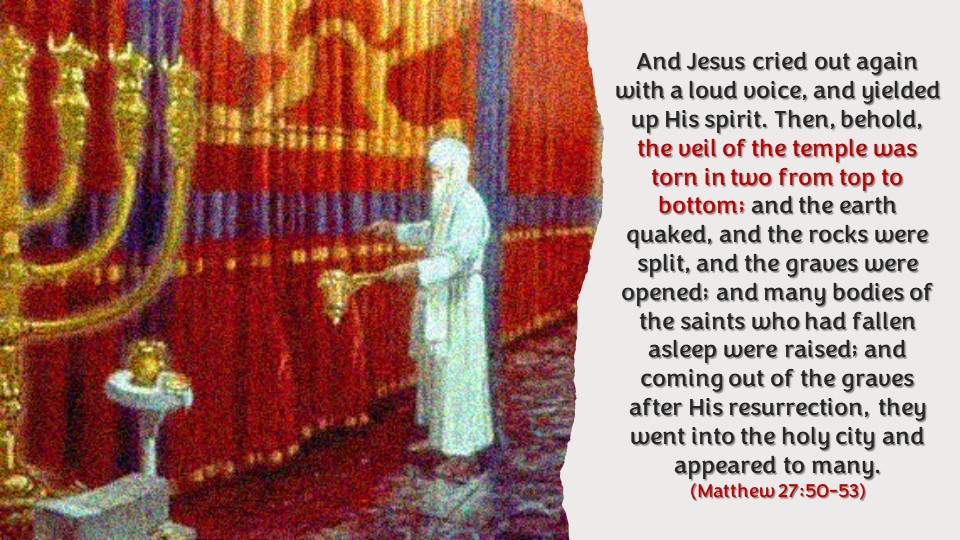
And Jesus cried out again with a loud voice, and yielded up His spirit. Then, behold, the veil of the temple was torn in two from top to bottom; and the earth quaked, and the rocks were split, and the graves were opened; and many bodies of the saints who had fallen asleep were raised; and coming out of the graves after His resurrection, they went into the holy city and appeared to many. (Matthew 27:50-53)

The Veil Of The Temple

Constructing the Tabernacle of the Lord was an exact process. The Lord gave Moses a pattern to build the Tabernacle and all the instruments, articles, designs, and forms. Tables were to be measured precisely. Gold ornaments adorned many pieces of the Tabernacle. Garments worn by the High Priest, the priests, and the Levites were exact. God told Moses to set up the Tabernacle according to the pattern shown on the mountain. Inside the Tabernacle, there was a special curtain of finely woven linen. It was decorated with blue, purple, scarlet thread and skillfully embroidered cherubim. The veil was to be hung on gold hooks attached to four posts of acacia wood overlayed with gold, set in four silver bases. God instructed Moses to hang the inner curtain from clasps and put the Ark of the Covenant in the room behind it. This curtain will separate the Holy Place from the Most Holy Place.

Many years later, when Solomon built the Temple of the Lord, he also followed the pattern given to him by the Lord. Across the entrance of the Most Holy Place, he hung a curtain made of fine linen, decorated with blue, purple, and scarlet thread and embroidered with figures of cherubim. After the people returned from seventy years in Babylon, the temple was rebuilt under the direction of Zerubbabel. In the eighteenth year of King Herod, the temple was rebuilt, and another veil was placed between the Holy Place and the Most Holy. This was a thick and gorgeously wrought veil some sixty feet high and thirty feet wide. When the veil rents apart, the priest who offered incense at the evening sacrifice about this same hour would have seen it rip and heard the incredible tearing noise.

The tearing of the veil was not man-made. God tore the curtain from top to bottom, showing His great power, declaring salvation had come to the earth through Jesus Christ. There is no other Savior whereby men can be saved. The Law of Moses would no longer save the Jew and the law of faith the Gentile. Jesus Christ became the veil, bringing all men to the Father. There was only one path to the Most Holy of Holies, where the Lord dwelt among the Cherubim. When Jesus died, the path to the Father for the Jews and Gentiles was only through the Son of God. Through the blood of Jesus Christ, all men can enter what was once forbidden.

In the religious world, there are many ways men seek eternal life in the Father. There are vast rooms built by men declaring salvation in Jesus Christ. They are decorated nicely with the trappings of religion filled with the dogmas of human wisdom. These rooms abound to accommodate the whims of the people to serve God in their own fashion. Millions of people fill these rooms, worshiping God and praising Jesus Christ. Sadly, they fail to understand the only place of salvation is behind the veil of Jesus Christ. There is only one place where eternal life is granted, and it’s through the veil. They have different names for the rooms built by men teaching doctrines not found in the Bible. Many are convinced if they accept Jesus as their personal Savior, they have gone behind the veil. Some religious groups encourage people to be good, and they will be saved. When the truth of the gospel is taught, showing the pathway through the veil, people will scoff and call the act a work and deny it.

There is only one way to the Father, and it is through the veil of Jesus Christ. Without obedience to the gospel of Christ, there will be no hope. The rooms are filled with those deceived into believing they are serving Christ when all they do is serve themselves. God constructed the Tabernacle and the Temple according to a pattern. The early church was built upon the pattern given by the Holy Spirit, including design, organization, and message of salvation. Denying the New Testament teachings denies the veil, Jesus Christ. Peter preached the message of the veil when he told the multitude, “Repent and let every one of you be baptized in the name of Jesus Christ for the remission of sins; and you shall receive the gift of the Holy Spirit. For the promise is to you and to your children, and to all who are afar off, as many as the Lord our God will call.” Welcome to the veil. Enter to find eternal life.

Posted in Uncategorized | Leave a comment

Unity Of Brethren

A Song of Ascents. Of David. Behold, how good and how pleasant it is for brethren to dwell together in unity! It is like the precious oil upon the head, running down on the beard, the beard of Aaron, running down on the edge of his garments. It is like the dew of Hermon, descending upon the mountains of Zion; for there the Lord commanded the blessing—life forevermore. (Psalm 133)

Unity Of Brethren

David understood the character of God’s people and the purpose they served in the scheme of God’s divine plan. The Lord created Adam and Eve as two people bound together in the unity of family but distinct in their characteristics. Humanity would bear the mark of their individuality as the world exploded in population. The murder of Abel was as much a stain on the purpose of God for men to live together in harmony as the act itself. From the beginning, God desired His creation to live in peace with one another. People are different from one another and must learn to live together and respect one another. The Law of Moses was filled with commands of how brethren were to treat one another. When Moses delivered the Ten Commandments, the first four were directed toward the relationship of man and God, and the final six of how men were to treat one another. There can be no vertical relationship with God if a man refuses to have the right kind of horizontal relationship with his brethren.

The spirit of unity has always been what God desires. He commands those who seek to follow His will to seek harmony in their relationships with one another. Aaron and Miriam murmured against Moses to the anger of the Lord. They were not trying to help Moses and to bring about unity. Korah tried to lead a rebellion against Moses, and he and his followers were destroyed by the hand of God. They were trying to destroy the unity of the people of God. Complaining, murmuring, gossiping, and divisive speech angers the Lord. It is the will of God that His people walk in the paths of unity. There is nothing better than God’s people serving the same purpose under the same banner, seeking the same unification of the work of the Lord.

Paul told the preacher Titus that if people are causing division, to give a first and second warning, and if they refuse to repent, have nothing more to do with them. To the Roman church, Paul urged them to note those who cause division and disunity and to avoid them. Unity is the character of those seeking to show the pattern of the New Testament. Luke speaks of the church in the early days having peace, filled with edification, walking in the fear of the Lord and in the comfort of the Holy Spirit. As a result of this unity, they were multiplying. That is where the church grows, and that is where it falls. Churches that are filled with unity-minded people will grow in spirit and number. Those churches who spend their time fussing, complaining, refusing to move forward, and causing division will die.

Unity is the grand design of God for His church. When brethren work together toward the same goal, growth happens. Leaders must be united. Members must seek the same goals. The work of teaching the lost is motivated by the desire to stand together in the work of the Lord, united under the same banner, fighting the same battle, seeking the same cause, and helping one another accomplish the work of the Lord. There is little time for distractions. Lost souls fill the landscape, and the church must be busy with the work of unity. Each individual who is doing their part in unifying the hearts of the members to the goal of saving souls will see the blessings of growth from the hand of God. How joyful it is when brethren dwell together in unity. Seek it. Demand it. Live it. Unity.

Posted in Uncategorized | Leave a comment

God’s Word Is Truth

For the word of the Lord is right, and all His work is done in truth. (Psalm 33:4)

God’s Word Is Truth

The word of God has always been true without regard to man or circumstance. When the Lord told Adam and Eve they would die when they ate the forbidden fruit, they died when they ate. God promised to flood the earth, killing all that had the breath of life and save Noah and his family. Everyone on earth died except the eight souls in the ark. Abram and Sarai were told they would have a son in their old age. Through the power and glory of God’s covenant with Abram, Isaac was born to a man one hundred years of age and his wife of ninety. The Lord promised Abraham a nation would come from his seed. Moses led the Hebrews out of Egyptian bondage to Sinai, where the nation of Israel was born. Because of disobedience and unfaithfulness, God punished Israel with forty years of wilderness wanderings, and each year was fulfilled.

Reading the Bible brings the distinct impression time and again that what God says is truth. This is the case whether it is a blessing or a curse. There are endless stories of the word of the Lord promising blessings to those who obey Him, and those blessings are provided. More often than not, the word of the Lord warns of punishment against those who disobey Him. In every case, the word of the Lord is truth. When the people worshiped the golden calf at Sinai, three thousand men were killed who refused to repent. Everyone aged twenty and up perished in the wilderness for the rebellion at Kadesh-Barnea. Joshua and Caleb were spared because they believed in the word of the Lord. Achan learned of the wrath of God when he took the devoted things from Jericho. David could not escape his adultery and murder, spending the rest of his life in conflict. The northern ten tribes of Israel laughed and scorned the prophets who warned them of impending destruction at the hands of the Assyrians until the army of the Assyrians destroyed the ten tribes to a man.

Noah believed in the promises of God and was delivered. Abraham accepted the fact that his body and the womb of his wife were dead but that God could create life, and Isaac was born. Joshua and Caleb knew the inhabitants of Canaan were nothing before the might of the power of God. When the Lord told Joshua how to conquer Jericho, the man of God did not hesitate. Daniel and his three friends were taken captive by the Babylonians and, in the face of great peril, never lost their faith in the word of God. Nehemiah rebuilt the walls of Jerusalem in fifty-five days with the faith that moved mountains. The word of the Lord is truth to those who believe in the power of the word of God.

Jesus is the embodiment of the word of God because He is the Word. Everything about Jesus is the word of His Father. When men seek God, they must find Jesus. The promise of eternal life is given to all that believe Jesus is the Christ, the Son of the living God. Anything short of this will result in destruction. The word of God is true when it declares Jesus as Lord and Christ. Jesus said He was the only way to the Father, the message of truth, and the means of eternal life. All Jesus taught is truth, and all Jesus did was truth. He gave the word of truth to His disciples, who went into all the world preaching Jesus Christ. On the Day of Pentecost, the apostle Peter told those gathered what they must do to be saved. The word of the truth declared by the Holy Spirit is that all men must repent and be baptized for the remission of sins. Based on the grace of God, His mercy, and love, all men must hear and obey the word of truth.

When Noah heard that God was going to destroy the world with a watery grave, he believed, and he acted. God’s grace told Noah what was coming and what he must do to be saved. Noah’s faith acted with works when he believed the word of truth and built the ark exactly as directed by the Lord. While the waters destroyed all life, the water saved Noah and his family. The word of truth is that water will destroy all those who refuse it and save all those who obey it. God’s word is right, and all of His works are done in truth.

Posted in Uncategorized | 1 Comment