The Value Of Kindness

And be kind to one another, tenderhearted, forgiving one another, even as God in Christ forgave you. (Ephesians 4:32)

The Value Of Kindness

What the world needs now is kindness. Mark Twain said that kindness is “A language which the deaf ear can hear, and the blind can see.” When can an act of kindness be wasted on another? It is the essential quality of showing one as friendly, generous, and considerate. Kindness should never be mistaken for weakness because it is the strongest of characteristics known to man. Someone who cannot learn to be kind is not a person of quality. While the world promotes the interest of self-worth and self-esteem to the belittlement of expressing a kind spirit, God looks down upon the act of kindness as part of His grace.

The Christian is an example of kindness. One of the traits of being a disciple of Christ is to be a person of kindness. Paul exhorted the saints at Ephesus to be kind, have compassion for others, and forgive in the manner God has forgiven them. The greatest kindness God did was to send His only begotten Son into the world to save a creature who was not deserving. Kindness is defined first by God and required of those who love Him and serve Him. Being kind is not a good idea that will garner many friends. The grace of kindness is what sets the Christian apart from the world.

It should be at the forefront of every person who names the name of Christ to learn how to be kind to others. There is more anger in the world with road rage, arguments erupting in stores, and office squabbles. Children of God should never be charged with the crime of unkindness. The heart of the Christian is molded into the image of Christ, who was kind to perfection. When people reviled against the Lord, He never responded in kind but with kindness. Letting the light of Christ shine in the world is the candle of kindness.

Every person who is a Christian should seek out opportunities to show kindness. Opening a door for someone, saying “Thank you,” being pleasant with an unpleasant cashier, and not engaging in vehicular stupidity with horns, brakes, and loud voices accompanied by hand signals. Helping people who are in need – even if they are a stranger – is showing kindness. God wants His people to be the example of kindness in a dark world that does not see kindness very often.

The character of kindness is an expression of the fruit of the Holy Spirit. To be the elect of God is to show kindness. It is a simple thing to do but carries the eternal weight of showing Christ to others. Kindness is a learned trait of goodness tempered by the calm spirit of godliness. The act of being kind is groomed through the knowledge of how much God has shown His kindness. The more a man seeks opportunities to be kind, the more grace he will find in life. It changes the heart to become softened by the nature of compassion. God expects His children to be kind, and He holds them in this regard. To be kind is to be like our Father.
Posted in Uncategorized | Leave a comment

Saving The Household

So the father knew that it was at the same hour in which Jesus said to him, “Your son lives.” And he himself believed, and his whole household. (John 4:53)

Saving The Household

When people heard that Jesus was in the area, they came out in multitudes to listen to His teaching and to be healed of their diseases. People sought Jesus out, hoping to find relief from their burden. A nobleman came to Jesus when He was near Capernaum to ask the Lord to heal his son before he died. Jesus told him to go to his son because he lived. When the man’s servants came to him, they told him his son lived. He asked them the time when his son recovered, and they told him it was the previous day at the seventh hour. The man’s reaction was to believe Jesus was the Son of God. Not only did the man become a believer, but also his whole household.

There are many stories of individual conversions and acceptance by those who believe Jesus to be the Son of God. What is amazing and exciting is when the impact affects the whole household. When the nobleman’s household heard the story of Jesus, they all became believers. Cornelius and his household were very devout in their belief in God but were not Christians. An angel told Cornelius to send for Peter, and he would tell him words whereby he could be saved. The apostle comes to the home of Cornelius, and the whole household is baptized into Christ. Paul visits the city of Philippi and finds some women having prayer by the river. A certain woman named Lydia heard the preaching of Paul, and she and her household were baptized.

While in the city of Philippi, Paul, and Silas were arrested after they healed a slave girl possessed with a spirit of divination. That night, there was a great earthquake that opened the doors of the prison and loosed all the chains of the prisoners. Fearing the prisoners had escaped, the jailer was about to kill himself when Paul stopped him. The apostle spoke the word to the jailor and his household, and they were all baptized. In the city of Corinth, Crispus, the ruler of the synagogue, believed on the Lord with all his household. Paul later reminds the saints at Corinth that he baptized Stephanas’s household. Remarkably enough and against all odds, there were Christians in the household of Caesar.

One of the lessons learned from the story of Noah is his persistence and determination to save his household. He knew the value of his soul, but he knew the importance of saving the souls of his household. This included his wife, three sons, and three daughters-in-law. Conversion should be a family affair. It should be an issue of the household. It is true that members of one’s own family can be the hardest to teach the truth, but there should never be an attitude of complacency about who is part of the household. The stories in the Bible of households obeying the gospel should be the norm. Noah could not imagine the thought of his wife perishing in the flood or his sons and their wives dying so tragically. He prepared an ark for the saving of his household, but he prepared their hearts to enter into the ark. We can do no less.

Your household is precious, and no waking moment should be wasted in not trying to secure the salvation of your household. The individual needs to realize their responsibility to obey the word of the Lord, and it must be the ever-present need to show the need of the household to embrace the gospel of Jesus Christ. The nobleman’s son was spared death, and then eternal life came to the household. What a blessed and wonderful story.

Posted in Uncategorized | Leave a comment

The First Baptists

After these things Jesus and His disciples came into the land of Judea, and there He remained with them and baptized. Now John also was baptizing in Aenon near Salim because there was much water there. And they came and were baptized. (John 3:22-23)

The First Baptists

One of the characteristics of John the Baptist’s teaching was indicative of his name. He was not called the Baptist because he was a part of the Baptist church. That church would not be formed for almost 1600 years, so no one could be called a Baptist in the denomination sense until John Smyth founded the Baptist Church in 1607 in London, England. John was called the Baptist because of what he did. Matthew describes John as the Baptist who came preaching in the wilderness of Judea. He preached repentance in the area of the Jordan because Jerusalem, all Judea, and all the region around the Jordan went out to him and were baptized by him in the Jordan, confessing their sins. Three things are clear about the teaching of John the Baptist: repentance, confession of sins, and baptism.

King Herod heard of John the Baptist. Everyone called John the Baptist, including the daughter of Herodias, when she asked for his head on a platter. Jesus said of those born of women, there is not a greater prophet than John the Baptist. In the early church, Paul found twelve men he thought were disciples of Christ. They confessed they had been baptized into John’s baptism. John told the Pharisees and Sadducees who came to his baptisms – that he baptized in water. He was baptizing in Aenon near Salim because there was much water there. Multitudes came to John to be baptized. John also was in Bethabara beyond the Jordan, where he was baptizing.

Jesus came to John the Baptist to be baptized of him. The request of his Lord humbled John, but Jesus explained His baptism was to fulfill all righteousness. John took Jesus down into the water and immersed the Lord. John was called the Baptist because he immersed people. He was not called John the Sprinkler or John the Pourer. A Baptist immerses in water. During the ministry of Jesus, the Pharisees had heard that Jesus made and baptized more disciples than John (though Jesus Himself did not baptize, but His disciples). Jesus left Judea and departed to Galilee.

John the Baptist and Jesus taught repentance, confession, obedience, grace, mercy, love – and baptism. The Holy Spirit does not tell how many John the Baptist baptized. There is no record of the number of those who were baptized by the disciples of Jesus. The early Christians taught the necessity of baptism. Every example of conversion in the Acts of the Apostles shows the necessity of baptism. Paul wrote to the saints in Rome and Colosse explaining the necessity of baptism. Peter said that baptism saves. Three thousand were baptized in Jerusalem when the Lord’s church began, and thousands more obeyed the gospel in the days of the early church. John was called the Baptist because he obeyed the command of God to baptize. Jesus left an example of righteousness. To deny baptism is to accept unrighteousness.

The religious world denies the necessity of baptism to their peril. Baptism never denies the grace of God or the mercy of God. Some complain that baptism is a work. Jesus told the multitude following the feeding of the five thousand that belief is a work. If a man cannot be saved by works, he cannot be saved by belief. Jesus told the eleven when a man believes he will be baptized. John the Baptist immersed, and the disciples of Jesus immersed to serve as a faithful witness of the divine plan of God to redeem man through the blood of Jesus Christ. If a man has not been baptized for the remission of sins, he has never been washed in the blood of Jesus Christ.

Posted in Uncategorized | Leave a comment

Lord And Christ

Therefore let all the house of Israel know assuredly that God has made this Jesus, whom you crucified, both Lord and Christ. (Acts 2:36)

Lord And Christ

Jesus of Nazareth was despised by the Jewish leadership, and because of their envy of Him, they succeeded in having an innocent man killed by the authority of the Roman government. The actions of the Jews and Pilate adjudicated guilt to Jews and Gentiles for the murder of the Son of God. After Jesus died, His enemies went to bed satisfied they had ended the threat of the man from Nazareth. They heard the stories a few days later the body of Jesus could not be found and that many had seen Jesus alive. Knowing they had witnessed Jesus die on the cross persuaded them not to be overly concerned about a resurrected man.

Seven weeks after Jesus was killed, the feast of Pentecost engulfed Jerusalem with travelers worldwide. Multitudes filled the city streets as the Feast of Harvest celebrated the fruits of the harvest. Every male was required to travel to Jerusalem during the feasts of Passover, Pentecost, and Tabernacles. Pentecost is taken from the fifty days from the first sabbath during the Feast of Unleavened Bread to the end of harvest. The crucifixion of Jesus was not a coincidence of human wisdom but the fulfillment of a divine plan. Jesus knew He would be crucified. He knew He would suffer much and then die. The death of Jesus was planned before time began. God knew His Son would be crucified.

The death of Jesus was accomplished because of the hatred of men toward God, but it was the act of love from God to sinful man that established two important needs of humanity. Because of sin, man needs a Lord and a King. It is not possible in human wisdom to save himself from the sinful state he finds himself in. History is filled with the blackened bones of those who tried to live apart from God. The nature of man demands a king, and Jesus became Lord and King when he died on the cross. Peter tells the Jews gathered in Jerusalem the Jesus they had killed was now the King of Kings and Lord of Lords. God made that Jesus – whom they had crucified – Lord. Salvation could only be found in subjection to King Jesus.

Jesus was not only Lord, but He was the promised Messiah, the Christ. For centuries, the Hebrew writers spoke about the coming Messiah who would turn the people’s hearts to God. Jesus was the fulfillment of that promise, and they had killed their longed-for Messiah. Everything about Jesus fulfilled the promise God made to Abraham. He had told them He was the Christ and proved He was the Son of God through His teachings and miracles. As they reflected on the life of Jesus, they realized everything Peter was saying was true. Jesus was the Messiah. God had allowed men to kill Jesus so that He could become Lord and Christ.

Three thousand Jews believed Jesus to be Lord and Christ and were baptized for the remission of their sins. The path of salvation remains the same today. It begins believing Jesus’ death was the plan of God in the beginning, and the story of Jesus proves Him to be the Christ, the Son of the Living God. There can be no salvation without submitting oneself to the Lordship of Jesus Christ and embracing the Messianic promises of Jesus, proving Him to be God’s Son. God made Jesus Lord and Christ so that we could find hope. Jesus reigns at the right hand of God today over His Kingdom, the church. He is King of Kings and Lord of Lords.

Posted in Uncategorized | Leave a comment

Headline America

But know this, that in the last days perilous times will come: For men will be lovers of themselves, lovers of money, boasters, proud, blasphemers, disobedient to parents, unthankful, unholy, unloving, unforgiving, slanderers, without self-control, brutal, despisers of good, traitors, headstrong, haughty, lovers of pleasure rather than lovers of God, having a form of godliness but denying its power. And from such people turn away! (2 Timothy 3:1-5)

Headline America

The Bible describes the eternal plan of salvation wrought through the grace of God sending His only begotten Son into the world to save the world. There is no doubt that the veracity of what is found on the pages of holy writ magnifies the wonderful love of God for humanity. The Bible is a multi-faceted book of insight into people’s character regardless of culture, historical timestamp, or moral persuasion. One of the clear messages of the word of God is how it constantly describes in detail the way of man with God.

Paul is nearing his death when he writes to Timothy about the coming perilous times. He was not writing to a specific moment in time exclusive to a singular event. The last days have been going on for nearly two thousand years, and the nature of man seeking wisdom without God remains unchanged. Paul does not introduce anything new to the world Timothy lived in. Some aspects of the Roman world are far more degrading and degenerate than what is found in America today. Still, it is easy to read the text of Paul’s letter and see how true the character of man’s failure remains the same.

There will always be difficult times in the affairs of humanity. These are grievous and terrible times when the putridity of human wisdom is on full display for history to record its failures. Reading Paul’s description of the perilous times is ripped from the headlines of The Daily Journal of America. People will love only themselves and their money. Everything is about wealth and having more stuff. The lottery fans the seeds of greed and covetousness. Debt is enormous for most families. The vanity of the human body has created an industry of plastic surgery, drugs, weight loss, body sculpturing, piercings everywhere, body art, etc.

The world is filled with boastful and proud people who scoff at God, are disobedient to their parents, and are ungrateful. This movement and that movement destroy sacred institutions long held as foundational to the community. The home is eviscerated with transgenderism, homosexuality, divorce, and sexual immorality. It’s a “me, me, me” world at the cost of young children victimized by a cruel society. Politicians cannot define what a woman is. A woke society seeks to recreate a world that does not exist. There is nothing sacred.

Communities have become war zones of neighbors against neighbors (there are shows highlighting the conflict). People have become unloving and unforgiving. Respect for authority has disappeared. It is common for people to slander others and have no self-control over anything. Good things are scoffed at and vilified. People are cruel to one another, even the aged. Friends will betray their friends. Pride exalts the nation to become filled with its own self-worth. Religion and a belief in God will increasingly come under attack as American rejects the need to believe “In God We Trust.” Many will act religiously and have no concept of obedience to the word of God.

Headline America is filled with the message of Paul. Warned by the Holy Spirit, it should not come as a surprise when the world turns away from God. These are perilous times, which have been around since Adam and Eve lost the garden. Sin is at the root of the problem. Jesus came to offer the solution to the problem, and until men accept the message of Jesus Christ, perilous times will exist. The good news is the kingdom of God will never fail, and in the darkest days of perilous times, lights of glory shine in the hearts of those saints who reject the world and live for God. A little leaven goes a long way. Be that leaven in a perverse generation and a light in a very dark world.

Posted in Uncategorized | 1 Comment

Will There Be Animals In Heaven?

For God so loved the world that He gave His only begotten Son, that whoever believes in Him should not perish but have everlasting life. (John 3:16)

Will There Be Animals In Heaven?

On the fifth and sixth day of creation, God created all the animals that dwell on the face of the earth. Before the flood in the days of Noah, there was no fear of man on animals, and animals were not used for food. After the flood, the fear and dread of man came upon every beast of the earth, on every bird of the air, on all that move on the earth, and on all fish of the sea. Man could eat animals. When God made a covenant with Noah never to destroy the world with a flood, He also made a covenant with the animals included in that promise. The rainbow serves as a reminder that God will not kill all the humans and animals on the planet as He did with the flood.

God’s covenant with animals does not include eternal life. Do animals go to Heaven? Man was created as an eternal being who lives in a physical body and is given life by the breath of God. Genesis 1:27 is where God said he would create man in His image, and He did. When God created the animals on the fifth and sixth day, He never said He would create them in His image (Genesis 1:20-25). What separates man from animals is the nature of eternity. From this nature, man is a moral agent, able to make decisions based on good and evil. Animals cannot determine moral judgments because they are not eternal. Nothing can reside in eternity unless they are created in the eternal spirit.

Jesus came to die for men who are sinners. Animals cannot sin because sin is a transgression of the law of God requiring the knowledge of good and evil. Adam and Eve ate of the Tree of the Knowledge of Good and Evil, not animals. Jesus promised eternal life only to men, not animals. After the flood, God told Noah murder was defined as when a man kills another man. Killing an animal is not murder because an animal does not have an eternal nature (Genesis 9:6).

Isaiah 65 is about the coming of the kingdom found in Christ. The prophet uses metaphorical language in Isaiah 65:25 to describe the nature of that kingdom with animals who are enemies of one another being at peace. Isaiah never suggests animals will be in Heaven. Animals cannot dwell in Heaven without an eternal nature. This applies to the context of Romans 8. The world suffers under the weight of sin but does not suggest animals suffer a moral dilemma in understanding right and wrong. Jesus told Nicodemus that He had come to die for the whole world, but He never suggested He died for the cricket, worm, dolphin, eagle, rattlesnake, elephant, alligator, etc.

Heaven is a place for the saved. What can animals be saved from if they have no moral nature? Salvation comes from the understanding that a person is lost, but an animal has no consciousness that he is lost or saved. Can an animal (a giraffe, for example) believe Jesus Christ is the Son of God? Obviously not. God has a covenant with animals, but only in His relationship with the world. That covenant does not extend to animals being in Heaven. If one animal is in Heaven, all animals are in Heaven (including the mosquito). Only the animal created in the image of God will be in eternity – either in Heaven or Hell. If animals can be in Heaven, can animals be in Hell? The answer is obvious. Jesus died for men – not animals. The Bible reveals the mind of God to men – not animals. Dogs and cats will not be in Heaven, no matter how cute and lovable they are. Jesus died to save men from sin, not dogs and cats.

Posted in Uncategorized | 1 Comment

A Lamb Without Blemish

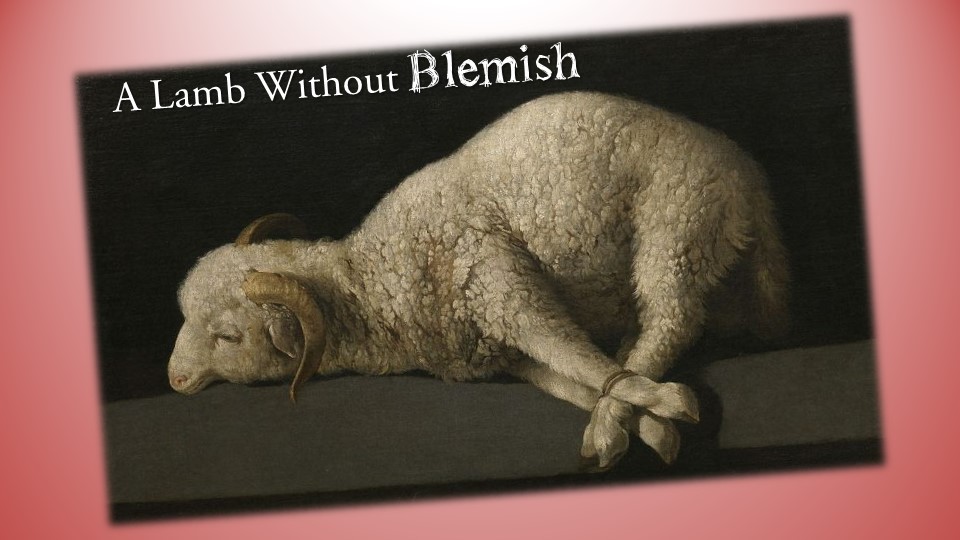
But with the precious blood of Christ, as of a lamb without blemish and without spot. (1 Peter 1:19)

A Lamb Without Blemish

Sacrifice has always been a part of worship. Cain and Abel gave offerings to the Lord because the law of God required it. When giving a sacrifice, the Lord has always wanted the best. This appeals to the nature of man’s pride to give up something of greater value as an offering to the Lord. Abel gave of the firstborn of his flock and of their fat. Cain brought an offering of the fruit of the ground to the Lord. Cain’s offering was rejected because of his heart. Abel’s offering was accepted because he was righteous.

Under the law of Moses, the offerings of a lamb could only be a lamb without blemish. God would not accept any animal that was blind, broken, maimed, or diseased with a tumor, scurvy, or infection. Without blemish meant, the sacrifice was a perfect specimen. God expected nothing less. He wanted the very best a man had and demanded he give of the firstlings of the flock and the lamb that had so spot or blemish. The prophet Malachi condemned the nation of Israel after the Babylonian captivity for offering blind sacrifices and the lame and the sick. They had despised the name of God by offering defiled sacrifices.

The imagery of the lamb without blemish would become the shadow of the greatest sacrifice of Jesus on the cross. Redemption came through the blood of a lamb without spot that was offered by men to appease the wrath of God. Jesus was the divine Lamb who offered Himself as the sacrifice for sin to redeem man from the wrath of God. What set Jesus apart from all men is His perfection. All men are blemished in the metaphorical sense of their relationship with God, which means all men sin. Men are blemished. Even if a man were able to commit one sin in his life, he would still be blemished and unfit for a sacrifice to God. There are some great people in the Bible’s history, but none could offer an unblemished life as proof of God’s love.

Jesus is the only man who lived without sin. There is no blemish in His life – without exception. He never sinned – period. Consider the magnitude of a life where a man never says an ill word, seeks revenge for injustice done against him or others; who always left His life in the hands of the Father. As a teenager, Jesus never disobeyed His parents or acted rebelliously. He never lusted after a woman, used vain language, filled His heart with pride, got angry and sinned, or disobeyed any commandment of God. His life was perfection to perfection.

The blemish so common to all men is never found in Jesus Christ. Like a lamb without blemish, there is nothing in the more than thirty years of Jesus’ life that was not in harmony with the will of the Father. Everything He did, what He said, how He conducted Himself – was perfect. There was not the slightest hint of sin in the life of Jesus. When He stood before the Roman court of Pilate accused by false witnesses, He remained silent. Jesus knew He must die to save all men, including those who lied about Him. His sacrifice was the perfect offering of a sinless life to pay the debt of sinful man. The blood of Jesus is precious because it is without sin. Jesus is a lamb without blemish and without spot. Thank God!

Posted in Uncategorized | Leave a comment

Listening To The Majority

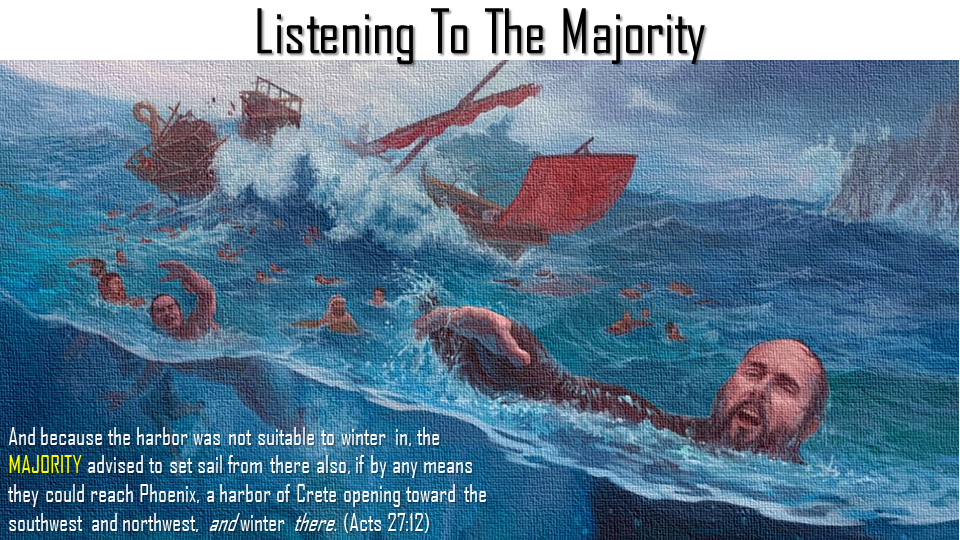
Now when much time had been spent, and sailing was now dangerous because the Fast was already over, Paul advised them, saying, “Men, I perceive that this voyage will end with disaster and much loss, not only of the cargo and ship, but also our lives.” Nevertheless the centurion was more persuaded by the helmsman and the owner of the ship than by the things spoken by Paul. And because the harbor was not suitable to winter in, the majority advised to set sail from there also, if by any means they could reach Phoenix, a harbor of Crete opening toward the southwest and northwest, and winter there. (Acts 27:9-12)

Listening To The Majority

Maritime travel in the first century was a hazardous undertaking. Ships were small and ill-equipped for the harsh conditions of the Mediterranean. Navigation was still primitive to a large degree, allowing for little guidance for sailors to measure their journey. Paul’s trip to Rome from Caesarea was complicated by the rigors of sea travel that almost cost him his life. They changed ships in Myra, a city of Lycia, bound for Rome. Under armed escort, Paul sailed with two hundred seventy-five people (including the gospel writer Luke). After many days, the ship arrived in Crete, in a place called Fair Havens, near the city of Lasea. The time of year was dangerous for ships to sail.

After staying in Fair Havens for some time, Paul warned the soldiers and the ship’s crew it would be best to remain in port until a suitable time was found to sail. He warned the trip could end in disaster and much loss, including their lives. The centurion decided to take the advice of the owner of the ship and set sail. Luke writes the majority of people on board agreed it would be best to sail immediately to reach Phoenix, a harbor of Crete, and to winter there. This decision would be a fateful decision for the ship’s owner and his cargo.

Beginning the voyage, the journey went well with a soft wind, and everyone felt assured the decision was good. Not long after they set sail, they were caught in a storm called Euroclydon. A Euroclydon is much like a hurricane or Levanter (a strong easterly Mediterranean wind). It caught the ship and tossed it about for more than two weeks. It was very perilous, but Paul assured the people that if everyone followed his instructions, no life would be lost. God assured Paul he would reach Rome, and those who traveled with him would not perish. The ship wrecked on the coast of Malta with no loss of life. Paul taught many the gospel in Malta and would eventually arrive in Rome.

The majority thought it was a good idea to sail. Paul had warned them it would be an unsafe journey. It seems clear Paul’s advice came from the word of the Lord, but his warning was ignored by the democracy of the more than two hundred people on board. After they were caught in the storm, Paul reminded the stricken crew they should have listened to him. Ignoring the word of the Lord would cost the owner his ship and cargo. When men do not listen to the word of the Lord, a price is paid.

Majority rule is a wonderful form of democracy, but the kingdom of God is a monarchy. Supreme authority is vested in one person under a monarchy. The kingdoms of men find the rule of a monarchy problematic. They also refuse to accept the rule of God in the spiritual realm. Jesus warned the wisdom of the majority is destruction. The masses follow the broad way, and most people will never see Heaven. That is a stark and difficult statement to accept, but it is true. Listening to the majority is never a good idea unless the majority is listening to God. That seldom happens.

Salvation is an individual choice, not measured by the decisions of the masses. The influence of the majority can sway the hearts of the individual, but ultimately, eternal life will be granted to each individual based upon the choices made by the individual, not the majority. Following what the majority says is seldom a wise choice. Going with the flow or following the path of least resistance is a dangerous path to walk. Following the majority is remaining silent when a word of caution should be said. If the people traveling with Paul had listened to his counsel from the word of the Lord, the journey would have turned out differently.

Posted in Uncategorized | Leave a comment

Growing As A Christian

For though by this time you ought to be teachers, you need someone to teach you again the first principles of the oracles of God; and you have come to need milk and not solid food. For everyone who partakes only of milk is unskilled in the word of righteousness, for he is a babe. But solid food belongs to those who are of full age, that is, those who by reason of use have their senses exercised to discern both good and evil. (Hebrews 5:12-14)

Growing As A Christian

When a baby is born, they are unable to digest solid food as their bodies have yet to develop the proper tools for consumption and digestion. God created the newborn without teeth and the intestinal requirements to eat food that an adult would eat. Milk is the nutrition of all babies. The mother’s milk has all the required nutrients to sustain life until the infant matures to handle solid food. As an adult with fully developed tools to chew, swallow, and digest food, there is no limitation to what a man can eat.

Spiritual growth is like the needs of an infant growing to maturity. When a person obeys the gospel of Jesus Christ, much is unknown. They are not expected to process the deeper meanings of the Word that someone who has examined the scriptures for many years possesses. Spiritual growth begins with the milk of the word, and then by reason of use and careful study of the Word, the heart starts to unfold the deeper meanings of those things, good and evil. Everyone begins with milk, and the Father wants everyone to grow to eat solid food.

An adult who cannot wean themselves from milk will become sick and die. A growing body demands greater calories and nutrients than milk can provide. Spiritual growth follows the same pattern as the physical body. To grow in Christ, the heart must move beyond the first principles of the word of God and grasp larger tracts of knowledge. The goal is not to attain all the knowledge contained in the Word because no man can understand all the knowledge kept within the pages of the Bible in ten lifetimes or more. God does expect His children to leave the milk of the word.

The problem faced by the first century Christians is the same problem the church faces today. There are too many saints who have never given up the milk of the word and are satisfied to partake only of milk and become unskilled in the word of righteousness. They are grown adults with the mind of a baby. This is contrary to the design of the spiritual body. If a man grows to adulthood and retains the mind of a baby, he is unable to function in the world. When the hearts of God’s people reside in the realm of spiritual milk, they cannot fight against the wiles of the devil. The end is apathy, ignorance, and destruction.

It takes time to learn the word. The desire must be to leave the milk for stronger food. Becoming skilled in the word of righteousness is not a scholarly development left only to the few who possess keen minds of wisdom. Secular education does not determine whether a man has the skill to know the word of God. When an open heart seeks to discern what is good and evil through the reading and study of the word of God, they will become skilled in what the Divine will of the Father must be for the individual. Anyone can do this if they are willing.

Growing as a Christian is the most fundamental part of the Christian’s life. Either a person is growing or they are dying. There is no middle ground. When someone has been a Christian for many years and still requires milk, they are unskilled and vulnerable. Those who daily seek the wisdom of God will find their lives full of the eternal wisdom established before time began. You can read and understand God’s mysteries if you take the time. Grow in Christ. Discern good and evil and long for the solid food of the word. It will fill your life with an incredible feast of good things.

Posted in Uncategorized | Leave a comment

Repentance Does Not Change Consequences

Now therefore, the sword shall never depart from your house, because you have despised Me, and have taken the wife of Uriah the Hittite to be your wife. (2 Samuel 12:10)

Repentance Does Not Change Consequences

David’s sin with Bathsheba was a tragedy in the life of a man who was so devoted to the Lord. Few men have risen to the stature of the son of Jesse as a faithful man of God whose life so emulated the spirit of holiness and truth. The sad reality is the larger the faith, the larger the target for Satan to use his wiles. Bathsheba was bathing at her home. She was very beautiful to look upon, and David saw her from his rooftop. After inquiring who the woman was, the king sent messengers to bring the woman to his house, and he lay with her. Sending her home, he could not imagine the horror of consequences that would soon envelop his life.

In time, Bathsheba discovered she was pregnant and told David. The king realized a plan needed to be created to cover up their sin and ordered Bathsheba’s husband home from the war. Uriah was a Hittite, but he was a noble warrior and one of David’s mighty men. After repeated attempts to get Uriah to go home to his wife, David finally signed a note (delivered by Uriah) to Joab, the king’s commander, to ensure Uriah is killed in battle. The plan succeeded as Uriah was killed in battle, and Bathsheba mourned her husband. David had Bathsheba brought to his home, where she became another wife for David, and the child was born.

God sent Nathan, the prophet, to tell David of the consequences of his actions. David repented for what he had done, and the Lord set aside the penalty of the law requiring the death of David and Bathsheba. However, God did not remove the consequences of David’s action. Uriah had been murdered by the hand of David, and that could never be changed. The Lord told David the sword would never depart from his house. David’s reign as king of Israel would be marred by those who sought to take his life and kingdom. Ironically, the greatest enemies of David would be those of his own household.

Nathan warned David his sons would take his wives and rape them in the presence of the nation of Israel. The consequences of David’s action would bring years of heartache, pain, and sorrow. Amnon, son of David by Ahinoam, raped his half-sister, Tamar, daughter of David by Maacha. Her brother Absalom would avenge her when he killed his half-brother, Amnon. Absalom would try to take the throne from his father and be killed by Joab. Near the end of David’s life, his son Adonijah (son of Haggith) tried to usurp the throne. David repented, but he lived with the consequences of his sin.

The law of sowing and reaping is an absolute law often ignored. Sin will bring consequences both in the eyes of the Lord and the affairs of man. A man can rebel against the word of the Lord and be forgiven, but this may not remove the consequences of what he has done. If a man commits murder, he can be forgiven, but that does not mean he will not pay the civil penalty of either prison or death. Sexual immorality can be forgiven, and the body still suffers from the disease of the act. There is nothing that suggests repentance can and will remove the consequence.

If a man first ponders the consequences of his actions, the sin may not happen. Foresight is the key to removing heartache from a lifetime of sorrow. Taking the time to consider how the act will impact the relationship with God and how that action will bring about consequences can often dispel the desire to sin. Joseph was tortured daily with the sexual advances of Potiphar’s wife. When she tried to force herself upon him, Joseph immediately knew the penalty of his sin against God and refused her. He suffered grave consequences for being pure, but he did not live the rest of his life regretting the outcome of forbidden lust. Suffering for righteousness has a greater taste than swallowing the bitter pit of regret over sinful actions.

Never commit an act you will regret for the rest of your life. The grave is full of broken hearts whose lives were filled with the agony of times past when bad decisions were made. David suffered because of one night with the wife of Uriah. When Matthew wrote his gospel of Jesus Christ, he reminded the world again of the mother of Solomon as the one who had been the wife of Uriah. Sometimes, consequences continue to mar the name generations after a person dies. God forgives, but remember, the seed sown in haste may bring about a harvest of pain.

Posted in Uncategorized | Leave a comment