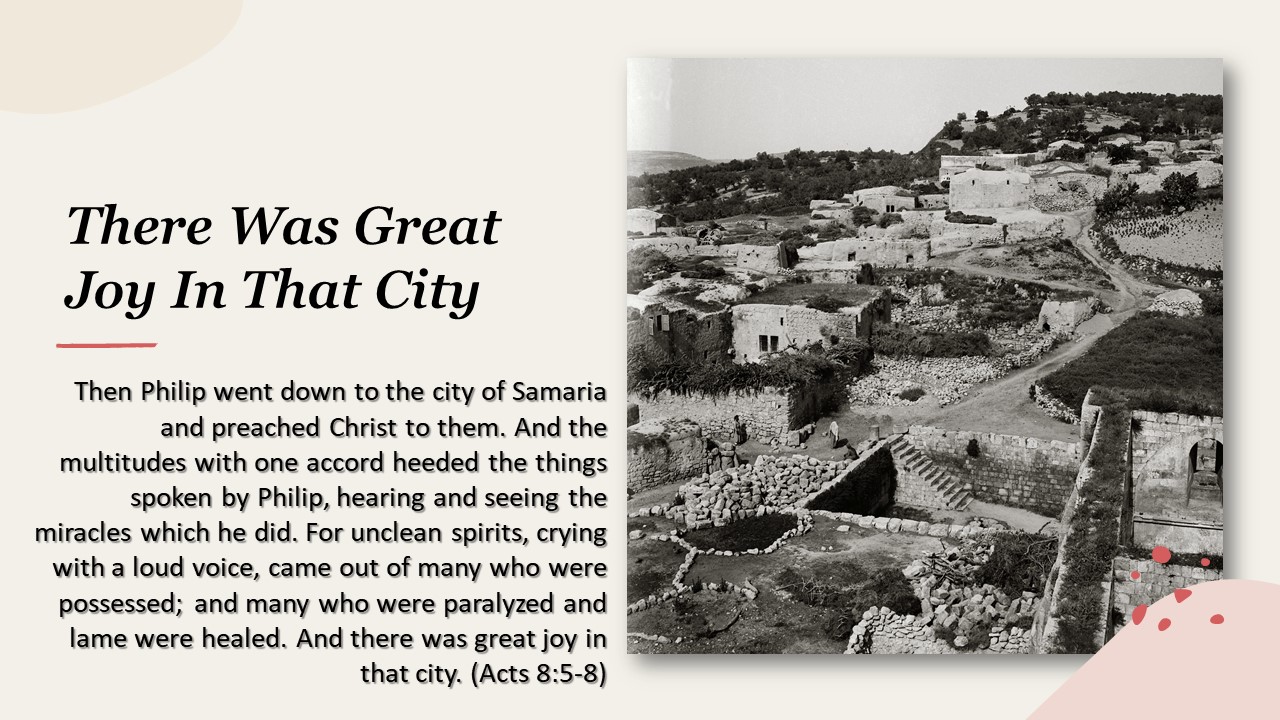
There Was Great Joy

Therefore those who were scattered went everywhere preaching the word. Then Philip went down to the city of Samaria and preached Christ to them. And the multitudes with one accord heeded the things spoken by Philip, hearing and seeing the miracles which he did. For unclean spirits, crying with a loud voice, came out of many who were possessed; and many who were paralyzed and lame were healed. And there was great joy in that city. (Acts 8:4-8)

There Was Great Joy

The city of Samaria was first established by Omri, king of Israel, during the days of the divided kingdom. It became the capital of the northern ten tribes and the central place of idolatrous worship under the influence of Ahab and Jezebel. Herod would fortify the city and call it Sebaste. When the persecution of the early church took a toll on the saints, many left Jerusalem. They went into the regions of Judea and Samaria (regional), preaching and teaching the gospel of Christ. Philip, the evangelist, traveled to the city of Samaria (35 miles north of Jerusalem) and preached Christ to them. The apostles had laid hands on Philip and six other men to minister to the needs of the widows in Jerusalem. Arriving at Samaria, Philip confirmed the word of Christ through the miraculous power of the Holy Spirit, casting out unclean spirits, healing those who were paralyzed or lame. The city filled with joy as the multitudes listened closely to the preaching of Philip, eager to know about the Christ. It was a time of revival in the city of Samaria.

Preaching the gospel in Samaria had its challenges. It is unclear whether Philip was sent to Samaria or took it upon himself to go to the city. Jews had no dealings with Samaritans and for a Jew to come into a Samaritan city to preach the gospel was a bold move. The apostles in Jerusalem were excited about the work of Philip in the city as later they would send Peter and John to pray with the people to receive the Holy Spirit. A popular sorcerer named Simon would also obey the gospel of Christ. The work of evangelism in Samaria was exciting. Luke notes that because of the preaching of the gospel, there was great joy in the city.

Philip took a bold step to go to Samaria and preach. This city could have been a hostile place for a Jew to visit, especially someone preaching the risen Christ. When the Lord sent Jonah to Nineveh to preach, the prophet was going to a Gentile city that could have been a hostile place for the preacher to be – but God had a plan. There was something in Nineveh that moved God’s heart to send Jonah and there were people in Samaria that needed to heart the gospel, so Philip went. There was great joy in the city of Samaria and that was remarkable.

The gospel has not changed from the days of Philip. It can still move hearts and bring joy to individuals, families, communities and even to cities. What is remarkable about Philip preaching in Samaria is the city was filled with joy, not just a few families. It would have been easy for the Jewish Christians sitting comfortably in Jerusalem to look at Samaria as a city that would be wasting time to preach and look for greener pastures in other places. Why go to a Samaritan city and preach the gospel? What would those Samaritan dogs know about grace, mercy, love and the compassion of God? Philip found a city ready for the gospel. Hungry hearts devoured the teaching of the risen Savior and many souls came to know the forgiving power of Jesus Christ. And all of this took place in the city of Samaria.

There are many cities of Samaria that need the gospel of Christ. Some are found next door. Others are found in undesirable parts of town. It would be remarkable to turn a city upside down with the preaching of the gospel. Trying to move hearts today with the gospel of Christ would face no greater challenge than what Philip faced the moment he arrived in the city of Samaria. He preached and souls responded. Not everyone found joy in the gospel. The ones who did, had their lives changed forever because a man came to Samaria. He came to their town, their community and their neighborhood. And there was great joy in that city.


Posted in Uncategorized | 4 Comments

God Spoke And They Did Not Listen

The word that came to Jeremiah concerning all the people of Judah, in the fourth year of Jehoiakim the son of Josiah, king of Judah (which was the first year of Nebuchadnezzar king of Babylon), which Jeremiah the prophet spoke to all the people of Judah and to all the inhabitants of Jerusalem, saying: “From the thirteenth year of Josiah the son of Amon, king of Judah, even to this day, this is the twenty-third year in which the word of the Lord has come to me; and I have spoken to you, rising early and speaking, but you have not listened. And the Lord has sent to you all His servants the prophets, rising early and sending them, but you have not listened nor inclined your ear to hear. They said, ‘Repent now everyone of his evil way and his evil doings and dwell in the land that the Lord has given to you and your fathers forever and ever. Do not go after other gods to serve them and worship them, and do not provoke Me to anger with the works of your hands; and I will not harm you.’ Yet you have not listened to Me,” says the Lord, “that you might provoke Me to anger with the works of your hands to your own hurt. (Jeremiah 25:1-7)

God Spoke And They Did Not Listen

For twenty-three years, Jeremiah preached a message of repentance to the people of God, but to no avail. Other prophets declared the word of the Lord to Judah and the people did not listen. It seemed as if the hearts of God’s chosen nation had turned completely away from the truth. Nothing could penetrate the stubborn refusal to change the will of rebellious hearts bent on following after idols and pagan doctrines of the nations around them. The northern ten tribes of Israel had long disappeared from the landscape of a forgotten land and Judah stood on the precipice of destruction by the hand of Nebuchadnezzar, king of Babylon. Final destruction was inevitable and came swiftly in 586 B.C. when Jerusalem fell and the Temple burned.

The devastation of the Babylonian army upon God’s people was complete and thorough. God sent warnings to the people by His messengers because He had a love for them but they mocked the word of the Lord and scoffed at men like Jeremiah. The wrath of the Lord came against His people and nothing could be done. The Babylonians killed the young men, even chasing after them into the Temple. They did not pity the people, killing young men and young women, the old and the infirm. The Temple was ransacked and all the articles and treasures of the Lord were taken. Nebuchadnezzar ordered his army to burn the Temple of God, tear down the walls of Jerusalem, burn all the palaces, and completely destroy everything of value. For twenty-three years, Jeremiah had warned the people and they would not listen.

God pleaded with His people to repent from their evil ways and evil doings. He warned them against going after the gods of the land to serve them and worship them. His anger would be aroused if the people refused and they refused because they did not want to listen. God promised them he would not harm them if they repented. Sadly, they did not listen. They provoked the Lord God to anger with the works of their hands. The punishment of captivity came upon them because of their rebellion and to their own hurt. Babylon conquered the once proud and noble nation of Israel and carried the people away to a second captivity. Seventy years would pass before the hand of God delivered them from bondage.

The apostle Paul described the character of God as one of goodness and severity. Everyone wants to embrace the goodness of the Lord because that is pleasant and enjoyable. Most reject the notion that God can be a severe God. Israel rebelled against the will of God and for many years, prophets urged the people to change their lives and return to a true worship. Men like Jeremiah warned the rebellious hearts to repent and change but with no success. When the longsuffering of the Lord came to an end, judgment appeared on the horizon. Those of Judah should have learned from the lessons of their northern brethren that God’s word is true. They should have listened to the prophets who warned them of the consequences of ignoring the word of God. In the final days, when it was too late, the people realized the word of the Lord was true. Judgment came and captivity began.

God has delivered His word to all men through the preaching of the word. The Bible is the revealed mind of God declaring His mercy and grace to those who are willing to abide by His word. This same message outlines the wrath of God against disobedience. Rejecting the Bible as truth will only bring the anger of the Lord. All the things promised in the preaching of Jeremiah and the prophets came true because the people refused to listen. A day will come when the world comes to an end and all men stand before the righteous throne of God. The books will be opened and the Bible, the word of God, will be presented as evidence before the hearts of all men and judgment will begin. Those who heard the word of God and obeyed its message will find joy and comfort. To the majority of people who refused to acknowledge the Bible as the divine word of God, the wrath of the Lord will be handed down. Are you listening?

Posted in Uncategorized | Leave a comment

The Nazarene

And he came and dwelt in a city called Nazareth, that it might be fulfilled which was spoken by the prophets, “He shall be called a Nazarene.” (Matthew 2:23)

The Nazarene

There are towns and cities in every community that are held in disregard or contempt. The reasons can be based upon history, prejudice, or the moral character of its citizens. In the first century, the city of Corinth was known for such sexual promiscuity that “to act like a Corinthian” was a synonym for debauchery and prostitution. Little is known about the city of Nazareth, and its only reference in the Bible is the New Testament. Joseph and Mary were in Nazareth when Gabriel announced the conception of the Son of God to the young couple. Jesus would not be born in Nazareth as the prophecy foretold the city of Bethlehem would be the heritage of God’s Son. Through the providence of the heavenly Father, a proclamation from Caesar Augustus that all the world should be registered took Joseph and Mary to their hometown of Bethlehem, where Jesus was born. The Son of God would spend a couple of years in Bethlehem before his parents fled to Egypt to escape the soldiers of Herod. After some time, Joseph took the family to Nazareth, where Jesus would spend the greater portion of His life.

The wise men from the East came seeking the King of the Jews when Jesus was around two years of age. They recognized the son of Mary as being a king and finding Him in Bethlehem fit the prophecies of the prophets. The wise men could not imagine that after they returned home, Jesus would become a citizen of Nazareth and be called a Nazarene. Instead of hailing from the city of Bethlehem, Jesus would be known as Jesus of Nazareth. This model did not fit what the prophets said about the coming Messiah. Growing up in Nazareth did not follow the pedigree of a person of any importance.

It is uncertain why Nazareth was held with contempt but events from the life of Jesus could explain the prejudice against anyone called a Nazarene. Jesus spent almost His entire life in the city of Nazareth. He often went into the synagogue to read, study, and discuss the scriptures. His father (as was supposed) was a carpenter as Nazareth employed many carpenters. The people of Nazareth knew well who Jesus was. There can be little doubt the ‘handiwork’ of Jesus found itself among the crafts of agriculture, as well as utensils of everyday life as He forged the craft of carpentry like his father. Jesus had brothers and sisters who were well known among the Nazarenes. Joseph and Mary were not wealthy citizens but they were part of the fabric of Nazareth.

Jesus began His public ministry of preaching in the synagogue of Nazareth. The people were offended by this carpenter’s son, who had wisdom and the power to do miracles. Jesus was nothing more than a carpenter’s son. His mother was Mary, a woman of no importance. The brother of Jesus were not influential members of society and His sisters less. All in all, the family of Jesus was a common as any others of Nazareth. When Jesus taught in their synagogue, the leaders were offended by Him and Jesus could do no mighty works among them because of their unbelief.

Luke recorded when Jesus came into the synagogue of Nazareth, He read from the book of Isaiah. After He gave the book back to the attendant, Jesus proclaimed the reading of the prophet was fulfilled in Jesus Himself. When the men heard the gracious words of Jesus, they were filled with a wave of furious anger. They took Jesus and forced Him out of the city to the edge of the hill where they planned on throwing Jesus down to kill Him. Jesus passed through the crowd unawares and went His way. Twice they expelled Jesus from their borders. Jesus would seldom return to Nazareth because of their unbelief. Thus, the city of Nazareth was not held with great respect as to the rough character of its citizens.

Jesus would be called a Nazarene, attaching a stigma of dishonor to the one who became the King of Kings and Lord of Lords. There is a great providential dichotomy in where Jesus was born according to prophecy and where He would grow up. If anyone had asked Jesus where He was born, they could have realized His Messianic birth. Jesus was rejected because He was known as a Nazarene. When the hearts of men removed the Nazarene and saw Jesus for who He was, they would come to see the power of the Son of God. People still look at Jesus as nothing more than a Nazarene who was a good man and a good teacher but nothing more. Salvation does not come from the Nazarene. The gift of God comes from the child born in Bethlehem to fulfill all the promises of God. Jesus is the Son of God.

Posted in Uncategorized | Leave a comment

Jeremiah Forbidden To Marry

The word of the Lord also came to me, saying, “You shall not take a wife, nor shall you have sons or daughters in this place.” For thus says the Lord concerning the sons and daughters who are born in this place and concerning their mothers who bore them and their fathers who begot them in this land: “They shall die gruesome deaths; they shall not be lamented nor shall they be buried, but they shall be like refuse on the face of the earth. They shall be consumed by the sword and by famine, and their corpses shall be meat for the birds of heaven and for the beasts of the earth.”

For thus says the Lord: “Do not enter the house of mourning, nor go to lament or bemoan them; for I have taken away My peace from this people,” says the Lord, “lovingkindness and mercies. Both the great and the small shall die in this land. They shall not be buried; neither shall men lament for them, cut themselves, nor make themselves bald for them. Nor shall men break bread in mourning for them, to comfort them for the dead; nor shall men give them the cup of consolation to drink for their father or their mother. Also you shall not go into the house of feasting to sit with them, to eat and drink.”

For thus says the Lord of hosts, the God of Israel: “Behold, I will cause to cease from this place, before your eyes and in your days, the voice of mirth and the voice of gladness, the voice of the bridegroom and the voice of the bride. And it shall be, when you show this people all these words, and they say to you, ‘Why has the Lord pronounced all this great disaster against us? Or what is our iniquity? Or what is our sin that we have committed against the Lord our God?’ Then you shall say to them, ‘Because your fathers have forsaken Me,’ says the Lord; ‘they have walked after other gods and have served them and worshiped them and have forsaken Me and not kept My law. And you have done worse than your fathers, for behold, each one follows the dictates of his own evil heart, so that no one listens to Me. Therefore I will cast you out of this land into a land that you do not know, neither you nor your fathers; and there you shall serve other gods day and night, where I will not show you favor.’” (Jeremiah 16:1-13)

Jeremiah Forbidden To Marry

Being a prophet during the tumultuous times of divided Israel could be a challenging experience. God told Hosea to marry a prostitute and when Ezekiel’s wife died, he was told not to mourn her, weep for her or let tears run down his face. Jeremiah was a prophet during the days of Josiah, king of Judah, until the end of the eleventh year of Zedekiah, the son of Josiah, until the carrying away of Jerusalem to captivity in Babylon. The Lord tells Jeremiah not to take a wife and to bear sons and daughters. In the lives of each prophet, a living example was given for the people to see the will of the Lord. Forbidding Jeremiah to marry became a sign of the severity of God’s wrath upon Judah. Knowing the fierceness of what was coming through the hand of the Babylonians, God spared Jeremiah the grief of watching his family die gruesome deaths.

The severity of God’s anger is described by the people dying from disease. No one will mourn for them or bury them, and they will lie scattered on the ground like manure. They will die from war and famine, and their bodies will be food for the vultures and wild animals. What father could bear to see his family destroyed with such ferocity as the judgment of the Lord God upon His own people? There would be no mourning or lamenting what happened to Judah. God had taken His peace away from the people. The Babylonians came by the hand of the Lord and their cruel and barbaric warfare would devastate the people and the land. There would be no lovingkindness or mercy from the Lord. Young and old would die. There will be so many dead bodies, and no one will take time to bury the corpses. All joy and hope would be taken away. Babylon would come as the scourge of the Lord God Almighty in great wrath.

Because of the sins of the people, the Lord took away His presence from the land. Babylon would be allowed, through the will of God, to destroy Judah. The Babylonians marched into the Temple and entered the Most Holy of Holies with impunity. They took the holy items of the Temple with no resistance. In 586 B.C., the House of the Lord, built by Solomon more than three hundred years earlier, burned. The city of Jerusalem was left in ruin, smoldering as a heap of stone and broken gates. All the glory of Israel was taken away. It would be seventy years before a remnant would return to a city destroyed. Jeremiah would preach the message of doom to a forsaken people and his life would show the veracity of the will of God. The prophet was forbidden to marry in part to spare his family from the incredible hardships. It was also to prove to rebellious Judah that God’s word was true.

The people could not understand why God had deserted them. All the disasters that came against them puzzled the people. They did not understand why the Lord would allow such a thing to take place. Jeremiah would tell them it was because their fathers had forsaken the Lord and the people of Jeremiah’s day had done worse than their fathers. The previous generations were unfaithful to God and worshiped other gods and served them. They abandoned the Lord and did not obey the word of God. Jeremiah tells the people they were worse than their ancestors! They stubbornly followed their own evil desires and refused to listen to the pleas of a loving Father. God’s wrath was all that was left. Jeremiah became a symbol of the severity of that wrath.

God does not forbid anyone from marrying but the prophet Jeremiah remains a powerful illustration of the judgment of the Lord upon unrighteous nations and ungodly people. Those who deny the reality of perdition do not understand the parable of Jeremiah. Judgment is real against those who forsake the Lord. As the Lord cast out His own people from the land, the righteousness of God will cast out those who serve the gods of this world. Sin damns a soul and the promise of God is real. Jeremiah was forbidden to marry to tell a lesson still relevant to modern man.

Posted in Uncategorized | Leave a comment

Gender Identity

Then God said, “Let Us make man in Our image, according to Our likeness; let them have dominion over the fish of the sea, over the birds of the air, and over the cattle, over all the earth and over every creeping thing that creeps on the earth.” So God created man in His own image; in the image of God He created him; male and female He created them. (Genesis 1:26-27)

Gender Identity

President Abraham Lincoln loved to employ a brain-teaser to make a point to his citizens. He would ask, “How many legs would a sheep have if you called his tail a leg?” Naturally, they would answer, “Five.” Lincoln would correct them by telling them, “You are mistaken. The sheep would still have just four legs. Calling something a leg doesn’t make it so.” In a recent news report, students at a university were upset the administration allowed “cis men” to come into their dorms to install heaters. The dorms were the residence of women and transgenders. The residents felt threatened by the “cis men” coming into their rooms. This was not an episode of Star Trek where the Klingons were attacking with “cis men” but rather a gender identification model that now identifies a person with perverted gender identification.

Cisgender describes a person whose gender identity is the same as their sex assigned at birth. The word cisgender is the antonym of transgender. Remarkably, society has finally turned full circle in the corruption of the moral compass to require the identification of those who are declared cisgender as opposed to transgender. If a man is a heterosexual (another gender identification) remaining in his identification as a male, he is labeled a “cis man.” Others are then identified by their decision to be whatever they identify themselves to be.

The irony of the conversation of cis men is that all men are cis men and all women are cis women. A man who calls himself a woman is still a man and when a woman wants to identify as a male, she remains a female. Changing the outward appearance, taking chemicals to alter various aspects of the human body or undergoing surgery does not change a man to a woman or a woman to a man. In other words, Bruce Jenner is still Bruce Jenner – regardless of what he looks like or identifies himself as being something different. What the immoral pundits of gender identity fail to understand and believe is that when God created humanity, He made them male and female in His image. There are two parts of a person: the physical and the spiritual. Man can change the physical but he cannot change the spiritual.

All men are eternal beings created by God – in His image. Throughout the Bible, the scriptures identify humanity as male and female. The animals were created as male and female. There is no transgendering among the animals because they know they are what God created them to be. Men can dress like a woman but what God sees is a man in a woman’s clothing. A man can identify himself as a woman and God will continue to view him as a man. What the world does not understand is the breath of life and eternal spirit of man cannot be changed by the will of men. Jesus said God created in the beginning male and female and that remains unchanged.

When every soul stands before God, they will be what they are at birth – male and female. God will judge men and women according to the spirit they were created at conception. Salvation will be determined by how a man and woman live as men and women in this world. Sexual perversion is an abomination in the eyes of God. The Lord desires for no one to be lost but those who follow the path of sexual perversion will be identified as male and female in the eyes of God and then condemned for perverting the creation of God. Homosexuality is against the will of God. Attempts at transgender is an exercise in futility. Morphing into whatever gender identification desired by the lust of the flesh will face the wrath of God. There are only males and females and that is how it will always be. Everyone is “cisgender” because what a man or woman is at birth is what they will be in death. Sin will never change that truth.

Posted in Uncategorized | 1 Comment

God Abounds In Goodness

And the Lord passed before him and proclaimed, “The Lord, the Lord God, merciful and gracious, longsuffering, and abounding in goodness and truth, keeping mercy for thousands, forgiving iniquity and transgression and sin, by no means clearing the guilty, visiting the iniquity of the fathers upon the children and the children’s children to the third and the fourth generation.” (Exodus 34:6-7)

God Abounds In Goodness

It did not take long for the children of Israel to turn away from God and seek after the golden calves of Egypt. While Moses was on the mountain receiving the law from the Lord, the people urged Aaron to make them gods to worship. Aaron created a golden calf, and the people rose early in the morning offering burnt offerings, peace offerings, and playing the whoredom of idolatry. Moses returned from the mountain in anger and threw the commandments of stone down, pulverized the calf to powder and made the people drink the water filled with its residue. Three thousand men died that day and the Lord plagued the people because of what they did with the calf which Aaron made. The Lord relented from the destruction he sought against the Hebrews and Moses was instructed to make new tablets to write the commandments upon. God renews the covenant with Israel and the journey to the promised land begins.

The Lord showed His great power to the Hebrews through the plagues, death of the firstborn, miracle at the Red Sea and the defeat of the Amalekites. There should be no reason for them to doubt His power and might to accomplish whatever He determined for His nation. Sadly, the heart of the people lacked the commitment and devotion to follow the Lord fully. After the incident of the golden calf, God shows Moses the measure of mercy and grace toward a rebellious people. The character of Jehovah God is merciful, gracious, longsuffering and abounding in goodness and truth. All of these attributes are essential to understanding who God is and why He does what He does. It would be easy for the Lord to destroy the whole nation and begin anew. He does not.

God is good to Israel because God is good. His goodness is abundant, plentiful, rich, and full of divine grace beyond measure. God is not good because He does good things; He is good because that is what He is – fully. He will not forget His people, and He will not abandon them, treat them with indifference, or neglect them. Everything about the character of God is the goodness He showers upon the rebellious hearts of men. Adam and Eve rejected His will and the goodness of God saved them. The world turned completely away from the Lord, but the goodness of the Lord spared eight souls in the ark. Humanity rejects the will of God, and the Father sends His only begotten Son to die for everyone. Sin troubles the lives of the righteous and yet the goodness of the Lord forgives.

God is good but He will not allow the guilty to go unpunished. The goodness of God should not convince the ungodly they will be spared from judgment. Forgiveness comes only to those who seek the mercy of the Lord as they change their hearts through godly sorrow. Mercy is only offered to the righteous. God is good as found in Jesus Christ. The goodness of God is found in His word that tells men how to be saved. On the final day of judgment, the goodness of God will be the measuring stick for those who are saved and those who are lost. For those who are saved, God’s goodness abounds every day looking forward to the abundance of glory found in Heaven. God is good. Thank God.

Posted in Uncategorized | Leave a comment

The Point Of No Return

For it is impossible for those who were once enlightened, and have tasted the heavenly gift, and have become partakers of the Holy Spirit, and have tasted the good word of God and the powers of the age to come, if they fall away, to renew them again to repentance, since they crucify again for themselves the Son of God, and put Him to an open shame. For the Earth which drinks in the rain that often comes upon it, and bears herbs useful for those by whom it is cultivated, receives blessing from God; but if it bears thorns and briers, it is rejected and near to being cursed, whose end is to be burned. (Hebrews 6:4-8)

The Point Of No Return

It is difficult to imagine the possibility of the impossibility of salvation. There is rooted in the creation of man a need for self-preservation. The instinct of survival is foremost in the spirit of every person. Doing harm to self is against the norm of who and what a man must be. This is recognized in the physical world as those in life-threatening situations make herculean efforts to fight for survival. Great stories of personal triumph are told when against all odds, a man survives a catastrophic event from a natural disaster, accident, or facing certain death. Courage marks the course for those who defy death. Sadly, that is not found in the spiritual world where sin is the doom of man.

The tragedy of the book of Hebrews is found in the stories of those who had enjoyed the blessings of God’s grace, mercy, and love and had turned their back on the Divine gift of salvation over time. Many saints were challenged in their faith and remained resilient to the cause of Christ. These bold warriors of Christ refused to draw back to perdition, believing to the saving of their souls. But some had turned so completely away from God, there was no hope. This was not a casual departure from truth. There were men and women who had been enlightened with the gospel of Christ through the preaching of the word. They had tasted the heavenly gift of divine grace and imbibed deeply in its mercy. When they obeyed the gospel of Jesus Christ in baptism, they had received the gift of the Holy Spirit, becoming a partaker of the Holy Spirit. The word of God had filled their hearts with the manna from above. Leaving unchecked the power of sin, these same men and women succumbed to the temptations of Satan and turned their back on God, rejected Jesus Christ, and denied the Holy Spirit.

There can come a time in the life of a child of God they so totally rebel against God that nothing can be done to renew them to grace. It is impossible to renew them again to repentance. Their hearts are hardened as deeply as the heart of Pharoah, who defied Moses and the wrath of God. The Old Testament is filled with stories of God’s people, the promised nation of righteousness, who turned their backs entirely on God. Ahab was one of the most wicked kings of Israel and he was a Jew, a child of Abraham. Nothing could redeem him. In the body of Christ, Satan fills the hearts of the unsuspecting and through deceit and lies, corrupts the heart to the point of no return. It is impossible to renew them again.

The reality of total apostasy is a difficult concept to accept but it is real. It must have been difficult for the Hebrew author to pen those words with the probable knowledge of whom he spoke. The early Christians suffered greatly and while many remained loyal to the cause of Christ, many turned their backs and walked with Jesus no more. All the pleas and warnings of others could not and would not bring them back. The reality of total apostasy is alarming. This knowledge should arm the souls of the courageous to fight more valiantly for the cause of Christ, seeking the assurance of divine blessing to remain faithful and true. There must be diligent efforts to seek out those who are going the path of no return. All energy must be given before that place in the road is reached where there no longer remains a sacrifice for sin and it is impossible to renew them again. More importantly, I must guard against the wiles of the devil who would desire me to give up my hope and deny my faith. God give me courage.

Posted in Uncategorized | Leave a comment

Tell No One You Were Healed

When He had come down from the mountain, great multitudes followed Him. And behold, a leper came and worshiped Him, saying, “Lord, if You are willing, You can make me clean.” Then Jesus put out His hand and touched him, saying, “I am willing; be cleansed.” Immediately his leprosy was cleansed. And Jesus said to him, “See that you tell no one; but go your way, show yourself to the priest, and offer the gift that Moses commanded, as a testimony to them.” (Matthew 8:1-4)

Tell No One You Were Healed

Leprosy was the most dreaded disease of Bible times. There was no cure and death was a slow and agonizing process. Lepers were required by the Law of Moses to separate from all people shouting out “unclean” if they walked among a crowd. Following his sermon on the mountain, Jesus was approached by a leper who came and worshiped him. What makes the story incredible is to turn the clock back a short time when the leper heard Jesus was in the area. He knew his disease was a certain death sentence. How long he had been a leper is not known. For all reasons, there was nothing that could be done for him. Hearing Jesus was in the area, the man resolved withing himself to seek out Jesus and beg for healing.

As the multitude followed Jesus, the leper approached Jesus. This immediately created an awkward situation as those in the crowd fell backward from the leprose man. No one would have come near him for fear of contracting the disease. It took great courage and faith for the man to come to Jesus and worship him. Also, the man’s faith was so great; he told Jesus that if he were willing, he would heal him of his impossible disease. This was an incredible measure of faith to come to Jesus earnestly seeking what he believed Jesus could do. He did not ask Jesus if he could heal him but that he believed Jesus could heal him. Faith on this level was rare for those who followed Jesus.

The Lord immediately granted the request with a heart of compassion as he put his hand on the man and healed. The first miracle was the touch of Jesus. Leprosy created a world where only other lepers would touch their fellow lepers. Family members would have to abandon their loved ones. Leprosy took away the joy of touching. Jesus did not hesitate. He put out his hand and touched the leper, and cleansed him of the disease. Immediately the leprosy was cleansed. The feeling of the man at that instant was remarkable beyond description.

After Jesus heals the leper of the most terrible disease imagined, the Lord gives him strict instructions. He tells the healed man not to tell anyone. The former leper must go and show himself to the priest according to the Law of Moses and make the appropriate sacrifice. To be proclaimed clean of leprosy, the man would take two living and clean birds, cedarwood, scarlet, and hyssop. Following the examination by the priest, the man could return home. Faithfulness to the law was required even for miracles.

When the man returned home, it would be clear he was no longer a leper. The Holy Spirit does not tell us how he explained to his family his healing. Jesus knew it would be evident to everyone the leper was no longer a leper. There could be many reasons for the man to be cured of leprosy. Jesus forbade the man from making a public proclamation of his healing.

There is wisdom in the request, as difficult as it might have been. At first glance, it would be hard not to tell everyone what great things Jesus had done. To be cured of leprosy was one of the great miracles of the Lord. Yet, Jesus told the man not to tell anyone. There was a subtle lesson in the request of Jesus for the man to remain silent. Being healed of leprosy was a powerful manifestation of the power of Jesus but the greater mission of Jesus was to cure the heart. The former leper would rejoice in being healed of such a dreaded disease but he still faced the reality of death. Instead of spending his life telling how he was cured of leprosy, he needed to share the news of the man who was God that healed him and gave him eternal hope. His spiritual healing was more important. Be humble. Live without the accolades and curiosity of men. Be a servant.

It would be hard not to tell everyone from the housetops to the mountains of the healing but the man learned a lesson about what is more important than physical healing. Seeing the power of Jesus should have changed the man’s life. There is much to the story that longs to be told. Did the former leper become one of the early servants in the Lord’s church a few years later? There is hope he brought his family into the kingdom of Christ. On more than one occasion, Jesus told those he healed to tell no man. The greater lesson points beyond the physical healing to the one who brought the power of the Divine to show the sonship of Jesus Christ. It was a blessing for Jesus to heal the leper. What made the miracle greater was the obedient heart of the man seeking the blessings of God. Tell no man you were healed but tell everyone you are saved.

Posted in Uncategorized | Leave a comment

God Commands Musical Instruments In Worship

And he stationed the Levites in the house of the Lord with cymbals, with stringed instruments, and with harps, according to the commandment of David, of Gad the king’s seer, and of Nathan the prophet; for thus was the commandment of the Lord by his prophets. (2 Chronicles 29:25)

God Commands Musical Instruments In Worship

Music has been in the world from the beginning of time. Seven generations from Adam was a man called Jubal, the father of all those who play the harp and the flute. The appeal of music is part of creation as God formed man to be inventive to write music and invent many different kinds of instruments. When Moses gave the law to the people, there was music on stringed instruments, harps with eight strings and ten strings, lyres, cymbals, loud cymbals, timbrels, flutes, tambourines, lutes, trumpets, horns, instruments of fir wood, and sistrums.

David was a skilled harp player and invented many musical instruments. When David brought the ark to Jerusalem, there were singers and Chenaniah the music master with the singers accompanying the occasion. At the dedication of the Temple, Solomon had thousands of musicians singing and playing instruments. The book of Psalms is filled with musical instruments as praise to the Lord glorified Him with the sound of the lute, harp, timbrel, stringed instruments, flutes, cymbals, and clashing cymbals. Praise to the Lord filled the earth with musical instruments and singing. God was richly praised by the music of men worshiping Him with great fervor.

During the reign of Hezekiah, king of Judah, a period of restoration swept across the nation. One of the most important acts of Hezekiah was to restore temple worship. The king repaired the temple and commanded the priests to make offerings to the Lord. He stationed the Levites in the house of the Lord with cymbals, with stringed instruments, and with harps. When the sacrifices were made, the Levites with the instruments of David and the priests with the trumpets began playing along with the singers as the sacrifices were made. They sang praises with gladness, and they bowed their heads and worshiped. Hezekiah sought to restore temple worship to honor God. He gathered the musicians to play on the instruments of David according to the command of David, of Gad the king’s seer, and of Nathan the prophet; for it was the commandment of the Lord by His prophets.

Musical instruments were used in temple worship by the direct command of God. Prophets like Gad and Nathan were divinely instructed to included musical instruments in the worship, and Hezekiah was obedient to that command. God commanded the use of musical instruments in the Law of Moses, and those who faithfully followed the law included musical instruments in their worship. Nearly three hundred years after David, the king understood the law of God. He gathered the singers and musicians to restore temple worship in accordance with the command of God.

When the New Testament church began on the day of Pentecost, there were devout Jews who became the first converts to the gospel of Jesus Christ. These men were well versed in the commands of the Law of Moses. The apostles’ preaching pricked their hearts, and they gladly received the word of truth. The first members of the church of Christ were Jews who were familiar with the use of instruments of music. They had long followed the commands and traditions of their forefathers in worship, which included musical instruments. For a short time, the gospel was taken to the Jews, but then the family of Cornelius became Gentile converts. Greeks used instruments of worship in their religion. The early church was filled with Jews and Greeks, and all of them were familiar with musical instruments.

Hezekiah restored temple worship and included instruments of music because it was a command of God. The New Testament church began with devout Jews and then Gentile converts who never once mentioned using instruments of music in worship. There is not a single passage of authority in the New Testament where the early church used an instrument in worship. The absence of musical instruments in the New Testament church is evident by the authority of God. At no time did the early church engage in worship with a musical instrument because God never commanded it. History shows the instruments were not introduced until much later and under heavy criticism. It was not until the 8th Century the organ was introduced.

God commanded musical instruments in the Law of Moses. He never suggested the use of instruments in the New Testament. What the early saints did to worship God was to sing. That is the kind of music commanded by God. This was the only music mentioned by the early church. Authority matters in the mind of God, and when men do what He has not commanded, they sin. Musical instruments are never authorized or permitted in the New Testament church. As Charles Spurgeon said, “We might as well pray by machinery as praise by it.” 

Posted in Uncategorized | 11 Comments

Two Realities Few Believe

But the day of the Lord will come as a thief in the night, in which the heavens will pass away with a great noise, and the elements will melt with fervent heat; both the Earth and the works that are in it will be burned up. (2 Peter 3:10)

Two Realities Few Believe

It is said that death and taxes are the two certainties of life but the two realities of life are found in Peter’s warning of the impending return of the Lord and the total destruction of the known world. Everyone agrees death is certain and every Spring taxes come due. Nobody likes paying taxes and everybody loathes what death brings. The certainties of life come with an accepted norm that all will die and the government will require its pound of flesh. Sadly, the greater reality beyond death and taxes is the eternal question of life being governed by a higher being that has reserved the known universe for destruction and the accountability of humanity. The day of the Lord is the most real thing a person can know. What the day of the Lord brings is the second most real thing that every soul should understand. Life for all humanity will end, and then comes a judgment.

Many pundits warn of the impending destruction of the world by global warming. Some have suggested a depletion of the ozone and pollution from fossil fuels or a host of other man-made calamities could bring the human race to an end. There is nothing further from the truth. Without reservation and any possible truth to the claim, nothing within the arsenal of man’s power could destroy planet earth. Nuclear holocaust, supposed global warming, and whatever level of air pollution is used to scare the population into believing the great lie of human power it pales in comparing who rules the world and the universe. Humanity can and never will destroy the world because that is left in the hands of the One who created the world and the universe.

God is coming back one day. He made that promise two thousand years ago and He has not forgotten. Death will take the lives of hundreds of thousands of people every day and this will continue unabated until the Lord God decides to send His Son. Oil spills will fill the oceans and skies will fill with pollution, but the power of nature will continue to cleanse and purify the environment as it has done from the beginning. Yes, man can harm the environment, but he can never destroy the planet. That judgment is left in the hands of the mighty God who formed the world from the abyss of nothing. When the Lord returns, planet earth will explode in a fiery ball. The moon will become a mass of dust, and the sun will burst into nothing. Every planet and all the stars will erupt in the fiery wrath of God, and in an instant – the universe will cease to exist.

When the Lord returns and the world is burned up and the universe destroyed, all life on Earth will also be burned up. The first reality is that when the Lord returns, every soul on Earth will lose their carnal bodies, but they will retain their spiritual image of the Almighty. When a man dies, his body returns to the dust from whence it came, but his eternal spirit returns to God who gave it. At the coming of Christ and the destruction of the world, the body will dissolve into nothingness amidst the burning heat of God’s wrath, but the eternal nature of man will be transported to the presence of the Creator – Lord, God Almighty. The Earth ends, but humanity does not.

There are two certainties that all men must consider. The certainty of the universe being destroyed is incredible and universal, but that is not the most important part of the story. The second certainty of the world’s destruction will be an instant in time and become the abyss of blackness again. The first certainty is the coming of Christ to gather all men together for a judgment of righteousness, truth, and justice. That is what all men should know and fear. The day of the Lord will come as a thief in the night, and most will be unprepared. Disbelieving in the return of Christ and the destruction of the world does not change reality and its certainty. There is a great day coming. It will be a loud and powerful scene when the world explodes. The greater noise will be the sound of those unprepared to meet their God – and it will be too late. Two realities. Whether you believe the second one is not as important as whether you are prepared for the first one.

Posted in Uncategorized | Leave a comment