
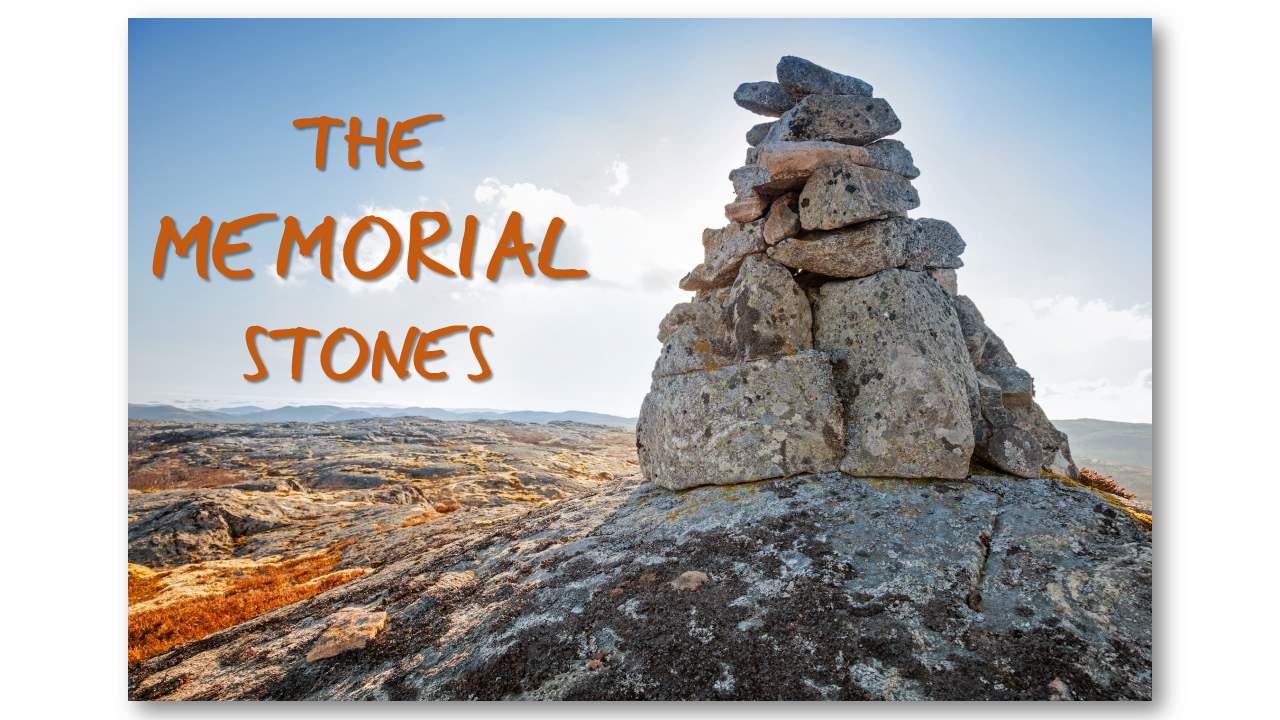
And it came to pass, when all the people had completely crossed over the Jordan, that the Lord spoke to Joshua, saying: “Take for yourselves twelve men from the people, one man from every tribe, and command them, saying, ‘Take for yourselves twelve stones from here, out of the midst of the Jordan, from the place where the priests’ feet stood firm. You shall carry them over with you and leave them in the lodging place where you lodge tonight.'” (Joshua 4:1-3)
The Memorial Stones
God wants His people to remember. The function of the memory is given by the Creator as a tool to guide the spirit of man to the throne of God. Memorials are as ancient as the world. Great feats are remembered, courageous men are honored, and stories are immortalized in memorials. When the children of Israel crossed the Jordan River to enter the land of promise, God wanted memorial stones erected to remind them of the One who brought them there and gave them the land.
The twelve tribes of Israel were represented by one stone taken from the midst of the Jordan River. Like crossing the Red Sea forty years before, the people would cross the flooded Jordan River on dry ground. The priests bore the ark of the covenant before the people, and when their feet dipped in the water’s edge, the waters flowing downstream stood still and rose up in a heap. Then, the priests stood still in the midst of the Jordan as all of Israel (nearly two million souls) crossed on dry land.
After the people crossed the Jordan, Moses told the people to take twelve men from each tribe and gather twelve stones from the midst of the Jordan. These stones would form a memorial at Gilgal for the people to know who delivered them and gave them the land of milk and honey. As a sign of the power of God, the memorial stones will tell how the flooded Jordan stood up and the people crossed on dry ground. The peoples of the earth would know the hand of the Lord, that it is mighty, and to fear the Lord God forever.
The Lord has given the church memorial stones to cause the people to remember. Jesus stood in the midst of Hades and stopped the power of death. The hand of God permitted the hands of men to kill His Son. Only through the mighty power of the Father did the Son offer Himself as the lamb for sacrifice to redeem sinful man. The Lord’s Supper is a memorial feast to remind the people of God of the price paid, allowing them to enter the eternal promised land. Each first day of the week is a time to ask, “What does this memorial mean?” As an everlasting memorial, the Supper turns the hearts of the penitent to the love of God, His power to redeem man, and the ultimate sacrifice of Jesus on the cross.
Joshua set up the memorial in Gilgal. Jesus established His memorial in Gethsemane when He gave Himself willingly to the angry mob. The Lord’s Supper was given by Jesus earlier that night as a reminder of God’s love. On the following day, Jesus suffered on a cross of wood and died. The memorial stones had turned to wood. Jordan could not hold the Son of God, and on the third day, Jesus rose. When the children ask what the memorial of the Supper means, they must be told this is where Jesus crossed over Hades and conquered death. The sting of death is dried up. Jesus has given the victory to God’s people. Lord, come quickly. The land of promise awaits.
 The Heaton File
The Lord’s Supper. the most expensive meal ever, was paid for by the Blood of Jesus.
LikeLiked by 1 person
The Lord’s Supper, the most expensive meal ever, was paid for by the Blood of Jesus.
LikeLiked by 1 person