They Talked All Night

Now on the first day of the week, when the disciples came together to break bread, Paul, ready to depart the next day, spoke to them and continued his message until midnight. There were many lamps in the upper room where they were gathered together. And in a window sat a certain young man named Eutychus, who was sinking into a deep sleep. He was overcome by sleep; and as Paul continued speaking, he fell down from the third story and was taken up dead. But Paul went down, fell on him, and embracing him said, “Do not trouble yourselves, for his life is in him.” Now when he had come up, had broken bread and eaten, and talked a long while, even till daybreak, he departed. (Acts 20:7-11)

They Talked All Night

The church at Troas was an amazing group of saints who hungered for the word of God. Paul visited the city for the first time on his second missionary journey and returned to worship with the church on a third trip. His time was limited as he was trying to reach Jerusalem as soon as possible on the Day of Pentecost. Paul stayed a week in Troas, wanting to worship with the saints on the first day of the week. When the Lord’s day came, Paul enjoyed the fellowship of worship with the Christians in singing, praying, remembering the death of Jesus in the Lord’s Supper and preaching the word. The greater part of the day was spent in Paul discussing the word of God as he continued his message into the night. Lamps were lit as darkness fell, but the church remained listening to Paul.

Troas was a church that loved to hear the word of God. It is doubtful that Paul would see any of the saints again, as his journey would lead not only to Jerusalem but to Rome. They did not object to him preaching all day. His message continued into the night. The crowd remained listening to Paul. A young man named Eutychus chose the wrong place to sit and overcome by sleep, fell out of the third-story window to his death. There is little doubt this shocked and dismayed the church as they looked at their dear brother lying dead, broken by the fall. By the grace of God, Paul went down and restored him to life. The church rejoiced that Eutychus was alive. They gathered again, enjoyed some food together, and talked all night. It was the breaking of day that Paul and the church dismissed.

The week Paul spent in Troas was a memory he would cherish all his life. His journeys had taken him to many places in the Roman Empire. Each experience held a special remembrance; some fondly and others with regrets. That Lord’s day Paul spent with the church at Troas had to be among the most remembered times in Paul’s life. It seems the brethren would not go home. Paul preached until midnight because anxious souls wanted to hear more about the gospel. When Eutychus died, the hearts of the brethren were filled with grief, but then the power of God exploded in a resurrection. No one went home. They spent the rest of the night into early morning talking. And it can be sure one of the things they discussed was Eutychus.

After Paul left and the brethren recovered their sleep, the discussions must have continued. One attribute of the church at Troas is that they loved to listen and talk about the word of God. They did not worry about what time it was. The Lord’s day was a time to worship their Savior. There were no time restraints on the hearts. It wasn’t very likely Paul spoke non-stop for the whole day and night as if in a preacher’s mode of sermon. The fellowship of the brethren was the communion of the word and they loved to talk about the gospel. They were willing to talk all night.

There is a lesson from the church at Troas. Sometimes in our busy schedules, we convince ourselves we could not spend hours worshiping and talking about the gospel, much less talking all night about it. Again, this does not suggest preachers should preach for hours, as the lecture sermons can become tiring. Maybe the church is missing another part of fellowship when saints sit around talking about the Bible without time restraints. This cannot be a daily occurrence, but what about more worship together as a body of Christ on the Lord’s day? Why do we hurry through our services so we can rush out to ball games, shopping, birthday parties and Sunday afternoon naps? Paul would find few (if any) places he would be allowed to talk until midnight and then continue through the night. Thank you church at Troas, for talking all night.

Posted in Uncategorized | 2 Comments

Day And Night – Boys And Girls

Then God said, “Let there be light”; and there was light. And God saw the light, that it was good; and God divided the light from the darkness. God called the light Day, and the darkness He called Night. So the evening and the morning were the first day. (Genesis 1:3-5)

Day And Night – Boys And Girls

In the beginning, God created the heavens and the earth. Moses begins the story of creation with the declaration that everything in the world was formed by the divine hand of the Living God. The beginning of all things finds its place in the record of Moses describing how and why all things exist. Nothing on the earth or in the seas, or in the heavens above was created apart from the will, design, purpose, and power of the divine. God spoke and the world was created. The first day of creation was the day that light divided from the darkness on the face of the deep. God’s will spoke light to be on the formless earth and in an instant, it was so. When the Lord looked at the earth, he could see the light and darkness. There was no land and sea, plants, animals, or humans – just light and darkness.

God called the light Day, and He called darkness Night. Day and night are the oldest names in the history of man. They precede God calling the man, Adam, and Adam calling God’s creation, Woman and then later, Eve. It was Adam that named all the animals, as directed by God. On the second day of creation, the Lord divided the firmament from the waters which were under the firmament; and it was so. God called the firmament the heavens or the sky. On the third day of creation, the waters under the heavens were gathered together in one place separated from the dry land. God called the dry ground Earth and the waters Seas. And God saw that it was good. He liked what He saw in the perfection of His creation.

Creation would continue with lights in the heavens called the sun, moon, and stars. Animals were created on the fifth and sixth days and called birds, sea creatures, cattle, creeping things and beasts of the earth. On the sixth day, God created male and female with the command to multiply and fill the earth. Adam and Eve would have a child and call his name Cain meaning, “I have acquired a man from the Lord.” Moses writes that God created them male and female, blessed them, and called them Mankind in the day they were created. Adam lived to be nine hundred thirty years and the record says he had sons and daughters.

There is still day and night. The sun, moon, and stars remain in the sky and are called the sun, moon, and stars. Earth is still recognized as the dry land and the seas fill the earth. There are birds in the sky, fish in the sea, and animals that roam the face of the earth. Sons and daughters are born to Mankind in the manner prescribed by the word of God in the beginning. As with all things, humans bear fruit according to their kind. Little boys are born and little girls are born, just like they did when Cain was born and every child after him. God forms the seed in the woman’s womb ascribing male and female and that cannot change. When a woman gives birth to a male child, he will always be a male. Little girls are born girls and will die in the image of what God created them to be.

Refusing to call boys, boys and girls, girls; is like refusing to call the large fiery ball in the sky the sun. Day and night remain day and night because that is what God called it. There will always be males and females; regardless of the Micky Mouse mentality of men that ignores a law they cannot change to be something that will never be. Bruce Jenner was born a male and will die a male. William Thomas is a male, regardless of a name change. Nothing can change that. Imagine a child standing on top of a mountain, telling the world he is now a bird. He believes he can fly because he believes he was created as an eagle with all his heart. Believing himself to be a bird, he jumps over the cliff. The consequences are severe. He dies because he believes himself to be something God did not create him to be. There are no wings to save him because he was not born of an eagle but of a woman.

At the end of the day, boys will be boys and girls will be girls. The question is not so much as to what a person believes themselves to be or not to be but two things: what God created them to be and what they will be in death. Male and female are independent creations that only God can change and He will not. Everyone is born either male or female. All of Mankind will die and when they die, they will die what they were created. Man’s wisdom cannot change that no more than they can move the sun or the moon from their place.

Posted in Uncategorized | 2 Comments

A Need For Sound Doctrine

Holding fast the faithful word as he has been taught, that he may be able, by sound doctrine, both to exhort and convict those who contradict. (Titus 1:9)

A Need For Sound Doctrine

The church of Jesus Christ has been established for two thousand years, built upon the divine truth that Jesus is the Son of the living God. Everything proceeds from the authority of God as Jesus Christ is the chief cornerstone from which the church derives its pattern, plan, and purpose. As in the construction of a building, there is a plan to establish a design that will last for a very long time. When construction is not done with care and forethought, the foundation is weakened and the building will collapse over time. The project’s structural integrity is how sound the workmanship is given to its creation. Following the architect’s exact details of the blueprint will also determine if the building withstands the test of time.

Sound doctrine is core to the design of the church. Without sound doctrine, the church cannot exist. Paul admonishes those men who take on the local congregation’s leadership to be men who will be able, by sound doctrine, to exhort and convict those who are wrong. There is a pattern that is unsound, wrong, full of error, and dangerous. Jesus did not die to purchase the church with His blood and leave the doctrine to men. Sound doctrine is that which comes from the mouth of God. It is sound speech, being sound in the faith with sound doctrine and sound words. A sound mind comes from sound doctrine.

When Jesus healed the man with a withered hand, He restored the man’s hand to being whole. This is the meaning of that which is sound. The whole or complete doctrine of God is singular. It comes from the mouth of God and cannot be changed by the wisdom of men. Over the centuries since the church was established, the philosophies of men have created a pseudo-church that looks a little like the New Testament church but is built upon the totems of error – or doctrine that is not sound. Modern day religion is not sound doctrine. It is not based upon the keeping of the word of God. The carnal desires of human wisdom have changed the church to fit their personal needs catering to the entertainment and fleshly needs of the human spirit.

There is a need in the changing world to establish sound doctrine. It comes from standing on the word of God and nothing else. Speech must be sound. Being sound in faith establishes authority on what God says. The doctrine of the church comes from the mouth of God. When the mind is focused on the sound doctrine of Jesus Christ, it will not be moved by the whims of men. The Bible is the only authority and without the authority of Jesus who stood before Satan declaring, “It is written,” there is no hope. Sound doctrine means – “It is written.”

Posted in Uncategorized | Leave a comment

The Lord Gets Weary

You have wearied the Lord with your words; “Yet you say, “In what way have we wearied Him?” In that you say, “Everyone who does evil is good in the sight of the Lord, and He delights in them,” or, “Where is the God of justice?” (Malachi 2:17)

The Lord Gets Weary

There is little doubt the longsuffering of God is one of the greatest eternal graces given to men. The divine suffering waited in the days of Noah. For forty years, the Lord endured the abuse of His own people as they wandered through the wilderness. In the period of the Judges, God delivered Israel time and again after they had abandoned Him. After the death of Solomon, the patience of the Lord allowed Israel to remain for two hundred years and Judah three hundred forty-five years. After the remnant returned from seventy years of captivity, the heart of the people became dull and despaired. Worship became mundane and lifeless. Idolatry had been removed from the nation, but they had little desire to devote their hearts to God.

The burden of Malachi was to correct the attitudes of the nation of Israel and rebuke the half-hearted worship offered by the people. The Temple had been rebuilt and the walls restored through the courage and faith of men like Nehemiah, Jeshua, Zerubbabel, Haggai, Zechariah, and Ezra. Yet worship to God was so lax it became a burden with indifference, vanity, and weariness. Sacrifices were offered with diseased and lame animals. The table of the Lord was given no respect. Worship was nothing more than going through a series of inconsequential actions without feeling – to appease a God few loved or cared for. God had had enough. The faithless people had worn out the patience of the Lord by their murmuring and discontent. Life was not going like the people wanted and as they complained, the Lord lost patience.

Discontent calls into question the justice and holiness of God. It impugns the divine character of the Lord. The mistake men make is to believe the longsuffering of God is without end. It is a divine truth the longsuffering of the Lord is immeasurable, but no one should be lulled into believing the patience of God will not end. In the days of Noah, the longsuffering of God waited, but then it started raining. During the forty years of wandering, everyone above the age of twenty years died because of unbelief. After the death of Solomon and the kingdom divided, God allowed His nation to remain until the Assyrian and Babylonian armies appeared. The Creator neither faints nor is weary and His understanding is unsearchable but there comes a time when the Lord becomes weary with the faithless spirits of those who refuse to obey Him.

If the longsuffering of the Lord is without measure, consider the amount of rebellion it takes to have the Lord say He is wearied with the words of men. God’s patience has an ending point. A time can come when the Lord has had enough. He is wearied, tired, and without mercy when men’s hearts refuse to acknowledge Him. When God becomes weary, men become lost. Will men do evil and expect God to accept them? He is full of compassion, but there is no mercy to those who will not subject themselves to His will. The saddest words a man will hear is when they hear the voice of the Father say to them, “You have wearied me with your words.” What comes next is not good. The lesson of the day is to live in such a way that you do not weary the Lord.

Posted in Uncategorized | 1 Comment

The Power Of Ungodly Influence

But Moses was angry with the officers of the army, with the captains over thousands and captains over hundreds, who had come from the battle. And Moses said to them: “Have you kept all the women alive? Look, these women caused the children of Israel, through the counsel of Balaam, to trespass against the Lord in the incident of Peor, and there was a plague among the congregation of the Lord. Now therefore, kill every male among the little ones, and kill every woman who has known a man intimately. But keep alive for yourselves all the young girls who have not known a man intimately. (Numbers 31:14-18)

The Power Of Ungodly Influence

Forty years had passed since the nation of Israel stood at the entrance to Canaan, a land promised by God to Abraham and his descendants. When the Lord promised the land to Abraham, He told the patriarch the iniquity of the people was not thoroughly evil to destroy them. Centuries later, Moses led the people to the promised land and it was time to bring judgment upon the iniquity of the people. King Sihon of the Amorites had been soundly defeated and Og king of Bashan was killed, along with his sons, and all his people, until there was no survivor left.

Balak, king of the Moabites saw all that Israel had done to those who stood against them. He called for Balaam to curse the people of Israel, but the Lord would not permit Balaam to bring a curse upon Israel. Though Balaam could not curse Israel, he knew he could tempt the people to sacrifice to the gods and commit harlotry with the women of Moab. Twenty-four thousand were killed in the plague brought by God. The influence of Balaam was so complete, Zimri the son of Salu, a leader of a father’s house among the Simeonites, brought a Midianite woman named Cozbi the daughter of Zur into the camp and committed adultery with her in the sight of all Israel. Phinehas the son of Eleazar, the son of Aaron the priest saw it and took a javelin and killed them both.

Moses would not be permitted to enter the promised land, but God had one final war for the great leader of Israel. The Lord tells Moses to bring judgment upon the Midianites. Twelve-thousand men went to war against the Midianites and they killed all the males and the kings of Midian. Balaam the son of Beor, was also killed with the sword. The children of Israel took the women of Midian captive with their children. They burned all the cities with fire and took all the spoil of the land. Returning from the war, the Israelite army presented all they had captured to Moses, to Eleazar the priest, and to the people of Israel. But Moses became angry with the officers and the captains. He wanted to know why they had kept all the women alive. He reminded them of how the women had turned the hearts of Israel from God through the counsel of Balaam.

The power of ungodly influence had destroyed twenty-four thousand of God’s people. The cause and root of the wickedness came from the temptation of the ungodly women. Moses tells them to kill all the male children and every woman who was not a virgin. They were allowed to keep the virgin girls for themselves. The word of the Lord is firm against the ungodly influences that seek to destroy His people. God had told Abraham the ungodliness of the people was not to a point where judgment was justified, but when Moses arrived with the nation of Israel, the wickedness of the people had surpassed the longsuffering of God. To the modern mind, killing all the male children and women who were not virgins is an incredible command to give and carry out. Nonetheless, the influence of ungodliness was to be removed entirely from the nation.

God is full of love, but He also is a Lord of justice and righteousness. The people destroyed in the conquest of Canaan faced the wrath of God because they were so wicked; the justice of God demanded their destruction. Allowing the influence of the world to slowly permeate the heart or the mind will destroy the character of righteousness. The command of God is a severe action against evil. Jesus would later tell His followers that if the hand causes one to sin, it would be better to cut it off and if the eye causes one to sin, it would be better to pluck it out. Jesus did not suggest this literally, as sin is not a problem of biology but of the evil heart. The action against sin may have to be severe.

Killing all the male children and the women who were not virgins is a rash act but needed if the people would be saved. There are things in life that may need to be removed. Jobs may need to be changed; marriages are reconsidered, friendships ended, possessions are given up, and a host of things that could hinder salvation. Abraham was told to offer his son as a burnt offering and he obeyed the word of the Lord. The rich young ruler was told to give all he had to the poor, but he refused. What are you willing to do for the Lord to remove ungodly influences?

Posted in Uncategorized | Leave a comment

Denying Truth With Lies

And Stephen, full of faith and power, did great wonders and signs among the people. Then there arose some from what is called the Synagogue of the Freedmen (Cyrenians, Alexandrians, and those from Cilicia and Asia), disputing with Stephen. And they were not able to resist the wisdom and the Spirit by which he spoke. Then they secretly induced men to say, “We have heard him speak blasphemous words against Moses and God.” And they stirred up the people, the elders, and the scribes; and they came upon him, seized him, and brought him to the council. They also set up false witnesses who said, “This man does not cease to speak blasphemous words against this holy place and the law; for we have heard him say that this Jesus of Nazareth will destroy this place and change the customs which Moses delivered to us.” (Acts 6:8-14)

Denying Truth With Lies

Truth is older than error. Satan has lied from the beginning and is the father of lies. Truth has never changed under the tyranny of lies because truth is everlasting. Believing the world is flat does not change truth but only highlights the ignorance that lies seek to distort the truth. Truth is absolute. One plus one equals two in any language, culture, or historical reference. The devil never denies truth. He only seeks to manipulate truth sufficiently to cause a man to believe a lie to be truth. The snake told Eve she would not die. She did but not as she thought. Jesus quoted scripture to attack Satan, so the devil also quoted scripture but not in a divine context.

In the early days of the church, a man full of faith and the Holy Spirit was charged with blasphemy by a sect called the Synagogue of the Freedmen. The Jerusalem church had chosen Stephen to serve as a minister to the Hellenist widows along with six other men. Luke writes that Stephen performed amazing miracles and signs among the people. He caught the attention of the Libertines, who began to debate Stephen concerning the risen Christ. It did not go well. Stephen was powerful in his defense of the gospel and the Freedmen could not withstand his wisdom. The Libertines were met with a powerful argument against them at every turn of their defense. They could not dissuade Stephen or properly defend against his divine truth.

When wicked men face the truth, they cannot defend against the purity of divine law. Stephen rebutted every argument given to him by his challengers. As a last and final resort, the Freedmen, unable to stand against the wisdom and Spirit of Stephen, persuaded some men to lie about Stephen. They charged Stephen with blaspheming Moses and the Law. This accusation brought serious consequences if proven to be true. The second defense of wicked men is to rouse the people against the accused into a mob state of mind. Accusing Stephen of blasphemy was an easy charge of sedition, not requiring any validation because the anger of the crowd was the fuel feeding the fire. Stephen was brought before the Jewish council, which included a young man named Saul of Tarsus. The lying witnesses claimed Stephen was always speaking against the Temple and the Law of Moses. They also suggested that Jesus of Nazareth (who had been killed by a mob some months earlier) would destroy the Temple and change the customs Moses gave the people. The crowd was electrified with hatred and anger. Stephen remained calm. He was given a short time to defend himself before the people rushed upon him, dragging him out of the city where they murdered him. And Saul of Tarsus was party to the whole sordid ordeal of lies attacking truth.

Wicked men attack truth with lies because that is all they have to fight with. Truth remains the same because it is eternal. The accusations against Stephen were words mixed together to present a truth that was nothing but lies. Jesus would destroy the temple, but He was speaking of His body. The Law of Moses was taken away and the covenant of grace would be found in Jesus Christ. Truth is easily identified when examined for its simplicity, but men full of hatred cannot see the truth. They seek to destroy truth with lies. The sermon Stephen preached before he was killed was truth. Saul of Tarsus would find himself in the same place as Stephen many years later when he became a soldier of the cross of Christ. Falsely accused, Paul appeals to Caesar.

Truth never suffers under the barrage of error or lies. Men will die because of truth, but the character of God’s word remains the same. Jesus died at the hand of false accusers. Stephen died at the hands of false accusers. Truth never changed. The purpose of truth is to establish God’s word in this life so that eternal life can be found in death. Lies will destroy life here and in the life to come. Truth is eternal – both here and in the life to come. Never fear lies when you have the truth.

Posted in Uncategorized | Leave a comment

God Never Fails

Blessed be the Lord, who has given rest to His people Israel, according to all that He promised. There has not failed one word of all His good promise, which He promised through His servant Moses. (1 Kings 8:56)

God Never Fails

All that God has promised,

Has come to pass as promised,

Everything he promised,

Is true because He promised.

Nothing God has done has failed,

Because with God nothing failed.

Everything that man did failed,

Because with men all has failed.

God is full of goodness,

His word is always goodness.

All He does for man is goodness,

The promise of God is goodness.

The word of God is always true,

Every promise made by Him is true.

Man can trust that God’s word is true,

All that God has shown is true.

Jesus promised eternal life,

The Father’s promise is true life,

When men seek eternal life,

They find that promise in His life.

There has not failed one word of all,

There has not failed one promise of all.

God has given to men His very all,

When Jesus died gave His life for all.

I can know the promises of God,

Everything I trust and know is God.

Eternal life is a promise of God,

And I believe in the love of God.

(Kent Heaton)

Posted in Uncategorized | 2 Comments

Forgiveness Comes From Forgiving

And whenever you stand praying, if you have anything against anyone, forgive him, that your Father in heaven may also forgive you your trespasses. But if you do not forgive, neither will your Father in heaven forgive your trespasses. (Mark 11:25-26)

Forgiveness Comes From Forgiving

God is a just God and requires justice from those who seek Him and ask for blessings from Him. The gods of men are without compassion or concern for others. Justice in the eyes of God begins with the heart of the petitioner. A man comes to God seeking mercy, grace and love and yet holds hatred, malice, and an unforgiving spirit toward his fellow man. There is a contradiction in this appeal. Forgiveness is an eternal gift given by a God who is so full of mercy He gave His only begotten Son to die for the miserable character of humanity. The death of Jesus was the most horrible death imagined by the cruelty of the world. A man who never committed sin was brutally murdered by religious thugs that hated Him because of envy. The Jews rejected one of their own and the Romans executed the Son of God on a cross. Jesus uttered His love for all humanity as He hung on the cross when He asked His Father to forgive those who were killing Him. And a man dares to come before that same Father asking for something he is unwilling to give another?

Forgiveness comes from a forgiving heart. It is easy to ask God for forgiveness but much harder to forgive another. This contradiction is not acceptable to the Father. There is no way around the requirement of God’s love demanding a pure heart to come before Him. When a man is praying, he must first forgive anyone he holds a grudge against so that God will forgive him also. One goes with the other. God forgives when the heart of the one praying has forgiven the one who has wronged him. And there are no exceptions, allowances, loopholes, or arguments that can be made to dissuade the mind of God from accepting the prayers of unforgiving men.

Jesus emphatically says that His Father will not (under any circumstances) forgive a man unwilling to forgive another. Prayers offered with grudges dangling from them will die in transition. God will not hear but judge the man guilty. Forgiveness is more than removing sin. It teaches the heart how to live with those who share the same burden of sin. If there is strife between two men, there is a reason. The unwillingness to forgive another shows a heart that has not learned the true meaning of God’s grace. What man has ever deserved forgiveness? Who among all men can boast they deserve forgiveness from God? How many times in a man’s life will he sin against God and the Lord forgive … and this same man refuses to forgive someone who may have offended him or slighted him in some small way? What is the comparison?

Jesus told a parable in His early ministry of a man who owed his lord millions of dollars and because of the love of the master, the debt was forgiven. This same man found a man who owed him a few dollars demanding restitution with anger and hatred. Jesus illustrated the volume of forgiveness every man receives from the Father compared to the pitiful amount of forgiveness from another and the hypocrisy of such unforgiveness. Jesus is clear: if there is no forgiveness in the man’s heart for his brother, he will receive no forgiveness from the Father. Forgive another before asking God to forgive you. Then, and only then, will God remove your sin. Forgiveness is found in two prayers. The first prayer involves my brother and the second prayer petitions my God.

Posted in Uncategorized | 1 Comment

Thank God For Rain

For I know that the Lord is great, and our Lord is above all gods. Whatever the Lord pleases He does, in heaven and in earth, in the seas and in all deep places. He causes the vapors to ascend from the ends of the earth; He makes lightning for the rain; He brings the wind out of His treasuries. (Psalm 135:5-7)

Thank God For Rain

A day of rain can bring a day of reflection. The clouds turn dark and the sound of falling rain begins softly before turning to a heavy pour of intense noise sprinkled with a burst of thunder. It is an amazing display of nature to see the vibrant energy of a rainstorm fill the landscape sweeping through the land with rivers of water. The animals scurry to shelters of safety while some stand stoically in the dark shadows of a rain shower. There is glory in the creation of God’s design and none so powerful as the weather that skips across the globe in wind and rain.

Early man was not unaware of the forces of nature. The psalmist looks upon the elements of rain, wind, and lightning to see the hand of God in every droplet. He recognizes the forces of nature are not conjured by the magic of an unknown god. The Greeks called Zeus the god of rain and thunder and the Romans gave the name Jupiter to their god of clouds, rain, thunder, and lightning. Neither Zeus nor Jupiter was anything more than the imaginations of human philosophy that created nothing and by whose hand nothing was sustained. The Lord God Almighty is the one who formed the patterns of weather on the first four days of creation. He is above all gods by His power and His creation because the weather comes from His mighty hand.

Rain is a testimony that the Lord is great. Whatever pleases Him, He does throughout all heaven and earth, and on the seas and in their depths. He causes the clouds to rise over the whole earth. He sends the lightning with the rain and releases the wind from his storehouses. God does that. It is the testimony of His power and His majesty. Human wisdom tries to forecast the weather, but the real question is whether the weather follows the will of men or the will of God. Man can tell where weather has been but seldom knows where weather will be. The rain comes from the hand of God and abides in His will. He is great and He controls the elements of the world. Nature testifies to the hand of a mighty Creator.

A day of rain is a day of reflection. It will interrupt plans, slow traffic and cause problems from time to time. There are frustrations that may come with the rain. Men will complain because they get wet, their clothes are soaked, or the roof leaks. Imagine a world without rain. There would be more significant problems than anyone could imagine. What would the world be with too much rain? The answer to that question is found in the story of Noah. Rain reflects on the cycle of weather ordained by the hand of God to show creation that God rules in the affairs of the universe. Maybe a good hard rain that stops everything is an excellent time to spend with the One who created the rain. It is not an inconvenience; it is a blessing to know God and thank Him – for rain!

Posted in Uncategorized | 1 Comment

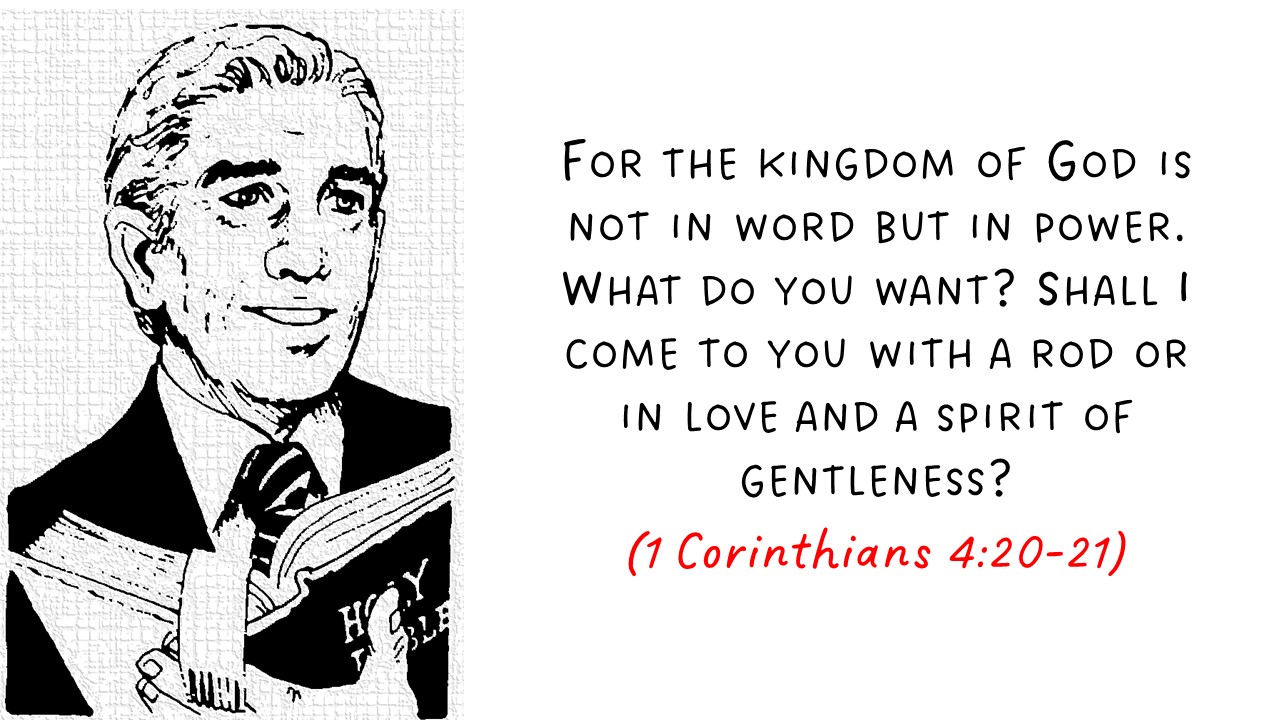
Kingdom Preaching

For the kingdom of God is not in word but in power. What do you want? Shall I come to you with a rod or in love and a spirit of gentleness? (1 Corinthians 4:20-21)

Kingdom Preaching

Preaching is as old as the world because sin has been around since the beginning of time. The object of preaching is to reveal the mind of God to sinful man. Noah is called a preacher of righteousness in a world of complete depravity. Solomon calls himself a preacher, the son of David. Prophets were more preachers than discerners of the future, but their message was the same – to cause the people to repent and turn to the Lord. John the Baptist began his ministry before Jesus to prepare the way for the master preacher. When Jesus began His ministry, the people were astonished at His teaching. As the perfect Son of God, Jesus is the example of kingdom preaching.

The sermon on the mount is an example of Jesus preaching to soothe the afflicted and afflict the comfortable. He dealt with controversial subjects with candor. Comparing the philosophies of the religious elite of His day and the Law of Moses, the Lord showed the hypocrisy of their teachings, reaffirming the eternal truths of His Father. The people recognized the authoritative volume of the preaching of Jesus by His clarity of speech. Throughout His ministry, Jesus would preach sermons of comfort and assurance and, when the occasion arose, would scorch the hard hearts of the people in fiery sermons of rebuke. He tells a woman caught in adultery to go and sin no more and tells the scribes and Pharisees they compass land and sea to win one convert and make him twice as much a son of hell as themselves. Preaching for Jesus was steel and velvet.

When Paul writes his first letter to the church at Corinth, he has a laundry list of problems and no small way to address them. The church was racked with division, carnality, immorality, rebellion, false doctrine and brethren lacking love for one another. He begins his letter with commendation and love for them, but then he begins to chip away at the church’s huge problems with words of rebuke, chastening, harshness, and plain speech. It was a letter of intense feeling. Paul could have written a friendly letter to thank them for their faithfulness, or he could have written them a scathing letter of criticism. He chose to do both. Mixed within the pages of his epistle to Corinth, the apostle came with a rod and in love and a spirit of gentleness.

Kingdom preaching is about the message of the rod and the plea of comfort and commendation. The only kind of true preaching is the proper mixture of both. Examining the preaching of Jesus will find how the Lord used the rod when necessary and words of love and gentleness on the other. This is the outline of the letter to Corinth. Paul used a rod to punish the brethren, but he also shared with them his love for them. That is kingdom preaching. When a preacher does nothing but preaches the rod, he creates an audience of resentful, angry, depressed, and hopeless souls. If a man refuses to preach the rod and only fluffs the sermons with love and joy, he creates a community of soft, shallow, and hopeless souls filled with their own self-worth lacking any courage or faith. Kingdom preaching must be the message of severity when needed and the sermon of goodness as needed.

The result of Paul’s letter to Corinth is found in his second letter to Corinth. He came down hard on the brethren for allowing the man with his father’s wife to go unchecked. Because of the kingdom preaching of Paul, the brethren did what he asked them to do – in love. The brethren were made sorry which led to repentance. That is the wonderful work of kingdom preaching. There are times people need to be reminded of the severity of God. He will punish the disobedient, there is a consequence to sin, and there is a place of eternal punishment. Sin must be addressed clearly and with the power of the word of God, without reservation. A man who refuses to preach against sin is a spiritual coward unworthy of the pulpit. Browbeating the saints is not the work of the preacher. A man of faith must preach of faith and show that faith in his life. Kingdom preaching is about grace, mercy, love, forgiveness, and hope. Preach the rod and preach love and gentleness. That is kingdom preaching.

Posted in Uncategorized | 2 Comments