Sin Is Owned By Self

Amaziah was twenty-five years old when he became king, and he reigned twenty-nine years in Jerusalem. His mother’s name was Jehoaddan of Jerusalem. And he did what was right in the sight of the Lord, but not with a loyal heart. Now it happened, as soon as the kingdom was established for him, that he executed his servants who had murdered his father the king. However he did not execute their children but did as it is written in the Law in the Book of Moses, where the Lord commanded, saying, “The fathers shall not be put to death for their children, nor shall the children be put to death for their fathers; but a person shall die for his own sin.” (2 Chronicles 25:1-4)

Sin Is Owned By Self

Amaziah was the eighth descendent of Solomon to sit on the throne of David as king of Judah. His father, Joash, was seven when he became king, and Amaziah was born in the fifteen year of his reign. Most of the reign of Joash followed in the way of the Lord as long as the high priest, Jehoiada, lived. At the death of Jehoiada, Joash turned his heart away from the Lord, and he was killed by his own servants, Zabad and Jehozabad. Amaziah was twenty-five years old when he became king and would rule over Judah for twenty-nine years, following in the way of the Lord. The Holy Spirit notes the heart of Amaziah was not loyal to the Lord.

It was not uncommon when a king began to rule to remove all those who opposed him. The great-grandfather of Amaziah, Jehoram, killed all his brothers and many of the princes of Israel. After Jehoram died by the hand of the Lord, his wife Athaliah usurped the throne for six years after killing all the royal heirs of the house of Judah. Joash, the son of Ahaziah, was hidden by his sister for six years while Athaliah reigned over the land. When Amaziah began to rule, he executed the servants who had murdered his father, the king. Joash had turned his heart away from the Lord. When a small army of Syrians came against Judah, God allowed the Syrians to punish Joash and Judah for forsaking Him. Joash was severely wounded in the battle, and his servants killed him in his bed.

Amaziah punished the men who killed the king in accordance with the Law of Moses. The family of Zabad and Jehozabad did not suffer any harm, as would often be the case. God had written in the Law of Moses that parents must not be put to death for the sins of their children, nor children for the sins of their parents. Those deserving to die must be put to death for their own crimes. Sin is accountable from individual guilt, and the Lord only holds the individual responsible for his sin. A parent can be an evil parent, but the child will be judged by his or her choices. An evil child will not be held as a judgment against the parent. Adam and Eve were not guilty of Cain’s sin. God judges each person as an individual who is solely accountable for their own sin.

Human nature wants to deflect guilt to someone other than the one guilty. Society is blamed for the decisions people make. Parents are held in disdain for the conduct of children. Blame is given for sinful actions to everyone except the one that God sees. There is an influence that society has on people, and parents can neglect their children, but the Lord will not acquit someone because of the sins of another. In the case of the family of Achan (conquest of Jericho), they were all culpable and guilty and deserved the wrath of God. The lesson from Amaziah is that each person will stand before the Lord with every person that has lived on the face of the earth and will be standing alone before a righteous God. You are responsible for yourself.

Posted in Uncategorized | Leave a comment

I Am Gabriel

And the angel answered and said to him, “I am Gabriel, who stands in the presence of God, and was sent to speak to you and bring you these glad tidings.” (Luke 1:19)

I Am Gabriel

Angels are the messengers of God found throughout the Bible. The first time an angel is spoken is when Hagar is in the wilderness after running away from the cruelty of Sarah. God sent the Angel of the Lord to comfort her and instruct her to return to Abraham, where she would have a son, Ishmael. The angel would appear a second time to Hagar when she and Ishmael are cast out, showing them a place to get water. When Jacob left home after receiving the blessing of his father Jacob, he had a dream of angels ascending and descending a ladder reaching into heaven. An angel appeared to Jacob when he dwelt in Haran and told him to return home. Moses saw the burning bush, and the angel of the Lord spoke to him. When the Hebrews were crossing the Red Sea, an angel of the Lord stood between them and the ensuing Egyptian army. God promised to send His angel before Israel to defeat their enemies and guide them to the promised land.

An angel of the Lord stood before Balaam as he sat on his donkey. In the early days of Israel, during the period of Judges, an angel of the Lord spoke to all the children of Israel, warning them not to make a covenant with the people of Canaan. Gideon was threshing out wheat when the angel of the Lord enlisted him in the work of being a judge over Israel. The birth of Samson was announced by the angel of the Lord to the wife of Manoah. God’s judgment for David’s sin of numbering Israel was carried out by an angel with a plague killing seventy thousand men. David saw the angel, and so did Ornan the Jebusite. Elijah the prophet, was sustained by the care of an angel. An angel of the Lord killed in the camp of the Assyrians one hundred and eighty-five thousand men. Angels delivered Hananiah, Mishael, and Azariah from the burning furnace and Daniel from the lions’ den. An angel talked with the prophet Zechariah.

During the ministry of Jesus, an angel would stir the waters of the pool called Bethesda. After the stirring of the water, whoever stepped in first was made well of whatever disease he had. An angel of the Lord released the twelve apostles after being arrested, telling them to go and preach the words of life. An angel gave Philip and Cornelius instructions. When Herod killed James the apostle and arrested Peter, an angel delivered Peter from prison. Paul was comforted by the presence of an angel.

The Bible is filled with stories of angels doing the work of the Lord. There are many misconceptions about angels that persist despite what the Bible says. Angels are never referred to as women but only as men. None of the angels who appeared to men are said to have wings. The angels in Ezekiel are mentioned with wings, but these are in a vision in the heavenly realm. The Ark of the Covenant had cherubim spread out and covered the mercy seat with their wings. Angels were messengers of God to carry out His will. Two angels are named in scripture: Michael, the archangel, and Gabriel. The scriptures never refer to Gabriel as an archangel. Gabriel appeared to three people in scripture: Daniel, Zacharias, and Mary.

Twice in the story of Daniel, Gabriel appears to explain the vision of the ram and the goat and to give assurance of the seventy-week prophecy. Gabriel appeared on the right side of the altar of incense and announced to the priest Zacharias that he and Elizabeth would have a son in their old age. Gabriel tells Zacharias to name the child John. When the birth of Jesus was announced, Gabriel came to Mary, while Matthew only says an angel of the Lord appeared to him. Six months after the appearance to Zacharias, Gabriel was sent by God to tell Mary she would have a son and she would call his name Jesus. Gabriel was an angel tasked with bringing good and comforting news, while Michael the archangel seems to be the angel of wrath and war. The most poignant scene of scripture is when the Son of God was bowed down in great sorrow in the Garden of Gethsemane, and the Father sent an angel to strengthen (invigorate) Jesus. God sends a comforter to comfort His Son. Gabriel stood in the presence of God. Thank God for Gabriel.

Posted in Uncategorized | Leave a comment

When The Trumpets Blow

And the Lord spoke to Moses, saying: “Make two silver trumpets for yourself; you shall make them of hammered work; you shall use them for calling the congregation and for directing the movement of the camps. When they blow both of them, all the congregation shall gather before you at the door of the tabernacle of meeting. But if they blow only one, then the leaders, the heads of the divisions of Israel, shall gather to you. When you sound the advance, the camps that lie on the east side shall then begin their journey. When you sound the advance the second time, then the camps that lie on the south side shall begin their journey; they shall sound the call for them to begin their journeys. And when the assembly is to be gathered together, you shall blow, but not sound the advance. The sons of Aaron, the priests, shall blow the trumpets; and these shall be to you as an ordinance forever throughout your generations. When you go to war in your land against the enemy who oppresses you, then you shall sound an alarm with the trumpets, and you will be remembered before the Lord your God, and you will be saved from your enemies. Also in the day of your gladness, in your appointed feasts, and at the beginning of your months, you shall blow the trumpets over your burnt offerings and over the sacrifices of your peace offerings; and they shall be a memorial for you before your God: I am the Lord your God.” (Numbers 10:1-10)

When The Trumpets Blow

The Hebrews that came out of Egypt numbered 603,550 men from twenty years old and above who were able to go to war in Israel. Adding the women, children, and other adults, the Israelites numbered more than a million souls. As they moved from place to place, they separated into twelve tribes, each in order positioned in specific areas around the tabernacle. It would be a daunting task to move a few million people in an orderly fashion from place to place. On the day the tabernacle was raised up, a cloud covered the tabernacle during the day and as a cloud of fire at night. The movement of the people was determined by whether the cloud remained above the tabernacle. At the command of the Lord, they remained encamped, and at the command of the Lord, they journeyed. Everywhere the Hebrews traveled, they did so by the will of the Lord.

When it came time to move the people, God instructed Moses to make two silver trumpets of hammered work. These trumpets would be used for calling the congregation and directing the camps’ movement. When both trumpets were blown, the congregation of Israel gathered at the tabernacle entrance. If one trumpet is used, only the leaders or heads of the tribes will meet with Moses at the tabernacle. There would be a sound that told the congregation to move, and the tribes on the east side of the tabernacle (Judah, Issachar, Zebulun) would move first. At the second signal, the tribes camped in the south (Rueben, Simeon, Gad) would break camp and move. The tribes on the west side of the tabernacle (Ephraim, Manasseh, Benjamin) would follow, and bringing up the rear would be the tribes on the northern side of the tabernacle (Dan, Asher, Naphtali). The key to all of this movement was the blowing of the trumpets.

There was a distinction made when blowing the trumpets to gather the people and the advancement. Only the sons of Aaron, the priests, were allowed to blow trumpets. When the people went to war, an alarm would be sounded. During the day of the appointed feasts and at the beginning of months, the trumpets were to be used over the burnt offerings and the peace offerings. The two trumpets were used to move the people, call the nation to war, and to show honor to the Lord over the sacrifices. Moses forged the two silver trumpets with hammers according to the word of the Lord and would be used during the forty years of wandering to direct the movements of the whole nation of Israel.

The word of the Lord guided the Hebrews from Egypt to Canaan, and using two silver trumpets, the people rose up or remained in place. Different sounds meant different things, and there was an order to how the people moved from place to place. God understood the challenge of moving the nation as a people walking through the land would take direction and obedience on their part. When it came time to leave Sinai, the cloud was taken up from above the tabernacle of the Testimony. The two silver trumpets were blown to sound the advance, and the tribe of Judah led the people out from the Wilderness of Sinai. The other ten tribes followed in accordance with the sound of the trumpets. For the next forty years, whenever the people heard the trumpet, they obeyed.

When it came time to move, the people obeyed the trumpets. It may have been inconvenient and untimely for them, but when the trumpets were blown, they packed their possessions and prepared to move in the orderly fashion required by the word of the Lord. The tribe of Naphtali was always last, and the tribe of Judah was always first. The word of the Lord declared when the nation would move and how they would move. Any deviation from the commands of God was met with a penalty. When the trumpets blew, it was time to act because the trumpets were the sound of the word of God.

There are no silver trumpets today, but the principle remains the same. Jesus came and established His church and ordained spiritual silver trumpets that are in place for a purpose and design. The silver trumpet of baptism is the only way sins are washed away. There are many examples of God’s pattern of the New Testament church like the silver trumpets: assembly of the saints on the first day of the week, the Lord’s Supper, prayer, meditation on the word of God, thanksgiving, benevolence, church discipline, the role of women, elderships, teaching the lost, and a host of sounds that call the people of God to obey the word of the Lord. If a man is not listening to the trumpet of the Lord, he will miss the blessings given by God. Listening to the trumpets demands immediate attention and obedience. When the word of the Lord sounds, the answer is, “Here am I, Lord. What do you desire?” Listen for the trumpets of God. Respond. Obey. One day another trumpet will sound, but then it will be too late. Live each day following the sounds of the trumpet of the Lord so that when He returns and blows the trumpet of God, salvation is given.

Posted in Uncategorized | Leave a comment

Here I Raise My Ebenezer

Now as Samuel was offering up the burnt offering, the Philistines drew near to battle against Israel. But the Lord thundered with a loud thunder upon the Philistines that day and so confused them that they were overcome before Israel. And the men of Israel went out of Mizpah and pursued the Philistines and drove them back as far as below Beth Car. Then Samuel took a stone and set it up between Mizpah and Shen and called its name Ebenezer, saying, “Thus far the Lord has helped us.” (1 Samuel 7:10-12)

Here I Raise My Ebenezer

When Samuel began to judge Israel, he begged them to put away their foreign gods and the Ashtoreth they served and return to the Lord with all their hearts. He promised them if they returned to the Lord, they would be delivered from the oppression of the Philistines that are so plagued the people for many years. The children of Israel put away their foreign gods and the Ashtoreth and served the Lord only. When the Philistines heard what the people of Israel had done under the leadership of Samuel, the lords of the Philistines went up against them with their vast army. Israel was afraid of the Philistines, begging Samuel to ask the Lord to intercede for them. Samuel prepared a sacrifice before the Lord, and as he was performing the sacrifice, the Philistines drew near to battle against Israel. The people of Israel faced certain death.

As the Philistines began their attack against Israel, the Lord thundered with a loud thunder upon the Philistines, confusing them and causing them to be in disarray. Taking advantage of the confusion, Israel descended upon the Philistines, pursuing them into a huge valley 1000 feet deep, at the bottom of which was a torrent rushing over a rocky bed. Israel defeated their enemy as far as below Beth Car. It was a resounding defeat made possible by the help of the Lord. The victory was through the power of God. Israel would not be oppressed by the Philistines, and the hand of the Lord was against the Philistines all the days of Samuel. In thanksgiving for deliverance from the Philistines, Samuel took a large stone Samuel and placed it between the towns of Mizpah and Jeshanah. Samuel thanked God for the deliverance from the hand of the Philistines, honoring the Lord with a memorial to recognize God’s help in defeating the Philistines. He named the stone Ebenezer, which means “the stone of help.” It was important for the people and the world to know that victory over the Philistines could not have been possible without the help of God.

The Philistines are long gone, and the wars between Israel and the nations of Canaan have ceased. Biblical Israel is no more. Prophets like Samuel are only found on the pages of holy writ. But the war is not over. It is a different kind of war. Today’s war is an unnamed war led by the cruelest of despots humanity has ever faced. Long ago, in the garden of Eden, the battle began when Satan tempted Eve, and she succumbed to his wishes. For generations, the dark tentacles of the devil’s power held sway over the world. It seemed a hopeless and impossible task to overcome. And then, in the small town of Bethlehem, a child was born that would bring light to the world and become the greatest Ebenezer men could ever know. Jesus Christ came into the world to subdue the power of Satan. The devil succeeded in killing God on a cross, but then the Father raised up His Son to destroy the works of Satan. Humanity has found the thunder to defeat the devil. Like the Philistines of old, God thunders in His majesty, and Satan is subdued. The Lord God has given that thunder to His children so they can subdue Satan.

Through the grace and power of God, all the armies of Satan can be defeated. God has given the armor of the Holy Spirit to enforce His will on the devil. In the power of prayer, the minions of Satan fall. Through the teaching of the word of God, the purpose and plans of evil are destroyed. There is nothing that man can do alone against Satan. Without God’s help, there cannot and will not be any victory. When Satan raises his dragon head, God sends His angels of light to strike him down. The final victory that has already been written on the pages of God’s word is the army of the King of Kings and the Lord of Lords when they will march before the forces of Satan and destroy him, and God will cast the devil and hades into the lake of fire.

The memorial of Ebenezer is found in the word of God, in the voices of prayer, through the songs of faith, and in the blessing of the Lord’s Supper. When the life of a child of God seeks the righteousness of truth in a dark world of lies, an Ebenezer is raised to seek the help of God. Individual Christians who are faithful to His word are memorials called Ebenezer. Churches that stand for truth in communities filled with error are places of Ebenezer. There are many memorials of Ebenezer throughout the world of the faithful and devout who seek the grace and love of God. Without God, there is nothing. With God, there is everything. Here I raise my Ebenezer, and Satan will not take it away from me. Let it thunder.

Posted in Uncategorized | Leave a comment

Hard Preaching

“You stiff-necked and uncircumcised in heart and ears! You always resist the Holy Spirit; as your fathers did, so do you. Which of the prophets did your fathers not persecute? And they killed those who foretold the coming of the Just One, of whom you now have become the betrayers and murderers, who have received the law by the direction of angels and have not kept it.” (Acts 7:51-53)

Hard Preaching

Dale Carnegie would not have been impressed with the first-century disciple, Stephen. Very little is known about Stephen except that he had a good reputation, was full of the Holy Spirit and wisdom and was willing to work in whatever capacity the church needed. Stephen was a powerful defender of the gospel of Jesus Christ. Through the power of the Holy Spirit, he performed miracles and signs among the people. What set Stephen apart was not the power of the miracles but the power of his words. When a group of men from the Synagogue of the Freedmen could not resist the wisdom of Stephen, false witnesses were brought in to slander Stephen. Charging Stephen with blasphemy, he was brought before the council for judgment. Sitting quietly in the assembly was a young man named Saul of Tarsus. He listened intently to Stephen growing angrier with each passing moment.

The defense by Stephen was a powerful sermon outlining the history of the nation of Israel. Stephen was charged with speaking blasphemy against the institution of Israel, the Temple, and the Law of Moses. The charges included the same ones leveled against Jesus not many weeks earlier when the chief priests and scribes accused Jesus of threatening to destroy the Temple in Jerusalem. As Stephen wove his historical thesis through the story of Israel, he reminded the council how often Israel rebelled against God. The history of Israel was not a noble story, no matter how often the Jews tried to reinvent themselves under cover of a false narrative. First-century Judaism suffered from the same woke society that plagues every generation that ignores the reality of the past.

Stephen knew he faced a hostile crowd. No indication of the wrath and fury would be brought against him as he outlined the sermon in bold statements of fact. A tipping point came when he called the council a stubborn people. The truth lay in the fact the council acted like the Gentiles who were deaf to the truth. Almost from the beginning at Sinai, the Hebrews resisted the will of God. Their history was not one of honor, and the Jews of the first century were more corrupt and filled with pride than ever. Stephen tells them they forever resisted the Holy Spirit and denied the word of God. The council was no better than the ancestors before them. Stephen was not trying to anger the council but did not back away from preaching the truth. It cost him his life. Hard preaching can do that.

The world of the first century is no different than generations before and after. One of the singular natures of man is his inability to change. The character of sin has corrupted the heart of men to reject the gospel of Christ. Stephen boldly took a stand for righteousness and truth. After the death of Stephen, Saul of Tarsus began a campaign of terror against those who preached Christ. It would be nearly two hundred years the early church would suffer under the hand of persecution. Preaching Christ crucified and the Savior risen is not a popular doctrine. The modern ‘woke’ world does not abide well in preaching the truth about morality, fidelity, modesty, righteousness, and singular devotion to the one church. What happened to Stephen is not an isolated case. The people of God will always suffer persecution because the light shines in a dark world that does not accept the light.

Preaching must not always be hard preaching, but there comes a time when it is required. It is easy to soft-peddle the gospel not to offend the audience. When elders instruct the preacher to go easy on the message to create an inviting atmosphere of acceptance, it begins to pave the road to compromise. Preachers and elders who refuse to preach hard doctrines when necessary are spiritual cowards. Jesus taught many sermons of grace, truth, and mercy. He also preached hard sermons against the hypocrisy of the Jewish leaders. Stephen was a great preacher who changed the lives of many people. When Peter preached his sermon on Pentecost, the hearts of many were pricked and moved to obey the gospel. Stephen preached a hard sermon that also pricked the hearts of the audience, but then they killed him. Hard preaching is hard. So is judgment.

Posted in Uncategorized | Leave a comment

He Lived A Long And Full Life

After this Job lived one hundred and forty years and saw his children and grandchildren for four generations. So Job died, old and full of days. (Job 42:16-17)

He Lived A Long And Full Life

Job is one of the most remarkable men recorded in holy scripture. His story is one of righteousness, devotion, prayer, dedication, and loyalty. He was an intensely patriarchal man who cared deeply for his ten children. God had blessed Job with a good life as one of the greatest men of the East. Job’s wife was a recipient of these blessings, and her love for God and husband would be tested beyond measure. For all the good things of life enjoyed by Job and his wife, a day came when suddenly everything was taken. It was not a series of events that happened over a lifetime. Tragedy struck within hours, and in one single day, news came to Job and his wife; their ten children were killed in a freak storm. The Sabeans raided the livestock of Job, killed his servants, and took the oxen and donkeys. Fire suddenly appeared from the sky, killing all the sheep and the servants who tended them. The Chaldeans came and raided the camels and took them away. All the servants, save one, who tended the camels were killed. Not only did Job lose his ten children but the hundreds of servants who cared for his flocks. Untold numbers of families lost loved ones that day. Life was turned upside down.

The story of Job, his wife, and his four friends is a struggle of faith, doubt, blame, anger, and hopelessness. Throughout the dialogue of those around Job, he searches for answers to life and the tragedies that fell so suddenly upon him. Mrs. Job was devasted by the death of her ten children and reacted with intense grief. She lost hope early. Three of Job’s friends sat in judgment against a righteous man accusing him of being less than righteous. Job struggled in his own faith to know why God would allow such a tragedy to happen to him. The conversation wore on with little hope of an answer. Finally, Elihu, who had quietly sat listening to his elders, rebuked them and chastised Job for their lack of faith in the purpose of God. Then the Lord God took up the rebuke and answered Job from a whirlwind. Job’s response was humbling. He repented and sought the Lord’s blessings once again.

Job never asked why the calamities happened to him. His family surrounded him and consoled him, and comforted him for all the trials he had suffered. His ten children were still dead and could never be replaced. The Lord blessed the latter part of Job’s life with ten more children, great wealth, and the joy of seeing his children to the fourth generation. Job lived one hundred and forty years more. Then he died, an old man who had lived a long, full life. There would be more struggles in those one hundred plus years. As Job felt the spirit of life leaving him, he reflected on his life and the incredible journey he had endured and smiled. It was a good life with incredible blessings, and it was a good life with unexpected hardships. He knew that life was not measured by the number of camels, oxen, sheep, and donkeys he had. Job also knew that as blessed as he was to have fourteen sons and six daughters, his life was measured by his relationship with God.

Eliphaz, Bildad, and Zophar were good friends and cared for Job. They heard of the tragedy he had suffered and got together and traveled from their homes to comfort and console him. When they saw Job from a distance, they scarcely recognized him. Wailing loudly, they tore their robes and threw dust into the air over their heads to show their grief. Then they sat on the ground with him for seven days and nights. No one said a word to Job, for they saw that his suffering was too great for words. They did not understand the plight of Job and tried to rationalize but, sadly, were mistaken. At least they were there trying to comfort Job, and he appreciated them being there. Job had good friends, and he had a good life.

A good and full life is sometimes filled with sadness and tragedy. Job and his wife experienced more than most. The book of Job is more about victory than sadness; as the end of life came, Job could look back and know that God had never deserted him or abandoned him. That one day that turned his world upside down did not define his life with despair but helped him grow closer to his God. He lived for the glory of his own death with the sorrows of life would end, and he would see his Lord face to face. Living a long life and enjoying a full life is found in God. At the end of life, that is the only thing that mattered to Job.

Posted in Uncategorized | 1 Comment

It Is Only A Tent

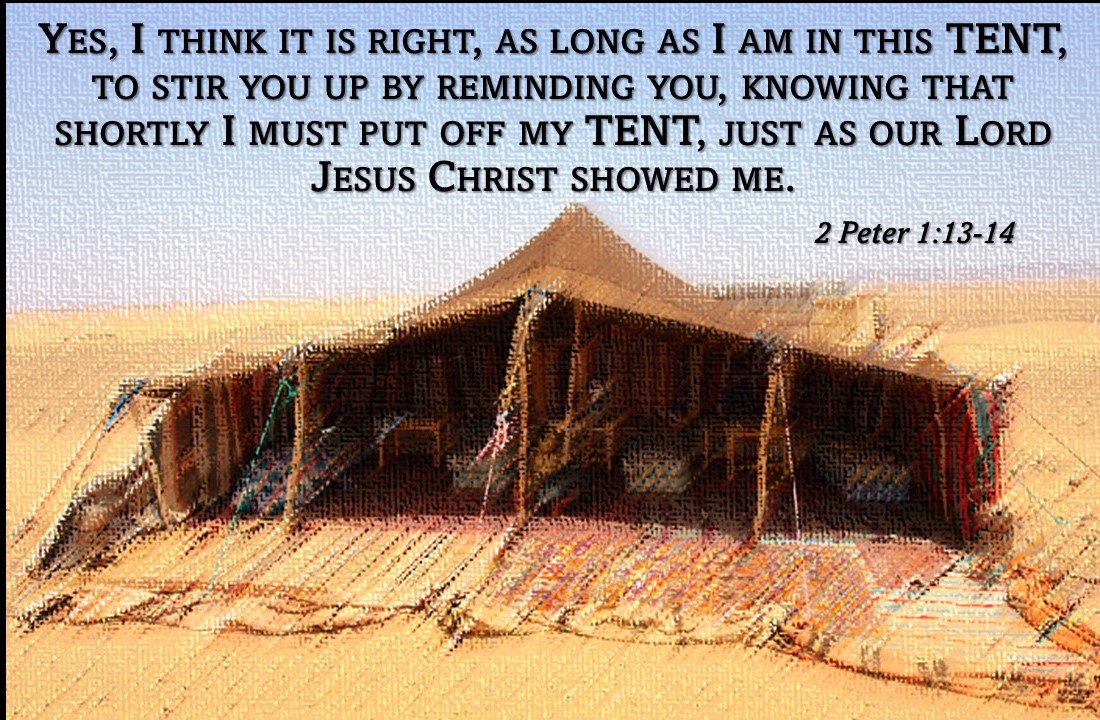
Yes, I think it is right, as long as I am in this tent, to stir you up by reminding you, knowing that shortly I must put off my tent, just as our Lord Jesus Christ showed me. (2 Peter 1:13-14)

It Is Only A Tent

Life seems to be such a complicated affair. Childhood grows into adulthood with many aspirations and goals desired, attained, and wished for. Time is dedicated to the pursuit of a good education resulting in a secure job so that life can be rewarded at the end with a relaxing time of retirement. Families are created. Homes established. Life is filled with the joys of laughter and measured by the sorrows of suffering. Legacies are built, memories cherished, and life is told in endless stories of the abundant years of living to a good old age. The most challenging reality that all men face who live to be of an old age is that everything about life, with all its promise and toil, is nothing more than a temporary dwelling place that Peter calls a tent.

From the beginning of time, men have built cities with established dwelling places for security, comfort, and prosperity. Tent dwellers were more adventurous souls who had no permanence in life, moving from place to place. A tent can be a comfortable place, but it has no sense of endurance or longevity. A building can stand for generations. Tents fade away into nothing over time because they are frail and easily destroyed. The purpose of a tent is to use it for a temporary purpose with no intention of keeping it forever. A tent dweller is a wanderer without a permanent home. Peter described his life in the clearest form as nothing more than a tent, created for a short time and rolled up one day and cast aside.

Life is not permanent. One of the most misunderstood parts of living is the clearest of realities. Nothing is lasting about life. Someone may live one hundred years of age, but they still die. Young people die as well as old people. There is no distinction between male and female, tall or short, rich or poor when it comes to life and death. Everyone – without exception – lives in a tent. The irony is that many tent-dwellers convince themselves they are living in permanent places of glory that will never go away. And then death comes, and they find life is living in a tent like all other men. The saddest part about life is that so few believe that God has promised to give them a permanent dwelling place when living in a tent is over. Most seek to build houses in their tents below, making no provisions for eternity. Jesus said He would prepare a dwelling place for the saved so that men could give up their tents for a heavenly home.

Tent living is hard and has many drawbacks. There will always be things to fix, repair, and keep in place. The truth is the efforts of tent maintenance are fruitless because all tents decay and are destroyed. What God accomplished through His Son was to give all tent-dwellers the promise of eternal life that if they lived in their tents faithful to His word, He would allow them to live in His eternal city that will not fade away. Eternity depends on how a person lives in his tent. Pitch your tent in the grace of God and obey the will of the Father. When it comes time to leave your tent, a dwelling place of eternal glory will be yours. No more tent dwelling. Thank God.

Posted in Uncategorized | Leave a comment

Builders And Complainers

But it so happened, when Sanballat heard that we were rebuilding the wall, that he was furious and very indignant and mocked the Jews. (Nehemiah 4:1)

Builders And Complainers

The task of rebuilding the walls of Jerusalem was daunting. After seventy years, the people of God returned to Jerusalem and found a city in ruin with its walls torn down and gates burned. There was nothing of the former glory of Jerusalem remaining. Those who returned from captivity found hardship and despair as the people began to resettle in the city. The first task was to rebuild the temple destroyed in 586 B.C. It would take twenty years to finish building the temple because of the persecution and infighting among the people. The walls and gates of the city will remain unfinished for almost one hundred years. Ninety years after the first group returns, Nehemiah comes to Jerusalem, and the work of rebuilding begins. In a remarkable feat of leadership, Nehemiah and others rebuilt the city walls and restored the gates in fifty-two days. Like the building of the temple, there was opposition to the construction of the walls.

When Nehemiah came to Jerusalem, he faced opposition from three men: a Moabite named Sanballat and his allies Tobiah the Ammonite and Geshem the Arabian. Sanballat and his friends were upset that Nehemiah had come to seek the well-being of the children of Israel and tried all they could to disrupt and destroy the work of Nehemiah. They were very angry this cup-bearer of the Persian king would come to Jerusalem to impose his will and rebuild the walls. The temple had been finished some seventy years before, but no effort was made to rebuild the walls. Sanballat liked the way things were and had no interest in rebuilding the walls. Any action by Nehemiah was met with disdain and threats. When he heard Nehemiah was rebuilding the wall, he was very angry and flew into a rage and mocked the Jews. He could not see how ignorant Jews could build a wall that could even withstand a fox walking on it.

Nehemiah faced a fierce crowd of critics. He dealt with threats, complaints, fear, and persecution but never gave up. The threats of Sanballat and others did not dissuade him because he knew he was doing a good work for the Lord. Nehemiah believed what he was doing was the work of God, and the Lord would bless their efforts for His glory. Despite all the complaints brought by the critics, the walls and gates of Jerusalem were completed in fifty-two days. Nehemiah saw the work as the will of God, refusing to let those who complained stop his work.

There are two pictures in the story of building the walls of Jerusalem. The first picture shows the laborers and workers picking up the stones and moving them into place. Groups of families took a section of the wall and worked diligently to finish their tasks. Some people did not want to work, so others did their work for them. Men and women joined in the task. Gibeonites worked alongside Meronothites. Shallum, leader of half the district of Jerusalem and his daughters, made repairs. Eliashib, the high priest, along with some Levites and priests, put their shoulders to the task of rebuilding. Goldsmiths and merchants worked on the wall. Those who had a mind to work focused on the building were encouraged by the leadership of Nehemiah.

The second picture in the story of the building of the walls were the complainers, the “non-doers” and “nay-sayers” who had done nothing for many years and were unwilling to do anything now. Ninety years had passed since the people first returned to Jerusalem. The temple was restored, but no one cared about the walls and gates. Sanballat, Tobiah, and Geshem lived in the city and saw the walls broken and the gates burned but never lifted a finger to restore the city of God. They liked the way things were. Even when Nehemiah came to Jerusalem and began work on the walls, the complainers tried to stop the work. They could have joined in under the leadership of Nehemiah and helped, but they tried to stop the work. Why would they not want the walls rebuilt? They did not care for the work of the Lord. Their hearts were satisfied with how things had always been, refusing to see how the city was in ruin.

There are lessons for the church to learn from Nehemiah. The church faces a lot of building and restoring and rebuilding. Some see the need to work, and those who sit with folded hands complain. It is easy to become accustomed to the way things are, content, satisfied, and accept things as they are. Churches will go for decades (and longer) without shepherds to lead them, satisfied the Lord is pleased with their sound doctrine. Evangelism is almost non-existent, worship is lukewarm, hearts are stifled, and young people are lost to the world. There are many reasons for the church’s problems, but it is often because modern-day Sanballat’s discourage the work. The church needs courageous men and women with the heart and spirit of Nehemiah who will do the work of the Lord even when facing criticism. There will always be those who are willing to work and those happy to complain. Don’t wait to be told to work. Roll up your sleeves, and let’s work together in the kingdom of God.

Posted in Uncategorized | 1 Comment

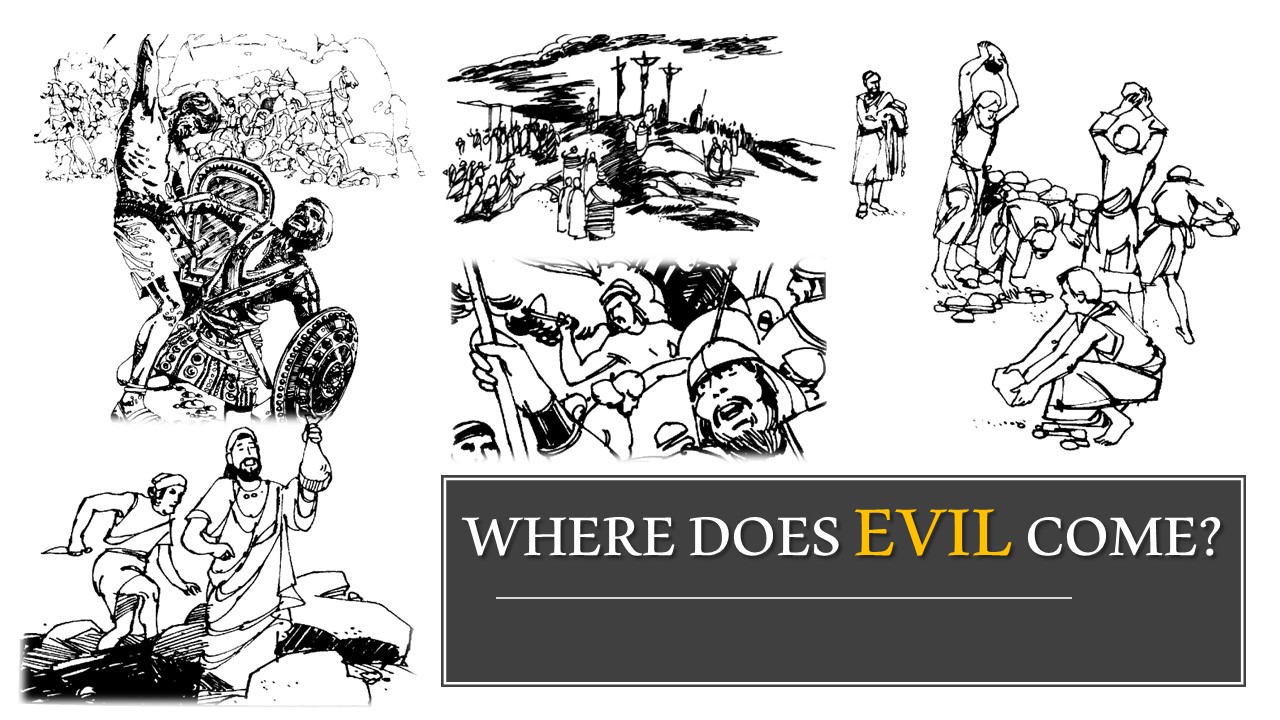
Where Does Evil Come?

When He had entered a house away from the crowd, His disciples asked Him concerning the parable. So He said to them, “Are you thus without understanding also? Do you not perceive that whatever enters a man from outside cannot defile him, because it does not enter his heart but his stomach, and is eliminated, thus purifying all foods?” And He said, “What comes out of a man, that defiles a man. For from within, out of the heart of men, proceed evil thoughts, adulteries, fornications, murders, thefts, covetousness, wickedness, deceit, lewdness, an evil eye, blasphemy, pride, foolishness. All these evil things come from within and defile a man.” (Mark 7:17-23)

Where Does Evil Come?

Adam and Eve experienced the best of both worlds and the evil of the fallen world. They are the only people in the history of humanity that knew what it was like to live in a perfect world and then see firsthand what evil will do. When they disobeyed God in the garden, they felt ashamed and hid from the presence of the Lord. That feeling will pale in comparison to what would happen years later when the firstborn son killed his brother. The murder of Abel was not the first sin in the fallen world. Long before Cain was filled with wrath at his brother, sin had challenged the souls of Adam and Eve. Sin began to multiply as children were born, and the knowledge of good and evil filled their hearts. Cain did not sin for the first time in his life in killing Abel. His heart was on a downward spiral of jealousy, pride, anger, and wrath. A greater sin was crouching at the door, eager to control the spirit of Cain.

Early man understood the will of the Lord to sacrifice offerings in worship. Cain and Abel offered the best of what they had, but Abel’s heart was pure, and Cain’s was not. The Lord did not accept the offering of Cain because his works were evil. It was not the offering of the fruit of the ground God rejected. Cain had evil in his heart. God saw what men could not see. The Lord knew Cain’s path would lead to murder, and He warned Cain. One day Cain and Abel were talking. They were in a field together. Cain was seething with anger, and he attacked Abel and killed him. The scriptures do not reveal the manner Cain killed Abel. He could have picked up a rock or used a knife or a weapon of some kind. Cain killed Abel because of what was in his heart, not his hand.

Jesus describes the nature of evil as a problem of the heart. He uses a parable to define sin when the heart is filled with evil. Eating a piece of chicken does not defile a man because it is consumed and then expelled. Food does not enter the heart. Evil comes from the heart. Sexual immorality does not come from the outside but from a heart filled with the evil desires of the flesh. When a man commits fornication or adultery, punishing the flesh will not address the problem. Sin dwells in the heart. Lust is a byproduct of an evil heart. Whatever Cain used to kill Abel did not kill Abel; the evil heart of Cain killed Abel. Murder is not found in the object but in the heart that has been trained to disregard human life. Herod had no compulsion to send his army into Bethlehem to kill every child two years old and under because his heart was filled with wickedness.

The heart is where sin begins. Whatever motivates a man to commit adultery, murder, steal, lie, or any such thing is something that is first seeded in the heart. The focus is often on the object of the sin rather than the cause of the evil. Cutting off the hand because a man steals may be an object lesson for others but fails to appreciate the real problem in the thief’s heart. Until the heart is changed, the world will continue in evil. All the rhetoric condemning the object of sin will have no impact until God is put back in the heart. It should come as no surprise that every society that methodically removes God from the heart will suffer the consequences of evil hearts killing others. History bears witness to the fallacy of human wisdom trying to unravel the mystery of evil. The presence of evil is the absence of righteousness. Take God away, and man becomes an animal that will devour one another with little or no consciousness. The greatest solution to evil will come when the Lord returns. Lord Jesus, come quickly.

Posted in Uncategorized | Leave a comment

The Hebrews And The Jews

Now it happened, when they spoke to him daily, and he would not listen to them, that they told it to Haman to see whether Mordecai’s words would stand; for Mordecai had told them that he was a Jew. (Esther 3:4)

The Hebrews And The Jews

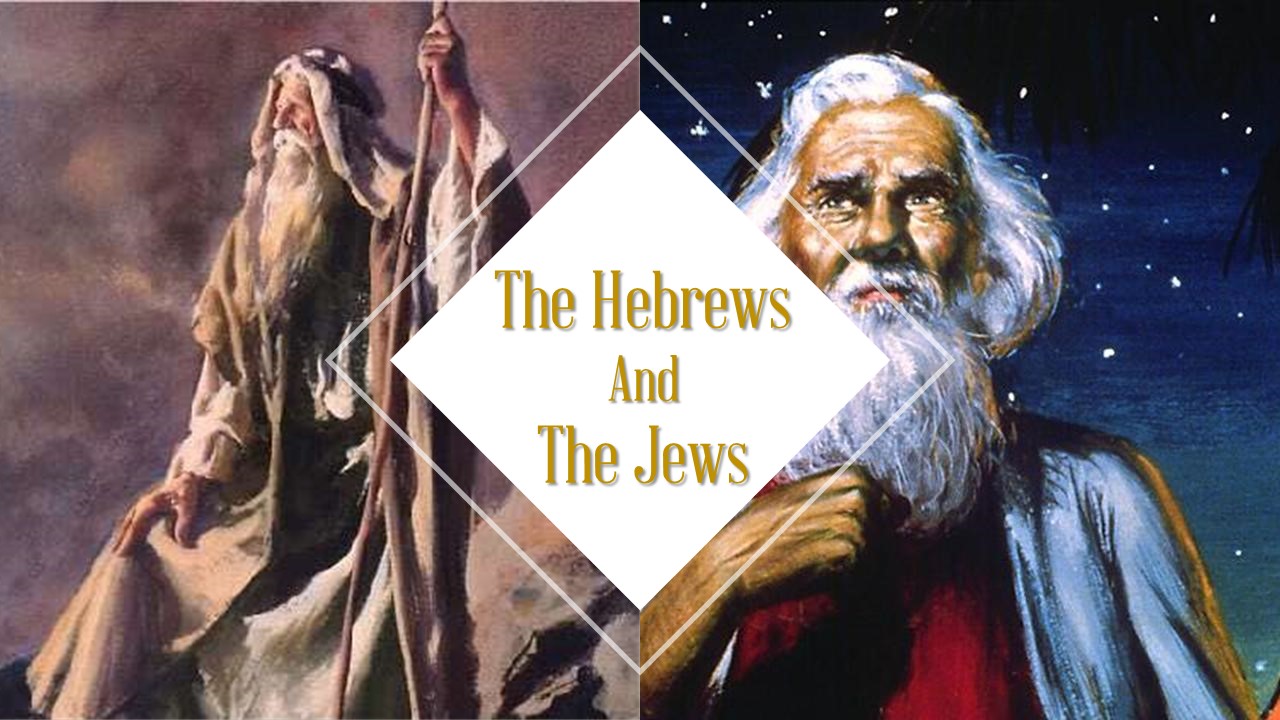
Esther is a book about a Jewish maiden who became queen of Persia. The story revolves around Esther being chosen to replace the first queen of Persia, Vashti, and the conflict between Haman, a prince of Persia, and Mordecai, a relative of Esther. Haman had been promoted by the king to receive honor and glory, but Haman would not bow and give reverence to him. When Haman inquired who Mordecai was, it was reported that he was a Jew. The name Jew was not always a part of the history of Israel. When Abraham came to the land of Canaan, he was called a Hebrew because he had come from the other side of the Euphrates. The Hebrew distinction could have come from an ancestor of Abraham called Eber. As the people of Abraham began to grow, they were known as the Hebrews.

Potiphar’s wife referred to Joseph as the “Hebrew servant.” The Egyptians called the family of Jacob Hebrews. Moses saw an Egyptian beating a Hebrew and the next day saw two Hebrews fighting each other. The term Hebrew became the distinction of the people of Abraham and also became the derivation of their language. The children of Israel came from the lineage of the twelve sons of Jacob. After wrestling with the Man all night, Jacob’s name was changed to Israel. The Hebrew nation would be known as the nation of Israel and its citizens, Israelites. Before the law was given at Sinai, the people were known as the Hebrews. When they became a nation at Sinai, they were the people of Israel. The term Israelite was used by the Jews of themselves among themselves; the term Hebrew was the name by which they were known to foreigners.

Following the death of Solomon, Israel divided into the ten tribes who rebelled with Jeroboam, and the two tribes of Judah and Benjamin remained faithful to Rehoboam. The northern tribes were called Israel and the southern tribes Judah. In 722 B.C. Assyria took Israel captive, and the ten tribes were never heard from again. Judah and Benjamin were carried away to Babylonian captivity in 606 B.C. Before the Babylonian captivity, the remaining Hebrews were called Jews as a corruption of the name Judah. Jeremiah would call his people Jews. By the time of Esther and Mordecai, the people of God are referred to as Jews, a name that will become synonymous with the children of Abraham.

The wise men seeking Jesus called Him the King of the Jews, and the woman at the well called Jesus a Jew. John uses the term Jew extensively in his book, and Luke writing the Acts of the apostles, refers to the Hebrews as Jews. Paul shows the distinction of humanity when he refers to the Jews and the Gentiles (Greeks). There is one lineage of men that come from Adam, and there are those who by heritage comes from Adam through Abraham. While the tribal identities have been lost over time and no Jew can identify which son of Jacob they have descended, they remain Hebrews or Israelites by birth. The Hebrews came out of Egypt and became the Israelites at Sinai. After the fall of the northern tribes and Judah and Benjamin remained, then the Hebrew Israelites became known as the Jews.

Jesus came from the tribe of Judah, and He was called a Jew. God sent His Son to die for everyone called a Jew and all those called Gentiles. In the eyes of God, there is no distinction. The Jews cannot be saved without Jesus, and no Gentile (non-Jew) will be saved without Jesus. Only in Jesus are the Jew and Gentile brought together as one. There is no distinction. Thank God for His mercy and grace to all men.

Posted in Uncategorized | Leave a comment