The Sword In Mary’s Heart

The Sword In Mary’s Heart

In a small village of Galilee, the angel Gabriel came from the Heavenly Father to tell a young maiden incredible news that would change her life and the destiny of mankind. Joseph and Mary were newly wed, unaware of the remarkable change that would take place. Gabriel tells Mary she will have a son by the Holy Spirit, and He will be called Jesus. Nine months after Joseph and Mary travel to Bethlehem of Judea to register for the census, Jesus is born. In accordance with the Law of Moses, the infant son is circumcised on the eighth day and called Jesus. Thirty-two days later, when the days of her purification according to the Law were completed, Mary traveled with her husband and newborn son to Jerusalem to present Jesus at the temple.

There was a man in Jerusalem named Simeon who had been promised by God he would not see death until he had seen the Lord’s Christ. When Joseph and Mary entered the temple, Simeon knew the child they held in their arms was the promised Messiah. He took Jesus in his arms and blessed the young child as the salvation of the world. Joseph and Mary marveled at the words of Simeon. After blessing the young couple, Simeon turns to Mary and tells her words she will never forget. The Child he held in his hand would change the world, but Simeon warns Mary that a sword would pierce her soul because of this little boy’s life.

The early life of Jesus is shadowed under a cloud of unknowns. When Jesus is a few years old, men from the East visit the family, and Joseph and Mary travel to Egypt soon after. After a few years, the family returns to Nazareth, where Jesus will grow into manhood. The son of Mary grows like any other child and enjoys the company of his stepbrothers and stepsisters. Contrary to the doctrine of Roman Catholicism, Joseph and Mary have other sons and daughters. Jesus grows up with siblings. The gospel writer Luke tells of one story when Jesus was twelve years old and amazed the Temple’s scholars. Nothing is known of the next eighteen years of the life of Jesus. There is one certainty that never escapes the mind of Mary – her eldest son is the Son of God.

Of all the people that have lived on the face of the earth, none lived with the absolute certainty that Jesus was the Christ, the Son of the Living God, as Mary did. Jesus was born of a virgin, and Mary was that virgin. She knew who Jesus was. The sword that would pierce her heart was watching her little boy grow into adolescence and then become a young man. Many were the struggles of her eldest son as he lived a perfect life battling the temptations of Satan. Did His siblings understand how unique their elder brother was? How did Mary deal with her grief in losing her beloved when Joseph died? Did she implore God for intercession? At the age of thirty, Jesus began His ministry. He taught the people He was the Son of God; while many believed and followed Him, many more did not. Mary saw the persecution of the Jewish leaders who hated her son, and she remained silent. When Nazareth rejected their hometown son, what did Mary say?

The greatest sword that pierced the heart of Mary was when the final day came that she must have known was coming. Her son was condemned to die at the hands of the Romans. As a mother, she would not have been far from her son as they condemned him and made him carry his cross. Mary watched as they nailed her son to a cross. She grieved in her heart as they lifted her precious little boy up on that cross and saw the agony and pain in his face. Mary remained silent as her soul was ripped with the sword of grief seeing her son’s suffering. She could have cried out, telling the people who He was, but she did not. When Jesus took those precious moments on the cross to tell his mother his love for her and ask John to care for her, could her heartbreak any more? Then Mary saw her son die. The sword had taken its greatest toll.

Simeon told Mary a sword would pierce her soul, and it did – often. Mary took that sword, and the last record of the mother of Jesus was when she assembled with the first disciples of the New Testament church. One can only imagine the role she must have played in the early church and the stories she could tell of her son. A sword pierced her heart all her life, but her sword of grief led her to the kingdom of God and the glory of her son, who was the Son of God. Mary’s faith was an incredible example of eternal love. A mother’s love comes with a sword. Thank you, Mary.

Posted in Uncategorized | Leave a comment

Choose Friends Carefully

After this Jehoshaphat king of Judah allied himself with Ahaziah king of Israel, who acted very wickedly. And he allied himself with him to make ships to go to Tarshish, and they made the ships in Ezion Geber. But Eliezer the son of Dodavah of Mareshah prophesied against Jehoshaphat, saying, “Because you have allied yourself with Ahaziah, the Lord has destroyed your works.” Then the ships were wrecked, so that they were not able to go to Tarshish. (2 Chronicles 20:35-37)

Choose Friends Carefully

During the time of the divided kingdom, Judah was ruled by good kings and evil kings. This was in contrast to the northern tribes of Israel, who endured two hundred years of evil kings. The first two kings of the southern kingdom of Judah were wicked. After the death of Solomon, Rehoboam, his son, did evil in the sight of the Lord, as did the son of Rehoboam, Abijam. After the short rule of Abijam, Asa, his son, ruled for forty-one years and was a good king, followed by the reign of Jehoshaphat. Like his father, Asa, Jehoshaphat was a good king seeking to please the Lord during his twenty-five-year reign. He carried out the religious reforms of his father and was blessed by the Lord to establish his kingdom. The Holy Spirit said of the king that his heart took delight in the ways of the Lord. Jehoshaphat was one of the great kings of Judah.

As good a king as Jehoshaphat was, he had one character flaw that plagued him his whole time as king. He did not distinguish the kind of people he aligned himself with. To his credit, he made peace with the northern tribes of Israel, but Ahab was the king he made peace with. Sealing the covenant of peace, the son of Jehoshaphat, Jehoram, married the daughter of Ahab and Jezebel. Ahab’s daughter, Athaliah, was a wicked woman who would lead her husband to walk in the way of the kings of Judah and rule as an evil king. Her son, Ahaziah, reigned for one year before Jehu assassinated him. Athaliah took the throne and killed all the male members of the house of David except for Joash, who was hidden by Jehosheba. Jehoshaphat could not have realized the impact of his alliance with Ahab that brought about so much evil in Judah.

During the reign of Ahaziah, king of Israel, Jehoshaphat allied himself with the king of Israel. Ahaziah acted very wickedly. The influence of Ahab and Jezebel was strong with the wife of Ahaziah, and the land was filled with the worship of Baal. Jehoshaphat wanted to establish a naval fleet at Ezion Geber, a port on the Red Sea (Gulf of Akabah), to go to Tarshish. The prophet Eliezer prophesied against Jehoshaphat for his alliance with Ahaziah. The ships were wrecked, and the planned navy was lost. Jehoshaphat chose the wrong people to align himself with, and the Lord punished him. It would seem the choices of Jehoshaphat influenced his son Jehoram who killed all his brothers to obtain their wealth.

The type of people chosen to be friends or allies strongly influences the good character of God’s people. Examples abound throughout scripture with the consequences of choosing evil companions that corrupt the good morals of the righteous. There are many examples of the good influences wielded by those who embrace the company of other godly people. The gospel of influence is measured by the kinds of people surrounding the Christian’s friendship. Choosing friends must be done with the greatest care of deciding if that association will help one reach heaven or cause the heart to serve the world. Friends have a powerful sway on the heart of the Christian. Choose wisely and with a great deal of prayer. Your soul may depend on it.

Posted in Uncategorized | Leave a comment

The Spirit Of Bondage

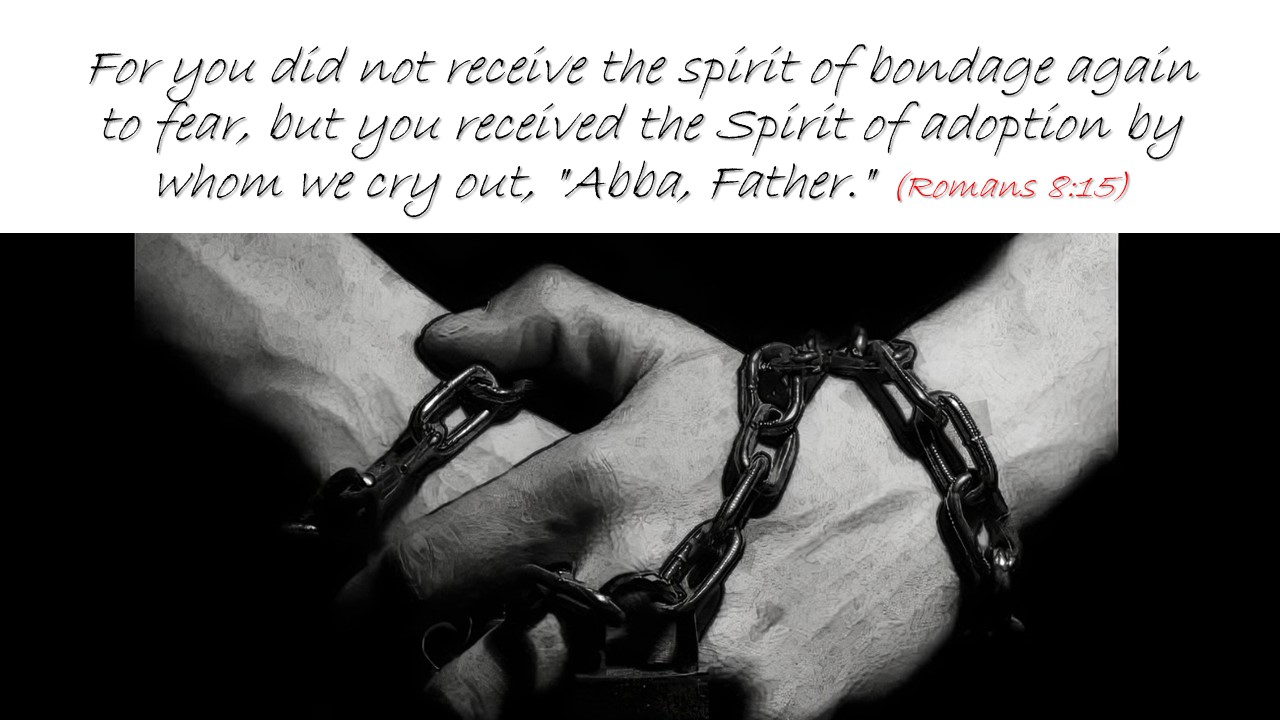
For you did not receive the spirit of bondage again to fear, but you received the Spirit of adoption by whom we cry out, “Abba, Father.” (Romans 8:15)

The Spirit Of Bondage

Freedom is the voice of those who seek to find happiness and joy in life. All men are made free with the ability to choose the course of their lives. Sadly, many become enslaved by their fellow man and, worse, enslaved by their own desires. Slavery is a negative subject that brings many emotions to the surface with repugnance and abhorrence, yet it is common in most people’s lives. There are movements decrying the slavery of men upon others, but what about the personal slaveries that bind men to the deceptive allure of pleasure? The spirit of bondage is the strongest of temptations trapping the soul into slavery of passion, drugs, desire, and uncontrolled habits.

The spirit of bondage is a tool of the devil to take the hearts of God’s people away from Him. It can become a lifelong struggle against chemical addiction, robbing life of health and happiness. Addictions to pornography trap millions of people. Uncontrolled spending by hoarders that cannot stop buying ruins lives. Gambling destroys countless lives every year. The “anonymous” clubs flourish from a harvest of souls enslaved to the spirit of bondage. God does not desire His people to be coupled to the slavery of sin but to find peace and happiness in the Spirit of adoption. True slavery is measured by the type of master that controls the spirit. Enslaving the soul to the flesh’s pleasures always brings heartache and ruin. Seeking happiness in drugs can end in destroying the body and then death. Financial ruin comes from those who cannot stop flittering away the family income.

One of the greatest addictions has become the cell phone. Smartphones have made a population of ‘unsmart’ people who cannot exist without media fixes from myriad apps that tantalize and tease the mind to want more. Children are neglected as parents consume their time staring at the tiny screens. Marriages become loveless as the love of the smartphone ruins the relationship. Young people cannot communicate with others. The spirit of bondage has taken over the souls of God’s people who lack self-control. Worship services cannot be completed without checking the phone. How many Christians can leave their cell phone in the car and go for more than an hour without checking Facebook? The excuse often is the phone is used with a Bible app, and while that is true, can that person honestly say they have never checked other media during worship?

There are many addictions that take the heart away from God. The need to disconnect to reconnect with God is needed now more than ever. Drug use was a prevalent temptation of choice, but now the sophisticated drug of use is the electronic media; known as the spirit of slavery. When the child of God cannot control – cannot control their desires, it becomes sinful. Self-control is one of the hallmarks of the Christian character. The lack of self-control is the lack of devotion to God. Allowing the spirit of bondage to consume the heart will destroy the soul. The Christian is not called of Christ to be enslaved to the bondage of fear. Christians are called to Christ to be people of God who received the Spirit of adoption by whom they cry out, “Abba, Father.” They cry out “allegiance” to the Father. Do not let the spirit of slavery consume the soul. Set yourself free from that which binds you – be free in Christ.

Posted in Uncategorized | Leave a comment

The Saving Of The Household

The nobleman said to Him, “Sir, come down before my child dies!” Jesus said to him, “Go your way; your son lives.” So the man believed the word that Jesus spoke to him, and he went his way. And as he was now going down, his servants met him and told him, saying, “Your son lives!” Then he inquired of them the hour when he got better. And they said to him, “Yesterday at the seventh hour the fever left him.” So the father knew that it was at the same hour in which Jesus said to him, “Your son lives.” And he himself believed, and his whole household. (John 4:49-53)

The Saving Of The Household

Jesus performed many miracles and, in some cases, was not present when the miracle happened. A royal official approached Jesus begging Him to heal his child who lay dying. The nobleman’s son was sick unto death, and the father had traveled some distance to find Jesus. When Jesus told him to return home, and his son would live, the man immediately began his journey home. He was met by a servant who told him the good news of the boys healing the previous day. When the man asked what time of day his son was healed, he learned it was the same hour Jesus had proclaimed him healed. The man believed in the power of Jesus to heal his son, but when the miracle took place, he and his whole household believed.

The impact of raising a child from a deadly disease had its impact not just on the father but on the man’s family. Jesus was not present when the healing took place. As the family worried over their son, around one-o-clock in the afternoon, he was immediately healed. It is unlikely they would have understood it was the moment the father had pleaded with Jesus. When they learned of the timing of the miracle and the power of someone to heal from a great distance, the family believed. Not only did the nobleman believe in the Son of God but his whole family. The scriptures do not give any details about the family, but whoever was part of this man’s family was now a believer in Christ.

There is nothing more powerful than considering the conversion of a family. Seeing one man believe and respond to the gospel of Christ is a wonderful story. Witnessing a man and his whole family responding is an incredible story. This man’s story does not stand alone. Numerous families became believers in the Christ. Luke tells the story of a Gentile named Cornelius, a devout man who feared God with all his household, who gave alms generously to the people, and prayed to God always. After an angel of the Lord told him to send for Peter and he sent his servants to bring Peter, Cornelius made some preparations for the arrival of the preacher. He called together his relatives and close friends to hear the word of the gospel. After Peter arrived and the Holy Spirit fell on those who heard the word, the household was baptized into Christ. Cornelius brought his family to the grace of God.

Paul and Silas were in prison in Philippi. At midnight, an earthquake shook the prison doors and loosed the doors and chains. Fearful the prisoners had escaped, the jailer prepared to take his life. Paul called out to the man and told him everyone was secure. When Peter spoke the word of the gospel to the jailer, he rejoiced, having believed in God with all his household. The household of the jailer obeyed the gospel. In the city of Corinth, Crispus, the ruler of the synagogue, believed in the Lord with all his household. Paul commended various families in his letters. In the Roman letter, he commended the household of Aristobulus and Narcissus, who are in the Lord. When he wrote to Corinth, Paul said he remembered baptizing the household of Stephanas. The household of Onesiphorus often refreshed the apostle Paul in his journeys.

The early church made the family an important part of the work of the kingdom. It does not matter how busy the world can be; the family remains the throbbing heart of the church, the community, and the nation. The church is in dire need of families who are faithful. Generational faith is handed down from one generation to another. What an amazing story to tell of baptizing a family, knowing this family will be an active part of the church. The nobleman who came to Jesus brought his single plea to heal his son and received a greater blessing than he could have imagined. His son was healed, and he praised God for that. Seeing his family believe that Jesus was the Son of God gave him great joy. Nothing in the world matters to a Christian father more than to lead his family to the throne of God in obedience. Families united under God’s saving grace are families devoted to the Lord.

Posted in Uncategorized | Leave a comment

The One Cup Or The Cup?

And as they were eating, Jesus took bread, blessed and broke it, and gave it to the disciples and said, “Take, eat; this is My body.” Then He took the cup, and gave thanks, and gave it to them, saying, “Drink from it, all of you. For this is My blood of the new covenant, which is shed for many for the remission of sins. But I say to you, I will not drink of this fruit of the vine from now on until that day when I drink it new with you in My Father’s kingdom.” (Matthew 26:26-29)

The One Cup Or The Cup?

Passover was one of the most important feasts for the people of Israel. The deliverance from Egypt was the memorial of the grace of God to free the Hebrews and a reminder of the penalty of sin against the nation of Egypt. Jesus spent His final Passover with the twelve in an upper room in Jerusalem. Using the Passover as a backdrop, the Lord institutes the memorial feast that would symbolize the grace of God to free men from sin and remind the world of the judgment of God when the Son returns. The feast included the sacrificed lamb, unleavened bread, and the cups of the fruit of the vine. Each element symbolized the memorial feast of when God saw the blood on the doorpost and lintel of the Hebrew homes and passed over, inflicting no harm but salvation.

Peter and John were instructed to ensure everything was ready for the Passover feast. They found a man carrying a water pitcher on his head and followed him to the upper room where all had been made ready. It was a large room furnished with the lamb, bread, and pitchers of the fruit of the vine. The necessary elements were also prepared such as tools to eat the Passover and drinking vessels for each man. After identifying Judas as a man who would betray Jesus, the Lord took the unleavened bread, and broke it, and gave it to the disciples. They were unaware of any significance of this act as Jesus told them the bread was His body given for them. He then took the cup and gave thanks and gave it to them. This symbolism of the cup was the blood of the new covenant, which is shed for the remission of sins. Again, the disciples knew little of its significance until after Pentecost.  

Judas betrayed Jesus that night, and the Son of God was crucified the next day. On the first day of the week, Jesus rose from the dead. For the next forty days, He appeared to certain disciples explaining the kingdom of God. Jesus ascended to the Father, and ten days later, the twelve apostles were in Jerusalem when the Holy Spirit came upon them. Through the preaching of the gospel, three thousand people were baptized for the remission of sins. Luke describes the early days of the church as a unified body of saints learning the apostle’s doctrine, including the breaking of bread or the Lord’s Supper. Jesus had told the disciples what they must do in organizing the early church. Through the inspiration of the Holy Spirit, the first disciples understood the significance of the memorial instituted by Jesus at Passover. One of the first things the infant church practiced was a weekly remembrance of the death, burial, resurrection, and return of God’s Son. The Lord’s Supper has continued for two thousand years.

Luke is the historian who details much of the beginning and growth of the early church. Through the writings of men like Paul and Peter, the application of the teaching of Jesus and the practice of the early church has been explained. The book of Acts shows how the early church met on the first day of the week to remember the memorial of Jesus in the Supper. Inspired by the Holy Spirit, Paul recounts the institution of the supper showing the saints at Corinth the proper manner of taking the supper. What is not discussed is the manner of the partaking in the utensils or pattern of the supper. The early Christians knew they must keep the supper on the first day of the week. They understood the supper consisted of the fruit of the vine (never referred to as wine) and unleavened bread. Christ ordained the supper as a feast of memorial to honor His sacrifice. It was never the intent of the Holy Spirit to divide the church over whether one cup or multiple cups were used and whether the bread must be on one or multiple plates. Nothing in scripture signifies the kind of grapes to be used; whether purple, red or white. How many prayers are offered during the supper is not discussed. There are many things God has left to the inherent authority of carrying out the command to take the supper.

The Lord took “the cup” because it was symbolic. Using “the cup” to teach “one cup” would suggest the supper must be done in an upper room and only by men. If one element of the supper is emphasized over another, all must join the argument for authority. When division happens because of the number of cups used to carry out the Lord’s will, the meaning of the supper is destroyed, and men fail to honor God. Refusing to take the supper is where the harm comes in denying the pattern of the early church. Is the significance in one cup, or is the significance in the memorial? Jesus shed His blood to save men from sin. That is the honor of taking the supper as a memorial of the feast of salvation.

Posted in Uncategorized | Leave a comment

I Felt Compelled

And Samuel said, “What have you done?” Saul said, “When I saw that the people were scattered from me, and that you did not come within the days appointed, and that the Philistines gathered together at Michmash, then I said, ‘The Philistines will now come down on me at Gilgal, and I have not made supplication to the Lord.’ Therefore I felt compelled and offered a burnt offering.” (1 Samuel 13:11-12)

I Felt Compelled

Saul was the sovereign ruler of the nation of Israel. He was the anointed the Lord set over them to be their king. God knew the people would desire a king, but it was never His desire for His people to seek leadership from men. Because of their wickedness, they had asked for a king for themselves. Despite their desire for a king, the Lord would not forsake them. He promised to care for them, and Samuel said he would pray for the nation to be blessed. The warning from Samuel to Saul and the people is they must fear the Lord and serve Him in truth with all their hearts, and they will be blessed. If they did wicked in the sight of the Lord, He would punish them.

Two years into the reign of Saul, the king gathers an army of three thousand men. He attacks the Philistines in Geba and defeats the city. The Philistines gather an army of thirty thousand chariots, six thousand horsemen, and an army like the sand of the seashore. When the people saw the massive army of the Philistines encamped in Michmash for war, they were terrified. Saul remained in Gilgal with an army trembling in fear. He knew it would take the power of the Lord to defeat such a large army, and he waited for Samuel to make intercession for the nation.

Seven days passed, and Samuel had not come when he said he would show. With each passing day, the people were more afraid, and Saul watched his army diminish. As king, he must be a man of courage and show a decisive spirit to stand against the massive army of the Philistines. He waited for Samuel, but Saul became frustrated the prophet did not come at the prescribed time. Days passed, and no Samuel. After the seventh day, Saul could wait no longer. He ordered the burnt offering to be brought, and he would make the sacrifice to the Lord. As king, he believed he had the authority to carry out the work of the prophet, who had delayed his coming, and to fight against the Philistine army. He was wrong.

Just as Saul was finishing the burnt offering, Samuel arrived. Saul went out to meet and welcomed the prophet with great eagerness. Samuel knew what Saul had done and asked him why he had disobeyed the command of the Lord. Saul defended his actions suggesting the people were restless as the Philistine army stood ready before them. He was unsure if Samuel would arrive in time to make the sacrifice, and if the Philistines attacked, the people of God would be destroyed. Saul tells the prophet he was compelled or forced to make a decision to make the sacrifice since Samuel had delayed his coming.

Was there fear in the camp of Israel standing before the army of the Philistines? Samuel had promised to come in a certain amount of time to make the sacrifice, but he had not come in the time prescribed. Could the enemy attack God’s people and destroy them with such a vast army? Was there not a need for a sacrifice to be made imploring the intercession of the Lord? Did it matter in this time of danger if Samuel made the sacrifice, or could Saul, as king, make that decision? Was not the action of Saul in the best interest of the people? Many questions could be answered in favor of Saul making the sacrifice, with the exception of one vital part of the equation: Saul had no authority to usurp the will of God.

Saul felt compelled to make the sacrifice, but he did not keep the commandment of the Lord. His heart was not true to the word of God. Samuel was the one who should have made the sacrifice. The king had no right to take the authority of God’s divine plan to fit his own need. He stood condemned for challenging the word of the Lord for an action that human wisdom viewed as acceptable. The intention of Saul was noble, but it was wrong. His desire was right, but his actions were disobedient. It did not matter to God what Saul felt compelled to do if it was not in keeping with the word of God.

The decision of Saul to make an unlawful sacrifice is seen in the religious world where men have taken upon themselves their own kind of law. Saul made an unlawful sacrifice by fitting the law of God to his needs. He did not trust the Lord knew what He was doing. In the mind of Saul, God did not understand the situation. Often in the lives of God’s people, the will of the Lord is challenged because human wisdom knows better than God. People will change the word of God to fit their own wisdom. Look at all the religious division where supposed followers of Jesus make the Bible fit their own dogmas, doctrines, and decrees and then praise the Lord for His abundant mercies. Saul made a sacrifice, and it was probably exactly like the sacrifice should be made. What made the sacrifice unlawful was Saul had no authority. If there is no Biblical authority, men serve the will of men; not God. Let the Bible speak and let men’s hearts follow God’s will. An old saying fits the occasion: “Where the Bible speaks, we speak. Where the Bible is silent, we are silent” (Thomas Campbell, 1809). Good advice.

Posted in Uncategorized | Leave a comment

The Decreasing Christian

You yourselves bear me witness that I said, ‘I am not the Christ,’ but, ‘I have been sent before Him.’ He who has the bride is the bridegroom; but the friend of the bridegroom, who stands and hears him, rejoices greatly because of the bridegroom’s voice. Therefore this joy of mine is fulfilled. He must increase, but I must decrease. (John 3:28-30)

The Decreasing Christian

John the Baptist was born for a special work in the ministry of Jesus. Like Elijah, he would seek to bring the people to the coming of the kingdom and the promised Christ. His work would prepare the people for the coming of the Lord. John would seek to turn the hearts of the fathers to their children and cause those who are rebellious to accept the will of God. The work of John preceded the ministry of Jesus. Multitudes came to John to hear his preaching and to be baptized. Jesus and John never worked together, but their missions were similar, with one exception: John knew his work was limited and the work of Jesus was unlimited.

John began his ministry when he was thirty years of age and died within a few years at the hand of Herod, the king. Some thought John was the promised Christ, and he repeatedly reminded them he was not the Christ, but he had been sent before the Lord as one who prepared the way. It was never the intention of John to supplant the work of Jesus. John knew his work was on a short leash, and his work would prepare the way for the greater effort of Jesus. Like the friend of the bridegroom, John was not the focus of the world, but the eternal bridegroom, Jesus, should receive the glory and honor of the Father. John knew the work of Jesus must increase, and the work of John must decrease. The more Jesus was in the world; the less John was center stage. He literally faded from sight, so the glory of God’s Son shone in a dark world.

There is a spiritual reality when a man becomes a Christian. The glory of man is his identity, character, and personality. That spiritual reality is the longer one serves the Lord Jesus Christ, the less he becomes himself and the more he becomes the image of the Son of God. The statement of John the Baptist that he must decrease while Jesus is magnified is the pure essence of a Christian’s life. Everything about the life of a child of God becomes more the imitation of Jesus in identity, character, and personality. The Christian knows his life is short and that all that identifies him must decrease while the personification of the Son of God increases. This comes about by faith and knowledge of the word of God. The deeper a man penetrates his soul into the character of Jesus, the more he becomes like the Son of God.

The purpose of life must always be to decrease the man and increase the Christ. Life is not about the identification of this life. Changing into the image of Jesus is the metamorphosis of the soul from the carnal to the eternal. As a light that penetrates the darkness of a sinful world, the Christian life shows the glory of God to those around him. That is accomplished when the man becomes like the Baptist – a transformed life. John the Baptist glorified God by decreasing so the glory of Jesus Christ would increase. In the life of the Christian, his purpose is to glorify God to the dimming of self so that Christ may be exalted in all things. Then, and only then, can the man of God know the depth of God’s love in saving him from wrath. Decrease me – increase Jesus.

Posted in Uncategorized | Leave a comment

Rejecting The Prayer Of Jesus

“I do not pray for these alone, but also for those who will believe in Me through their word; that they all may be one, as You, Father, are in Me, and I in You; that they also may be one in Us, that the world may believe that You sent Me.” (John 17:20-21)

Rejecting The Prayer Of Jesus

The moment of Jesus’ death was imminent, and Judas was gathering the soldiers and leaders to betray the Lord. Thursday night was filled with deep emotion for Jesus. He had taken His last Passover with His beloved twelve, announced the betrayal of Judas and Peter, and washed the feet of the apostles. Using the backdrop of the Passover feast, Jesus instituted the memorial of the feast that would unite the world under one banner of truth. The Lord’s final supper was to establish the nature and character of the kingdom. Through the sacrifice of Jesus and the blood of the cross, the church would be founded upon the eternal plan of the Father so the world would believe Jesus as the Son of God.

Following the supper and Judas leaving the upper room, Jesus and the eleven begin walking to Gethsemane. As they walk, Jesus continues to teach His disciples about the will of His Father. He offers a prayer for Himself and the eleven as they are unaware of what Judas is doing and how his actions will change the world. Jesus also prays for generations yet born. He sees beyond the scope of the cross to the day when the gospel will be preached in Jerusalem, and many will find salvation in His blood. Jesus knows the infant church will struggle as it grows, but the power of the gospel will touch thousands of hearts, and the joy of eternal life will be discovered. He knows all too well that Satan will weave his threads of apostasy into the church, and men will follow the wiles of deception. Jesus prays for all believers to be one, united under the single banner of His word and the will of the Father.

The prayer of Jesus is a powerful testimony to the desire of Christ for all believers to be one in Him. He never intended for a division to mar the character of the church. Those who believed in Jesus through the word in the first century only knew one church. There were no other churches, denominations, or faiths declaring Jesus as Lord. Paul would later declare there was only one body, one church. The world of the New Testament argued about how many gods there were, but there were no debates about how many churches. Paul standing on Mars Hill in Athens, was bold to declare there was one God. He never preached about the multiplicity of churches as the divine pattern of God. Reading the pages of the New Testament will show there was only one church and body of Christ.

Fifteen hundred years would pass before the apostasy turned a more productive turn. Within six hundred years of Pentecost, the mother of apostasy would be born in the Roman Catholic Church. From the womb of lies and false doctrine, protestant churches would spring from her belly as illegitimate children of an apostate mother. Churches began to multiply and stand under their own banners declaring allegiance to Christ. Religious leaders herald that all churches are one, but no unity exists. There is no unity in name, organization, method of membership, plan of salvation, or acceptance of the Bible as the word of God. The prayer Jesus offered on the night He was betrayed is now betrayed by a religious world filled with apostate churches.

Jesus prayed that all believers be one. Can anyone truthfully say the churches in any community are one? They may band together in a loose form of unity, but they return to their form of religion apart from the patterns of others. Can a Baptist be a Baptist in a Lutheran Church? Is it possible for a Methodist to be a Methodist in a Nazarene Church? Baptist worship as Baptist, Lutherans as Lutherans, Methodist as Methodist; and the list goes on. Jesus prayed that all those who believed in Him through the word be one. That unity is likened to the unity of Jesus and the Father. Through that unity, the world will come to know Jesus Christ. Because of the division clearly defined in modern-day religion, the world cannot know that Jesus is the Son of God.

The prayer of unity demands unity. Jesus prayed for unity, but men must obey His word to fulfill that prayer. Just because Jesus prayed for unity does not mean it automatically happens. His desire for all believers to be one must be met with obedient hearts willing to reject the false teachings of human wisdom and embrace the unity of God’s word. The world will be more receptive to the gospel when they see true believers living out the prayer of Jesus. Unite in the word of God. Reject the word of men.

Posted in Uncategorized | Leave a comment

The Perfect Genealogy

Now Jesus Himself began His ministry at about thirty years of age, being (as was supposed) the son of Joseph, the son of Heli, the son of Matthat, the son of Levi, the son of Melchi, the son of Janna, the son of Joseph, the son of Mattathiah, the son of Amos, the son of Nahum, the son of Esli, the son of Naggai, the son of Maath, the son of Mattathiah, the son of Semei, the son of Joseph, the son of Judah, the son of Joannas, the son of Rhesa, the son of Zerubbabel, the son of Shealtiel, the son of Neri, the son of Melchi, the son of Addi, the son of Cosam, the son of Elmodam, the son of Er, the son of Jose, the son of Eliezer, the son of Jorim, the son of Matthat, the son of Levi, the son of Simeon, the son of Judah, the son of Joseph, the son of Jonan, the son of Eliakim, the son of Melea, the son of Menan, the son of Mattathah, the son of Nathan, the son of David, the son of Jesse, the son of Obed, the son of Boaz, the son of Salmon, the son of Nahshon, the son of Amminadab, the son of Ram, the son of Hezron, the son of Perez, the son of Judah, the son of Jacob, the son of Isaac, the son of Abraham, the son of Terah, the son of Nahor, the son of Serug, the son of Reu, the son of Peleg, the son of Eber, the son of Shelah, the son of Cainan, the son of Arphaxad, the son of Shem, the son of Noah, the son of Lamech, the son of Methuselah, the son of Enoch, the son of Jared, the son of Mahalalel, the son of Cainan, the son of Enosh, the son of Seth, the son of Adam, the son of God. (Luke 3:23-38)

The Perfect Genealogy

The study of family lineage has always been a part of the human landscape. From early times, charting the course of a seed line has been a vital part of establishing bloodlines and kinships, whether to determine a monarchy or family curiosity. With the recent death of Queen Elizabeth II, the question of succession to whom would receive the crown was foremost on the minds of the world. Queen Elizabeth can trace her ancestry as a direct descendent of Henry VII (1457-1509). Through Victoria (1837-1901) and several other of her great-great-grandparents, Elizabeth is directly descended from many British royals. However, tracing her lineage throughout the generations back to the first man Adam is impossible. Many lineages show a lengthy course of history, but none compared to the genealogy of Jesus Christ.

Genealogy comes from the Greek meaning “the making of a pedigree.” The family tree of Jesus is given by the gospel writers Matthew and Luke. Matthew’s gospel is directed toward the Jewish mind proving that Jesus was a descendant of Abraham. Jesus was of the tribe of Judah, the fourth son of Jacob and Leah. The pedigree of Jesus of Nazareth was necessary to establish the change in the priesthood, as pointed out in the book of Hebrews. As the High Priest of the new covenant, Jesus would disannul the Law of Moses through the priesthood of Melchizedek instead of Levi. Luke presents the humanity of Jesus, tracing his lineage back to Adam. As a first-rate historian, Luke thoroughly investigated the story of Jesus but knowing the family tree of Jesus would only come through divine knowledge. The Holy Spirit outlined the complete historical genealogy of Jesus to show that Jesus was the answer to humanity’s lost condition. Jesus emptied Himself of the divine to dwell on the earth as a man experiencing all of the trials and travails of human flesh. It would mean little if Jesus was not a man. The genealogy presented by Luke shows the incredible sacrifice Jesus made.

How many people can trace their pedigree without interruption to the Garden of Eden? The only man who has ever shown His genealogical history in complete form is Jesus Christ. His family pedigree is one of the testimonies of the divine nature of the word of God. The Jews valued genealogy to a level of worshiping lineages. Paul warned the early Christians against putting too much stock in foolish discussions about spiritual pedigrees or quarrels and fights about obedience to Jewish laws. The lineage of Jesus in Matthew and Luke’s gospel is the thumbprint of the Lord God to show divine royalty. Only through God’s divine providence can the lineage of Jesus be perfected through the word passed down from generation to generation. The past of Jesus affirms our future. He is the Son of God. Check His pedigree. It’s perfect.

Posted in Uncategorized | Leave a comment

Why Do People Do Evil?

Thus King Rehoboam strengthened himself in Jerusalem and reigned. Now Rehoboam was forty-one years old when he became king; and he reigned seventeen years in Jerusalem, the city which the Lord had chosen out of all the tribes of Israel to put His name there. His mother’s name was Naamah, an Ammonitess. And he did evil because he did not prepare his heart to seek the Lord. (2 Chronicles 12:13-14)

Why Do People Do Evil?

After the death of Solomon, Rehoboam, his son, reigned in his place. Under David and Solomon, the nation of Israel united and became the greatest nation in the world. The Lord blessed Solomon with great wisdom, power, prestige, and possessions but the son of David let his foreign wives carry away his heart. As the grandson of David and son of Solomon, Rehoboam should have seen the power of God working in the lives of these two great men. Israel was a prosperous nation through the grace of God. When his father died, Rehoboam began dismantling the nation with his oppression of the people leading to a civil war. Jeroboam, the son of Nebat, led a revolt against Rehoboam and tore ten tribes away from Judah and Benjamin. The fractured kingdom would never recover.

When Rehoboam established himself as king, he abandoned the law of God, and the people followed his apostasy. After Shishak, king of Egypt, came against Jerusalem, the Lord did not permit the Egyptians to conquer Rehoboam, but Shishak ransacked the treasuries of the Lord’s Temple and the royal palace. He stole everything, including all the gold shields Solomon had made. Rehoboam humbled himself, but his heart was not devoted to the Lord. The legacy of Rehoboam was he did evil in the sight of the Lord because he did not prepare his heart to seek the Lord. He did not seek after God with all his heart. The nature of sin strongly influences men to rebel against the Lord God. Rehoboam’s evil came through neglect of preparing his heart to heed the word of God.

The first words of the devil to Eve were to challenge the word of God. Satan knows that if he can keep the heart from giving devotion to the Lord, he has a measure of success that can lead to total destruction. What did Rehoboam lack in knowing the word of God? Everything needed to follow the word of the Lord was available for the king to read and heed, but he allowed evil to cover his heart. Evil comes when men do not prepare their hearts to seek the word of the Lord. There are only two choices a man can make: serve God or rebel against the word of God. Evil comes when men choose to follow their will.

Human wisdom tries to rationalize where evil comes from, but the origin of evil is when the heart rejects God. Sin is the problem. Sexual immorality is not because of some psychological failings or mental condition. It is a matter of the heart. Anger and hatred grow from evil hearts. Addictions come from hearts unprepared to face the reality of sin. Men try to find answers to why evil exists, and some will blame God. The reason evil exists is that the heart of men grows worse and worse. In the days of Noah, God saw that every intent of the thoughts of the heart was only evil continually. Pharoah was evil because he hardened his heart. Satan entered the heart of Judas to betray Jesus. Peter condemned Ananias and Sapphira because they conceived evil in their hearts. Evil hearts come from those who refuse to prepare their hearts for God. Rehoboam should have listened to his father, who wrote that men must keep the heart will all diligence, for out of it spring the issues of life. A heart left unguarded will fail.

Posted in Uncategorized | Leave a comment