The Memorial Stones

And it came to pass, when all the people had completely crossed over the Jordan, that the Lord spoke to Joshua, saying: “Take for yourselves twelve men from the people, one man from every tribe, and command them, saying, ‘Take for yourselves twelve stones from here, out of the midst of the Jordan, from the place where the priests’ feet stood firm. You shall carry them over with you and leave them in the lodging place where you lodge tonight.'” (Joshua 4:1-3)

The Memorial Stones

God wants His people to remember. The function of the memory is given by the Creator as a tool to guide the spirit of man to the throne of God. Memorials are as ancient as the world. Great feats are remembered, courageous men are honored, and stories are immortalized in memorials. When the children of Israel crossed the Jordan River to enter the land of promise, God wanted memorial stones erected to remind them of the One who brought them there and gave them the land.

The twelve tribes of Israel were represented by one stone taken from the midst of the Jordan River. Like crossing the Red Sea forty years before, the people would cross the flooded Jordan River on dry ground. The priests bore the ark of the covenant before the people, and when their feet dipped in the water’s edge, the waters flowing downstream stood still and rose up in a heap. Then, the priests stood still in the midst of the Jordan as all of Israel (nearly two million souls) crossed on dry land.

After the people crossed the Jordan, Moses told the people to take twelve men from each tribe and gather twelve stones from the midst of the Jordan. These stones would form a memorial at Gilgal for the people to know who delivered them and gave them the land of milk and honey. As a sign of the power of God, the memorial stones will tell how the flooded Jordan stood up and the people crossed on dry ground. The peoples of the earth would know the hand of the Lord, that it is mighty, and to fear the Lord God forever.

The Lord has given the church memorial stones to cause the people to remember. Jesus stood in the midst of Hades and stopped the power of death. The hand of God permitted the hands of men to kill His Son. Only through the mighty power of the Father did the Son offer Himself as the lamb for sacrifice to redeem sinful man. The Lord’s Supper is a memorial feast to remind the people of God of the price paid, allowing them to enter the eternal promised land. Each first day of the week is a time to ask, “What does this memorial mean?” As an everlasting memorial, the Supper turns the hearts of the penitent to the love of God, His power to redeem man, and the ultimate sacrifice of Jesus on the cross.

Joshua set up the memorial in Gilgal. Jesus established His memorial in Gethsemane when He gave Himself willingly to the angry mob. The Lord’s Supper was given by Jesus earlier that night as a reminder of God’s love. On the following day, Jesus suffered on a cross of wood and died. The memorial stones had turned to wood. Jordan could not hold the Son of God, and on the third day, Jesus rose. When the children ask what the memorial of the Supper means, they must be told this is where Jesus crossed over Hades and conquered death. The sting of death is dried up. Jesus has given the victory to God’s people. Lord, come quickly. The land of promise awaits.
Posted in Uncategorized | Tagged , , , , , , , , , , , , , , , , , , , , , , , , , , , , | 2 Comments

Here I Raise My Ebenezer

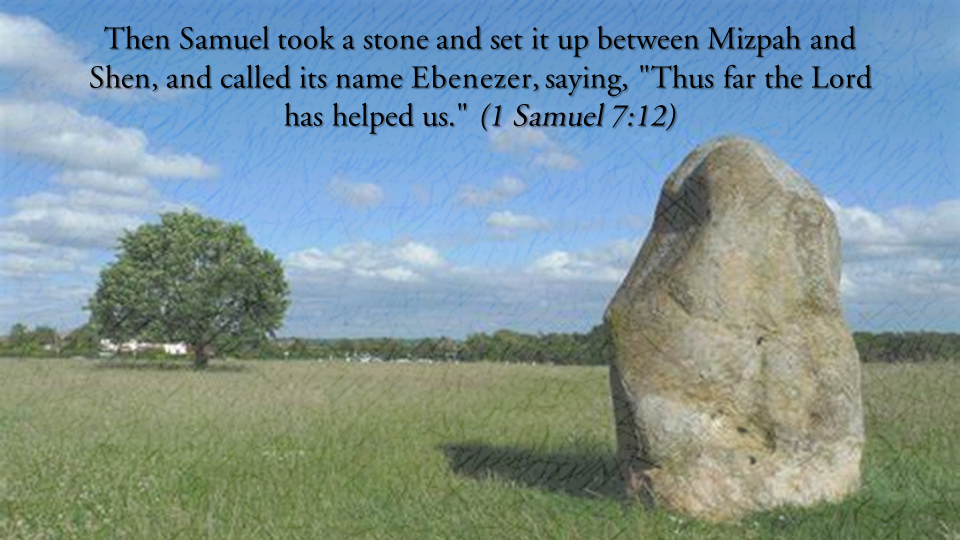
Then Samuel took a stone and set it up between Mizpah and Shen, and called its name Ebenezer, saying, “Thus far the Lord has helped us.” (1 Samuel 7:12)

Here I Raise My Ebenezer

The history of the nation of Israel and the Philistines was a time of perpetual conflict. God had told the first settlers of Canaan to destroy all of the people of the land, but they were unwilling. During the period of the Judges, Israel was constantly plagued with the nations around them. In the final days of Eli, the Philistines captured the ark of God. After seven months, the Philistines were plagued by God and returned the ark to Israel. It remained at Kirjath Jearim for twenty years.

Samuel began to judge the people after the death of Eli. He commanded the people to put away their pagan gods, such as Baal and the Ashtoreths. Gathering Israel at Mizpah, Samuel prayed to the Lord to forgive the sins of the people as they repented. When the Philistines heard of Israel gathering at Mizpah, the lords of the Philistines came to make war. The people cried out to Samuel to save them. Samuel made a sacrifice before the Lord, and the Lord answered. As the Philistines drew near, God thundered with a loud thunder that so confused the Philistines that they were overcome. The men of Israel defeated the Philistines and subdued them, so they did not come anymore into the territory of Israel. As long as Samuel lived, the hand of the Lord was against the Philistines.

After the great victory over the Philistines, Samuel took a stone, set it up between Mizpah and Shen, and called it Ebenezer. The great prophet and judge said, “Thus far the Lord has helped us.” Ebenezer means “Stone of Help.” As a memorial stone, Ebenezer reminded the people of the power of God to deliver them from the Philistines. This was not the first memorial given by God. The Passover feast was given to remind the people of their deliverance from bondage. In giving the Ten Commandments, God begins by reminding Israel that He brought them out of the land of Egypt, out of the house of bondage. Ebenezer was a testimony to the deliverance by the power of God.

There is an Ebenezer for the people of God that remains. It is not a stone somewhere in the desert or a place on Earth where men can assemble. The Stone of Help is Jesus Christ, the Ebenezer for God’s people. In the days of Samuel, the Philistines did not come up against Israel because God protected them. The Lord promised to protect them, and Ebenezer reminded them of His grace. Jesus Christ is the Way, the Truth, and the Life. He is the Great Shepherd who will guide His people and protect them. Satan has no power against those who trust in the spiritual Ebenezer.

The Lord’s Supper is an Ebenezer reminding the people of God of the blessings of the Father to send His only begotten Son. It is a weekly remembrance feast showing God’s grace and mercy to forgive the sins of disobedient people. As Samuel put up the stone to remind Israel of God’s providence and care, the supper of the Lord reminds the faithful of the enduring love of God to care for His people. Robert Robinson writes, “Here I raise my Ebenezer, hither by thy help I’ve come. And I hope by thy good pleasure, safely to arrive at home. Jesus sought me when a stranger, wandering from the fold of God. He to rescue me from danger, interposed His precious blood.” (O Thou Fount Of Every Blessing; 1758)

Posted in Uncategorized | Tagged , , , , , , , , , , , , , , , , , , , , , , , , , , , , , , , , , , , , , | Leave a comment

Original Sin

Original Sin

Adam and Eve lived in a perfect world where they could walk in the cool of the day with the Lord. Everything they needed was provided for them. They were both naked, and there was no shame. The Lord planted two trees in the midst of the garden where they could find life and death. God told them they could eat of the Tree of Life but prohibited them from taking of the Tree of Knowledge of good and evil. Satan deceived the woman into believing the word of God was wrong and unfair. Eve looked at the forbidden fruit with longing eyes, desiring to be wise and be like God, and took of the fruit. She gave some to Adam. Immediately, their eyes were open, and they both knew they were naked. Sin brought about the consciousness of guilt as they hid themselves from the presence of the Lord.

God would cast the man and woman out of the garden, and sin would reign in the hearts of men. Animal sacrifice would not suffice to stop the wrath of God, and only through the blood of Jesus Christ was peace found between man and God. Grace is given through the will of the Father to those who would obey Him. Each person is responsible for their actions and stands accountable individually before the Lord God. Everyone will be judged according to the works in their lives, whether good or evil. Jesus died to offer men the avenue of escape if they choose to submit to the will of the Father. No man is forced to submit. It is a private decision held within the trust of a single heart. Most will deny Christ, and only a few will be saved.

The question of salvation has always been the problem of men. Satan continues to deceive people into believing the lie. One such doctrine is the idea of original sin or Adamic sin. This doctrine puts into question the moral character of all men to accept that all are born in sin, corrupt, and guilty of sin at birth. John Calvin wrote, “Original sin seems to be a hereditary depravity and corruption of our nature, diffused into all parts of the soul, which first makes us liable to God’s wrath. (Institutes, II, 1536) The Westminster Confess of Faith says, “We are utterly indisposed, disabled, and made opposite to all good, and wholly inclined to all evil” (Formulary of the Presbyterian Church of Scotland, 1643).

Original sin is inherited, not acquired. This doctrine is the bedrock of Calvinism with the acronym TULIP. Total depravity: the belief that sin affects every aspect of human existence and makes humans unable to choose God by themselves. Unconditional election: the idea that God decides who will be saved based on his own will and not on human merit or condition. Limited atonement: the belief that Christ died only for the elect and not for the whole world. Irresistible grace: the belief that God’s grace is effectual and cannot be resisted or rejected by the elect. Perseverance of the saints: the belief that the elect will remain faithful and secure in their salvation until the end. If one stands, they all stand. Destroying one will destroy the others.

When Adam and Eve took the forbidden fruit, they unleashed on the world the plague of sin. Cain was guilty of killing Abel because Cain made a choice. Adam did not kill Abel; Cain killed Abel. God put a mark on Cain, not on Adam. Noah was saved by grace because he was obedient along with the seven. All those destroyed outside the ark were guilty of their sin. Paul affirms in Romans 5:12 that death spread to all because all sinned. Everyone is subject to death because the tree of life is destroyed. Sin is a choice of the individual.

The Law of Moses taught fathers could not be put to death for the sins of their children (Deuteronomy 24:16). Ezekiel explained the father was guilty of his sin, and the Son was guilty of his sin. The proverb heard among the captives in Babylon was, “The fathers have eaten sour grapes, and the children’s teeth are set on edge” (Ezekiel 18). This suggests the blame for the children comes from the fathers. God denied their proverb, claiming the children were guilty of their own sin. The soul who sins shall die.

Original sin has led to many false doctrines (mentioned above, TULIP). The reason many embrace infant baptism is because of the teaching of original sin. How can babies sin without knowledge? John said sin is a transgression of the law (1 John 3:4). Paul wrote, “I would not have known sin except through the law. For I would not have known covetousness unless the law had said, “You shall not covet” (Romans 7:7). Each will give an account of their sins, not their fathers (Romans 14:12; 2 Corinthians 5:10). David Riesman explains, “A concept of original sin is typical of a view of life which makes the past an authority over the present.”

If we all bear the sin of Adam, who will Adam blame?

Posted in Doctrine | Tagged , , , , , , , , , , , , , , , , , , , , , , , , , , , , , , , , , , , , , , , , , | Leave a comment

Good Advice For A Chaotic World

Repay no one evil for evil. Have regard for good things in the sight of all men. If it is possible, as much as depends on you, live peaceably with all men. Beloved, do not avenge yourselves, but rather give place to wrath; for it is written, “Vengeance is mine, I will repay,” says the Lord. Therefore “If your enemy is hungry, feed him; if he is thirsty, give him a drink; for in so doing you will heap coals of fire on his head.” Do not be overcome by evil, but overcome evil with good. (Romans 12:17-21)

Good Advice For A Chaotic World

It is a hard world to live in with all the anger and hatred manifesting in road rage, yelling contests in stores and restaurants, families fighting, and disrespect for authority. There is nothing new about the conditions of the world because sin has mangled the spirit of man since Adam and Eve lost the garden. God has always told man how to live peacefully in a world of conflict.

When men live outside the laws of God, there will be hatred. The children of God live by a law that governs their emotions to serve others with love and compassion. Paul offers some advice on living in a world of chaos that would be well to heed.

Evil abounds in the world, and evil men will always bring sorrow and heartache for their own purposes. The Christian does not pay back evil deeds with more evil. Jesus described the child of God as one who loves others, seeking their good and proper welfare. The singular desire of the Christian is to do everything they can to live in peace with everyone. This will be a challenge in a world that challenges a life of faith, but it can be done.

One of the main ingredients to the character of the Christian is his peaceable spirit. He does not seek to bring evil to others. He desires to bring the joy of Jesus Christ to those who do evil. It takes courage not to avenge wrongs or injustice. Rising above the noise of the world seeking its own ways is where the Christian shines the most.

The workplace can be a competitive world of backbiting, backstabbing, and vicious wranglings. For the Christian, his example is one of godliness and kindness toward others. As a disciple of Jesus Christ, the Christian brings calm to the workplace as they let their light shine by doing good. Evil is not repaid with evil, vengeance is not rewarded with anger, and evil is overcome with good.

Families are torn apart with jealousy, anger, yelling, and hatred. For the child of God, their family is an example of goodness to one another and to others. As neighbors in a community, their home is a model of godliness and caring for others. The challenge Paul offers is the example of the Christian spirit feeding enemies that are hungry and giving them drink when thirsty. What this does is bring peace by doing good and shining the light of righteousness in the lives of those filled with the evil of the world.

Vengeance belongs to God and should be left to His will. It is not the place of the Christian to execute righteousness judgment on those whom the Lord will judge. Those who profess a love of Christ show by their example a love toward enemies in doing good things. Evil should not conquer the heart of the Christian; love should overcome evil with good.

The advice Paul gives is two-fold. First, it is the commandment of God. The Lord has always expected and demanded His children live above the evil of the world. Judgment of the Christian will come from his relationship with those in the world. Secondly, the admonition of Paul is good advice on how to live in a crazy, mixed-up world. The practical applications of these attitudes will bring a remarkable change to the individual and to the community.

Let God shine in your neighborhood so that others can see Christ living in you. Have regard for good things in the sight of all men.

Posted in Uncategorized | Leave a comment

Evangelists Ordaining Elders

For this reason I left you in Crete, that you should set in order the things that are lacking and appoint elders in every city as I commanded you. (Titus 1:5)

Evangelists Ordaining Elders

The island of Crete had between 90 to 100 cities of varying size when Paul left Titus to preach the gospel and set in order those things that were lacking. As an evangelist, Titus found himself in a work needing a great deal of patience, wisdom, and faith. Paul warned the evangelist the people of Crete were of suspicious character as one of the poets lamented, even one of their own men, a prophet from Crete, has said about them, “The people of Crete are all liars, cruel animals, and lazy gluttons.” In this kind of world, Titus was to establish the Lord’s church.

One of the foundational designs of the New Testament church was the divine organization of the local congregation. When Paul and Barnabas preached the gospel in the cities of Asia Minor, they appointed elders in every city. Paul wrote to the evangelist Timothy, outlining the qualities of those who desired to serve as bishops in the Lord’s church. The work of shepherding the flock of God was a very serious undertaking, as Paul warned the Ephesian elders to keep watch among themselves for false teaching. The Holy Spirit had made them overseers of the church bought with the blood of Jesus Christ.

Paul left Titus in Crete to carry out one of the important functions of the evangelist: appoint elders. The church needs the spiritual guidance of those men who are called pastors, elders, bishops, overseers, and shepherds. These men are to watch out for the souls of those members entrusted to their care with the divine warning of accountability before God. The work of the evangelist is to teach, instruct, admonish, and establish the congregation of God’s people to be led by those men who take on the mantel of shepherding the flock of God among them. Growing as a church requires following the pattern. When churches exist for many years without the spiritual leadership of shepherds, they fail to follow the pattern of the New Testament.

Titus had much work to do. The churches in Crete faced many challenges as they grew in spirit and number. As an evangelist, Titus would spend time with men who had the qualities outlined by Paul. These men were required to exhibit the qualities given by the Holy Spirit. Paul had written to another evangelist, Timothy, with similar instructions. The work of an evangelist is to help establish and ordain elders. It is not the work of the elders to act for the church in selecting other elders. The scriptures do not suggest elders have such power, and God does not authorize elders to usurp or lord over the flock. H. Leo Boles writes, “The power of elders in the church is small. They cannot make a single rule or enact a principle to impose on the church that is not found in New Testament teaching. They have no power save that which is granted them by the New Testament. They cannot add a single command; neither can they give any promise of blessing. They cannot lord it over God’s people . . . When churches begin to delegate their own inherent powers and rights to elders, the days of their degradation has set in; that moment they depart from the New Testament pattern” (“How Elders Are Appointed.” The Gospel Advocate, Feb. 2, 1941).

The work of shepherds is to oversee the church to make certain the word of God is obeyed. There is no better way to establish the authority of the church than following the divine plan. Paul and Barnabas (evangelists) ordained elders in every city. Paul wrote the instructions regarding the qualities of bishops to Timothy and Titus (evangelists). The elders oversee the process of the work of establishing elders, allowing the evangelists to do their work in ordaining elders. There is wisdom in this pattern so that elders do not exercise lording over the flock of men desired or rejected in the process of creating leadership. Elders who abuse their power reject the word of God. The Lord established the authority of the evangelist as part of his work to ordain elders.

Posted in Uncategorized | Leave a comment

Lost Courage

Then Jesus said to them, “All of you will be made to stumble because of Me this night, for it is written: ‘I will strike the shepherd, and the sheep will be scattered.’ But after I have been raised, I will go before you to Galilee.” Peter said to Him, “Even if all are made to stumble, yet I will not be.” Jesus said to him, “Assuredly, I say to you that today, even this night, before the rooster crows twice, you will deny Me three times.” But he spoke more vehemently, “If I have to die with You, I will not deny You!” And they all said likewise. (Mark 14:27-31)

Lost Courage

To be courageous is to embolden the spirit to face fears with the resolve that no matter what happens, fidelity will be the call to arms to preserve. Pain will not deter or dissuade the purpose. The danger will only be supposed to be temporary. Courage flies in the face of what seems a present danger, but there will be no backing down. The word for the day is onward and upward. Victory is assured. Nothing will diminish the spirit. The challenge of courage is whether it is found in words spoken in haste or when the danger is real. For Peter and the ten remaining apostles, the voice of courage was found in the moment of confidence when the threat was not real. When the mob came to the garden to arrest Jesus, courage was lost immediately.

Jesus had warned the apostles of what would happen to Him in Jerusalem. Jesus said the scribes and chief priests would take Him by betrayal and condemn Him to death. He would be delivered to the Romans where they would mock Him, scourge Him severely, and beat and spit upon Him. Then they would take Jesus and kill Him. He told His disciples this on multiple occasions. On the night Jesus was betrayed, He told the eleven they would all be made to stumble and deny Him. Peter courageously declared his infinite resolve never to deny His Lord. He suggested the other ten may stumble, but that would not happen to him. What great courage Peter expressed.

The courage of Peter was admirable, but Jesus knew how weak Peter’s faith was, and the severe test of courage he would fail in a short time. Only to Peter Jesus directs His words when He tells the confident apostle that before the rooster crows twice, Peter would deny His Lord three times. Peter reacted with words of defiance for the courage of spirit he possessed to die for the Lord if he had to. He said emphatically, “If I must die with you, I will not deny you.” The ten apostles said the same. What great courage!

A short time later, when Jesus and the eleven arrive in the Garden of Gethsemane, Jesus goes off to pray by Himself. Peter, James, and John join Jesus at a distance but cannot remain awake while Jesus prays. Judas had completed his betrayal, bringing a large mob of scribes, chief priests, and soldiers to arrest Jesus. In a moment of despair, Peter lunges at the servant of the High Priest with a sword and cuts an ear off. Jesus heals the man immediately, telling Peter to put up the sword. They bind Jesus in chains and lead Him off. The eleven disciples forsake Jesus as their courage fails.

Peter follows a short distance behind the mob who are taking Jesus away. He keeps his distance from Jesus to make sure no one knows he is with the man from Nazareth. Before the rooster crows twice that night, Peter lost his courage and, three times, vehemently denied he knew Christ. His lost courage failed him and his Lord, Jesus Christ. What happened to the man who would die for Jesus? His faith was not where it needed to be.

The spirit of courage is best when danger is far away. It is easy to fill the heart with confidence before facing the foe. What happens when danger is breathing down the neck changes the meaning of courage to a resolution not to give up. Peter failed Jesus that night for lack of courage, but his lack of courage did not destroy him. Judas lost his faith and killed himself. Peter regained his faith and preached the first sermon at Pentecost. He would become a great leader in the early church, bringing many people to Christ. His courage is best defined by his life. He never gave up on Jesus again, although he faltered from time to time, but God’s grace was merciful.

It is not easy to be courageous. The spirit of the Christian must resolve to tell the story of Jesus to others. Courage is needed to talk with neighbors, friends, and co-workers about salvation. Sitting in a church building makes it easy to talk about what needs to be done, but who among us is willing to embrace divine courage and go into all the world to share the gospel? We cannot let lost courage define our mission. There will be times of failure, but like Peter, we have to pick our faith back up and regain our courage and fight the fight a little harder. Be a fighter. Have courage.

Posted in Uncategorized | 2 Comments

A Certain Rich Man And A Certain Beggar

There was a certain rich man who was clothed in purple and fine linen and fared sumptuously every day. But there was a certain beggar named Lazarus, full of sores, who was laid at his gate. (Luke 16:19-20)

A Certain Rich Man And A Certain Beggar

There are many inequalities in life that separate men by social class, education, wealth, and prosperity. It is the shared nature of the human story to find some men living in an abundance of luxury and those who dwell in abject poverty. Jesus said the poor will always be among the people of the world. The Son of God did not come to remove the barriers of wealth so that everyone would have an equal share of the world’s good. God has always included in His commandments for those who have to care for those who have not. The story of Ruth illustrates the Law of Moses when the reapers were to leave the corners of the field for people in need. Those whom God blessed were to extend benevolence to those who struggled.

In the story of Lazarus and the rich man, the focus is on the problem of the disparity of the men who have an abundance of wealth failing to care for those less fortunate. The rich man was a very rich man. Jesus said he was clothed in purple and fine linen. Purple was a costly commodity because of the rarity of harvesting the dye necessary for the garments. Clothing with purple dye was chiefly worn by princes, nobles, and those who were very wealthy. The fine linen was a soft, white garment made in Egypt from flax grown on the banks of the Nile. It was a much-sought article of luxury and was so expensive that it could be worn only by princes, priests, or those who were very rich.

The rich man dressed in purple and fine linen every day. He did not have a few garments worn on special occasions. His riches were so great he wore the most expensive clothing every day. He fared sumptuously every day. The rich man’s life was void of any cares of life as he enjoyed the best life had to offer. Nothing was lacking in his life as he enjoyed the finest foods, homes, goods, pleasures, and enjoyments of the flesh. For the rich man and his five brothers, life was an incredible feast of living with the best. There is no suggestion that the family’s riches were gained by illegal or immoral means. They were some of the wealthiest people in the world, and everyone knew it. One man especially knew how rich man was. His name was Lazarus.

For those who cared for Lazarus, they knew if there was to be any blessing for the lame man, he would find them at the gate of the wealthiest man in the area. Each day, Lazarus was laid at the rich man’s gate, hoping for the crumbs that fell from the man’s table. Lazarus was in the greatest misery of the human story. His body was covered with sores. He was unable to carry himself about, depending on others. The hunger that filled his stomach with wrenching pain was daily. There was little in life that was a blessing for Lazarus. The wild dogs that roamed the streets licked his wounds. Creatures without souls had sympathy for a man created in the image of God.

One thing that was a blessing for Lazarus was his faith in God. Jesus says that both men died, and angels carried Lazarus to the bosom of Abraham. Regardless of the terrible condition Lazarus found himself in, he was a righteous man worthy of eternal life. His faith in God, like the man Job, preserved his spirit to love God and serve Him. Death was a blessing for Lazarus. In contrast to the rich man who enjoyed life and then faced the horrors of death, Lazarus was comforted from all his pain. The rich man woke up in eternity screaming for water. Lazarus woke up in the arms of Abraham.

The contrast in life remains as a contrast in death. A certain rich man was no longer rich, and a certain beggar was no longer begging. Death was the common fate of both men. Only one had prepared for death. All the riches of purple and fine linen and houses and wealth were left for others to divide among themselves. The rich man died with empty hands. Lazarus died with an empty stomach, but his body was resurrected to an eternal body of joy filled with the glory of God. The lesson of a certain rich man and a certain beggar is that you are one of those men. You will die facing the horror of torment, or you will die and see the face of Abraham. You choose what kind of certain man you will be.

Posted in Uncategorized | Leave a comment

Authority In Religion

Authority In Religion

When God began His revelation to man, He started with a declaration of authority. In the beginning of all things, God created everything. Everything that follows Genesis 1:1 must be accepted as the word of God because nothing existed before the power of God created the world. Authority comes from that which has the ultimate power to control all things, and only God has ultimate authority. He created light. By His hand, He formed the oceans and land. The sun, moon, and stars were placed in their exact position by the authority of God. Animals were formed through the creative design of the Lord. The authority of God was established over man when the Lord formed Adam from the dust of the ground and created a woman from the rib of man. Authority is resident in God and in all He says.

Authority in religion is measured by the word of God alone. There is no authority of man when it comes to worship and obedience. In the Garden of Eden, Satan challenged the authority of God when he deceived the woman. Cain and Abel offered sacrifices because God commanded them. Moses wrote the law for the people to read and understand who had final authority. As the Ten Commandments were delivered to the people, God reminded them who He was. He told them, “I am the Lord your God, who brought you out of the land of Egypt, out of the house of bondage” (Exodus 20:2). What He was telling them was He had all authority.

There are two parts to authority. On one occasion, when Jesus returned to the Temple to teach, the chief priests and elders came up to him demanding by what authority He was doing what He was doing and who gave Him His authority (Matthew 21:23). Their disbelief tainted the motive for the question Jesus was the Son of God, but their conclusions were accurate. Worship to God must be done with the right authority, and authority must be given by someone. Jesus taught what He taught because He spoke the words of His Father. The Father had given Jesus the authority to teach, heal the sick, raise the dead, make righteous judgments, and challenge the religious leaders of His day. Jesus established the authority of God by showing the will of the Father. No one can be saved unless they do the will of the Father.

Authority in religion must come from the word of God. There is no authority outside the Bible. The Holy Spirit delivered the holy scriptures in written form for men to read and understand the mystery of God in salvation. The apostle Paul said that men could read what he wrote and know God’s will. Obedience to God is not measured by strong emotional feelings within themselves. The reason there are so many different kinds of churches comes from the failure to honor the authority of God’s word. Men have itching ears to heap unto themselves teachers that will appeal to their carnal desires. The authority of men rests upon the whims of a religion created to satiate the masses rather than the pure word of God.

How many doctrines of men are not found in scripture? The question lies in where the authority is. Most religious people do not embrace the doctrine of authority, choosing to accept salvation by grace and faith without works. What this leads to in religion is the dogma of human authority, not the word of God. Authority in religion comes from recognizing the Bible as the final authority in all things. It means to handle the word of God in the fashion it was designed. All men can read and understand the Bible, and it is inherent for all men to read and understand the Bible. When a man speaks of God, let his lips speak the authority of Him who said, “In the beginning, God!”

While on maneuvers, a battleship lookout noted a light in the dark, foggy night. After noting the light’s coordinates, the captain recognized his ship was on a collision course with the other vessel. The captain instructed, “Signal the ship: We are on a collision course; advise you change course 20 degrees.” The return signal countered, “Advisable for you to change course 20 degrees.” The captain signaled, “I’m a captain; change course 20 degrees.” The response was, “I’m a seaman second class; you’d better change course 20 degrees.” By this time, the captain was furious. His signal curtly ordered, “I’m a battleship. Change course 20 degrees.” The reply: “I’m a lighthouse. You make the call.” God’s authority is never changing; it’s always constant. Whenever a change of course is required, we must make the correction from our end.

Posted in Uncategorized | Leave a comment

Thumbs And Toes

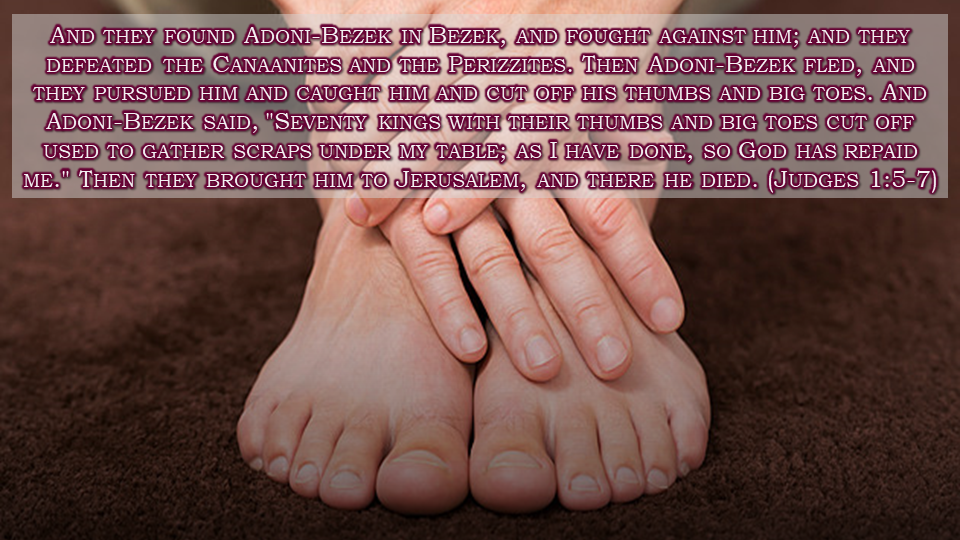
And they found Adoni-Bezek in Bezek, and fought against him; and they defeated the Canaanites and the Perizzites. Then Adoni-Bezek fled, and they pursued him and caught him and cut off his thumbs and big toes. And Adoni-Bezek said, “Seventy kings with their thumbs and big toes cut off used to gather scraps under my table; as I have done, so God has repaid me.” Then they brought him to Jerusalem, and there he died. (Judges 1:5-7)

Thumbs And Toes

There are some strange stories in the Bible, and none as unusual as the story of Adoni-Bezek. A city of Canaan called Bezek was ruled by a ruthless chieftain named Adoni-Bezek. He was in league with the Perizzites. During the conquest of Canaan, Adoni-Bezek was conquered by Simeon and Judah. It was an act of ‘lex talionis’ or the concept of an eye for an eye and a tooth for a tooth; the thumbs and big toes of Adoni-Bezek were cut off. This would render the king unable to run and incapacitate him from holding a weapon in his hand. It was a cruel manner to reduce a man to an invalid with no defense to protect himself. When Adoni-Bezek was punished, he admitted he had done the same thing to seventy kings he had subjected. The mangled kings became beggars in the king’s court, humiliating themselves before their conquerors. Cutting off the toes and thumbs reduced a man to being less than a man.

The Law of Moses suggested the principle of an eye for an eye. If a man caused disfigurement on his neighbor, as he has done, it would be done to him. This included fracture for fracture, an eye for an eye, and a tooth for a tooth. Adoni-Bezek was a pagan king, but because of his cruelty, Judah and Simeon delivered the same treatment to Adoni-Bezek as he had done to others in an act of revenge. There is a divine judgment upon those cruel to others to have punishment exacted upon them in the same fashion. Adoni-Bezek was a wicked man who delighted in the suffering of others who suffered the same fate he inflicted on his fellow man.

There has always been the law of reaping what is sown. Adoni-Bezek reaped the punishment for his crimes. He felt the crushing pain of having his thumbs and toes cut off. Learning to walk and hold things with the remaining fingers was humiliating, painful, and difficult. But this is how the seventy kings experienced the cruelty from Adoni-Bezek. Sin never goes unpunished. Many evil men escape the judgment for their crimes in this life, but all accounts are laid bare in the judgment. If a man never receives due reward for his crime, he will learn that crime does not pay when he wakes up in eternity. In the case of Adoni-Bezek, he was repaid in his own coin.

Jesus showed in the sermon on the mount that the law of revenge (eye for an eye; tooth for a tooth) was not in the constitution of the kingdom. What Jesus did not repeal is the judgment against cruelty and sin. The Christian learns to go the second mile for his enemy. Jesus further admonished that prayers should be given to those who seek to harm the child of God and to do good to them. The consequences of sin are not to be meted out by the Christian. Judgment in this manner is left to the mind of God. A man can escape the judgment of his unrighteous acts now, but the Lord will settle those matters in eternity.

Posted in Uncategorized | Leave a comment

Where God Sits

Have you not known? Have you not heard? Has it not been told you from the beginning? Have you not understood from the foundations of the earth? It is He who sits above the circle of the earth, and its inhabitants are like grasshoppers, who stretches out the heavens like a curtain and spreads them out like a tent to dwell in. He brings the princes to nothing; He makes the judges of the earth useless. (Isaiah 40:21-23)

Where God Sits

The fascination with the world has long intrigued the minds of men searching for hidden secrets of an amazing creation. Through modern technology, many questions have been answered while innumerable puzzles still wait to be revealed. The nature of the world has been an object of curiosity from the beginning of time. Egypt has shown how advanced the knowledge of early man was formulated in the construction of the pyramids, temples, and the sciences. Moses was learned in all the wisdom of the Egyptians, including astrology, interpretation of dreams, medicine, mathematics, and the language of their hieroglyphics.

It was assumed by many that most people believed the world to be flat rather than a sphere. There was a strong belief in the “flat earth theory,” but many understood the earth to be a sphere. One of the early proponents of the earth being a sphere was the Greek philosopher Pythagoras (570-495 B.C.). Aristotle (384-322 B.C.) proved the earth was a sphere with physical evidence. Eratosthenes of Cyrene (276-195 B.C.), a Greek mathematician, astronomer, and head librarian to the Library of Alexandria in Egypt, used crude calculations to determine the size of the earth was 24,000 miles. This was very close to the actual diameter of 24,901 miles. Galileo (1564-1642) believed the world was round and accepted the conclusion by Nicolaus Copernicus the sun was the center of the solar system.

The prophet Isaiah wrote his book about 740 years before Christ. In his grand description of the majesty of the Lord God, the prophet ponders the answers on how God can measure the waters in His hand, measure heaven with a span, and calculate the dust of the earth in a measure. There is none like Jehovah God. The nations are but a drop in a bucket. Idols are dumb and lifeless, but God is all wise and all-powerful. Isaiah reminds the people that the Lord God sits above the circle of the earth and the inhabitants of the world are like grasshoppers. The Holy Spirit declared the earth was a sphere long before men like Pythagoras concluded the same. It is difficult to know what man knew before Isaiah and that, likely, the believers in God had a hint of the spherical nature of the earth. The earth was round before it was discovered to be a sphere.

Human wisdom has opened the vistas of many mysteries over the centuries and will continue to reveal new truths. For the child of God, the evidence of hidden secrets only confirms what is already known. God made the world and everything in it with perfect order and design. When the apple fell and hit Isaac Newton on the head, the law of gravity already existed. Newton explained the law that was established in creation. Explorers discovered what was true from the beginning – the earth is round. Truth is older than error and is not created by the revelation of man. The circle of the earth confirms the nature of the earth, but it shows the power of the one who sits above its circle.

What has man done to come close to an image of what God has done? He can send a man into space, but God has already been there, sitting and waiting and watching. Who is equal to God? The heavens are filled with innumerable stars, created by the hand of the One who sits above the circle of the earth – and God has a name for every star. Because of his great power and incomparable strength, not a single one is missing. Worship, glory, and honor must be given to Him, who sits far above the wisdom of men, showing His might and power so that men can glorify Him. Take a moment to look up and see who is sitting there. He is God.

Posted in Uncategorized | Leave a comment