The Holy Spirit

Now may the God of hope fill you with all joy and peace in believing, that you may abound in hope by the power of the Holy Spirit. (Romans 15:13)

The Holy Spirit

In the beginning of time, the Holy Spirit was hovering above the face of the waters. From creation, the Holy Spirit has been an integral part of unfolding the scheme of redemption. Moses performed miracles by the Holy Spirit. Through the inspiration of the Holy Spirit, Moses described the world of Genesis and then penned the other books of the Pentateuch.

Throughout the history of Israel, God worked His wonders through the Finger of God (Holy Spirit). Jesus was conceived in the womb of Mary by the Holy Spirit. At the beginning of His ministry, Jesus was baptized to fulfill all righteousness.

When Jesus came up out of the water and was praying, the heavens were opened to Him, and He saw the Spirit of God descending like a dove and alighting upon Him. All the miracles Jesus performed were accomplished by the Finger of God (Holy Spirit).

Knowing that He must return to the Father, Jesus instructed the eleven to remain in Jerusalem until they were given power from on high. Ten days after Jesus ascended to the Father’s right hand, the twelve apostles (now including Matthias) were in Jerusalem when they were baptized in the Holy Spirit.

This was a sign of the power of God given to His ambassadors of the gospel of Jesus Christ. When the devout Jews asked Peter and the other apostles what they must do to be saved, Peter told them to repent and be baptized for the remission of their sins, and they would receive the gift of the Holy Spirit. What Peter promised was to be given to all men in every generation. That promise was not the promise given to the apostles by Jesus.

A distinction must be made between the Baptism of the Holy Spirit and the gift of the Holy Spirit. Jesus promised the apostles the power of the Holy Spirit but only to the apostles. They were endowed with power from God to perform all types of miracles (healing, raising the dead, casting out demons), which they did in their ministry.

The gift of the Spirit promised by Peter in his response is the promise of the Holy Spirit to everyone who obeys the gospel of Christ. This gift is non-miraculous and has no power attached to it.

This is best understood from the story of Philip preaching in Samaria (Acts 8). Philip went down to the city of Samaria and preached Christ. The multitudes obeyed the gospel, hearing and seeing the miracles which he did.

A sorcerer named Simon also obeyed the gospel. When the apostles in Jerusalem heard what Philip was doing in Samaria, they sent Peter and John, who came and parted the gifts of the Holy Spirit to the saints. Simon thought to purchase the power and was rebuked for his wickedness.

Philip had the power of the gifts of the Holy Spirit, but he could not pass that gift to another person. The Samaritans (including Simon) had been baptized into Christ and received the gift of the Holy Spirit (non-miraculous). Peter and John came to Samaria to pass along miraculous gifts to the waiting saints.

Three things are noted about the Holy Spirit in this story: (1) Philip had received the power of the gifts of the Holy Spirit (casting out demons, healing the paralyzed and the lame). (2) All those who obeyed the gospel received the gift of the Holy Spirit; (3) Peter and John were apostles and were the only ones who could pass along the gifts to others. When Peter goes to the home of Cornelius, the baptism of the Holy Spirit is given to the Gentiles in the same fashion as upon the apostles at Pentecost.

The miraculous gifts of the Holy Spirit were part of the scaffolding of the early church. Through the gifts of the Holy Spirit, the church was able to go throughout the world unto every nation. When the establishment of the church was completed with the fully revealed word of God, the spiritual scaffolding was removed – the age of miraculous gifts ceased.

The Holy Spirit is still active today through the saints who have been baptized in Christ and the power of the word. Paul explained to the Christians in Rome how the Holy Spirit dwells in them, and to the Ephesian brethren, the sword of the Holy Spirit is the word of God.

To the churches of Galatia, Paul reminded them of the fruits of the Holy Spirit. Until the Lord returns, the Holy Spirit will continue to fulfill His work of the divine plan of the Father.

All Christians must realize the importance of filling their hearts with the word of God and setting their minds on the things of the Spirit. The Holy Spirit is not to be worshiped as Jesus Christ because everything the Spirit did was to lead men to Christ.

Jesus died for all men. The Holy Spirit guided men into all truth so they could see and realize the love of God accomplished through His only begotten Son.
Posted in Uncategorized | Tagged , , , , , , , , , , , , , , , , , , , , , , , , , , , , , , , , , , | Leave a comment

168 Hours Of Friendship

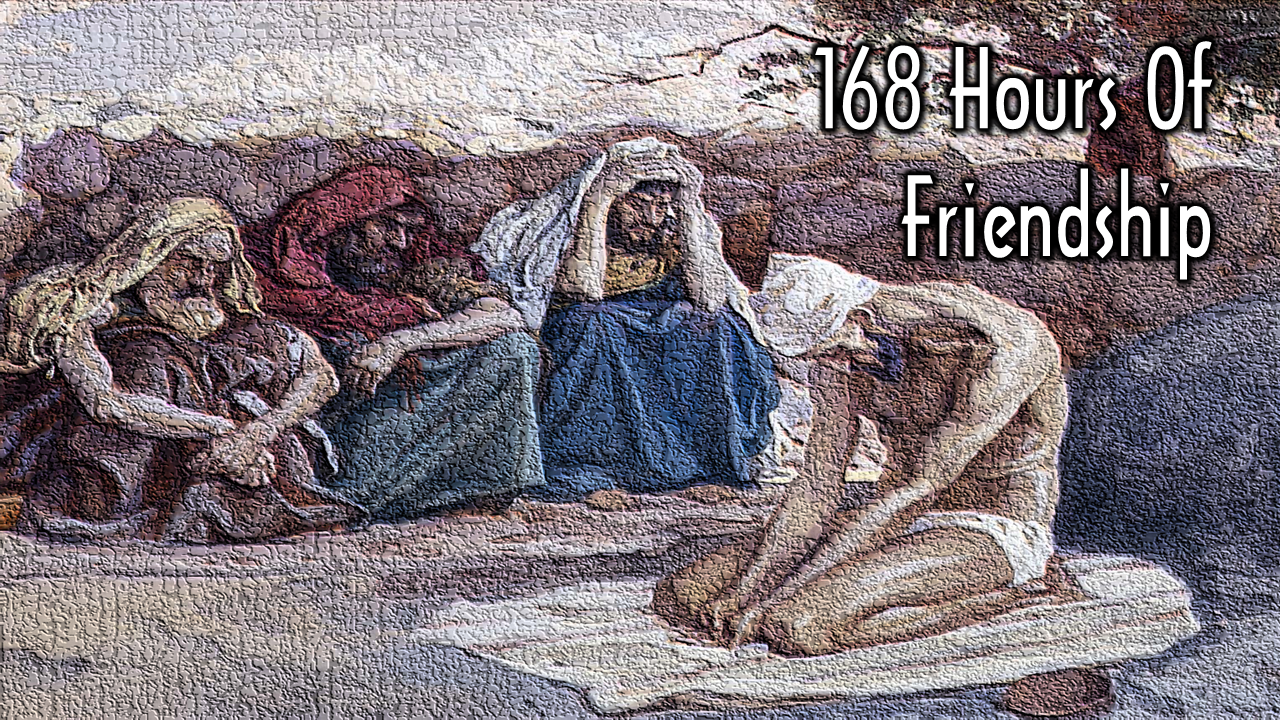
Now when Job’s three friends heard of all this adversity that had come upon him, each one came from his own place—Eliphaz the Temanite, Bildad the Shuhite, and Zophar the Naamathite. For they had made an appointment together to come and mourn with him, and to comfort him. And when they raised their eyes from afar, and did not recognize him, they lifted their voices and wept; and each one tore his robe and sprinkled dust on his head toward heaven. So they sat down with him on the ground seven days and seven nights, and no one spoke a word to him, for they saw that his grief was very great. (Job 2:11-13)

168 Hours Of Friendship

The story of Job is the courage of a man who faced overwhelming odds, experienced his own mortality, challenged God wrongfully, and remained a man of faith in the end. Job’s story is one of victory. His faith was put to the test, as few men experience. He sunk in despair in his misery, blaming God. Like any man, Job struggled with the burden of the flesh and the desire to serve the spirit. Compounding his story were three men who came to see him.

Eliphaz the Temanite, Bildad the Shuhite, and Zophar the Naamathite were friends of Job. These three men heard of the terrible things that happened to Job and felt the need to visit their dear friend. The story of Job is centered on the discussions between Job and his friends. Before Job and his friends unravel the mystery of life, a story of friendship is established that is often overlooked.

Life is a busy activity of taking care of family, working to support the family and the challenges of living. It isn’t easy to take a lot of time off from the heavy responsibilities of the daily grind. When Eliphaz, Bildad, and Zophar heard of the tragedy of Job, they could have done many things. They could have sent provisions to Job, couriers telling their friend of their sorrow, or thought within themselves how sorry they were for their friend. What these three men did was a remarkable example of deep friendship.

Eliphaz, Bildad, and Zophar planned to leave their families to visit their friend face to face. He needed to see them. Their presence is what was required of the day. Whatever the distance was, it was of no consequence. They made an appointment together to see their friend, mourn with him, and comfort him. Friendship is the willingness to sacrifice the time to help someone in need. Their hearts were broken when they saw him. They could not recognize Job. More importantly – Job recognized them. How his heart must have leaped at the sight of his trusted friends. In the midst of his sorrow, Job experienced friendship.

When the friends of Job planned to visit, they did not plan on stopping by and leaving. They desired to help Job as long as it took. No one could have imagined what would happen next. The three men sat down with Job on the ground. Not on soft cushions of fine silk relaxing in the splendor of riches accustomed by the rich. Eliphaz, Bildad, and Zophar sat on the ground with Job. And they sat there on the ground with Job for a week – seven days – 168 hours – 10,080 minutes. For seven days, no one spoke a word to Job. They watched him day by day take a potsherd and scrape himself while he sat in the midst of the ashes.

Job suffered from painful boils from the sole of his foot to the crown of his head. The three friends watched Job writhe in pain for seven days, and they did not leave him. The nights were long, and the days filled with the sorrow of Job, but they did not forsake their friend. They could have run away, but they remained for seven days without speaking a word. Job spoke first, deploring his birth, and then a conversation ensued with his friends, trying to understand what happened.

Job and his friends were wrong about their conclusions. In the end, God rebuked Job, but the man of God was not lost. His faith was firm, and so was the faith of his friends. What is missed in the story of Job is the faith of his three friends in the beginning and at the end. The friends were indeed wrong in their conclusions. God’s wrath was aroused against Job’s friends, demanding they make sacrifices so that Job could pray for them. They humbled themselves and obeyed the word of the Lord. As they made their way home, Eliphaz, Bildad, and Zophar were greater men of faith because of their friendship with Job and their faith in God.

I must learn to be like Job’s friends. We all find ourselves in the place of the three men trying to understand the issues of life. The joy of the story is found at the end when the four men parted ways, more profound in their love for one another and richer in their experience of faith in God. I suspect somewhere among the hosts of witnesses looking down on my wrecked life are four men who understand the value of friendship and the eternal reward of godliness. Thank you, Eliphaz, Bildad, and Zophar; and thank you, Job.

Posted in Uncategorized | Tagged , , , , , , , , , , , , , , , , , , , , , , , , , , , , , , | Leave a comment

Wife Catchers

And the children of Benjamin did so; they took enough wives for their number from those who danced, whom they caught. Then they went and returned to their inheritance, and they rebuilt the cities and dwelt in them. (Judges 21:23)

Wife Catchers

In the closing days of the period of the Judges over Israel, there was war with the Benjamites. The children of God were fighting against their fellow brethren of the Lord. When the battle was over, twenty-five thousand men of valor from Benjamin died. The men of Israel were remorseful to destroy so many of the Benjamites. Without men to produce a continual seed line, the tribe of Benjamin could disappear. After appealing to the Lord for guidance, the elders of the people devised an unusual plan.

The first plan involved sending twelve thousand of their most valiant men to fight against the inhabitants of Jabesh Gilead. They were to kill all the males and the women who were not virgins. When the fighting was over, they found four hundred young virgins who had not known a man intimately. Unfortunately, there were not enough women for the tribe of Benjamin. It seemed Benjamin would not survive as a tribe.

A second plan was put into action by the elders of the congregation. There was a yearly feast of the Lord in Shiloh. The Benjamites were told to hide in the vineyards and watch. When the daughters of Shiloh come out to dance, the Benjamites are instructed to catch a wife for himself and take her to the land of Benjamin. The daughters came out of the city, and the Benjamite men caught themselves a wife and took her back to their homeland. They rebuilt their cities, and life returned to normal.

“Wife catching” was an unusual courting ritual. The tragedy of Jabesh Gilead was those who died in the fighting and the four hundred taken from their homes and families. When the daughters danced outside the city of Shiloh, they were captured by men hiding in the vineyards and taken back as their wives. Many families suddenly lost their daughters without warning. It was a sad story for so many people.

There are many twists in the story of Israel, and the period of the Judges was when there was no king, and everyone did what was right in their own eyes. Finding wives for the Benjamites came as the result of an internal war pitting brother against brother, Hebrew killing Hebrew, and the people of God trying to destroy one another. The men of Gibeah, a town of Benjamin, committed a terrible outrage on the concubine of a Levite, raping her to death. At the war’s end, only six hundred men remained in Benjamin.

The story of ‘wife catching’ illustrates the failing of the wisdom of man when they seek after the wickedness of the world. There was no king in the land, leaving everyone to do as they desired. This ended in a disastrous war with tens of thousands of lives lost. Families were destroyed as their daughters were kidnapped and given away as wives. The wisdom of man always ends in disaster. Israel is left as an example of what happens when men do not follow the plan of God.

Posted in Uncategorized | Tagged , , , , , , , , , , , , , , , , , , , , , , , | Leave a comment

God Is My Refuge

Thus God, determining to show more abundantly to the heirs of promise the immutability of His counsel, confirmed it by an oath, that by two immutable things, in which it is impossible for God to lie, we might have strong consolation, who have fled for refuge to lay hold of the hope set before us. (Hebrews 6:17-18)

God Is My Refuge

A refuge is a place of shelter or protection from danger or distress. In the Law of Moses, God made provisions for cities of refuge where a manslayer could flee. There were six cities of refuge in Israel as cities of the tribe of Levi. From a military standpoint, a refuge was a fortress of protection from enemies, usually a high place. Typically, whoever held the higher ground had the advantage. Taking refuge in God was a constant theme of divine protection from the wiles of the devil.

Sixteen psalms speak of the refuge of God. The Lord will be a refuge for the oppressed in times of trouble. God was a refuge for the poor. David wrote about the Lord being his rock and the saving refuge of His anointed. Seeking refuge in the Lord was finding security in the fortress of divine power. Finding refuge in God gave strength, a very present help in trouble. The people of Israel sought the Lord of hosts, the God of Jacob, as their refuge.

When David hid from King Saul in a cave, the psalmist wrote about the mercy of God enveloping him as the shadow of eternal wings and refuge in the day of trouble. God is called salvation, glory, the rock of salvation and refuge. The people of God could always trust in Him and pour out their hearts to Him because He is their refuge. As the protector of the righteous, the Lord was One whom the saints could seek continually because of the promise to protect them.

God was always a refuge for His people living in a world that denied the Lord God. As a refuge and fortress, security was to be found in the bosom of the Father. Like a powerful, great bird, God would spread his feathers around His child, drawing them under His wings for refuge. A shield and buckler were used for defense against enemies, and God was that refuge. Like the high hills and cliffs protected the wild goats and rock badgers, the Lord would lift His people up to heights of safety without fear.

When the eyes of the faithful turn to the Lord, He becomes their refuge because He cares for them. No soul would be destitute in the refuge of the Lord. His portion would be in the land of the living. David said it best when he described the grace of God as lovingkindness and fortress, his high tower and deliverer, his shield, and the One in whom he took refuge, who subdued his enemies around him.

There is no greater hope than to come to the Lord God as a refuge to lay hold of the hope set before them. God has made promises that He will protect His children, and that promise is security and hope. Paul said the Lord will not allow Satan to tempt a man beyond what he can endure. Why? God is the refuge that will limit the power of the devil. Jesus taught His disciples to ask the Father to keep them from the wicked one. Why? God has the power to protect His people.

God does not lie. He cannot lie. To understand how powerful seeking refuge in God is demands the understanding of the promises of God. The Lord has shown abundantly to the heirs of promise the immutability of His counsel. As the refuge of His people, God is unchanging. Everything promised by God comes true, and that is the refuge all men should seek. For those who are saved, it becomes the strong consolation of hope that God is faithful no matter what happens in life. His words are true. He does not change. Refuge in God is everlasting when one turns their life over to the will of Him who is the high tower, deliverer, shield, and lovingkindness of mercy. The storms of life will not overcome those who take refuge in the rock of salvation.

Posted in Uncategorized | Tagged , , , , , , , , , , , , , , , , , , , , , , , , , , , , , , , | Leave a comment

Instrumental Music

And do not be drunk with wine, in which is dissipation; but be filled with the Spirit, speaking to one another in psalms and hymns and spiritual songs, singing and making melody in your heart to the Lord, giving thanks always for all things to God the Father in the name of our Lord Jesus Christ, submitting to one another in the fear of God. (Ephesians 5:18-21)

Instrumental Music

Instruments of music have been around since the beginning of time. Jubal was the seventh generation removed from Adam, and “He was the father of all those who play the harp and flute” (Genesis 4:21).

David was a skilled harpist and inventor of musical instruments. “Then David and all Israel played music before God with all their might, with singing, on harps, on stringed instruments, on tambourines, on cymbals, and with trumpets.” (1 Chronicles 13:8)

During the temple worship of Solomon, instruments filled the House of the Lord (2 Chronicles 5:11-14). The Jews were experts with instruments of worship. There is little doubt the worship of Israel was filled with the music of instruments of music.

The first converts to the gospel of Christ were Jews. There would be a time of transition for the Jews to learn that circumcision was no longer a sign of the covenant between them and God. They would know the Sabbath was no longer required to be kept sacred. Many laws no longer applied to salvation, and many things they did in worship were not done in the early church.

Three thousand devout Jews were the first Christians, and from Pentecost, the church never used instruments of music in worship. If there were a people versed in the use of instruments of music, the Jews were that people. In all the early church writings, the Jews never suggested or used the instruments.

The reason is clear: when they continued in the apostle’s doctrine, the Holy Spirit instructed the first disciples to use the musical instrument designed by God – the mouth.

When the doctrines of the New Testament church were established, singing was the type of music commanded by God. Ephesians 5:19 does not mention pianos, guitars, and trumpets.

Paul affirmed the same message in Colossians 3:16 for the saints to sing to one another. The church at Corinth needed correcting about their worship, and Paul reminded them to sing with the understanding of what is being sung (1 Corinthians 14:15).

The use of instruments of music came in the sixth century and was not readily accepted until the 16th century. So great was the opposition that it would have been abolished by the Council of Trent but for the influence of Emperor Ferdinand.

Another argument against using instrumental music in worship is what history has to say. Consider the writings of some early church fathers. Thomas Aquinas said, “Our church does not use musical instruments, as harps and psalteries, to praise God withal, that she may not seem to Judaize.”

Augustine (354 A.D.) writes, “Musical instruments were not used. The pipe, tabret, and harp here associate so intimately with the sensual heathen cults, as well as the wild revelries and shameless performances of the degenerate theater and circus.”

In 190 A.D., Clement of Alexandria declares, “Leave the pipe to the shepherd, the flute to the men who are in fear of gods and intent on their idol worshipping. Such musical instruments must be excluded from our wingless feasts, for they are more suited for beasts and for the class of men that is least capable of reason than for men.”

During the Protestant movement against the teachings and practices of the Roman Catholic Church, many religious leaders condemned using instruments.

John Calvin (Presbyterian) said, “Musical instruments in celebrating the praises of God would be no more suitable than the burning of incense, the lighting up of lamps, and the restoration of the other shadows of the law. The papists, therefore, have foolishly borrowed this, as well as many other things, from the Jews. Men who are fond of outward pomp may delight in that noise; but the simplicity which God recommends to us by the apostle is far more pleasing to Him.”

Charles Spurgeon, an influential Baptist preacher (1834-1892), writes, “What a degradation to supplant the intelligent song of the whole congregation by the theatrical prettiness of a quartet, bellows, and pipes! We might as well pray by machinery as praise by it.”

A popular commentator named Adam Clarke (Methodist) declared, “Music, as a science, I esteem and admire; but instruments of music in the house of God I abominate and abhor. This is the abuse of music; and here I register my protest against all such corruptions in the worship of the Author of Christianity.”

Clarke went on to write, “John Wesley, who was a lover of music, and an elegant poet, when asked his opinion of instruments of music being introduced into the chapels of the Methodists said, in his terse and powerful manner, ‘I have no objection to instruments of music in our chapels, provided they are neither heard nor seen.”

Finally, Martin Luther summed it all up when he said, “The church rings with the noise of trumpets, pipes, and dulcimers; and human voices strive to bear their part with them. Men run to the church as to a theatre, to have their ears tickled.”

History does not authorize the use or non-use of instruments because Jesus is the only authority. But history helps to clarify and illustrate the rejection of instruments in times past. The student of scripture must find in the word of God the authority to use instruments of music. There is no authority, and using instruments of music is without divine approval.

Posted in Uncategorized | Tagged , , , , , , , , , , , , , , , , , , , , , , , , , , , , , , , , , , , , , , , , , , , , , , , | Leave a comment

Divine Justice With A Tent Peg

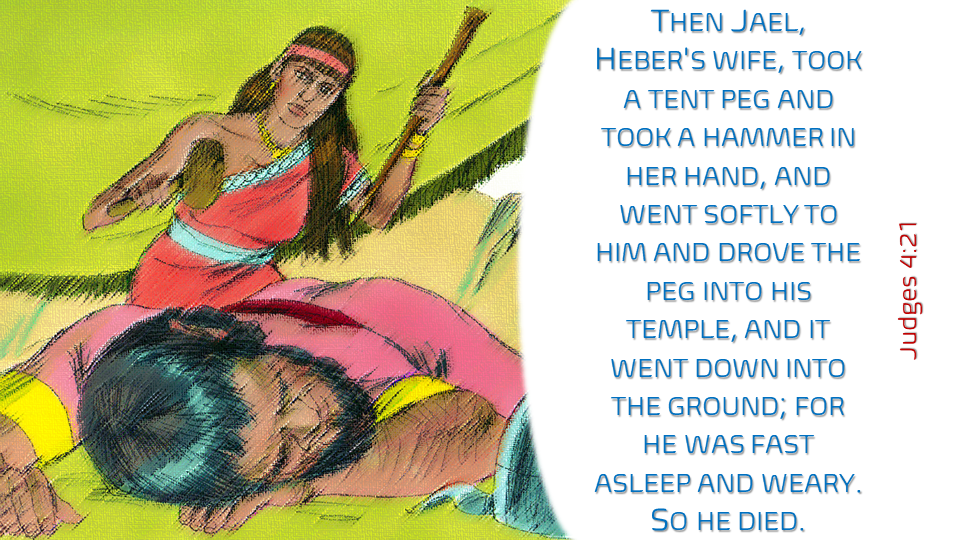
And he said to her, “Stand at the door of the tent, and if any man comes and inquires of you, and says, ‘Is there any man here?’ you shall say, ‘No.’ ” Then Jael, Heber’s wife, took a tent peg and took a hammer in her hand, and went softly to him and drove the peg into his temple, and it went down into the ground; for he was fast asleep and weary. So he died. And then, as Barak pursued Sisera, Jael came out to meet him and said to him, “Come, I will show you the man whom you seek.” And when he went into her tent, there lay Sisera, dead with the peg in his temple. (Judges 4:20-22)

Divine Justice With A Tent Peg

When Israel came into the land of Canaan, the Lord instructed them to utterly destroy the people of the land, including the Hittites, the Girgashites, the Amorites, the Canaanites, the Perizzites, and the Hivites and the Jebusites. They were to receive no mercy from the people of Israel. Under the leadership of Joshua, the people of Canaan were subdued within seven years but not annihilated.

After the death of Joshua, Israel was ruled by judges, and the people did what was right in their own eyes. As a story of peace, war, oppression, and salvation, Judges is how the Lord brings the enemies of Israel against them to punish them. One hundred twenty years after Joshua died, Deborah became the fourth judge of Israel. The children of Israel did evil in the sight of the Lord, so the Lord sold them into the hand of Jabin, king of Canaan. His commander was a man named Sisera.

The salvation of Israel came by the hand of Deborah and Barak, son of Abinoam. Deborah enlisted the help of Barak to lead the people to war against the Canaanites. The Lord routed Sisera and all his chariots (nine hundred chariots of iron) and all the people with him. Sisera escaped capture and hid in the tent of Jael, the wife of Heber the Kenite.

Jael invited Sisera into her tent and covered him with a blanket. She offered him some milk to drink, and Sisera fell fast asleep. As the commander slept, Jael took a tent peg, took a hammer in her hand, and went softly to him and drove the peg into his temple. The force was so great the peg came out of his head into the ground. Sisera died immediately.

Barak was passing by when Jael called out to him and told him the man he sought was in her tent. Entering the tent, Barak saw Jael lying on the ground with a tent peg driven through his temple. He was dead. That day, God subdued the enemies of Israel, and there was much rejoicing.

Deborah would later sing a song of praise for the great victory over the Philistines, mentioning what Jael had done. She described how Jael had taken a tent peg with a workman’s hammer; pounding Sisera, piercing his head, and split and struck him through his temple. In a mournful prose of the death sonnet, Deborah speaks of Sisera’s mother, who looked for her son to return home with no hope. Sisera met his end through the divine justice of God.

Divine justice is a constant theme throughout the Bible. God never hesitates to describe the penalty of His wrath against evil men. Sisera was a wicked and evil man. God used Jael as an instrument to exact justice against a wicked man. The divine justice of God is swift and without mercy. God promised Abraham He would not destroy Canaan until the iniquity of the Philistines was full and overflowing. What Jael did was divine justice.

God is a loving and compassionate Father. What many fail to believe in is the wrath of God. In the days of Noah, God destroyed every living being save those in the ark. Sodom, Gomorrah, and the cities of the plain were destroyed with fire and brimstone. At the same time, Lot’s wife was killed for disobeying the command of God. The Israelites wiped out the nations of Canaan under the direction of the Lord. Jael drove a tent peg through the temple of Sisera. The wrath of God was completed.

The warning of the wrath of God is the eternal question. Satan has convinced everyone there is no such thing as divine judgment. The devil does not mind if a man believes in God as long as he believes God would never punish anyone for anything. That is a lie (one of the biggest). Sisera thought he had escaped the wrath of God. He was wrong. No one will escape the wrath of God. Jesus died to save man from God’s wrath, but that is a choice that must be made. Will you make that choice?

Posted in Uncategorized | Tagged , , , , , , , , , , , , , , , , , , , , , , , , , , , , , , , , , | Leave a comment

Denying, Living, And Looking

Teaching us that, denying ungodliness and worldly lusts, we should live soberly, righteously, and godly in the present age, looking for the blessed hope and glorious appearing of our great God and Savior Jesus Christ. (Titus 2:12-13)

Denying, Living, And Looking

The grace of God is abundant in the way the Lord has redeemed man from His wrath through the sacrifice of Jesus Christ. Jesus came to die for all men. There is no respecter of persons with God. He desires for all men to repent. For God so loved everyone in the world that He willingly gave His only begotten Son for the sins of mankind. Grace is the expression of the divine to save man who does not deserve redemption.

Salvation came from God to a world filled with darkness. Grace was offered, but there can be no mercy if grace is not acted on. Man cannot be saved by grace alone. There is a need for man to accept the grace of God in his obedience to the will of the Father. The grace of God teaches men to deny the sinful passions of the flesh, live with the wisdom from above, and look forward with hope to the promises of God. Grace leads man to redemption, but man must act upon his faith to be saved.

The gospel of Christ teaches that ungodliness and sinful pleasures must be turned away from. Obedience to the will of the Father demands sanctification or being set apart. Jesus taught that without repentance, there is no salvation. Turning away from ungodliness and worldly lusts is necessary. The grace of God will not save those who refuse to change their lives. Coming to Jesus Christ demands a denial of those things contrary to the will of the Father.

When the heart denies the desires of the flesh, the grace of God leads a person to live soberly, righteously, and godly. To live soberly is to restrain the heart from seeking after the passions of the world through the knowledge of the word of God. A righteous life is one guided by the principles of what is right in the eyes of God; not men. Righteousness is the character of doing right. This comes from the word of God.

Finally, the grace of God leads a man to live a godly life. Living godly is seeking to imitate the character of Jesus Christ. To be a godly man is to show control of the passions of the heart, fulfill responsibilities to others, and exemplify the word of God in every part of life. Godliness comes from the knowledge of God’s word.

Denying the passions of the world and living in the character of God leads a man to look forward to the blessed hope and glorious appearing of Jesus Christ. Having removed the trappings of the flesh, the spirit embraces the knowledge of eternal life and the longing to be clothed further with the heavenly garb. Jesus is coming back. That will not be a day of fearful expectation but one of joy to see the Lord coming in the clouds.

The grace of God appeared to all men to deny sin, live for Christ, and look forward to what God has planned for His children. Three things guide the heart to know the love of God that passes all understanding. When the heart denies the passions of the flesh and lives for righteousness, there is nothing else to respond but the hope of the glorious appearance of Christ. Deny. Live. Look forward.

Posted in Uncategorized | Tagged , , , , , , , , , , , , , , , , , , , , , , , , , , , , | Leave a comment

I Love The Lord Because

I love the Lord, because He has heard My voice and my supplications. Because He has inclined His ear to me, therefore I will call upon Him as long as I live.

The pains of death surrounded me, and the pangs of Sheol laid hold of me; I found trouble and sorrow. Then I called upon the name of the Lord: “O Lord, I implore You, deliver my soul!”

Gracious is the Lord, and righteous; yes, our God is merciful. The Lord preserves the simple; I was brought low, and He saved me. Return to your rest, O my soul, for the Lord has dealt bountifully with you. For You have delivered my soul from death, my eyes from tears, and my feet from falling. I will walk before the Lord In the land of the living. I believed, therefore I spoke, “I am greatly afflicted.” I said in my haste, “All men are liars.”

What shall I render to the Lord for all His benefits toward me? I will take up the cup of salvation, and call upon the name of the Lord. I will pay my vows to the Lord now in the presence of all His people. Precious in the sight of the Lord is the death of His saints. O Lord, truly I am Your servant; I am Your servant, the son of Your maidservant; You have loosed my bonds. I will offer to You the sacrifice of thanksgiving and will call upon the name of the Lord. I will pay my vows to the Lord now in the presence of all His people, in the courts of the Lord’s house, in the midst of you, O Jerusalem. Praise the Lord! (Psalm 116)

I Love The Lord Because

The writer of Psalm 116 is unknown, but his language is well known. Love is a profound expression of the heart when it comes to God. His love for the Lord was not a shallow experience of casual love but a life filled with trials and troubles in the battle with sin and the victory found in the house of the Lord.

Life for the man of God was not easy. Whatever pains surrounded him seemed insurmountable. He had trouble and sorrow. The trials he faced brought him low in spirit. Afflictions overwhelmed him on every side. Death seemed near and very real. His faith was shaken. Tears filled his face with grief. His feet almost stumbled.

Through the gloom of life’s tragedy and trials, the psalmist saw the light of God and trusted in the word of the Lord. In his trial, he had called out to his Savior to hear his pleas and listen to his prayers. His faith was challenged, but he did not waver from trusting the Lord would see him through his trial. In his great affliction, he believed in the word of the Lord.

Friends often mistake the trials of life as punishment. Like the friends of Job, the psalmist was beset with men who accused him. They forsook him in his hour of need. Man’s wisdom did not bring comfort, and the psalmist saw men for what they were. His trust was in the Lord. He knew salvation could only come from the Lord.

Death was ever near the man. He cried out in his suffering with supplications to God. Death was wrapping its arms around the man as the trials of life engulfed him. Facing certain death, the psalmist sought the protection of the Lord to save me. He was in distress. Crying out to the Lord to hear his petitions, the psalmist begged the Lord to deliver him.

Joy is found in salvation. The trials of life produce patience to abide in the presence of the Lord. Through the power of prayer, the man found deliverance but the gracious hand of the Lord. He was delivered from certain death. His joy was found in the righteousness of God and His mercy to save him. He was humbled and brought low by the experience and then found joy in his deliverance by God’s hand.

Faith is understood by the actions of a heart touched by the grace of God. Seeing the divine providence of the Lord in his life, the psalmist declares his faithfulness to God. He will walk before the Lord with a heart of full obedience. His life will testify to the glory of God’s grace to save him. He will offer sacrifices of praise to the Lord in the house of God.

Worship is the soothing ointment of a soul cleansed by the gracious hand of a loving Father. Precious in the sight of the Lord is the death of His saints. He was saved from death, but he knew the joy of dying. That day would come, and he was prepared. Understanding the frailty of life, the certainty of death, and the victory found for the saints of God, the psalmist extols his love for the Lord.

The psalmist was saved from the troubles and sorrows of life. God gave him victory. He would serve the Lord in faithfulness, calling upon the name of the Lord. His life would be filled with the experience of facing death and finding victory in God to overcome his fears. And that is why he begins his psalm, “I love the Lord, because …” Why do you love the Lord? What psalm can I write to declare what God has done for me and why I love the Lord with all my heart?

Posted in Uncategorized | Tagged , , , , , , , , , , , , , , , , , , , , , , , , , , , , , | Leave a comment

We Need People Who Blush

“Were they ashamed when they had committed abomination? No! They were not at all ashamed; nor did they know how to blush. Therefore they shall fall among those who fall; at the time I punish them, they shall be cast down,” says the Lord. (Jeremiah 6:15)

We Need People Who Blush

The prophet Jeremiah lived in the turbulent time of the waning days of God’s people. He was the last great prophet during the final four decades of the kingdom of Judah. There was no hope for Jerusalem. A brief period of hope blossomed under the reign of Josiah, but upon his death, the people of God spiraled down into moral disintegration and religious apostasy.

Judah had become a perverse people, filling their lives with the immoral decadence of the nations around them. Adultery was rampant as the people gathered in great numbers to the house of prostitution. Every one neighed after his neighbor’s wife. Worship to God was ridiculed, and false prophets abounded. There was spiritual and civil corruption. The fear of the Lord was abandoned. Judah had become a place of self-indulgent, satisfied people without limitations to their wicked deeds. The orphans are denied justice, and the poor are neglected.

God warned Judah of impending doom if they did not repent. The Lord promised to thoroughly glean the remnant of Israel like a man cleans his vineyard, leaving nothing. God was angry. His people were destroyed for lack of knowledge. Their indulgence in the idolatry of the nations around them had brought the swift and full measure of divine righteousness to destroy them. The northern tribes of Israel had long since disappeared because of the wrath of God. Now, the fury of the Lord was to be turned against those who remained.

The condition of the people had become so evil there was no shame in committing the immorality common for the day. Sin was good, and good was evil. Light had been turned into darkness, and the darkness to light. The people were so full of evil that they could not blush. They had no shame for what they did. Everything they did was without guilt, remorse, or fear. Evil flourished. God’s people had filled themselves with so much shame that they felt nothing. Adam and Eve heard the sound of God walking in the garden and hid from His presence. Israel pranced around the Lord God naked and unashamed.

What makes the story of Jeremiah tragic is how the people of God can fall so far from grace. Few in the world blush or even know how to blush. Blushing is often involuntary and brought on by some type of emotional stress. This could be caused by passion, embarrassment, shyness, fear, and even anger. A person’s face turns red. The reaction is due to a psychological impulse about something that is said or done, or experienced that is uncomfortable for the person.

God looks at His people and realizes sin cannot make them blush. Men like Job feared God and stayed away from evil. Joseph refused to engage in sexual immorality with Potiphar’s wife because he recognized it as wickedness. When a man reaches the point that sinful activity does not impact his heart, he will fall prey to its devices and be destroyed. Judah had become so filled with the wickedness of the world; that sin did not bother them. They had become accustomed to the wiles of the devil.

It is easy to be lulled into a false sense of worldly security where sin is no longer an issue of blushing. The people of God must learn to blush. There must be evidence of a heart that “eschews” evil and will not permit it to be a part of a righteous life. Television has taken away the shocking ‘word’ used in the movie, “Gone With The Wind.” Blushing has now gone with the wind. Sexual immorality is so common it does not bother many, and there is no shame. Using God’s name as a curse causes few to flinch.

Holiness produces blushing. Don’t miss the point. It is not a matter of the bodily reddening of the face but the heart that needs to blush. The more time spent in the word of God, the greater the need to have a heart blushed with the righteousness of God. Learning what sin is and what sin will do will shock one at sinful behavior. Husbands and wives need to know how to blush. Parents must show their children the nobility of a blushing heart in view of God’s heart. Children need to learn to blush. Do you blush?

Posted in Uncategorized | Tagged , , , , , , , , , , , , , , , , , , , , , , , , , , , , , , , , , , , , , , | Leave a comment

Baptism

And Jesus came and spoke to them, saying, “All authority has been given to Me in heaven and on earth. Go therefore and make disciples of all the nations, baptizing them in the name of the Father and of the Son and of the Holy Spirit, teaching them to observe all things that I have commanded you; and lo, I am with you always, even to the end of the age.” Amen. (Matthew 28:18-20)

Baptism

The single disagreement among Bible students can be found on whether baptism is necessary for salvation. There is nothing more crucial for the defense of error than to deny the necessity of baptism and for those believing in its requirement to defend it at all costs. Being ready to give a defense for the hope that lies within must be found in an honest heart that accepts and defends the Biblical teaching on baptism.

Over the past two thousand years, the term baptism has become a meaning that, while accepted in the religious world, defies the meaning of how the Holy Spirit used the word in the writing of the New Testament. Baptism, defined in modern terms, means “A Christian sacrament marked by ritual use of water and admitting the recipient to the Christian community” (Merriam-Webster’s Collegiate Dictionary, Eleventh Edition, 2014). The word can be defined as “dip, plunge, sprinkle, pour, and immerse.”

These terms are common in the modern language but do not find their companions in the New Testament. Tom Hamilton writes, “On the other hand, we could acknowledge honestly that our English word ‘baptize’ was created after the ecclesiastical establishment had already adopted several forms of ‘baptism’ which the N.T. does not mention. When the time came for the first English translations of the Bible to be made, ‘baptizo’ was forbidden to be translated into its true meaning, ‘immerse,’ because this would explicitly condemn and expose the practices of the ecclesiastical establishment. Instead, ‘baptizo’ was transliterated, and it was implied that the theological meaning for ‘baptism’ which had developed over the centuries, was intended by the N.T. wherever ‘baptizo’ occurred.”

The transliterated word ‘baptizo’ has become so common that it is hard for most people to recognize the original intent of the word to mean immersion. John the Baptist baptized in Aenon near Salim because there was much water there (John 3:23). Jesus went down into the water when He was baptized (Mark 1:9-10). Philip and the man from Ethiopia “went down into the water, and he baptized him” (Acts 8:38). Paul would later describe baptism as a burial (Romans 6:3-7).

Clearly, baptism cannot be a sprinkling or pouring. Tom Hamilton concludes, “It is only because people have been convinced that ‘baptizo’ has this theological meaning that they can say such things like, ‘Sprinkling is just another, equally acceptable way of baptizing.’ If they said, ‘Sprinkling is just another, equally acceptable way of immersing!’ they would see this statement for the silliness it is.”

Jesus taught the necessity of baptism in the commission given to the eleven (Matthew 28:18-20; Mark 16:15-18; Luke 24:46-49). The book of Acts is a testimony to the work of the apostles to carry out the commission of Jesus.

There are eight main stories of conversion in the book of Acts and every case of conversion involved baptism: the Day of Pentecost (Acts 2); the Samaritans (Acts 8:5-13); the Ethiopian eunuch (Acts 8:35-38); Saul’s conversion (Acts 9 & 22); Cornelius and his household (Acts 10-11); Lydia (Acts 16); the Philippian jailor (Acts 16); and finally the Corinthians (Acts 18). There are twenty-one other stories of conversions in the book of Acts describing how believers (disciples) were added and multiplied.

The most convincing texts for the necessity of baptism come from Romans 6:1-7 and Colossians 2:11-13. Baptism is a burial into the death of Jesus Christ. Without resurrection, there is no hope of eternal resurrection. The only way to be resurrected is to be buried, and the only way burial occurs is in the waters of baptism.

Paul convinced the saints at Colosse of the necessity of baptism when he showed them how baptism is spiritual circumcision. A man could be in covenant agreement with God under the Law of Moses without circumcision. No man can be saved without putting off the body of the sins of the flesh by the circumcision of Christ, buried with Him in baptism.

Baptism is where the blood of Christ washes away sins (Acts 22:16). Jesus said at the institution of the Lord’s Supper His blood was shed for the remission of sins (Matthew 26:28). Peter told those on Pentecost to repent and to be baptized for the remission of sins (Acts 2:38). The Hebrew writer declared there is no remission of sins without blood (Hebrews 9:22).

There is no remission of sins apart from the blood of Christ and the only place a man finds the blood of Christ is in the waters of baptism. Many deny baptism because they say it is a work. When the crowd asked Jesus what they must do to work the works of God, the Lord replied, “This is the work of God, that you believe in Him who He sent” (John 6:28-29).

They would not deny belief as necessary but sadly deny the very thing that washes away their sins: baptism. The words of Jesus have not faded over time. “He who believes and is baptized will be saved; but he who does not believe will be condemned.” (Mark 16:16)


Posted in Uncategorized | Tagged , , , , , , , , , , , , , , , , , , , , , , , , , , , , , , , , , , , , , , , , | Leave a comment