They Bound The Hands Of Jesus

Then the detachment of troops and the captain and the officers of the Jews arrested Jesus and bound Him. (John 18:12)

They Bound The Hands Of Jesus

It seems impossible to imagine the hands that created the world, and the expanse of the universe could be bound in chains as a common criminal. Jesus touched lepers and healed them. Putting His hands on the blind, sight was restored. The Lord took children and laid His tender hands upon them, blessing them. Often, the hands of Jesus were folded in prayer to His Father, sometimes all night. When Peter faltered in his faith on the sea, Jesus reached out His hand to save the sinking disciple. Jesus laid His hands on many people, and they were healed.

In the Garden of Gethsemane, Judas brought a few hundred people to betray his Lord to the mob. John describes the fear of the crowd of Jesus when He announced who he was and how the mob fell backward to the ground. Identifying Himself, the soldiers arrested Jesus and bound Him. There was no warrant, and no charges were filed against Him. Jesus was betrayed and led away to endure a mockery trial of Roman malpractice and finally killed through the hatred of the Jews and the efficiency of the Romans. In death, the Romans nailed the hands of Jesus to a cross.

What was lost on those who arrested Jesus was the divine grace allowing them to place irons on the hands of the Son of God. These hands could raise the dead, heal the sick, and – if so desired – call the host of angelic powers to rescue Him by the wave of His hand. Jesus did not resist. He did not try to run away. As the mob left the city gates in the dead of night, the Lord could see the lanterns and torches coming to arrest Him. He could have sent His disciples away to safety and fled to some mountain. The hands of Jesus waited for the clapping of irons to encircle Him.

The hands of Jesus were bound because His heart was abounding with eternal love. Jesus knew what was coming. He understood the suffering He was about to endure at the hands of those He came to save. His heart was bursting with the love of His Father. There was sadness in His eyes as he saw how the heart of humanity had been crushed by sin. His hands were powerful, but His love was greater. It was on the cross that He opened His hands to accept the iron spikes that would severe His flesh with intense pain. For hours, He felt the agony of His hands holding the weight of His body as His flesh ground itself upon the rough wood.

Jesus knew He must be bound to set men free. His bondage was but for a moment. The hatred of men would last for a little while, but the redemption found at Golgotha would last for an eternity. Two thousand years removed the gift of God’s Son, allowing those in Gethsemane to bind Him resounds with the voices of the angels proclaiming the glory of a risen Savior. Thank God the Father allowed that misguided mob to place the hands of Jesus in irons. Fifty days afterward, three thousand souls were released from the chains of sin. Are you bound? Come to Jesus. He was bound to set you free.

Posted in Uncategorized | Leave a comment

Everything Begins With Light

In the beginning God created the heavens and the earth. The earth was without form, and void; and darkness was on the face of the deep. And the Spirit of God was hovering over the face of the waters. Then God said, “Let there be light”; and there was light. And God saw the light, that it was good; and God divided the light from the darkness. God called the light Day, and the darkness He called Night. So the evening and the morning were the first day. (Genesis 1:1-5)

Everything Begins With Light

The morning awakens with the beams of early light gliding over the horizon to bathe the new day in sunshine. As the sun rises in the sky, light leaves the sun, arriving eight minutes and twenty seconds later, having traveled a distance of 92.96 million miles. The sun is a massive, hot ball of plasma with temperatures ranging from around 27 million degrees Fahrenheit at the core to only about 10,000 degrees Fahrenheit at the surface. If the sun gave off only half of its present radiation, the world would freeze; if it gave off half as much more, the earth would burn. The sun is not the source of light.

When God created the world, He established a perfect organism of life. The universe and all that is in it was created in six days. Each day was a progressive increase in the necessities of life built upon one another. The sun, moon, and stars were not created until the fourth day. These planetary orbs would be lights in the firmament of the heavens to divide the day from the night. Seasons were established by the position of the sun and moon for days and years. The sun would give light to the earth, and at night, the moon would reflect the light of the sun.

On the second day of creation, the Lord divided the waters from the waters with a firmament. The firmament was called Heaven. The third day, the waters under the heavens were gathered together into one place, and dry land appeared. God called the dry land Earth and the waters He called Seas. After dividing the seas from the earth, God created the grass, the herb that yields seed, and the fruit tree that yields fruit. At the end of the third day, the world was divided into seas (without any animals) and dry land filled with vegetation and trees (without any animals).

What a strange world it was at the end of the third day. The earth was a globe filled with beautiful blue waters absent of any animal. On the dry land, there were green, lush, beautiful gardens of grass, bushes, and trees filling the landscape – without an animal in sight: no birds and no land animals. Most importantly, no sun, moon, or stars were in the heavens above. Yet, in the absence of the sun, the world was filled with light.

Creating light first was necessary to sustain life on the third day. The vegetation of the earth lives through a process of Photosynthesis. Britannica says, “Photosynthesis is the process in which green plants use sunlight to make their own food. Photosynthesis is necessary for life on Earth. Without it, there would be no green plants, and without green plants, there would be no animals.” God created light first to sustain the vegetation before He created the sun and animals. The light had to be created first to sustain life.

The new creation of man begins the same way God created the world. Before God created light, the world was without form, void, and full of darkness. Creating light changed the world. The state of man changes when he is accountable to his Creator. Because of sin, man’s heart is in darkness, without form, and void. The first thing a man needs in his life is light. Jesus said He had come into the world as a light, that whoever believes in Him would not abide in darkness. He is the light of the world. To follow Him will remove the darkness.

Everything must begin with Jesus as the light. God created the world in perfection and divine order. Coming to God requires coming to Jesus, believing He is God’s Son, and obeying Christ’s word. If a man tries to save himself in any other form, he will die. There is a spiritual photosynthesis that must take place. It begins with water dividing the sins of man from the redemption in Christ. When a man obeys the gospel, he becomes a body of light to shine to all in the world. His life will bless all those to whom he shows the glory of God. Salvation – like creation – begins with light. That Light is Jesus Christ, and Him crucified.

Posted in Uncategorized | Leave a comment

An Unleavened Life

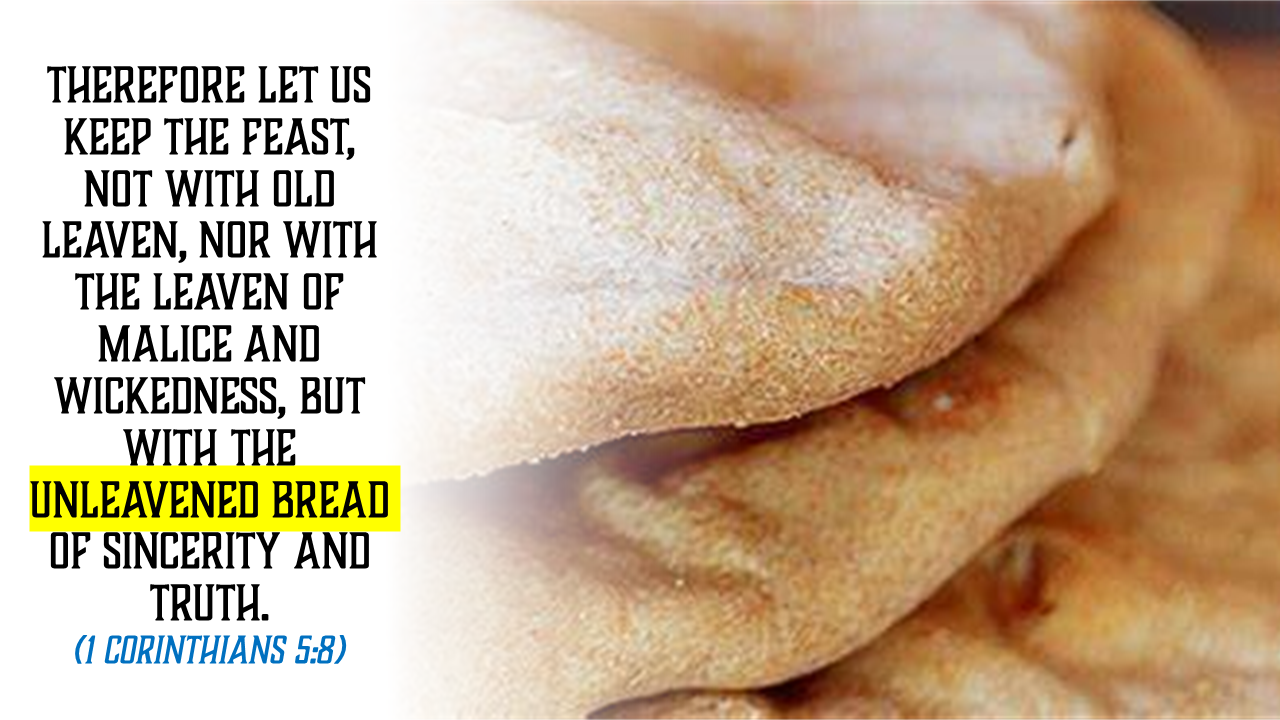
Therefore let us keep the feast, not with old leaven, nor with the leaven of malice and wickedness, but with the unleavened bread of sincerity and truth. (1 Corinthians 5:8)

An Unleavened Life

In the midst of Paul’s rebuke of the Corinthian brethren for allowing sexual immorality to continue in the church, he reminds them of the true character of the child of God. Allowing immorality to continue without taking any action was sinful in itself, polluting the church family with the influence of the ungodly. He demands they take severe action against the couple to purge their ungodly influence from among them. Paul uses the example of leaven to show that allowing sin of any nature to continue unabated and unchallenged impacted everyone.

It is easy to sit back and think what other people are doing does not impact the group. Paul tells the church they have allowed the leaven of ungodliness to continue, influencing the whole church. A little leaven will leaven the entire group if not taken care of. He commands them to purge out the leaven of wickedness to remain a body of unleavened souls seeking the purity of the gospel. Christ is the Passover as the sacrificial lamb slain to redeem men by His blood.

Paul’s plea goes to the heart of each individual. The broader subject is the couple in adultery, but the important picture is how it has affected the individuals. They had allowed the immorality of the man and his father’s wife to corrupt their lives. Every Christian must be the unleavened bread of sincerity and truth to the word of God. What was allowed to happen in the collective group at Corinth was impacting everyone on an individual level. Christians must stand for truth. This is not done simply by doing the right things in the right way in worship. It impacts how they live each day as unleavened, uninfluenced souls from a world filled with darkness.

The leaven of sin can so easily ensnare the heart. Refusing to put away sin is allowing the leaven of the devil to change the hearts of the godly to accept evil. The Corinthians had allowed the couple to remain in their immoral relationship without challenge. That was a greater sin. To be the church of the Lord, the lives of the saints must be unleavened in their attitudes toward sin. So many of God’s people act like the world, dress immodestly in the fashion of the world, accept the immoral lives of brethren, never blush at evil, and accept the norms of society as acceptable before God. The Lord demands unleavened lives.

Unleavened bread has no leaven in it. Any part of leaven can and will affect the dough. Great care is taken to remove leaven so the bread remains pure. Unleavened lives refuse to allow the leaven of the world to be a part of any form or fashion. Allowing any part of the worldly leaven to influence the heart can change the lives of the Christian. Every effort must be taken to remove the leaven of the world from the hearts of those who seek the upward call of Christ Jesus. Sincerity and truth are the elements of an unleavened life. The Christian must be true and faithful to Jesus Christ. No Christians unwilling to put away all sin can have or give evidence of sincerity.

Posted in Uncategorized | Leave a comment

The Power Of The Gospel

And Jonah began to enter the city on the first day’s walk. Then he cried out, saying, “Yet forty days, and Nineveh shall be overthrown!” So the people of Nineveh believed God, proclaimed a fast, and put on sackcloth, from the greatest to the least of them. (Jonah 3:4-5)

The Power Of The Gospel

Jonah was a great preacher of the gospel. He is called the running prophet, the reluctant prophet, and the angry prophet, but when he preached to Nineveh, they changed their hearts and believed in God. Nineveh was the capital of the Assyrian Empire. It is one of the oldest cities in the world, having its origin with Nimrod, the great-grandson of Noah.

The Lord tasked Jonah to go to the city of Nineveh and cry out against it, for their wickedness was great. At first, Jonah disobeyed God’s command, fleeing to Tarshish. On the way to Tarshish, the Lord sent a great storm, nearly breaking up the ship he was on before the mariners threw Jonah into the sea. God prepared a big fish, and Jonah spent three days and nights in the belly of the beast. After the Lord spoke to the fish, Jonah was vomited onto dry land.

God again tells Jonah to go to Nineveh and preach the message God tells him. Jonah enters the city, telling the residents that in forty days, the wrath of the One True God will come down upon them and destroy them. Nineveh was not a Jewish city. It was a city filled with Gentiles. Jonah did not preach the Law of Moses or the covenant of circumcision or keep the Sabbath day found in the law. The Ninevites needed to repent before the wrath of God came upon them. They responded to the message of Noah by believing in God, proclaiming a fast, and putting on sackcloth, from the greatest to the least of them.

Much is said about Jonah’s story, which centers on Jonah and the fish. The real story of the book of Jonah is the power of the gospel changing the hearts of those whom no one would have considered deserving of salvation. Nineveh was a foreign city filled with Gentiles. Why save them? One hundred and twenty thousand souls turned to God at the preaching of the good news of salvation found in believing God. Tragically, Jonah became angry these foreign dogs changed their hearts, and God would save them. The gospel moved them to repent and change their lives because the power is in the message.

Many Ninevites are walking around today, shunned and ignored because of who they are. The gospel can change the lives of anyone who turns their hearts to the Lord. Jesus died for Jews and Ninevites. A Jewish preacher went to a Gentile city and turned the heart of a city to God. That is the power of the gospel. That same power can be found today when the shackles of prejudice and hatred are removed to give the lost what they so desperately need – Jesus Christ and Him crucified. What the world needs more are patient hearts willing to share the gospel with a lost and dying world. Have you seen a Ninevite lately?

Posted in Uncategorized | Leave a comment

The Wasted Life

Then I hated all my labor in which I had toiled under the sun, because I must leave it to the man who will come after me. And who knows whether he will be wise or a fool? Yet he will rule over all my labor in which I toiled and in which I have shown myself wise under the sun. This also is vanity. (Ecclesiastes 2:18-19)

The Wasted Life

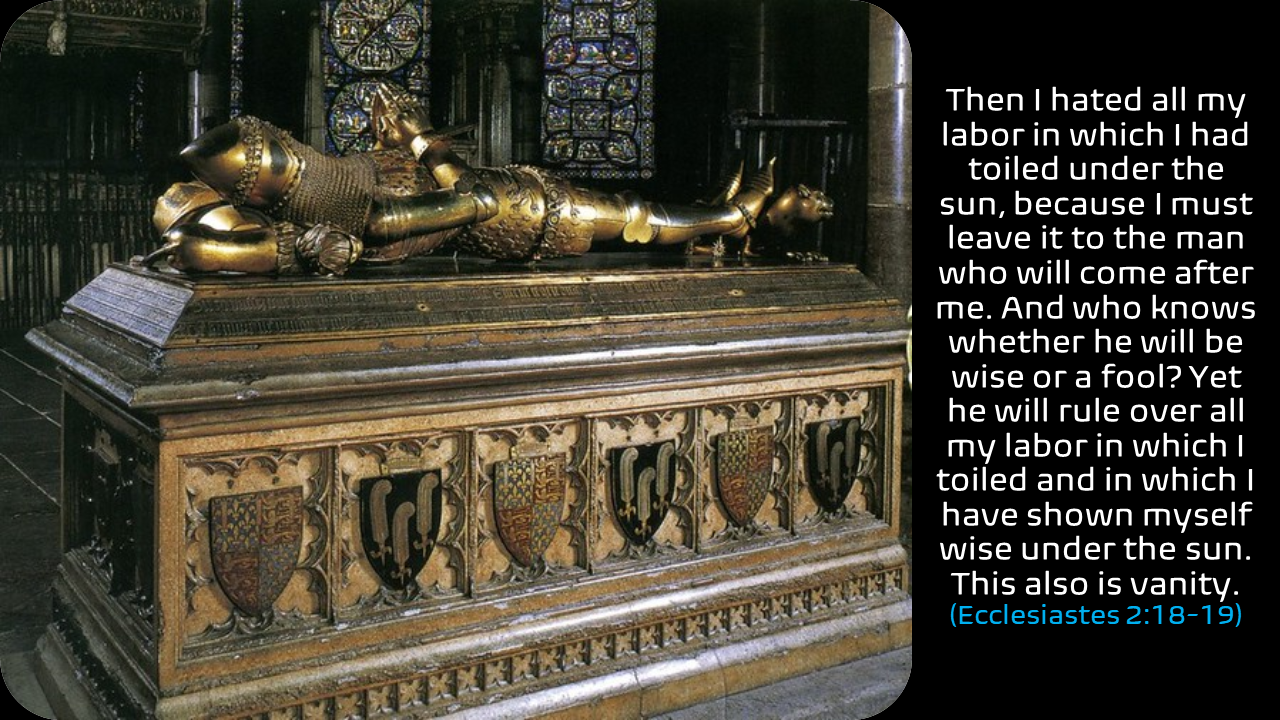
Edward of Woodstock was the eldest son of King Edward III of England. Born in 1330, he died at the age of forty-six without ascending the throne, dying before his father. His son, Richard II, succeeded his father to the throne. History remembers Edward as the Black Prince, one of the most successful English military men of his day. During the Hundred Years War, he distinguished himself at a very early age. English contemporaries view Edward as a model of chivalry and one of the greatest knights of the period.

Edward’s tomb was placed in the Canterbury Cathedral in accordance with his will. A bronze effigy adorns his tomb with his epitaph inscribed around his effigy, which reads:

Such as thou art, sometime was I.

Such as I am, such shalt thou be.

I thought little on th’our of Death

So long as I enjoyed breath.

On earth I had great riches

Land, houses, great treasure, horses, money and gold.

But now a wretched captive am I,

Deep in the ground, lo here I lie.

My beauty great, is all quite gone,

My flesh is wasted to the bone.

Edward’s epitaph reminds all men that death comes to everyone. He thought little of his hour of death, but the chimes of life ended in 1376. Life was good for the prince, who had great honors and riches. He suffered from dysentery, which would take his life. He had land, houses, great treasures, horses, money, and gold; but of what value in death? Edward recognizes that death is complete where there is no beauty and the body decays.

The story of Edward of Woodstock is the same sad refrain of those who live every day with little thought of their mortality. Having great tracts of land and houses did not keep the prince from dying. Death took away his power as a commander of an army. The horses, money, and gold went to those who remained, and they left it all to others when they died. Death is the reality no one wants to accept. Life is not about what is found here but what is discovered when the eyes close in death.

Edward’s epitaph should warn all who trifle with the empty promises of riches, power, and pleasure. Billionaires die as quickly as paupers, and the question remains the same for each: are you prepared to meet God when you die? The Lord is not impressed with how much money you have or the number of houses you own. It matters little to the Creator of your gold and silver because it belongs to Him anyway. Your breath comes from God. Serving the will of the Father is the purpose of life. Jesus died to open the way of salvation. Are you ready?

Posted in Uncategorized | Leave a comment

How To Run The Race

Therefore we also, since we are surrounded by so great a cloud of witnesses, let us lay aside every weight, and the sin which so easily ensnares us, and let us run with endurance the race that is set before us, looking unto Jesus, the author and finisher of our faith, who for the joy that was set before Him endured the cross, despising the shame, and has sat down at the right hand of the throne of God. (Hebrews 12:1-2)

How To Run The Race

Life can be filled with many struggles that test the faith of the strongest disciple. The first century Jewish Christians faced a great many challenges as they learned to leave the trappings of the Law of Moses for the blessings of the covenant of Christ. It was not an easy road to travel as their fellow countrymen turned their backs on them, ridiculed them, and brought suffering to their lives.

The writer of Hebrews attempts to encourage and lift up the spirits of the downtrodden by reminding them of the many examples of faith that preceded them. They faced trials but did not give up their faith. Many of the unnamed suffered death by stoning, the sword, and the saw and suffered afflictions and torments. These faithful saints never lost their faith as they looked to a city prepared for them by God.

A testimony of saints who have received their reward reminds the disciples of the hope in Christ. As a crowd of witnesses, the saints who have died stand as pillars of faith to those who continue to fight the good fight and never give up. Those in the race of life are spirited on by the shouts of the faithful, pushing them forward to maintain their faith. There is no reason to give up when so many have shown faith in remaining steadfast.

What does it take to run the race of life with a faithful spirit and love for the Lord? Runners need to eliminate any encumbrances that hinder their running. A runner would not attempt to run with a heavy coat or armor. The runners of faith must learn to run without the trappings of the world holding them back or making their run ineffective. Faith must remove anything that would hinder the race of a saint.

Sin must be removed from the heart of a man running the race because it is the heaviest weight that hinders the Christian runner. Evil habits, immoral practices, whatever part of sin there may be, will only impede the race of the child of God. These things must be eliminated. Trying to run the Christian race with one foot in the world is impossible. It takes both feet to run the race that leads to eternal life.

Running is hard and exhausting. To run the Christian race requires running. This is not a cakewalk or a stroll. There is running involved in the actions of the Christian. With that running comes endurance and perseverance. Having a spirit of faith and devotion to God, the Christian runs with purpose and the fortitude to run the entire race without giving up. Many will be the time when the spirit becomes discouraged. Don’t give up, and do not stop running. Look to Jesus as the hope of what is found in eternal life and the joy of heaven. He ran His race and lived without sin. All sin and fall short of the glory of God, but the Christian is a runner who keeps his focus on Jesus Christ and runs away from the world.

The race that is run for the Christian ends at the throne of God. It is a glorious race filled with other runners who struggle. The company of runners share a common road with a common goal in mind. Those who have died are a cloud of witnesses that the race can be run faithfully. The runners on the course with us also witness the joy of ending our race in the presence of the Lord Jesus Christ. Run good today. Help someone else run good today. Above all – keep running.

Posted in Uncategorized | Leave a comment

A Cross Without Wheels

And whoever does not bear his cross and come after Me cannot be My disciple. (Luke 14:27)

A Cross Without Wheels

The hangman’s noose is an offense to most people and is considered a hate crime in some circles. It would be disturbing to see a man walking around trailing a strand of rope with a hangman’s noose tied around him. The last public hanging in the United States was August 14, 1936, attended by a crowd estimated between 10,000 to 20,000. Jewelry stores do not carry gold hangman’s nooses for people to wear, and it would be offensive to see shirts emboldened with the noose.

If a First-Century Roman citizen were alive today and saw the jewelry of golden crosses people wore, they would be horrified. It would be incredulous to see crosses emblazoned on clothing. Nobody in the first century would put a cross (or three crosses) in their front yard or on a hill or field. The cross was a symbol of horrendous torture and suffering. Citizens of the Roman Empire were all too familiar with crucifixion as the Roman government punished thousands of people with crucifixion. Crosses with bodies in various stages of decay lined many streets.

For the Jewish mind, the cross was a despicable curse. No glory and honor was given to a man who was nailed to a tree. Everything about the cross was humiliating, agonizing, painful, and final. For a Jew to be crucified was the most horrible manner of death. The Law of Moses required a man who was crucified not to remain overnight, defiling the land that God gave Israel. He was to be buried that same day. The crucified man is accursed of God. There was no gold jewelry to bring honor to the cross.

Jesus taught His disciples to bear a cross to show allegiance to the King of Kings. Using this kind of language in the Roman Empire was radical and offensive. When the modern mind hears Jesus encourage men to bear a cross, there is an immediate softening of the image of the cross to be something glorified as a symbol of purity and righteousness; something with diamonds encased on it. It was anything but those images. To bear a cross was to remove self and accept the will of God completely. It was the highest level of suffering and cruelty.

Men try to show piety by carrying a cross through the streets of Main Street, USA. Most often, it is the entire cross, made out of soft wood, easy to carry, with padding for the shoulder and probably a wheel at the base. The man wears comfortable shoes and likely has a backpack for water and snacks for his journey. Ironically, the man portrays a complete misunderstanding and vivid misrepresentation of what Jesus did. Jesus carried an eighty-pound piece of timber on a back that had been severely beaten by the scourging. The Lord was abused, spit upon, slapped, kicked, prodded, and beaten on the head with a crown of thorns.

Jesus did not have a wheel on His cross. His ordeal so weakened him that he fell beneath the load. The Romans made Simon of Cyrene carry the cross. Then they nailed the Son of God to the timbers and watched Him die a miserable, horrible death. Men have replaced the cross of Jesus with a padded cross with a wheel. They should be ashamed of themselves. Jesus never intended for anyone else to bear that cross. He was the Son of God, and only He could bear that cross. Jesus suffered so we could rejoice in what the cross accomplished.

The glory of Jesus is found in the resurrection. Jesus took on the wrath of God to die for the sins of the world, and the Father raised Him from the dead. To bear a cross is not to take a piece of wood and try to be like Jesus. No man can be like Jesus! Bearing a cross to be a disciple of Jesus is to devote one’s life totally to Jesus Christ without turning back. A. W. Tozer said, “To be crucified means, first, the man on the cross is facing only one direction; second, he is not going back; and third, he has no further plans of his own.” And to add a fourth – he does not request a wheel.

Posted in Uncategorized | Leave a comment

It’s Not On The Clock

Now as he reasoned about righteousness, self-control, and the judgment to come, Felix was afraid and answered, “Go away for now; when I have a convenient time I will call for you.” (Acts 24:25)

It’s Not On The Clock

There are sixty seconds to the minute and sixty minutes to an hour. The clock measures the time that is real. Most people wear a device of some type to tell time, helping them plan and organize their day. Clocks and timekeepers can be found everywhere. There is one thing a clock does not have on its dial – a convenient time. What makes a convenient time so amazing is how many souls believe they have a convenient time to obey the will of God.

Plans are made with precision to know when to awaken, go to work, see a doctor, when a game begins, and the constant ticking of the clock governs every facet of life. Calendars fill with necessary appointments. It becomes a hectic race of running from place to place in life’s unending, busy hustle. People still believe they will devote themselves to the Lord when a convenient time happens.

What is a convenient time? It is when all things are in order, life has slowed to a snail’s pace, and the heart is ready to accept the will of God on human terms. The mistake is forgetting that while man creates the clock, the Lord creates time. In the beginning, God set the sun, moon, and stars for signs, seasons, and days and years. Men created time devices like sundials, obelisks, water clocks, candle clocks, the hourglass, and spring-driven clocks into the sophisticated electronic devices of today. These are instruments that measure what God created. Time comes from the hand of God. What God did not create is a convenient time.

Felix was a man who lived on time he did not have. He was a powerful man of influence and position as a Roman governor. The apostle Paul was placed under his care after the Jews charged Paul in Jerusalem. Paul had the opportunity to preach the gospel to Felix and his wife, Drusilla, who was Jewish. Felix was well-versed in the activities of the early church. Paul preached faith in Christ, righteousness, self-control, and the judgment to come. The preaching of Paul caused the governor to become afraid. His heart was responding to the message of the gospel.

As Felix heard Paul’s message, he recognized the truth of Paul’s words. Responding to the preaching, Felix tells Paul to go away, and when a convenient time comes, Felix will have him back to continue the message of Christ. Felix said he wanted to wait until it was more convenient. That day never arrived. He sent for Paul often, but it was to get money from Paul. After two years, Felix was replaced by Porcius Festus. The convenient time for Felix to obey the gospel never came.

The ticking of the clock should remind those seeking a convenient time that life is short and that today is the day of salvation. Many people who believe they will die at the midnight hour face death at 11:30. It comes suddenly, swiftly, and without warning. The sad reality of the convenient time is that most people die unprepared. There is no convenient time later; it is only now. Felix would have regretted his lost opportunity to serve Christ. When he died, he realized time was over.

People put off doing what they should do for God for many reasons. The list is endless as to why someone will not repent, change their life, obey the gospel, and serve the Lord. What makes their story more tragic is that they were looking for a time not found on clocks or watches. Time is real, and it disappears quickly. If you are looking for a convenient time to change your life, you are following a fool’s errand. Today is the only day you have. It may possibly be the last and final opportunity you have. Make the best of it. Obey God. Serve the Lord. Now.

Posted in Uncategorized | Leave a comment

Walking Worthy

I, therefore, the prisoner of the Lord, beseech you to walk worthy of the calling with which you were called, with all lowliness and gentleness, with longsuffering, bearing with one another in love, endeavoring to keep the unity of the Spirit in the bond of peace. (Ephesians 4:1-3)

Walking Worthy

Paul was a remarkable man who could take his dire circumstances and turn them into encouragement for others. He spent many hours in jails and prisons for the cause of Christ. Men tried to kill him on more than one occasion. His life was arduous in journeys from many points on the globe as he preached the gospel of Christ. Many churches were encouraged by the preaching of Paul. As the apostle sat in another Roman prison, he wrote a letter to his beloved brethren in Ephesus, reminding them of their character in the body of Christ.

Being a Christian, it is not difficult to understand the rudimentary principles of discipleship. Paul deals with many issues among the churches and doctrines, but he never forgets to remind the people of God how they should live daily. There were men like Paul and Barnabas who could travel to share the gospel with lost souls. Most people lived in small communities, working for their families to provide and care for them. Their lot was a time of raising families, being subject to the governing authorities, enjoying occasional recreation, and working for a living. To them, Paul writes to show them the character of heart found in the kingdom of Christ.

A Christian is a person who has a lowly and gentle heart. With humility, they show Christ living in them with a gentle spirit. Not everyone can so easily come by these traits. Learning to be humble and acting with a spirit of gentleness must be learned. That knowledge must come from the word of God because the Christian wants to let the world see Christ. The people of God must be known as patient and kind in their dealings. When they labor in their jobs, they are known to be unlike the world through their lowliness and gentility. As families seek the glory of God, a Christian husband and wife show fidelity in their character.

It was not an easy life to live for Christ in the city of Ephesus. It was the capital of proconsular Asia, which was the western part of Asia Minor and was known as a great metropolis. The Temple of Diana was there, boasting a theatre seating 50,000 spectators. Idolatry was a principal character of this great city, and there were Christians who lived in the shadows of its immorality. Still, Paul exhorted the saints to be patient with others, showing the spirit of love and humility, keeping the unity of the Spirit in peace. The shepherds of the Ephesian church had their work cut out for them in helping their flock maintain purity.

Ephesus is in ruins, and the Temple of Diana is destroyed. The church of Christ remains, and the people of God fill the earth, humble, gentle, longsuffering, bearing with one another, and keeping the unity of the Spirit of grace. When someone wants to know how to walk worthy of the name of Christ, Paul offers a few traits that will show the world the love of God. The church needs more saints who demonstrate these traits so that others can see Christ living in them. Walk worthy.

Posted in Uncategorized | Leave a comment

The Foolishness Of Alcohol

Who has woe? Who has sorrow? Who has contentions? Who has complaints? Who has wounds without cause? Who has redness of eyes? Those who linger long at the wine, those who go in search of mixed wine. Do not look on the wine when it is red, when it sparkles in the cup, when it swirls around smoothly; at the last it bites like a serpent, and stings like a viper. Your eyes will see strange things, and your heart will utter perverse things. Yes, you will be like one who lies down in the midst of the sea, or like one who lies at the top of the mast, saying: “They have struck me, but I was not hurt; they have beaten me, but I did not feel it. When shall I awake, that I may seek another drink?” (Proverbs 23:29-35)

The Foolishness Of Alcohol

Solomon observed there was nothing new under the sun. Since the beginning of time, humanity has repeated the same mistakes and faces the same challenges as any other generation. The “modern man” is relative to the time it is said, and everyone thinks their generation is the updated, new, modernized form of human wisdom. What makes the spirit of man humorous is the belief that his generation is smarter than the previous.

The consumption of alcohol is as old as the world filled with sin. Fruit trees were created on the third day of creation. After Adam and Eve were expelled from the garden, it did not take long for man to understand the process of taking various kinds of fruit to create beverages. The first suggestion of the abuse of alcohol can be assumed when the Lord looks upon the world and saw that every intent of the thoughts of man’s heart was evil.

Drunkenness has always been at the top of the list of sinful behavior. After the flood, Noah planted a vineyard and drank the wine and was drunk. He exposed himself to his sons, leading to the curse of Canaan for laughing at his father. After God destroyed the cities of the plain, including Sodom and Gomorrah, the two daughters of Lot got their father drunk and committed incest to bear children. Alcohol has destroyed many lives.

Solomon presents some practical wisdom about the dangers of drink. The foolishness of alcohol is the anguish it brings, the sorrows it creates, and the fighting that comes as a result. How foolish. Alcohol brings about destruction. Wounds are unexplained. The eyes are bloodshot. It is utterly foolish for a man to be enthralled by the poison of alcohol, and yet it has always been one of the strongest temptations known to men.

Families are destroyed by the foolish nature of those seeking out the conjuror of evil. Countless innocent lives have been snuffed out because of the uncontrolled effects of its power to kill. The irony of its poison is that it looks inviting as it sparkles in the glass, glistening in the siren call to find happiness at the bottle of the bottle; and in the end find nothing but death. It is a poisonous snake that stings like a viper. Solomon shows the futility of dealing with evil as a man who takes fire into his bosom, expecting not to be burned. If a man plays with fire, he will be burned.

A greater foolishness of alcohol is the degradation it brings on a man who will see strange things, hallucinations, and say crazy things, staggering as a sailor tossed at sea, clinging to a swaying mast. What a fool he makes of himself. A drunk can feel no pain and will not realize he is being attacked. When it is all over, he will stand up and go looking for another drink. What a fool. How great a fool he makes of himself.

Defending the practice of ‘drinking’ is a fool’s errand performed by fools who believe they are smarter than the Lord. Nothing is new under the sun because there were fools in the days of Solomon, just as there are fools today. Who has woe? Foolish people who think they are stronger than temptation and smarter than the evil one. How sad to see lives destroyed over a liquid, a substance of no value but of eternal consequence. The wise man abstains from every form of evil – including what sparkles in the cup. Don’t be fooled into being a fool.

Posted in Uncategorized | Leave a comment