Running Eyes

For the eyes of the Lord run to and fro throughout the whole earth, to show Himself strong on behalf of those whose heart is loyal to Him. In this you have done foolishly; therefore from now on you shall have wars. (2 Chronicles 16:9)

Running Eyes

King Asa was the third king of the kingdom of Judah and the grandson of Rehoboam. Because of the leadership of his grandfather, Rehoboam, and his father, Abijam, the people had endured the rule of wicked kings for twenty years. Asa would reign over Judah for forty-one years and did what was right in the eyes of the Lord. However, near the end of his reign (year thirty-six), he made a grave mistake when attacked by Baasha, king of Israel.

The civil war between the northern tribes of Israel and the southern two tribes of Judah had ravaged the land for many years. Baasha was a wicked king who refused to follow the word of the Lord. He invaded Judah and began building a fortress called Ramah. He planned to seal Asa in not allowing anyone to go out or come into Asa, king of Judah. When Asa heard of the invasion of Baasha, he brought silver and gold from the treasuries of the house of the Lord, including the kings’ house, and sent them to Ben-Hadad, king of Syria.

Asa sought a treaty with the Syrians to fight against Baasha. Ben-Hadad was in a treaty with Baasha, but he agreed when he received a bribe from Asa to break his treaty. Attacking cities in Israel, the Syrians stopped building Ramah and returned home. King Asa took all the provisions used to build Ramah and used them to build Geba and Mizpah. The grievous error Asa made was seeking the help of the Syrians instead of asking for the help of the Lord.

The prophet Hanani came to King Asa and rebuked him for not seeking the help of God. Asa relied on the king of Syria to deliver him from Baasha. Early, Zerah the Ethiopian came against Judah with an army of a million men and three hundred chariots. Asa was outnumbered with only an army of five hundred eighty thousand warriors. God delivered the Ethiopians to the army of Asa in a great victory. Now, faced with Baasha and the army from Israel, Asa did not ask God to help him. What Hanani told the king is revealing.

Hanani reminds King Asa that the eyes of God run to and fro throughout the whole earth, seeking those He can help. God desires to strengthen the hands of the weak and stir the feeble hearts of His people with courage. The eyes of the Lord seek ways to help His people. There is no greater army to fight against Satan than the army of the Lord led by the Commander of the army of the Lord. Asa had the opportunity to call upon the Lord, but he called on the king of Syria.

Our prayers fail because we trust in our own wisdom to solve our problems. Satan has convinced us that God does not answer our prayers, and we then do not trust Him. We seek answers in everything but God. Hanani declares God is looking for opportunities to help His people. What greater strength can a man receive than what comes from the Lord? Prayers are always answered. When the answers do not fit our desire (or demand), it is God’s will. Asa made an alliance with the wrong source. God is always faithful and will never leave His people. Trust in Him, and do not lean on your own understanding. Let the eyes of the Lord look down upon your life and bless it with the power of God. Ask, and you will receive. Knock, and it shall be opened to you.

Posted in Uncategorized | Leave a comment

Lessons From Two Men

But there was a certain beggar named Lazarus, full of sores, who was laid at his gate, desiring to be fed with the crumbs which fell from the rich man’s table. Moreover, the dogs came and licked his sores. So it was that the beggar died and was carried by the angels to Abraham’s bosom. The rich man also died and was buried. (Luke 16:20-22)

Lessons From Two Men

The story of Lazarus and the rich man is a story of contrast that is common to all men. On the one extreme is a man who lives with all the enjoyments of a worldly life. The rich man was very wealthy and enjoyed daily increases in wealth and prosperity. A man of his stature was an influential man. As a Jew, he could point to the success of his life to the blessings of God, but he was a man devoted to himself, not the Lord. The Law of Moses did not forbid a man from being rich, but the law prescribed that the poor be cared for and those in need be loved. The rich man did none of these.

A contrast to the rich man’s life was found at his gates. Little is known about Lazarus as Jesus relates the story. He has friends and family who carry him to the rich man’s gate to receive alms. It was a common practice for the oppressed to be placed at the gates of the well-to-do to receive some benevolence. According to the Law of Moses, this is how the people of God took care of one another. Lazarus begged for crumbs that fell from the rich man’s table.

Lazarus was not only a poor man, but he was also afflicted with a disease manifesting in sores all over his body. The gnawing in his stomach was overshadowed by the intense pain from the many sores covering his body. His misery was heightened by the degradation of lying on a thin carpet begging for the mere morsels of crumbs that could be found. Lazarus’s life was filled with suffering every waking moment. He could see and hear how well the rich man was doing. On occasion, the rich man would come through the gate to attend some great gathering, and there was Lazarus, reaching out his hands for a crumb. The rich man was disgusted with all the beggars surrounding his gate as he glared at them contemptuously.

The rich man was a Jew bound to keep the Law of Moses, but he did not. His life was an unrighteous affair of riches, sumptuous living, and seeking the fame and fortunes of life. He did not fear death because he knew he would be remembered for all he accomplished. When he died, there would be great festivals in his honor. His legacy was established, and he felt confident. At the rich man’s gate sat a man in contrast to his station in life. Lazarus was a righteous man who trusted in God. He did not make great fanfare about his faith. Whatever circumstance placed him at the rich man’s gate was not unlike the story of the patriarch Job. During his suffering, he believed in the promises of God.

Lazarus was a man of vision. He had nothing to eat and suffered from the sickness of sores covering his body. The only creatures giving sympathy were dogs, who would come and lick his sores, easing his pain. Through all his suffering, he kept his eyes on the better homeland, a heavenly country. Like Abraham of old, Lazarus looked to a city prepared for him by God. Lazarus learned to live a righteous life in his poverty. Lazarus was a righteous man who looked to a time when God would wipe away his tears and take away his sorrows. That time came for Lazarus and the rich man at the same time.

On a certain day, two men died who, in life, were the contrast of human suffering and prosperity. What is significant about the death of the rich man and Lazarus is they died the same way. When the rich man died, he left all his wealth and prosperity; when Lazarus died, he left all his poverty and disease. What makes the story of the two men different is what happened immediately upon their deaths. The man who suffered terribly during life was carried by angels to the bosom of Abraham. What a joy to feel the pains of a diseased body to be lifted. Lazarus was comforted by the joy of the Lord. His life had been a faithful love for the promise of God.

The rich man also died, and that is all Jesus said. Jesus said the rich man died and was buried, and being in torment, he lifted up his eyes and saw where Lazarus was. He never took notice of Lazarus in life, but now, in death, Lazarus has become a real person. The rich man refused to honor God. Now, he would remain in the torment of fire and gnashing of teeth forever. He knew – too late – what was important in life. Lazarus believed in God and found eternal comfort in the arms of a loving Father.

Two men are in contrast, and you are one of those men. Either you live like the rich man ignoring God’s will or serve the Lord God in faith and obedience like Lazarus. Death comes to all men. You will die. If you are unprepared for death, you will not be prepared for what comes next. It is real, it is horror, it is suffering. No one will come from the grave to warn you. You have the gospel of Jesus Christ. If you do not obey the gospel, there is no hope. Are you ready?

Posted in Uncategorized | Leave a comment

Why Am I Here?

Everyone who is called by My name, whom I have created for My glory; I have formed him, yes, I have made him.” (Isaiah 43:7)

Why Am I Here?

The question of man’s existence has been the great question men seek answers to. Adam and Eve began the conversation while trying to understand their relationship with God. Satan convinced them they did not need God. Cain thought he knew why he was on the earth. The world of Noah became so evil as men fulfilled their desires for their gratification to define their purpose in life. Noah had a different vision. He understood why he was there, and he honored God with his worship.

God called Abram to go to a land he would receive as an inheritance, not knowing where he was going. He dwelt in a land of promise as in a foreign country, dwelling in tents and waiting for a city which had foundations, whose builder and maker was God. That is what motivated Abram. He saw something more than the trappings of the world around him for his purpose in life. Moses was called the son of Pharaoh’s daughter and accepted the affliction of his people instead. He looked for an eternal reward. Moses knew why he was on the earth.

Men like Pharoah thought they were gods on earth exercising all authority and dominion. Kings like Ahab and Herod wielded significant power over the masses. They all believed their purpose in life was to rule over mankind. The great Ceasars of Rome demanded statues of their likeness to live for ages. Despots have risen in modern times, seeking to define their mark on history. They all share one thing in common. From Pharaoh down to those today who fill their coffers full of the wealth and pleasures of the world is – they die.

Pharoah died, and his treasures were lost through the sands of time. Robbers took some. Scholars found many and put them in museums. The statues of the Roman leaders remind the world of a day long ago and forgotten. All the despots of today toil for the vanity of something they will never possess. What they fail to know and understand is why they are here and what is their purpose in life.

The child of God has a distinct advantage over all men. Through the knowledge of the word of God, the disciple of Christ knows precisely why he is here and his purpose. Isaiah explained the purpose of man when he wrote seven hundred years before Christ. God created man for His glory. The purpose and function of man is to glorify God in his life by molding his character after the image of the divine. God formed man in His own image, the image of the divine nature.

Every man is a dual creature. He is first eternal, and then he is mortal. The preeminence of man begins with his eternal nature, not the physical. When men put more emphasis on the physical, they miss the reason God created them. God put man on the earth to show His glory. As the Master Craftsman, the Lord formed man as the image of Himself so that man would honor his Creator and Maker. That is his first and foremost purpose in life. It is not to gain as much money as possible. God did not create man to waste his life on the sensual aspects of life. The knowledge God desires is not of the world but of the Word. In the Word, man learns of his purpose in life.

Many struggle to find a design for their lives, walking aimlessly through the day without hope and without peace. God had given His word to direct the heart to Him. He desires for man’s heart to seek His glory through the knowledge of His word. When a man learns about his relationship with the Creator, he finds the story of Jesus, the Son of God. Understanding his complete worth is when the heart of man finds himself at the foot of the cross of Jesus. It is then he understands his purpose. Jesus died for you. You mean that much to Him. Honor Him with your life. Find your reason for living in Jesus Christ.

Posted in Uncategorized | Leave a comment

Lessons From Hormah

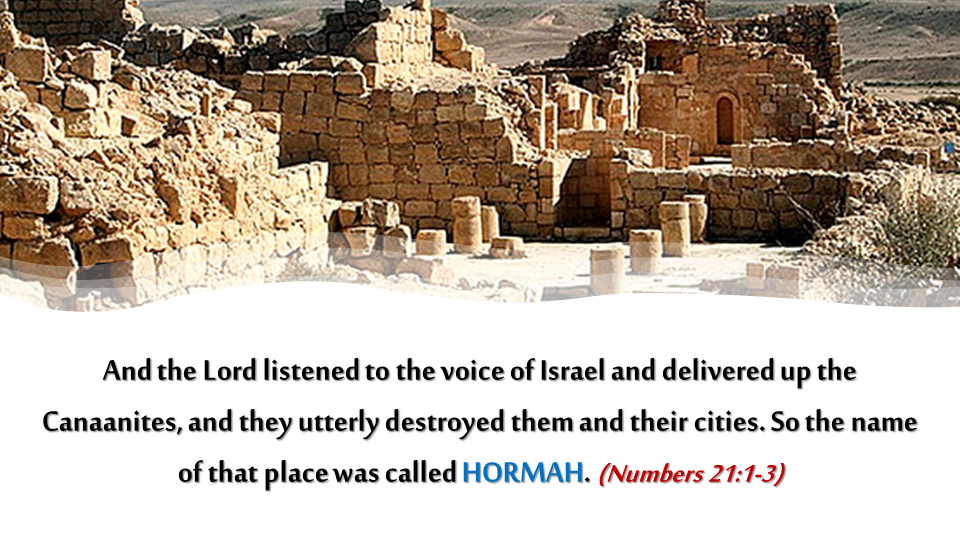
The king of Arad, the Canaanite, who dwelt in the South, heard that Israel was coming on the road to Atharim. Then he fought against Israel and took some of them prisoners. So Israel made a vow to the Lord, and said, “If You will indeed deliver this people into my hand, then I will utterly destroy their cities.” And the Lord listened to the voice of Israel and delivered up the Canaanites, and they utterly destroyed them and their cities. So the name of that place was called Hormah. (Numbers 21:1-3)

Lessons From Hormah

Israel spent forty years wandering in the wilderness as punishment for their rebellion at Kadesh Barnea. When they came to the land of Edom, the king refused to allow the Hebrews to pass through. The king of Arad attacked the people and took some prisoners. Israel made a vow to the Lord that if He would deliver the Canaanites into the hands of Israel, they would, in turn, utterly destroy the people and their cities. Heeding the vow of the people, God allowed Israel to kill all the people and raze their cities to the ground. Hormah is the word for the land’s destruction and the inhabitants’ banishment.

There are many examples of the story of Hormah in the Bible. On a human level, Israel marched against the king of Arad, the Canaanite, and slaughtered all the people: men, women, and children. The cities were burned, pillaged, and torn down. There was nothing to be left. Joshua would accomplish much of this destruction some years later. Still, the judgment of God had come upon these people for their wickedness and iniquity.

Hundreds of years earlier, God promised Abraham that his descendants would be given the land. The land couldn’t be given yet, for the iniquity of the Amorites was not yet complete. The Lord told Abraham the people of the land would be driven out, including the Kenites, Kenezzites, Kadmonites, Hittites, Perizzites, Rephaim, Amorites, Canaanites, Girgashites, and Jebusites. Later, the Lord told Moses that the Angel of the Lord would go against the Amorites and the Hittites, the Perizzites, the Canaanites, the Hivites, and the Jebusites to cut them off. When Israel destroyed the people of Arad, they completed the word of the Lord.

God keeps His promises. The promise to Abraham justified God’s righteous punishment for those who rejected Him. There would be many generations before the fulfillment of the word of the Lord came true, but it would not fail. The sinful nature of the people became so corrupt that God destroyed them. This is not unlike why God destroyed the world in the days of Noah. When Israel destroyed the people, they carried out the divine promise of God.

The people acted from the viewpoint of God’s wrath, not their own. It was not vengeance on the part of Israel to destroy the people. They first asked God’s blessing to attack the Canaanites because it was God’s will that must be accomplished. Killing all the people of the land came from the mind of the Lord against all ungodliness. As agents of God’s wrath, Israel acted under the banner of a righteous judge, executing judgment against those who were void of righteousness. It was clear Israel understood God’s role in the destruction of the people.

God is a God of wrath against ungodliness. It seems heartless to kill the Canaanites, but when a man understands what the wrath of God means, he will see the righteous judgment of the Lord. If a man commits horrible crimes against others, society deems him unfit to remain in the community. The Canaanites should not be thought to be good, righteous, loving people. They refused to retain God in their knowledge, worshipped idols, including human sacrifice, committed heinous crimes against one another, and lived immoral, decadent, sensual lives filled with sexual immorality. God’s wrath was complete when they were destroyed.

Hormah is a reminder of the promises of God, the righteous judgment of the Lord, and the reality of the eternal punishment of those who refuse to acknowledge God as Lord. Jesus told us about the day of judgment when all men bow before the great I AM to be judged according to their works. God has promised salvation to those who obey and condemnation to those who disobey. The promises of God always come true. Vengeance belongs to the Lord. There will be no one who will get away with evil in the sight of the Lord. All evil doers will be punished. Jesus said more about eternal punishment than any other. There is a place of everlasting Hell, which is fittingly called the lake of fire and brimstone. Hell is not temporary. Whether a person understands the meaning of eternal or not, they will when they find themselves in the darkness of perdition.

There are lessons to learn from Hormah. Believe and repent. Live for God. Obey His word. Now is the day of salvation.

Posted in Uncategorized | Leave a comment

What God’s Mercy Will Do

And I thank Christ Jesus our Lord who has enabled me, because He counted me faithful, putting me into the ministry, although I was formerly a blasphemer, a persecutor, and an insolent man; but I obtained mercy because I did it ignorantly in unbelief. (1 Timothy 1:12-13)

What God’s Mercy Will Do

Saul of Tarsus was a very angry man with a religious jealousy unmatched by anyone of his day. Many of the Jewish leadership wanted to destroy those who followed after Jesus of Nazareth. Still, Saul made it his life’s work to exterminate men and women who gave their allegiance to the man from Nazareth. As an influential man with great authority, Saul traveled from city to city seeking out the disciples of the Way. He placed men and women in chains with no regard for their lives. The historian Luke says that Saul wreaked havoc on the church. It was a perilous time to be a follower of Jesus.

When Paul stood before King Agrippa, he recounted his life story as a young man dedicated to the Law of Moses. He was zealous for the law as a devoted Pharisee with few men his equal. The tribe of Benjamin was always known as fierce warriors. Saul honored the tribal example of zealousness. He believed himself to be blameless concerning the righteousness that is in the law. No one could stand in his way. Saul punished the disciples of Christ often in every synagogue, compelling men and women to blaspheme the name of their Savior. No Christian was safe in a foreign city because Saul went after them there.

The first victim of Saul’s terror against the church was a disciple named Stephen. Saul listened to Stephen’s defense before the council until he and others could take no more. They gnashed at Stephen with their teeth in pure anger and hatred before bodily dragging the innocent man out of the city and stoning him to death. As each stone broke the bones of Stephen and slowly murdered the saint of God, Saul stood to the side, holding the garments of the executioners with an approving and authoritative posture. He felt justified in killing this man. After the death of Stephen, Saul found any opportunity to vote for those condemned to die. And many were sentenced to death. Then, he turned his attention to the church in general.

With threats and murderous intent, Saul went to the high priest in Jerusalem, seeking authority to travel to the northern city of Damascus to root out the many Christians found in the city. Receiving letters of authority, Saul assembled his soldiers and prison wagons to bring back from Damascus those who gave allegiance to Jesus. He was ready to arrest any man or woman who defied him. His plan was working to destroy the remnants of the followers of Jesus. As he traveled along each day, his desire grew more to end this blasphemous movement of followers who taught Jesus of Nazareth was the long-awaited Messiah.

Just outside the city of Damascus, the life direction of Saul took a remarkable turn. He met the One whom he had been persecuting. Obedient to the heavenly vision, Saul went into the city and remained in the home of those he came to arrest for three days. On the third day, Ananias gave Saul something he would never forget – mercy. It was not mercy from Ananias or the disciples of Christ but the joyous mercy of a forgiving God. Ananias told Saul to arise and be baptized to wash away his sins. And his sins were numerous and public.

Luke does not say where Saul was baptized, but it was a body of water. Rising from the waters to the joyful faces (and shocked faces) of the Damascus Christians, Saul realized what had occurred moments before. Through the grace of God, Saul of Tarsus was given an opportunity to repent of his sins. Confessing his allegiance to the Lord Jesus Christ from the town of Nazareth, Saul was baptized in water, and all his sins were washed away. He never understood completely how that happened because of all he had done against the church, but he had experienced the mercy of God without measure.

Paul would later write that he was the chief of sinners, but he knew that was an exaggeration. All sin and fall short of the glory of God, but Paul viewed his life for the terrible things he did against the kingdom of Christ, and the Lord gave him mercy. What God’s mercy did for Saul was to remove all he had done as far as the east is from the west. God would remember the sins of Saul no more. As the man from Tarsus rose from the watery grave, he felt the power of mercy overflow with eternal blessings of peace.

There is nothing that God will not forgive if a man is willing to repent and change his life. Saul, or as he is known as the apostle Paul, had much to forgive, but mercy cleansed him from his sins. He knew when he died, he was saved. The man who persecuted the Christians was saved. Mercy. How great the mercy of God. Embrace it. God is willing. Repent. Find the mercy of God.

Posted in Uncategorized | Leave a comment

A Speech Problem

But now you yourselves are to put off all these: anger, wrath, malice, blasphemy, filthy language out of your mouth. Do not lie to one another, since you have put off the old man with his deeds, and have put on the new man who is renewed in knowledge according to the image of Him who created him. (Colossians 3:8-10)

A Speech Problem

One of sin’s most prolific agents is the tongue’s misuse. The tongue is a small part of the body, but it causes more trouble than anything else. When the Holy Spirit made lists of sins, it was clear the sins of the tongue dominated the top of the list. Paul exhorts the Christians at Colosse to set their minds on things above whose lives are hidden in Christ Jesus. Troubling lips and praying knees do not go together. The letter is addressed to saints who must learn to put those things that defile the mind and body to death. This is not a letter designed for the unbeliever. Paul emphasizes that people of God should not allow these sins to be part of their lives.

As the elect of God, Christians should rise above the practice of the world where the uncontrolled tongue is common. The new man of Christ is renewed in the knowledge of God to season their speech with the grace of God. This means getting rid of certain habits and putting off patterns of speech that do not describe the heart of godliness. Among these are the sins of anger, rage, malicious behavior, slander, and dirty language. These are not attributes of the child of God. It is easy to fall prey to the uncontrolled tongue that lets loose with angry words and rage. God is not glorified when the loose tongue spews anger in an uncontrolled volume.

A recent term that has become common is “road rage.” This is where people in traffic situations become entangled somehow, and one or more people become enraged against another. There are multiple times when road rage has turned deadly when men kill other men over some slight or aggressive act while driving. This comes from people who fail to control their spirits and often ends with deadly consequences. And to what end? Someone dies over a traffic incident? Anger is one letter short of danger; when anger is uncontrolled, sin is the consequence, and the consequences can be eternal.

It is easy to look at sin as something large and something small. Murder and adultery may be considered big sins, while people view anger as a small, insignificant part of personality makeup. That is not the way God views anger. Paul does not suggest (as an option) that anger and rage should be removed from the heart of the Christian; those who embrace Jesus Christ are expected to follow these commands. There is no place for anger and rage in the heart of a Christian. It may take time to cleanse the heart of such things, but with the love of God, it can be done.

Malice is malicious behavior or conduct that is evil and cruel. Getting back at someone over an insult can be malicious behavior. Slandering someone’s good name or character is a sin of the tongue that will not go unpunished. One sin of the tongue that many do not seem to be concerned about is filthy language or shameful speaking. Telling dirty jokes, cursing, and allowing the same to be a part of one’s life is sinful. Sins of the tongue are dangerous things that, if left unchecked, can destroy a soul.

Lying is one of the most common sins. Convenient, compromising, blatant, and purposeful lying are all lies, regardless of their color. God hates lying. The Christian must be a person who tells the truth. Telling a lie comes from a heart that is filled with deceit. One of the things John wrote about those who will have their part in the lake, which burns with fire and brimstone, are those who lie. God hears all the words a man speaks and never misses a lie. Tell a lie, and a man will die. God is not mocked.

When a man has a speech problem, he finds a way to correct his speech. Filling the heart with the word of God and His grace will temper the spirit of sinning with the tongue. An unruly tongue comes from an unruly heart. A godly heart will speak words of godliness and truth. If you have a speech problem, change your heart. Seek help to mold your heart with the purity of the love of God. When you speak the truth, people will notice.

Posted in Uncategorized | Leave a comment

A Bath Will Not Save You

There is also an antitype which now saves us—baptism (not the removal of the filth of the flesh, but the answer of a good conscience toward God), through the resurrection of Jesus Christ. (1 Peter 3:21)

A Bath Will Not Save You

There is something that will save a man, and there is something that will not save a man. Peter shows that baptism will save, but taking a bath is not the same thing. One has the power to cleanse sins, and the other can only remove the filth of the flesh. When a man works by the sweat of his brow, he becomes dirty and covered with sweat. He may decide to bath to remove the dirt and sweat, and when he has done so, he is clean on the outside. Trying to look at baptism in the same way a man takes a bath has eternally different consequences. A man can bathe as fanatically as Adrian Monk, but he is only clean on the outside.

The act of baptism is not taking a bath. When Naaman was told to dip seven times in the Jordan River, the prophet did not suggest that all lepers should bathe in the muddy Jordan and be clean. There are no healing properties in the Jordan. Faith finally led Naaman to obey the word of the Lord, and he was cleansed of his leprosy. Many argue against baptism as essential for salvation because they think a man is taking a bath. Peter shows that salvation does not come from the removal of the filth of the flesh but the answer of a good conscience toward God.

Baptism is an act of the heart and mind struck down by God’s overwhelming grace and mercy. The Jews on the Day of Pentecost were pricked in their hearts for the murder of the Son of God. In the sermon Luke records of Peter, the apostle never mentions baptism. Peter’s sermon convinced the people to do something to save themselves. When pressed by the crowd to tell them what to do, Peter did not tell them to go and wash in the pool of Siloam. That is where the blind man was healed. He did not ask them to take a bath. Peter told the crowd to “repent and be baptized for the remission of your sins.”

In response to the command by Peter and the eleven to repent and be baptized for the remission of sins, three thousand people were moved by their good conscience to obey the word of the Lord. They answered with a good conscience toward God and were baptized. Peter did not contradict what he told the multitude on Pentecost with what he wrote the pilgrims of the Dispersion in his first epistle. One of the curious things missing from the conversion stories is the arguments people make today against baptism. Where in scripture does anyone say they will refuse baptism because they believe a sinner’s prayer can save them? Three thousand people did not argue with the words of the twelve.

When a man refuses to accept that baptism saves, he shows his evil conscience. There are only two kinds of minds: a good mind and an evil mind. Peter said that baptism saves. He parenthetically observes that he is not talking about bathing but about having a good conscience. The apostle said, “There is also an antitype which now saves us—baptism, through the resurrection of Jesus Christ.” If you reject this, you turn away from God’s grace. Believing baptism is not necessary for salvation comes from an evil heart of unbelief. When you accept the word of God, your good conscience will act accordingly. What hinders you from being saved?

Posted in Uncategorized | Leave a comment

The Eternal City

The city had no need of the Sun or of the moon to shine in it, for the glory of God illuminated it. The Lamb is its light. And the nations of those who are saved shall walk in its light, and the kings of the earth bring their glory and honor into it. Its gates shall not be shut at all by day (there shall be no night there). And they shall bring the glory and the honor of the nations into it. But there shall by no means enter it anything that defiles, or causes an abomination or a lie, but only those who are written in the Lamb’s Book of Life. And he showed me a pure river of water of life, clear as crystal, proceeding from the throne of God and of the Lamb. In the middle of its street, and on either side of the river, was the tree of life, which bore twelve fruits, each tree yielding its fruit every month. The leaves of the tree were for the healing of the nations. And there shall be no more curse, but the throne of God and of the Lamb shall be in it, and His servants shall serve Him. They shall see His face, and His name shall be on their foreheads. There shall be no night there: They need no lamp nor light of the Sun, for the Lord God gives them light. And they shall reign forever and ever. (Revelation 21:23-22:5)

The Eternal City

John makes a valiant attempt to describe eternal life, but it seems unimaginable to grasp the full meaning of how glorious the city of redemption will be. Light was created three days before the Sun and moon. The city of God will not be a physical place where the heavenly hosts cascade their light upon the surface. God’s glory will illuminate the righteous dwelling place, and the Lamb of God will be the source of its light. The eternal city will never be a closed place. It will be full of the bounties of God’s mercy and grace. There will never be a time of night or darkness because the purity of the light will dispel any fragment of shadows.

The inhabitants of the eternal city will be the redeemed and the separated. There will be a great harvesting of souls on the day of God’s judgment. He will take the unrighteous and remove them from His presence. Sadly, most will find themselves in unrighteousness and eternal darkness, where there will never be another shimmer of light. The eternal city will be filled with the saved of all time who have obeyed the will of the Father. No one who defiled the word of God will be allowed to enter, including the cowardly, unbelieving, abominable, murderers, sexually immoral, sorcerers, idolaters, and all liars. The eternal city will be a dwelling place of the righteous.

John describes a pure river of water proceeding from the throne of God and of the Lamb. The refreshing and nourishing waters of life will fill the image of the eternal city. A large tree will fill the middle of the street and on each side of the river. That tree is called the tree of life. Like the Garden of Eden, the tree of life shows the eternal glory of eternal life in the eternal city for those who have accepted eternal life.

There will be no tears in the eyes. Death will be destroyed. Is it possible to imagine a place where there is no death, crying, or sorrow? The Godhead will be there as the saints serve and worship them. Pure joy, happiness, contentment, and peace will fill the hearts and minds of the faithful. The eternal city is a place of eternal fulfillment in the bosom of God. For the first time, a man can look into the face of God and live. What an incredible sight to see the face of God and behold His glory with no fear. The name of the Lord will be emboldened on the forehead of the saved, showing their redemption from sin through the blood of the Lamb. What an incredible day that will be when we enter the eternal city.

What is more remarkable is how many are not preparing to enter the eternal city. Many live each day without thought of eternity. Their thoughts will turn to the eternal reward when it is too late, but there can be none. Not everyone who claims to know Jesus will be saved, but only those who do the will of the Father. You will not be allowed in the eternal city if you are not doing God’s will. Your eternal fate will be sealed in darkness and without God. God prepared an eternal city for salvation, desiring for none to perish. He also prepared a place for all those who refuse His grace. Where will your eternal dwelling place be? Light or darkness?

Posted in Uncategorized | Leave a comment

Preaching Jesus

Then Philip opened his mouth, and beginning at this scripture, preached Jesus to him. (Acts 8:35)

Preaching Jesus

The work of an evangelist is simple in form, basic in nature, and powerful in transmission. When Philip joined the man from Ethiopia in his chariot, he asked his student if he understood what he was reading. The man had been examining the book of Isaiah when Philip joined him. Seeking the help of any who would help him know further the mysteries of God, the Ethiopian implored Philip to join him and explain the meaning of the text.

There is an important bridge that Philip used to teach the lost sinner what he needed to do to be saved. He recognized the Ethiopian’s desire to know the truth from the word of God (the book of Isaiah). Philip saw an open heart (belief) to accept what was taught in scripture. The hope of Philip was to convict the heart (repentance) in obedience to the gospel of Christ unto salvation (baptism).

When Philip began to teach the Ethiopian, he did not discuss the modern views of religious opinions of the Jewish leadership or interpretations of the Law of Moses. He did not seek to soften the responsibilities of what the Ethiopian must do to be saved. The Ethiopian was a curious student of scripture who knew the importance of following the word of God with respect for the authority of scripture. Philip did not offer some plan of human wisdom to make it more palatable for a man from another country to accept. What Philip did was to preach Jesus. That is what the man needed. The story of Jesus is what must be told. There was no other avenue to take the man when teaching him the word of salvation.

There is little known about what Philip shared with the Ethiopian. Only three things are certain. First, Philip began where the man was in the book of Isaiah. He started with the word of God. Philip did not bring the books of men into the discussion. Beginning with the message of Isaiah, the evangelist opened the teachings of God to instruct the student. Second, he preached Jesus. Isaiah’s prophecy of the coming Messiah was fitting to begin telling the story of Jesus of Nazareth, a man attested by God by miracles, wonders, and signs. Philip would tell the eunuch that the man Jesus was raised by God to be both Lord and Christ (Messiah). There is nothing more to preach than Jesus.

The third certainty known of the teaching of Philip was baptism. As Philip was preaching Jesus, the student asked about baptism. The response by the Ethiopian is profound when he tells Philip, “See, here is water. What hinders me from being baptized?” It is clearly demonstrated that beginning with the word of God and preaching Jesus, the heart of the honest man will see the need to wash away sins in the waters of baptism. The eunuch is the one who pointed out the necessity. After confessing his allegiance to Jesus Christ, both the eunuch and Philip went down into the water, and the eunuch was baptized.

Philip preached Jesus. It is hard to find many churches today where Jesus is preached. Unlike the disciples of the first century, most pulpits talk about social issues, political controversies, and messages soothing to the ears of the listeners. If Jesus were truly preached in most pulpits, the preachers would not be popular. Modern preachers will not preach about sin. How can you preach about Jesus and not preach about sin? The pulpits of today spout human philosophy instead of preaching the Bible. Most people can attend a church service and never open their Bibles for all the good stories and feel-good sermons they hear.

When men stop preaching Jesus, they build a house built on sand. Religion becomes a social club with elite members ignorant of the basics of God’s word. If Philip were alive today, he would be shocked at the depravity of those who claim to follow Jesus and are not even close to being on the same page. If a man will not preach Jesus, he is not preaching truth. Jesus must be the central figure in preaching the gospel because the gospel is empty without Him. The heart of the message of salvation is Jesus Christ and Him crucified. Take Jesus out of preaching, and you will have a crossless message. Without preaching Jesus, the blood of Christ becomes water. Convincing the audience they can be saved without obedience to the word of God is a loveless dedication.

Preach Jesus.

Posted in Uncategorized | Leave a comment

No One Cares For Me

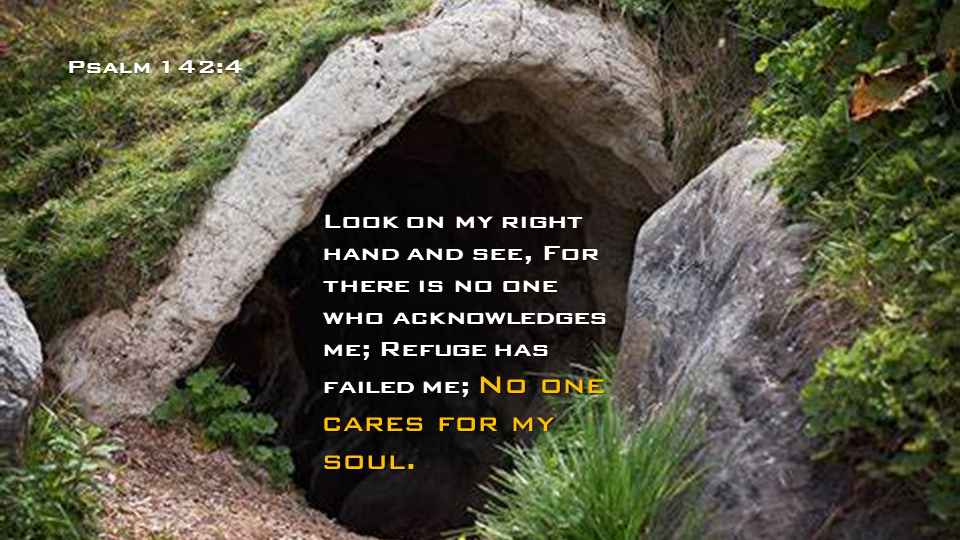
I cry out to the Lord with my voice; with my voice to the Lord I make my supplication. I pour out my complaint before Him; I declare before Him my trouble. When my spirit was overwhelmed within me, then You knew my path. In the way in which I walk they have secretly set a snare for me. Look on my right hand and see, for there is no one who acknowledges me; refuge has failed me; no one cares for my soul. I cried out to You, O Lord: I said, “You are my refuge, my portion in the land of the living. Attend to my cry, for I am brought very low; deliver me from my persecutors, for they are stronger than I. Bring my soul out of prison, that I may praise Your name; the righteous shall surround me, for You shall deal bountifully with me.” (A Contemplation of David. A prayer when he was in the cave. Psalm 142)

No One Cares For Me

The life of David was an ideal time for a shepherd boy in a big family with godly parents. As a boy, he was entrusted with keeping and protecting the sheep. He learned early the rigors of shepherd life with a trust in God to defend himself and his flock. This faith would serve him well as he stood in the valley of Elah against the giant Goliath. His life would change when he was taken to serve the king of Israel. Saul enjoyed the musical talents of young David. The son of Jesse would excel in combat, receiving the praise of the people. It was this praise that caused King Saul to become jealous of David to the point the king tried to kill David on numerous occasions.

Saul’s hatred of David grew into intense jealousy. Because of Saul’s rashness in disobeying the word of the Lord, he was rejected as king. Saul would spend much of his life chasing David like a flea in the wilderness. David loved his king and would never harm him, even when the opportunity arose. The constant running from the army of Saul exhausted David. On two occasions, David hid from Saul in the caves of Adullam and Engedi. It is not known if the psalm David wrote about his hiding in the cave is from these two stories, but David was familiar with hiding in caves to escape the soldiers of Saul.

The prayer in the cave is a cry of distress. David is seeking refuge, but there is no way to escape his enemies. He is overwhelmed by those who seek to harm him. His friends have forsaken him. He is alone with no one to help. He cries out to the Lord with tears of anguish. His spirit is overwhelmed by enemies who have set traps for him. David finds himself at a low point in life when he cries out to the Lord that there is no one to help him and no one cares what happens to him.

Abandoned by everyone, David seeks the refuge of the Lord. God is his sanctuary, his dwelling place. David is low, but through the Holy Spirit, he is exalted to the presence of the One who will never forsake or leave him. There is hope in God and God alone. He knows that the Shepherd of his life will bring him out of the prison of despair so that he may praise the name of the Lord. Mixed with the fear of betrayal and enemies seeking his life, David knows the power of God’s saving grace to lift him up. The joy of the presence of God gives David hope as he dwells in the cave of fear. There is nothing to fear when God is surrounding him.

Life is filled with many caves where the heart is overwhelmed with despair, sadness, heartbreak, loss, and fear. David learned in the cave that God is there. No cave is so dark God cannot light the heart of the oppressed. The world may be careless and cruel, but God is always faithful. David said no one cared for his soul. God cared for and blessed His servant. Never give up hope that God knows your grief and pain and understands your sadness. When you live in the caves of despair, trust in God, who will never fail you. He will never forsake you. Praise His name. Surround yourself with the righteous. God will deal with you in His bountiful care.

Posted in Uncategorized | Leave a comment