Big Words From A Weak Heart

And the Lord said, “Simon, Simon! Indeed, Satan has asked for you, that he may sift you as wheat. But I have prayed for you, that your faith should not fail; and when you have returned to Me, strengthen your brethren.” But he said to Him, “Lord, I am ready to go with You, both to prison and to death.” (Luke 22:31-33)

Big Words From A Weak Heart

Peter is a contradiction of terms. He is a bold and faithful servant willing to go to prison for Jesus and die for the Lord. Peter is also a man of great weakness at the moment of trial to swear he does not know Jesus and reacts with angry cursing when pressed. To compound the misery of his denial, Jesus sees and hears Peter’s disowning of his association with the Lord. Peter had big words sitting at the table with Jesus, but his words came from a weak heart. The apostle had too much pride in his faithfulness. In front of the other apostles, Peter wanted them to see him as a courageous disciple willing to endure the hardship of prison. His faith was bragged before the others to the point of being killed for knowing Jesus of Nazareth. Big words. Weak heart.

Courage is easy when the day is bright and calm. Little did Peter know where Jesus would take him in the next few hours. After the feast, Jesus took the eleven to Gethsemane to wait for Judas. Peter was with James and John as Jesus spent time alone in prayer. When the mob came, Peter took a sword in hand to defend Jesus. His action was more an act of fear than courage. He sliced the ear of Malchus off. Jesus healed the servant’s ear, and the mob put Jesus in chains and led him away. Peter did nothing. He followed at a distance. His courage was gone. The big words that filled the upper room were lost in a heart weakened with fear.

The detachment of troops and officers of the Jews took Jesus to the house of the high priest, Annas. Peter stood outside with John. When John brought Peter into the courtyard, someone asked Peter if he was a follower of Jesus. He denied knowing the man. His courage was gone, and he was unwilling to go to prison or die for Jesus. Peter is asked two more times if he is a disciple of Jesus. He denies knowing Jesus, cursing and swearing he is not one of His disciples. The rooster’s crowing drowns out the big words of Peter.

It is easy to have courage on Sunday morning when the church family is assembled in a common hall, praising the Lord with gladness of heart. The challenge comes when the days of the week are busy with life and living in a crooked and perverse generation. Identifying oneself with Jesus Christ becomes a greater struggle when standing for truth and righteousness. The world can be unkind to those who profess a moral compass based on the teachings of Jesus Christ. Coworkers will ridicule and laugh at the Christians. Family members will shun those who seek to live pure lives. The world is against the church of Christ on every level. Persecutions are coming because the gospel demands it. As the world draws farther away from godliness, the Christian stands increasingly more alone. What will become of the big words of faith and courage?

Peter denied the Lord three times, crushing the heart of Jesus. Joy would return to Peter when Jesus rose from the dead. Hope comes in the power of the resurrection. Peter resurrected himself when he reaffirmed his heart to serve the Lord. It was a bumpy ride for the apostle, but church history suggests Peter died a martyr’s death. He lived up to his words. When Peter’ returned to the Lord,’ he came all the way. Death was not the end for Peter; it was his beginning. Faith can be difficult. Do not give up. Let the light of Christ shine in your heart to show the world the glory of the Father. It’s not big words that save. Faith made perfect – that’s what is needed.

Posted in Uncategorized | 2 Comments

Living In A Dead Church

And to the angel of the church in Sardis write, “These things says He who has the seven Spirits of God and the seven stars: ‘I know your works, that you have a name that you are alive, but you are dead … You have a few names even in Sardis who have not defiled their garments; and they shall walk with Me in white, for they are worthy.” (Revelation 3:1,4)

Living In A Dead Church

The letters to the seven churches of Asia found in the book written by John are a telling commentary on the condition of a local congregation. Seven churches near one another are used by the Lord to describe the varied conditions of what can be found in any local church family. Ephesus was an amazing church with many good things to say about their work. However, they had lost their first love and needed to refocus their attention on serving the Lord. Smyrna was commended for the persecution they faced and did not waver in their commitment to the Lord Jesus Christ.

Pergamos was a good work, but it had a spirit of compromise that tainted their efforts. There were internal problems the Lord demanded needed to be corrected. Thyatira was known for their works, love, service, faith, and patience. With all these good things to say about the brethren, they had corrupted the truth of the gospel by allowing an evil influence to overcome the church. Philadelphia was a beacon of faithfulness in their love for the Lord to not deny the name of Christ in the midst of persecution. Laodicea was a church like so many. They were neither hot nor cold in their work of the Lord and languished in lukewarm apathy. Their view of themselves was misguided by their conceit of what they were doing.

The church at Sardis was unique among the seven. They had a name for themselves for all their works, but according to the judgment of Jesus Christ, the church family was dead spiritually. It is hard to imagine worshipping at a church the Lord deems “without life.” There are many things from the divine standpoint that can dictate why a church family is dead. From the view of the brotherhood, Sardis had a name for themselves. Jesus shows that having a good name among the brethren does not suggest a good name with the Father. There were severe problems at Sardis that needed to be corrected.

Jesus warns the church to be watchful and strengthen the things that remain. It seems not a lot of life was left in the congregation. The change that needed to take place was clear. Repentance was the order of the day. Judgment was coming. Jesus stood in the midst of the seven golden lampstands representing each of the seven churches. The lampstands are placed there by God, and by His will, the lampstand is removed. As long as the lampstand remained, Sardis was still a church of God, but it was on perilous ground.

With the sentence of death pronounced on the church at Sardis, the Lord made a remarkable observation. In the congregation of God’s people that have been called by the One who stands in the midst of the golden lampstand a dead church, some who had not defiled their garments and remained faithful to the Lord. A few names in Sardis would walk with the Lord in white because they were worthy. Sardis was not a flat-line church yet because of the faithful few names that remained. The faithful few were the leavening influence of God in the midst of death.

Sardis had a name among brethren. Churches have reputations and are known for various things that distinguish their work. When people try to find the perfect church, they show their lack of understanding of the nature of the family of God. People get upset about things that go on in this church family and that church family about issues that divide. Sardis had those who walked in white, and it was dead, according to the Lord. Would a faithful Christian worship at the church of God in Corinth? The apostle Paul would. Church families have problems. Running off to the “perfect” church will never solve anything. I’m thankful for the faithful at Sardis. They worshipped in a difficult congregation, but they worshipped God in truth. Can we do any less?

Posted in Uncategorized | Leave a comment

The Way That We Live

Beloved, I beg you as sojourners and pilgrims, abstain from fleshly lusts which war against the soul, having your conduct honorable among the Gentiles, that when they speak against you as evildoers, they may, by your good works which they observe, glorify God in the day of visitation. (1 Peter 2:11-12)

The Way That We Live

Early Christians suffered a lot under the heavy hand of persecution. First is the attack against the church by Saul of Tarsus. The Jews constantly harassed Paul and the early disciples. When the Romans began to persecute the people of God, it would last for nearly two hundred years with little respite. Peter writes his epistles during the reign of Nero, Roman Emperor. The early disciples suffered for wearing the name of Christ. In the midst of this oppression by the world, the aged apostle implores his readers to maintain a good example of righteousness and godliness. He wants them to have honorable conduct in the world that is persecuting them.

Peter reminds the Christians why they can endure the persecution. Life is transitory, brief, like a vapor that appears for a little while and vanishes away. The suffering from the world is only temporary because, as the nation of God, life is a sojourn and a pilgrimage. There is nothing last about life, whether good or evil. Having the mind of a sojourner or pilgrim places things in proper perspective. Nothing is permanent. The lusts of the flesh are temporary. All of the evil things said about the Christians were empty. Peter wants the people of God to give an example of faith and courage to a cruel world so they can see God living in their hearts and minds.

How a person lives defines the kind of person he is. When the Christian shows a forgiving heart, he manifests the character of the forgiveness of God. Refusing the lusts of the flesh to seek the nobility of godliness mirrors the godliness of the Father. Refusing to deny Christ instills in the eyes of the world a determination built upon faith and courage in the Son of God. The greatest tool a person has to show Jesus Christ to the world is the example of Christ living in the way they live.

As a man and woman, the Christian is devoted to prayer and examining the scriptures. This makes them a better person as an individual, a spouse, a parent, a citizen, a friend, and an example of how God can change the lives of anyone. The Jews killed Jesus, knowing He had done nothing wrong. Peter wants Christians to live in such a way that no charge of deceit, malice, or ungodliness can be found in the example of God’s people. How a person lives can determine how the world sees Christ. If a man professes to be a Christian and lives like the world, the wisdom of the world shows him to be a hypocrite. The church is damaged in reputation by those who act one way on Sunday and live like the devil the other six days of the week.

A Christian is a pilgrim seeking another home. While he abides in this realm, he will avoid worldly desires that compromise his relationship with God. His life is set to live a proper example of Jesus Christ among the unbelieving people of the world. When the enemies of Christ accuse a Christian of wrong, no evidence can be found because of their faithfulness to Jesus Christ. What the world sees in the Christian’s life is God’s glory. When they see God, they see truth.

Posted in Uncategorized | Leave a comment

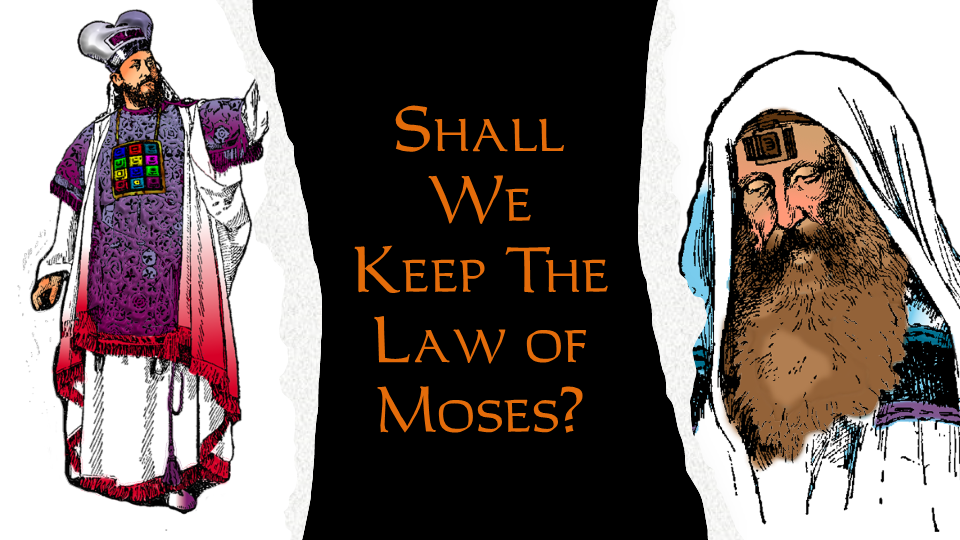
Shall We Keep The Law Of Moses?

But some of the sect of the Pharisees who believed rose up, saying, “It is necessary to circumcise them, and to command them to keep the law of Moses.” (Acts 15:5)

Shall We Keep The Law Of Moses?

The struggles in the early church revolved around establishing the doctrines and commandments of the kingdom of God. Jesus promised the apostles the Holy Spirit to guide them into all truth. During the early days of the church, the only scriptures available were the Law of Moses, the Prophets, and the Psalms. It would be fourteen years after Pentecost, and the first book of what is now known as the New Testament would be written (James). For the next fifty years, many more letters would be written to become the divine canon of God’s word.

Before the completion of the perfect word of God, the apostles helped to establish the will and commands of the Lord. The first converts of the gospel were Jews with the Gentiles being added a few years later. During this time of early growth, the doctrines of the church were being established. One of the greatest challenges of the church was to show the Jews how God had fulfilled His promises to Abraham through the Law, but under Christ, the Law of Moses was abolished for a better covenant. All of the laws and commandments of the Law of Moses were taken away through the Son of God’s death, burial, and resurrection. The church would not be governed by the Law of Moses.

An early problem for devout Jews belonging to the sect of the Pharisees was giving up circumcision. The covenant of circumcision was from the days of Abraham and the foundation of the relationship of God and the Jews. On the Day of Pentecost, devout Jews from every nation gathered in Jerusalem. When three thousand Jews heard the preaching of the twelve apostles, they were baptized into Christ, and the Lord added them to the church. Many of the practices of the Jews remained intact. Peter and John went to the temple to pray. Paul kept a vow. While many of the practices found in the Law of Moses were inconsequential to salvation, one key element of the Law of Moses remained in the eyes of many Jews: circumcision.

When Peter told the Jews at Pentecost what to do to be saved, he never mentioned circumcision. Philip preached Jesus to the man from Ethiopia and never suggested the need to be circumcised. Peter taught Cornelius and his household the gospel of Christ without requiring circumcision. None of the examples of conversion or teachings of the early church required circumcision to be saved. This bothered some Christians who were of the sect of the Pharisees. They demanded that circumcision be taught as essential for salvation, and recipients of the gospel must be commanded to be circumcised. Some teachers taught salvation through circumcision in many churches and commanded the Christians to keep the Law of Moses.

Jesus died to take away the Law of Moses. The Law did not save the Gentiles. They were a law to themselves. The Jews did a terrible job at keeping the Law. When the church was dealing with Jews (Hebrews) who wanted to return to the Law of Moses, the writer of Hebrews explained in great detail the fallacies of the Law and how it had been abandoned for the good news in Jesus Christ. Circumcision has nothing to do with salvation, and keeping the Law of Moses cannot save. There is nothing sinful about circumcision, but to bind it as Law is sin. Jesus died to bring the Jews to Him through His blood. A Jew cannot be saved by circumcision or keeping the Law of Moses. Peter told the Jews what to do to be saved. He told them to repent and be baptized for the remission of sins. This answer is the same for Gentiles. Salvation is not in the Law of Moses or the nation of Israel. Jesus Christ and Him crucified is the only way, truth, and life.

Posted in Uncategorized | Leave a comment

I’m Certain Life Ends At Death

The fool has said in his heart, “There is no God.” They are corrupt, they have done abominable works, there is none who does good. (Psalm 14:1)

I’m Certain Life Ends At Death

The preponderance of a fool’s wisdom heightens how ignorant his position will be. Many things are certain in life, but many are filled with uncertainty. There is a body of facts that can be quickly established without doubt compared to known factors. Each day begins with the rising of the sun, and the day ends when the sun disappears over the western horizon. This is a certainty that is repeated every day with fail. Jumping out of an airplane without a parachute will end in death because the law of gravity does not change. A person can be certain of that. When a man suggests he knows something with certainty, he admits he has ample proof to verify his claim.

In a recent post about religion, an individual made the bold statement, “I am not religious. I’m actually certain life ends at death.” The first part of his remark is a fact, and the second part of his conclusion is foolish. It takes little evidence for a man to show that he is not religious. Unbelievers exhibit the characteristics of a hedonistic view of life, namely that man is no more than an animal, guided by animal instincts, to do things like an animal. He does not believe in God because that would require accountability to the word of God. All unbelievers must admit the universe is a vast tapestry of incredible design that demands a designer. The biggest fools are those who say the orderly universe of immense design was created from nothing.

The remarkable statement that a man can be “actually certain life ends at death” shows how ignorant fools argue their positions for the impossible. A ten-pound sack of potatoes is determined by weighing the sack with an accurate scale to reach a precise conclusion. For a man to say he is certain life ends at death is to testify he has died, entered whatever world there is beyond death, and returned to say there is no life after death. This is an impossibility if life ends at death. That means no one can traverse the expanse of the realm of the dead to determine if life is there or not. If life does not exist after death – who can tell the story? Where do empirical facts come that give a man the certainty life ends at death?

A fool does not believe in life after death because he lives like an animal. An animal lives and dies, which is all there is to the animal’s existence. Only man has an eternal nature because God created man in His image and likeness. Animals were not made in the image of God (non-eternal), and when they die, there is nothing. Believers in God know they are eternal creatures that will never cease to exist. Death is real, and while life ends in death from a mortal view, every person who dies continues to exist in an eternal nature. The truth is that belief in life after death comes from faith in the word of God, which becomes the factual belief that life is more than the here and now.

Contrary to popular culture, it is impossible for someone to die and return to tell the story. Resurrection ended two thousand years ago. When a man dies, he cannot return to the realm of the living to tell the story. An unbeliever will look at life as the final event, and when a man dies, he will cease to exist. The sad part of the story is how surprised they will be when they awaken in eternity and realize – there is life after death. A greater tragedy is to rise in eternity to realize there is a God who told him there was life after death, and now he will experience death after life – for an eternity. The fool has said in his heart, “There is no God!” That’s a fact because when a man thinks life ends in death, he is a fool. The believer knows and believes through faith in the promises of God that there is incredible life after death. Praise God. Lord Jesus, come quickly.

Posted in Uncategorized | Leave a comment

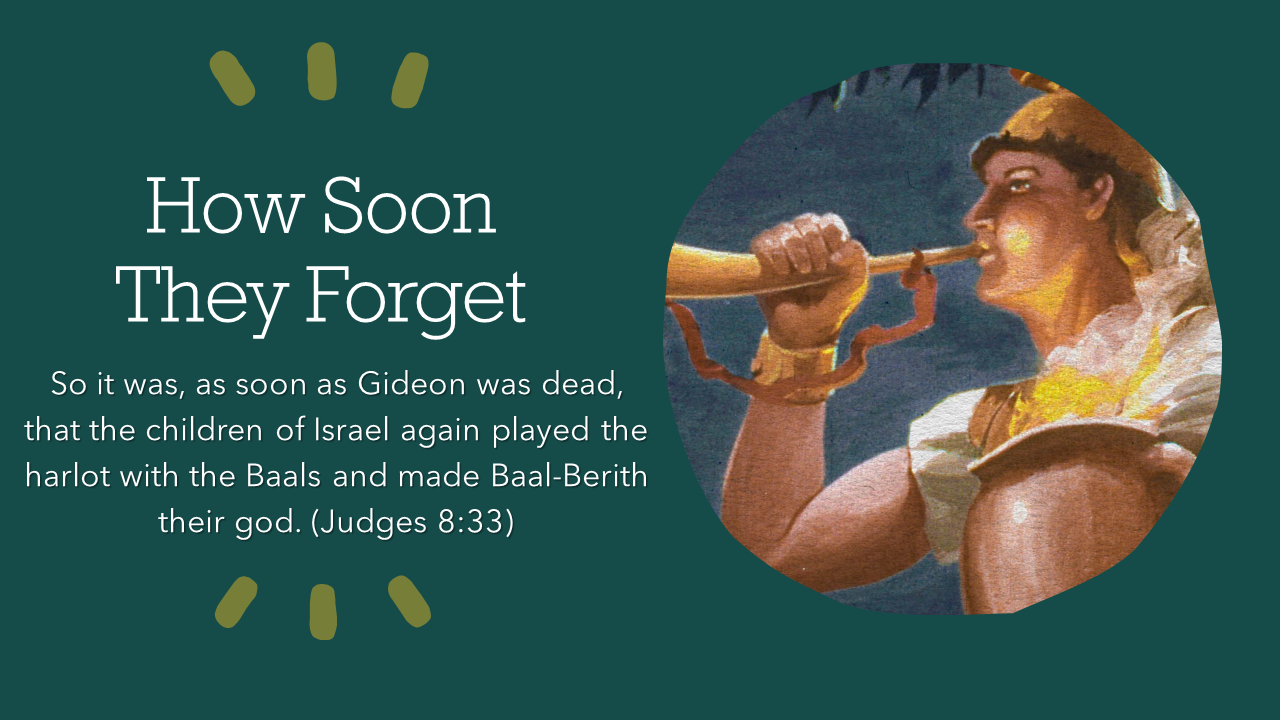
How Soon They Forget

So it was, as soon as Gideon was dead, that the children of Israel again played the harlot with the Baals and made Baal-Berith their god. Thus the children of Israel did not remember the Lord their God, who had delivered them from the hands of all their enemies on every side; nor did they show kindness to the house of Jerubbaal (Gideon) in accordance with the good he had done for Israel. (Judges 8:33-35)

How Soon They Forget

The period of the Judges ruling over Israel spanned more than three hundred years. After the death of Josuha, a generation arose who did not know the Lord nor the work He had done for Israel. The people did evil in the sight of the Lord and served the Baals, Ashtoreths, and other gods from among the gods, provoking the anger of the Lord. So began a long series of rebellions, oppression, repentance, and salvation. The Lord raised up judges to deliver the people from the calamity God brought against them. When the judge was dead, they reverted and behaved more corruptly than their fathers, plunging the nation into idolatry. The Lord would punish, the people would cry out, and the Lord would deliver.

Gideon was the fifth judge of the people. The faith of Gideon struggled with accepting the word of the Lord, but he would judge the people for forty years. His faith to fight against the Midianite army of more than one hundred twenty thousand with three hundred soldiers shows the power of God to deliver His people. Israel was at peace for forty years under the leadership of Gideon. The tragic nature of the people is that while Gideon was alive, they served the Lord. As soon as Gideon died, the children of Israel turned back to idolatry. The next oppressor came from among the people when Abimelech started a civil war. Seven more judges will rule over the people as God brought the Philistines and Ammonites to punish his people. Israel never seemed to learn the lesson of God’s wrath against ungodliness.

The leadership of the people kept the nation in check. When the judge died, the people had no king, and everyone did what was right in his own eyes. Gideon ruled for forty years, but the people immediately returned to wickedness when he died. They forgot the oppression of the previous nations that came against them. God sent these nations to punish the people, but they failed to acknowledge the divine discipline of the Lord and learn from it. It was easy for them to fall back into idolatry.

Chastening has no value if there are no lessons learned. The Lord’s wrath against Israel was to teach the nation the consequences of sin. They repeatedly returned to idolatry as soon as the judge was dead. How soon they forgot the goodness and severity of God. When they were oppressed, God delivered them. They soon forgot His grace. When they enjoyed forty years of peace and prosperity, they forgot God. The judges could only rule for a short time, and the people’s faithfulness was not solely dependent on the judge. It was an individual decision and a lack of faith in the people’s hearts. Chastening is something that must be learned from. No chastening is joyful, and the oppression of the enemies of Israel was real and very hard. God wanted to train the hearts of the people to trust in Him. They did not. Forgetting God came easy.

Reading the story of Judges reflects the nature of the human heart. Many find themselves outside the blessings of God and do not learn the lessons of repentance and remorse. God sends a message of deliverance, but to no avail. Only those who experience the chastening of the Lord and are trained by it will be blessed. How soon the people forgot the forty years of Gideon’s leadership is not so remarkable. The world is full of forgetful people.

Posted in Uncategorized | Leave a comment

The Lord Is In His Holy Temple

What profit is the image, that its maker should carve it, the molded image, a teacher of lies, that the maker of its mold should trust in it, to make mute idols? Woe to him who says to wood, “Awake!” To silent stone, “Arise! It shall teach!” Behold, it is overlaid with gold and silver, yet in it there is no breath at all. But the Lord is in His holy temple. Let all the earth keep silence before Him. (Habakkuk 2:18-20)

The Lord Is In His Holy Temple

Reverence and worship belong only to the Lord. The abomination of idols is found when men carve images from stone and wood overlaid with gold and silver to give reverence and worship to. Nothing is more absurd for a man to take a tree from the forest to carve a totem of his choosing to call his god with his own hand. The idol is mute. There is no breath in the carved image. An idol cannot teach and instruct. Yet man will create his god and fall down before it to give it the reverence due to the Lord. He worships the idol, which cannot benefit the worshipper. There is no value or profit for the teacher of lies. The Lord is in His holy temple. Let all the earth keep silence before Him.

Idolatry has always been the plague destroying the hearts of men. An idol can be an image of stone or wood shaped like a man or an animal. Mythology is the storytelling of idols created by men to satisfy their carnal nature. Created by men to serve them, idols represent the expression of the lustful hearts of human wisdom to fill the needs of what they demand. The idol cannot speak because man cannot put life into stone or wood. The idol has no mind as it is a material, inanimate object without life. An idol depends on its maker to care for it, and the worshipper becomes the protector of the god he worships as his protector. Idol worship is folly. The Lord is in His holy temple. Let all the earth keep silence before Him.

Idol worship has never gone away. In modern times, many civilizations create and worship idols. Hindu, Buddha, and Jainism religions are built on veneration of idols. Indigenous tribes of the Pacific Northwest worshipped totems. The Roman Catholic and Eastern Orthodox churches venerate images, statutes, and icons like idols. Venerating the mother of Jesus is a form of idolatry. Habakkuk shows the folly of creating images to worship because men make them for men to worship as their gods. When Israel was camped at Mt. Sinai, and the people became restless, Aaron formed a golden calf, declaring the image as the god who delivered them from Egypt. This was an affront to the holiness of the Lord God. Allowing a man-made image as the object or worship brought the wrath of God. The Lord is in His holy temple. Let all the earth keep silence before Him.

An idol is when something or someone becomes more important to us than God. It does not have to be made of stone and wood in the image of a man or beast. Many read passages about idolatry and think how silly it is to revere such things. They fail to realize that idols do not always come in the imagery of a stone figure. Anything that takes man’s heart away from devotion and worship to the Lord is an idol. A man’s job can be so important he neglects his family, his obligations to the work of the church, and his mind to the things of the world. He believes wealth, position, prestige, and popularity will save him. The family altar is the bank account. When he dies, he will spend his entire life working for everything he will never take with him. He served the wrong god. The Lord is in His holy temple. Let all the earth keep silence before Him.

Habakkuk was written to remind the hearts of men that the only thing that must receive reverence and fear is the worship of the Lord. God demands honor to be given to him. His temple is the only place of worship. The Lord demands and expects first place and will never accept anything less. As the Lord dwells in His holy temple, He declares to the world to be silent and consider who He is. His majesty will be proclaimed all over the world because the world testifies to His greatness. To create an idol or to waste a life seeking things that will be of no use in death is an abomination to the character of God. An idol cannot speak because it has no life. God has spoken because He gives life. The idol cannot receive worship; only God can receive worship. It is time to consider who God is, where He dwells, and for the earth to fall silent in the presence of the Lord God Almighty.

Posted in Uncategorized | Leave a comment

A Merciful God

Do not be furious, O Lord, nor remember iniquity forever; indeed, please look—we all are Your people! (Isaiah 64:9)

A Merciful God

When a man fails to understand the mercy of God, he cannot understand the greatness of a loving Father. Adam and Eve had one command to follow, and they rejected the word of God. God’s wrath could have destroyed them, but He chose to save them. The world turned away from God and killed His only begotten Son. God’s wrath could have destroyed the world for killing Jesus, but the Father chose to open the door of redemption to those who would accept His grace.

Isaiah, the prophet, lived when the people of God had totally turned away from God. The Assyrians had long destroyed the northern ten tribes. Only the remnant of Benjamin and Judah remained, and they faced the onslaught of the Babylonians who would take the people of God into a seventy-year captivity. The grace of God allowed a remnant to return. By His grace, He preserved the Seed through the faithful of Israel, who had returned from Babylon. During the final days of Judah, Isaiah instilled in the people’s hearts the mercy of God that allowed the remnant to survive. He begged God not to let His wrath consume the people. God’s people were guilty of sin, deserving the wrath of God. Isaiah pleaded with the Lord to remember His people. God did.

God has every right to be furious with humanity. Sin is the dominant character of the spirit of man. When a man transgresses the law of God, he sins and faces the wrath of a vengeful God. There is nothing humanity can do deserving of the mercy of God. Two thousand years ago, the wisdom of man murdered the only begotten Son of God. Jesus was innocent. He had never sinned. His death was the darkest stain on the human story. Mercy came on the first day of the week when the Father took His Son from Hades and rose Him to be Lord and Christ. Jesus is the way, the truth, and the life to all who seek Him because of the mercy of God.

Like Isaiah described many centuries ago, all men stand in judgment of the wrath of God. The world is filled with unrighteousness. Iniquity is the character of the human heart. But God’s mercy flows from the fountain of grace to take away the fury of the Lord and cause Him not to remember the sins of the repentant. He is willing to remember the sins of a man no more. God’s mercy will take away sin as far as the east is from the west. Why is God willing to do this? Because He remembers who His people are. Paul reminded Timothy the Lord knows those who are his.

The mercy of God is beyond the bounds of human understanding. God is a merciful God because He is full of love and grace. He does not ignore sin, allowing men to think they are not accountable for His judgment. The mercy of God does not remove the consequences of eternal punishment for those who reject His word. What the Father offers His children is His grace and mercy not to be furious and that He will not remember the iniquity of the heart. As the Father looks upon His child, He sees His people. May we look to our Father and see His mercy.

Posted in Uncategorized | Leave a comment

Have Thine Own Way, Lord

But now, O Lord, You are our Father; we are the clay, and You our potter; and all we are the work of Your hand. (Isaiah 64:8)

Have Thine Own Way, Lord

Adelaide A. Pollard (1902) desired to go to Africa for mission work for the Lord. She never achieved her goal even though it was heavy on her heart to help in some small way in the service of God. As she reflected on her lost opportunities, she realized a special part of the work of the Lord. God is a potter who forms clay to His will and His desire. She accepted her life and that she would not be able to fulfill her dream, realizing that it was not to be in the plan of God. In that acceptance, she focused on the passage, reminding her that God designs the clay in the fashion He desires.

Adelaide entreated the Lord to search her heart to know the desire that was there. She wanted to present herself to God as a humble spirit obedient to His will. It wasn’t easy to accept her dream could not be realized, and she begged for the power to learn the lesson of acceptance. In her final statement of faith, she acknowledged the yielding of her spirit to the design and purpose of God. No matter what life would bring, she sought to live for Christ and Him alone. All she desired was for the Lord to have His way in her life. That is all that mattered to her.

Life can be a challenge, and challenges come that can be overwhelming. For the heart unprepared for the trials of life, it can be a difficult and almost impossible journey. Learning to allow God to work His will in life is a very difficult task to embrace. There is a tendency to want to direct the affairs of God to fit the needs of the individual rather than asking the Lord to have His way and leaving it at that. A man comes to the Father with a particular request and then tells God how and when to carry out the request. God will not hear those prayers.

Singing the hymn “Have Thine Own Way, Lord” is a quiet reminder that in all things, God remains the potter and men the clay. The clay has no power over the potter. There is nothing the clay can do against the potter. God is the potter because He is the Creator. Man is the clay because he is the creation. Those roles never change. When a person becomes a child of God, they give their life to serve Jesus Christ and Him alone. In the same sense that God is the potter, Christ is the potter over the life of the Christian. Everything about the Christian life is about molding the character to the image of Christ.

To be in Christ is to be a slave of Christ, bending to His will, submitting to His word, and obeying His commands. A slave has no choice but to obey. As the clay in the potter’s hand, the design of the clay comes from the potter’s hand whatever He wills. Seeking the Lord to have His own way is finding the peace that passes understanding and the communion of the Holy Spirit. Life is measured – with its ups and downs – by the potter’s will. Developing this type of trust in the Lord helps to heal the hurt, find joy in the moments of life, and look more and more for the eternal glory to be revealed in death. Have thine own way, Lord. We are the work of Your hand.

Posted in Uncategorized | Leave a comment

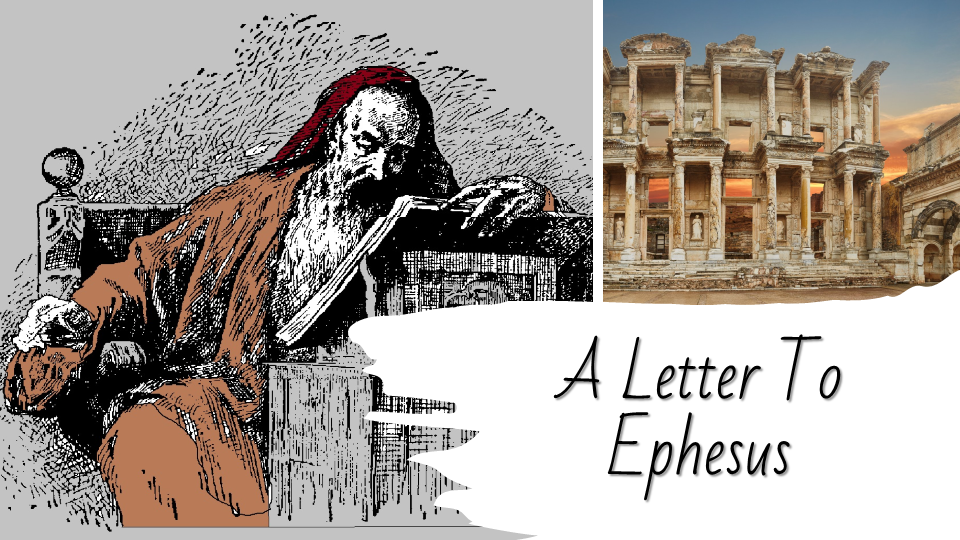
A Letter To Ephesus

To the angel of the church of Ephesus write, “These things says He who holds the seven stars in His right hand, who walks in the midst of the seven golden lampstands: I know your works, your labor, your patience, and that you cannot bear those who are evil. And you have tested those who say they are apostles and are not, and have found them liars; and you have persevered and have patience, and have labored for My name’s sake and have not become weary. Nevertheless I have this against you, that you have left your first love. Remember therefore from where you have fallen; repent and do the first works, or else I will come to you quickly and remove your lampstand from its place—unless you repent. But this you have, that you hate the deeds of the Nicolaitans, which I also hate.” He who has an ear, let him hear what the Spirit says to the churches. To him who overcomes I will give to eat from the tree of life, which is in the midst of the Paradise of God. (Revelation 2:1-7)

A Letter To Ephesus

Paul spent more time with the church at Ephesus than any other. The brethren were dear to the heart of Paul. On his way to Jerusalem, which would lead to his arrest and trial before Caesar, Paul called the elders of Ephesus to meet with him at Miletus. The farewell was sad as they stood on the seashore, kneeling down, praying, and weeping freely. Paul would never see the brethren again. A few years after his last meeting while imprisoned in Rome, the apostle wrote to the Ephesian saints and faithful in Christ. His letter declared the New Testament church promised by Jesus Christ.

A little more than twenty years after the death of Paul, the church at Ephesus was on the mind of God as He unfolded His revelation to the apostle John. The aged apostle had been banished to the island of Patmos when the Lord brought His revelation. John saw Jesus standing among the lampstands, each representing a church in the region of Western Asia Minor. The first letter addressed the church of Ephesus with many positive things to say but challenges that needed to be met. God’s letter to Ephesus (like the other six letters) is a testimony to how each church throughout the world can define itself. The church of Ephesus can be a pattern to build the church of the Lord today.

The Ephesian church was a church where everyone was active. Jesus commends Ephesus for their work and labor, showing the brethren were unafraid of industry. The vineyard of the Lord requires workers willing to get their hands dirty. There is much work to do in the fields white to harvest. A growing and thriving church is filled with workers. Jesus commends the church for their industry. Faced with trials of persecution, the church patiently carried out its evangelism and teaching. Teaching, admonishing, and seeking out lost souls is hard work. The church of Ephesus was not a lazy church.

Jesus knew what they had done. That brought comfort to the brethren, who knew the Lord saw their efforts. When troubles arose in the church, the saints would not tolerate unrighteousness. Some claimed to be apostles, but because of the diligent teaching of truth, the men were found to be false. The church at Ephesus was active in establishing truth to follow the admonition of Paul many years prior. Paul had warned the Ephesians elders to watch out for wolves among the flock of God who would come in and teach false doctrine. The Ephesian church was a vigilant church.

The church of Ephesus was in a city overcome with idolatry and wickedness. It would be easy to allow the world’s influences to infiltrate the church to change its teachings and doctrines. Jesus commends them for persevering and, through patience, not becoming weary in holding forth the light of truth. It can be overwhelming to watch for error and immorality constantly. The Ephesians successfully kept the church pure by testing the spirit of those who came among them. They had a lot of things to do and were very busy with the work of the kingdom. But there was one thing that Jesus pointed out that hindered their growth.

Paul had written to the church about their strong faith in Jesus and love for God’s people. Their roots would grow into the love of God as Paul exhorted the brethren to love one another. Now, Jesus warns the Ephesian church of their lack of love. They were busy with many things, but their love for God was empty. Their ‘first love’ was filled with vitality, vigor, and joy. Now, many years past their beginnings, they had become stale in their relationships with one another and with God. They were going through the motions.

Jesus reminds them of their first fruits and to repent for their lack of love. He encourages them to fill their hearts with love again and be busy with the work of the Lord. They hated the doctrine of the Nicolaitans, and so did the Lord. He wanted them to rekindle that first love to help them grow more and more in the grace of God. They were doing well, but they could do better.

Ephesus is a church that we should model in practice and examine what the Lord would say to us if He were to write a letter. Which one of the seven churches would best describe where we worship? The seven letters clearly show that not one church is perfectly filled with perfect people. Some churches had serious problems, while others needed to work harder. Take a test of the seven letters. Which church are you modeling after?

Posted in Uncategorized | Leave a comment