BIBLE TALK 92.1FM – What Is The Church of Christ – Part 1

Bible TalkNovember 24, 2014

Host: Kent Heaton

Guest panelist: Gene Taylor, Steve Peeler and Chase Shaffer

Bible Talk 92.1FM Hear it each Monday night 6:00pm-7:00pm EST

Visit our websitehttp://www.northvaldostacoc.com to LINK to the radio program or to listen to past programs.

Posted in Uncategorized | Leave a comment

BIBLE TALK 92.1FM – Prayer – Part 2

Bible TalkDecember 1, 2014

Host: Kent Heaton

Guest panelist: Jamey Hinds and Chase Shaffer

Bible Talk 92.1FM Hear it each Monday night 6:00pm-7:00pm EST

Visit our websitehttp://www.northvaldostacoc.com to LINK to the radio program or to listen to past programs.

Posted in Uncategorized | Leave a comment

BIBLE TALK 92.1FM – Prayer – Part 1

Bible TalkDecember 1, 2014

Host: Kent Heaton

Guest panelist: Jamey Hinds and Chase Shaffer

Bible Talk 92.1FM Hear it each Monday night 6:00pm-7:00pm EST

Visit our websitehttp://www.northvaldostacoc.com to LINK to the radio program or to listen to past programs.

Posted in Uncategorized | Leave a comment

BIBLE TALK 92.1FM – Why Does God Allow Suffering – Part 2

Bible TalkDecember 8, 2014

Host: Kent Heaton

Guest panelist: Paul Blake and Steve Peeler

Bible Talk 92.1FM Hear it each Monday night 6:00pm-7:00pm EST

Visit our website http://www.northvaldostacoc.com to LINK to the radio program or to listen to past programs.

Posted in Uncategorized | Leave a comment

Bible Talk 92.1FM – Why Does God Allow Suffering – Part 1

Bible TalkDecember 8, 2014

Host: Kent Heaton

Guest panelist: Paul Blake and Steve Peeler

Bible Talk 92.1FM Hear it each Monday night 6:00pm-7:00pm EST

Visit our website http://www.northvaldostacoc.com to LINK to the radio program or to listen to past programs.

Posted in Uncategorized | Leave a comment

The Compass And The Barometer

compassThe night was as dark as pitch and time was running out. A group of young soldiers were deposited on the side of a Kentucky road with instructions to gain the objective in only a few hours. With nothing to guide them but their senses and good luck the soldiers lumbered through the dense woods and crevices stumbling blindly as they tried to make sense of which way to go. The class in compass orientation was of no value because there were no compasses provided, no flashlights to guide the way. The only guide was the periodical burst of flare that would eventually bring the bone weary troops to safety. The lesson was learned about being lost without direction. It was one of the most confusing and sometimes frightful nights of my life.

A little over a thousand years ago man discovered the use of a compass in navigation. Compasses were originally developed when lodestones, a mineral that has naturally magnetized iron ore, were suspended above a board with the ability to pivot and turn. It was discovered that the stones would always point in the same direction, and align themselves with the north/south axis of the earth. No matter where you stand on Earth, you can hold a compass in your hand and it will point toward the North Pole.

A barometer is an instrument for measuring atmospheric pressure. Evangelista Torricelli invented the first barometer, known as the “Torricelli’s tube” in 1643. The thermometer is an instrument that measures temperature as it changes. The common factor of the barometer and thermometer is how they change with the weather. A compass does not change with the weather. Here is the lesson: God’s word is a compass in a storm that does not change. It is not a barometer that will change with the whims of man.

The great failing of man is the idea that God’s word changes with the needs of society. There is a prevailing thought that religion should change with the times and accept what may not have been accepted before. The law of man changes over time; the law of God does not. “Forever, O Lord, Your word is settled in heaven. Your faithfulness endures to all generations; You established the earth, and it abides” (Psalms 119:89-90). God’s word is a truth that does not change with time. Mathematics does not change because of culture, ignorance or societal views. One plus one will always equal two whether it is the year 1145 in the dark forest of Germany or 2015 in the plains of Kansas. The law of gravity is the same today as when Newton was hit in the head with an apple (and gravity existed before he sat under the tree). Nothing has changed.

Space exploration that is so often used as a vehicle to prove there is no God is based upon factors that have been held in constant by the Creator since time began. When the Lord spoke those words recorded in Genesis 1 the world has remained the same (2 Peter 3:5-7). Jesus proclaimed, “Heaven and earth will pass away, but My words will by no means pass away” (Matthew 24:35).

The moral code given by God is not a barometer that changes with the desires of man. Critics of the Bible will say that we live in a time when morality should not be judged by an outdated book. Sexual promiscuity is acceptable because society accepts it. Rick Atchley writes in his book ‘Sinai Summit’: “Some years ago … the U.S. Supreme Court wrote the legal definition of ‘obscenity.’ The court basically said that something is obscene if it is considered so by the local community. The court wrote this definition hoping it would stand the test of time, but do you know what is wrong with this definition? It makes the definition contingent on the values of changeable people. Thus, we are being exposed to literature, movies, and artwork today that ten years ago would have been considered obscene, but which our ‘communities’ no longer find shocking. What has changed – the content of the material, or the people who are the materials judges?” (page 34).

I learned as a young soldier the dangers of going without a guide to safely carry me to my objective. Life is fraught with danger when we try to navigate the deep crevices of our lives without a compass. The word of God is there to direct us in the right way – the only way (John 14:6). When I put my full trust in God and obey His word then I will be brought safely to a peaceful home in heaven.

Posted in Uncategorized | Leave a comment

Please Take A Survey

survey(2)Please Take A Survey

It seems we cannot get away from surveys. With each purchase a survey is included to see how the company has performed, the quality of the merchandise, the speed of service, cleanliness of facility, demeanor of personnel, time of day, weather, moon phase and a litany of pressing questions ranked 1-10 everything known under the sun. Surveys serve a purpose for self-examination and companies thrive on the business of product survey as well as employee survey. While the use of examining questions can be somewhat of a nuisance at times there is a lesson that has a sound Biblical principle for the child of God. One of the effective tools for growth and maturity is the use of self-examination.

In the medical field exams are vital to determine good health. In the spiritual field these exams are important to see how the spiritual body is growing or suffering from lack of nutrition. David implored the Lord to examine him and prove him in Psalm 26 and to see what was in his mind and heart. This is a bold request! We can invite people into our homes to see how we live but many things can be hidden from sight. When we invite the Lord to examine our minds and our hearts there is nothing that can be hidden. God knows the heart (Acts 15:8) and asking Him to scrutinize our lives is a bold test of faith.

The apostle John shows the character of examination when he writes, “My little children, let us not love in word or in tongue, but in deed and in truth. And by this we know that we are of the truth, and shall assure our hearts before Him. For if our heart condemns us, God is greater than our heart, and knows all things. Beloved, if our heart does not condemn us, we have confidence toward God” (1 John 3:18-21). Our motives are not just an outward manifestation of our faith but driven by the inward man whose image is laid clear by the eyes of the Lord. We serve a God who sees our motives, our desires, and our true character.

The Bible reveals three truths of examination the child of God will find that helps mold the Christian character into the image of godliness. The first is found in 2 Corinthians 13:5 – “Examine yourselves as to whether you are in the faith. Test yourselves. Do you not know yourselves, that Jesus Christ is in you?—unless indeed you are disqualified.” What Paul is asking is for all of us to take ownership of our lives as we see where we are with our faith in Jesus Christ. We know the answer to the question before the question is asked. Examining ourselves and proving (a stronger word) ourselves is where we come to terms with who we really are. We know that God knows our hearts but not until we acknowledge that we know our hearts can we grow properly.

What will the answer be when the survey is taken? Testing ourselves is to compare my life with the character found in holy scrip. Can I examine myself as a godly husband or wife; an employee that shines in the workplace or a neighbor that seasons those I come in contact with as an influence for good? These are attributes that show my life in the character of Jesus Christ. What is my involvement with the work of the church? How deep is my knowledge of God’s word? When do I see opportunities to talk with others about salvation? Examinations require questions! Tough questions. Hard answers.

The purpose of a life survey is to check our progress along the spiritual road of maturity. The saints of Hebrews 5 were rebuked for failing to grow as they should. “For though by this time you ought to be teachers, you need someone to teach you again the first principles of the oracles of God; and you have come to need milk and not solid food” (Hebrews 5:12). Failure to examine oneself can bring about spiritual immaturity. If a child does not grow in body we take them to the doctor for an examination. When we do not grow as a child of God we must examine ourselves – learning how to fill our lives with the proper spiritual nutrients.

A second truth about self-examination is found in Galatians 6:1-5 – “Brethren, if a man is overtaken in any trespass, you who are spiritual restore such a one in a spirit of gentleness, considering yourself lest you also be tempted. Bear one another’s burdens, and so fulfill the law of Christ. For if anyone thinks himself to be something, when he is nothing, he deceives himself. But let each one examine his own work, and then he will have rejoicing in himself alone, and not in another. For each one shall bear his own load.” Taking a survey of our own hearts is necessary when we see how others are overtaken with difficulty. We are not immune to the failings of character. It can be easy to condemn the person who falls but pride proceeds our own destruction (Proverbs 16:18). Satan is just as interested in my life as the life of the one he helped to stumble. We should never think the devil is too busy to bother with my life. Our self-examination helps us to have pity on those who are overtaken in a trespass and strengthen our resolve to resist temptation. The blessing of bearing burdens with others is the knowledge the burden I bear is also my own.

Humility is a virtue that gives vision to our lives in Christ Jesus. This character is the foundation of why we are willing to take survey of our life and to see the truth of who we really are. We can brag like the Pharisee who said, “God, I thank you that I am not like other men.” Or we can be like the tax collector who “would not so much as raise his eyes to heaven, but beat his breast, saying, ‘God be merciful to me a sinner’” (Luke 18:9-14). Jesus spoke this parable “to some who trusted in themselves that they were righteous and despised others.” The tax collector took stock of his life and knew his need for the Lord. Growth is best defined by the realization of our need for the grace of God for without it we are nothing.

A third admonition for self-survey is when we remember the sacrifice of Jesus on the first day of the week. “But let a man examine himself, and so let him eat of the bread and drink of the cup” (1 Corinthians 11:28). The power of the Lord’s Supper is the weekly remembrance of what Christ did for us and what we are doing for Him. As we take of the emblems honoring the sacrifice of the Son of God we must examine ourselves and commit our souls to the task seeking more courage to serve faithfully the cause of salvation. Jesus committed Himself to the cross; I must commit myself to the cross. The Lord gave His life so that I can be saved; I must give my life in service of self-examination to see that I am in the faith (2 Corinthians 13:5) and that I will not stumble (Galatians 6:4).

Our lives can never be full until we see the price Jesus paid for my sins. If we were able to stand on Golgotha and examine the body of Jesus hanging on the cross it would sicken our hearts and minds with grief. He did that for me. He died a most horrible death and it was my fault. He who knew no sin died for me because I wanted to enjoy some pleasure. How awful. How needful for me to examine my life and see my need for the mercy of a loving Father. Examining ourselves in the taking of the Supper is to see who I am and what I am. I am lost without Him and I cannot save myself. I need Him every hour. My life is nothing without Jesus Christ. The memory of His death is something I take with me each day with thanksgiving that He was willing to die for me. God be merciful to me a sinner.

When was the last time I took real stock of my life and examined closely my relationship with God? Paul would proclaim that at best he was the chief among sinners (1 Timothy 1:15). But his life was not burdened with the knowledge of his sin but the joy he knew in being found in favor with God. “I have fought the good fight, I have finished the race, I have kept the faith. Finally, there is laid up for me the crown of righteousness, which the Lord, the righteous Judge, will give to me on that Day, and not to me only but also to all who have loved His appearing” (2 Timothy 4:7-8). The aged apostle examined his life and found God’s love; and he found his own self-worth in knowing that God’s love had redeemed him.

We should all take the survey of David. “O Lord, You have searched me and known me. You know my sitting down and my rising up; You understand my thought afar off. You comprehend my path and my lying down, and are acquainted with all my ways. For there is not a word on my tongue, but behold, O Lord, You know it altogether … Search me, O God, and know my heart; try me, and know my anxieties; and see if there is any wicked way in me, and lead me in the way everlasting” (Psalms 139:1-4,23-24). Examine yourselves whether you are in the faith – let each one examine his own work – let a man examine himself. What a survey. And the survey says?

← Back

Thank you for your response. ✨

Posted in Character Study, Christian, Church, Marriage, Morality, New Testament, Old Testament, Proverbs, Social Issues, Uncategorized | Leave a comment

A Conversation With Nicodemus

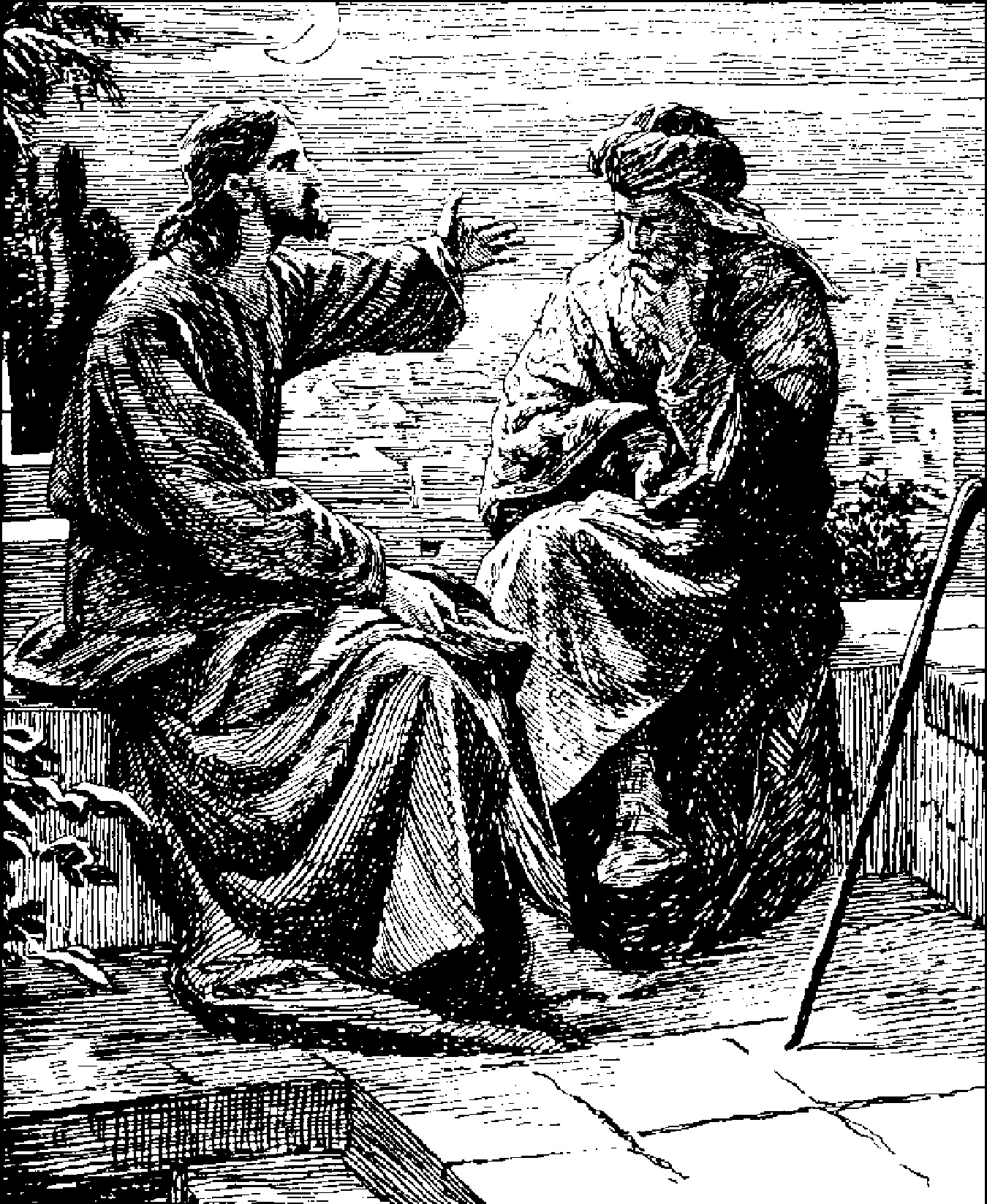
CHRT02Jesus had come to Jerusalem for the Passover when Nicodemus came to visit Him at night. Many people had believed on Jesus because of the signs which He had done in their midst but the Lord had not committed Himself to them, because He knew the hearts of men would often be devoted one moment and turn against Him the next. The late night visit by a ruler of the Jews must have invigorated the Lord that one in a place of authority and as a Pharisee would seek Him for counsel. The Pharisees constantly harassed Jesus attacking Him because of His miracles and teaching. Nicodemus was not of the same cloth.

The visit at night seems to have some significance as the only other times Nicodemus is mentioned in scripture reference is made to the fact that his visit was at night.  “Nicodemus (he who came to Jesus by night, being one of them) said to them … And Nicodemus, who at first came to Jesus by night, also came, bringing a mixture of myrrh and aloes, about a hundred pounds” (John 7:50; 19:39). The recorded conversation was short (just over 400 words). Whether there was more discussion is not revealed in John’s account for afterward Jesus and His disciples went to the land of Judea (John 3:22).

Nicodemus had an honest heart. The signs which Jesus had done (John 2:23) had an impact on this Pharisee unlike what his fellow rulers would come to believe. No doubt Jesus had impacted the Jewish leadership with His actions at the temple (John 2:13-22) and conflict with the establishment of Jewish hierarchy would intensify until they cried, “Crucify Him, crucify Him” (Luke 23:21). But Nicodemus could not deny the power manifested by Jesus and he was willing to acknowledge that no one save one sent from the Father could have such power. “Rabbi, we know that You are a teacher come from God; for no one can do these signs that You do unless God is with him” (John 3:2).

Belief in Jesus must begin with belief in His Father (2 Thessalonians 1:8). Later Jesus will be charged (by Pharisees) with casting out demons by “Beelzebub, the ruler of the demons” (Matthew 12:24) but Nicodemus believes in the true power of Jesus as being only from God. Jesus sees the enduring faith of this ruler and immediately goes to the heart of what Nicodemus needs. “Most assuredly, I say to you, unless one is born again, he cannot see the kingdom of God” (John 3:3). What a radical thought for the Jewish mind. Jesus is telling Nicodemus his life must take on a sweeping change that puzzles the Jewish ruler to ask, “How can a man be born when he is old? Can he enter a second time into his mother’s womb and be born” (John 3:4). The point of the lesson is found from an honest heart asking for clarification as he accepts what the Teacher is explaining.

The Lord is not meaning a physical birth as this would be an impossibility. Yet the spiritual birth would require something as impossible for the minds of the people to grasp as pondered by Nicodemus. Jesus answered, “Most assuredly, I say to you, unless one is born of water and the Spirit, he cannot enter the kingdom of God. That which is born of the flesh is flesh, and that which is born of the Spirit is spirit. Do not marvel that I said to you, ‘You must be born again.’ The wind blows where it wishes, and you hear the sound of it, but cannot tell where it comes from and where it goes. So is everyone who is born of the Spirit” (John 3:5-8).

The new birth is unlike the sign of the covenant rooted in the promises of Abraham. Circumcision was the covenant affirmed through Abraham as showing a binding relationship between God and His people. Now Jesus is telling him that salvation is found in being born anew or to be born from above. This new birth is found in water and in the Spirit, not the circumcision of the flesh. Nicodemus is puzzled. Nicodemus answered and said to Him, “How can these things be” (John 3:9)? It is here that Jesus goes to the heart of His teaching in showing to Nicodemus that the signs seen before (John 2:23) and the sign yet to come (the death of Jesus on a cross) would show men the light of the world (John 8:12; 9:5; 12:46).

Jesus was the Son of God seen through “miracles, wonders, and signs” (Acts 2:22) which God did through Jesus in the midst of the people. While Nicodemus did not know what the death of Jesus would mean to him later, Jesus foretells that as Moses lifted up the serpent in the wilderness, even so must the Son of Man be lifted up. The crucifixion of Jesus will be the central theme of man’s redemption and belief in the crucified Savior would give man eternal life. This sacrifice was not because man deserved it but only because of the love of Him who gave His only begotten Son to redeem man. Remember that Jesus is explaining what it means to be “born again” and this birth is “of water and Spirit.” The new birth is rooted in the love of God and the sacrifice of the one lifted up.

Rejection of the new birth would be the rejection of the Son of God. “For God did not send His Son into the world to condemn the world, but that the world through Him might be saved. He who believes in Him is not condemned; but he who does not believe is condemned already, because he has not believed in the name of the only begotten Son of God” (John 3:17-18). Nicodemus could see the connection between the new birth and the sacrifice of the One lifted up. On the day of Pentecost three thousand souls understood the lesson first heard by Nicodemus. Since that time simple hearts have obeyed the voice of Jesus still crying out in the night to honest heart seekers of truth to be born again.

Sadly many have rejected the teaching of Jesus. “And this is the condemnation, that the light has come into the world, and men loved darkness rather than light, because their deeds were evil. For everyone practicing evil hates the light and does not come to the light, lest his deeds should be exposed. But he who does the truth comes to the light, that his deeds may be clearly seen, that they have been done in God” (John 3:1-21). More often than not many people today reject baptism as necessary for salvation. Yet the scriptures frequently compare the words of Jesus to the promises found in the water burial. “Having been born again, not of corruptible seed but incorruptible, through the word of God which lives and abides forever” (1 Peter 1:23). “For in Christ Jesus neither circumcision nor uncircumcision avails anything, but a new creation” (Galatians 6:15). “Not by works of righteousness which we have done, but according to His mercy He saved us, through the washing of regeneration and renewing of the Holy Spirit” (Titus 3:5).

Paul illustrates that spiritual circumcision is the new birth. “In Him you were also circumcised with the circumcision made without hands, by putting off the body of the sins of the flesh, by the circumcision of Christ, buried with Him in baptism, in which you also were raised with Him through faith in the working of God, who raised Him from the dead” (Colossians 2:11-12). He also mirrors the teaching of Jesus to Nicodemus when he writes of the death of Jesus and baptism. “Or do you not know that as many of us as were baptized into Christ Jesus were baptized into His death? Therefore we were buried with Him through baptism into death, that just as Christ was raised from the dead by the glory of the Father, even so we also should walk in newness of life” (Romans 6:3-4).

Nicodemus would defend Jesus later (John 7:50-52) and finally help Joseph of Arimathea to bury the body of Jesus (John 19:38-42). The conversation he had with the Lord that single night must have changed his life forever. He had an honest heart and sought honest answers. His faith was in the simple words of a short conversation. He learned of the new birth and the true meaning of the cross he would later remove the body of Jesus from. We need men and women who have the heart of Nicodemus. He knew that salvation was not by faith alone nor did he just believe John 3:16 as his tenet of faith. The ruler of the Jews obeyed the command of water and Spirit.

The challenge of light and darkness still prevails in the hearts of men. Those who accept the appeal of Jesus will be saved and those who reject it will be lost. “He who believes and is baptized will be saved; but he who does not believe will be condemned” (Mark 16:16). “Repent, and let every one of you be baptized in the name of Jesus Christ for the remission of sins” (Acts 2:38). “Then Philip opened his mouth, and beginning at this Scripture, preached Jesus to him. Now as they went down the road, they came to some water. And the eunuch said, ‘See, here is water. What hinders me from being baptized?” (Acts 8:35-36). What about you?


← Back

Thank you for your response. ✨

Posted in Character Study, Christian, Church, Marriage, Morality, New Testament, Old Testament, Proverbs, Social Issues, Uncategorized | Leave a comment

Imparting Grace To Others

ListenThe wise man declared, “A word fitly spoken is like apples of gold in settings of silver” (Proverbs 25:11). There is so much value in “a word fitly spoken.” The Hebrew for “fitly spoken” here means “set on wheels.” All our words are set on wheels. If they are good words, they are wheeling on for good. If they are evil words, they go wheeling on for evil. Realizing the power of our words we see the beauty of words that are said in the proper manner. The “word” is the fruit set off by its circumstances, as the latter’s beauty is enhanced by the grace of the vessel which contains it. Paul uses this same image in Ephesians 4:29 when he writes “Let no corrupt word proceed out of your mouth, but what is good for necessary edification, that it may impart grace to the hearers.”

The tongue is a power creature that can bring about great blessing or terrible pain (James 3). As people of God we should task ourselves with speaking in a manner that edifies others. The word ‘edify’ is Latin for “making a house.” When we edify someone we are building them up. The Revised Version of Ephesians 4:29 suggest “but such as is good for edifying as the need may be.” When is there not a need to hear a good word from others? How often those who are downtrodden are lifted up from the doldrums of despair by a well-placed word of edification.

Jesus was the master of edification. When a leper came to the Lord in Luke 5:12-16 begging to be healed Jesus “put out His hand and touched him say, ‘I am willing; be cleansed” (v13). The emphasis is on the miracle of healing the body but notice also the healing of the mind when Jesus touched the leper and told him “I am willing.” Little children were brought to Jesus that He might lay his hands on them and pray for them (Matthew 19:13-15). Imagine the joy of heart the parents felt as they listened to the Lord offering up prayer for their children. Often in the ministry of the Lord would He take time out to edify the multitudes that came out to Him. “And Jesus, when He came out, saw a great multitude and was moved with compassion for them, because they were like sheep not having a shepherd. So He began to teach them many things.” (Mark 6:34)

The compassion shown by the Lord is our motivation to have a heart of kindness toward others. We all need a helping hand. “Therefore strengthen the hands which hang down, and the feeble knees” (Hebrews 12:12). The church is made up of different kinds of people who are traveling the road of life at different places. There are those who have the strength of Paul who boldly march forth with determined fortitude and faith. So often there are those who just struggle every day with how to be a Christian. I wonder how many leave the path of righteousness because the road becomes weary and hard and few words of edification are given to them. Discouraged and alone they wander off the road to despair.

The church at Corinth had a lot of problems and one was the failure to consider others to stir up love and good works (Hebrews 10:24). Paul reminded them that everyone was important. “For in fact the body is not one member but many. If the foot should say, ‘Because I am not a hand, I am not of the body,’ is it therefore not of the body? And if the ear should say, ‘Because I am not an eye, I am not of the body,” is it therefore not of the body?’” (1 Corinthians 12:14-16). They needed to learn the lesson about “words fitly spoken” to help and encourage those who were struggling. Notice a most important lesson Paul gives the saints at Corinth: “And the eye cannot say to the hand, ‘I have no need of you’; nor again the head to the feet, ‘I have no need of you.’ No, much rather, those members of the body which seem to be weaker are necessary” (1 Corinthians 12:21-22).

Words given for edification are words that may help the weaker members. We cannot view the weaker members as unnecessary but rather seek to impart grace to them to edify them to greater service. Weaker members go to heaven also remember! They need help in their struggles just as much as one stronger. Zig Ziglar said, “A lot of people have gone further than they thought they could because someone else thought they could.” Imagine the good that could be done if we used our speech to impart grace to others rather than constantly criticizing. “God grant that we may not hinder those who are battling their way slowly into the light” (Oswald Chambers).

“A man has joy by the answer of his mouth, and a word spoken in due season, how good it is” (Proverbs 15:23). Imparting grace to others is changing the old man of sin into the new man of Christ. Removed from the speech of God’s people is “anger, wrath, malice, blasphemy, filthy language … do not lie to one another” (Colossians 3:8-9). The character of the new man is found in the language of grace of putting on “tender mercies, kindness, humility, meekness, longsuffering; bearing with one another, and forgiving one another, if anyone has a complaint against another; even as Christ forgave you, so you also must do. But above all these things put on love, which is the bond of perfection. And let the peace of God rule in your hearts, to which also you were called in one body; and be thankful. Let the word of Christ dwell in you richly in all wisdom, teaching and admonishing one another in psalms and hymns and spiritual songs, singing with grace in your hearts to the Lord. And whatever you do in word or deed, do all in the name of the Lord Jesus, giving thanks to God the Father through Him” (Colossians 3:12-17).

It is important to see how our speech is found in all of the traits listed in Colossians 3. We should be strong enough to edify others by our words of encouragement. “Bless those who persecute you; bless and do not curse. Rejoice with those who rejoice, and weep with those who weep. Be of the same mind toward one another. Do not set your mind on high things, but associate with the humble. Do not be wise in your own opinion” (Romans 12:14-16). Words! The power of words!

Posted in Character Study, Christian, Church, Marriage, Morality, New Testament, Old Testament, Proverbs, Social Issues, Uncategorized | Leave a comment

How To Encourage Children

AP0506The sign reads, “Touch the future – teach children.” There can be no greater joy than having the opportunity to form lives at the headwater of life as molding the hearts of children. As a blank canvas awaiting the deep pigments of character so a child’s mind absorbs the teaching of those who craft their work in teaching children the wonderful story of God’s love. The wise man declares that children taught early in life will find security in old age. “Train up a child in the way he should go, And when he is old he will not depart from it” (Proverbs 22:6). Unprepared, novice, innocent and filled with hope children enter life with smiles and joy that brighten the hearts of time worn adults who have endured many challenges.

“A child is a man in a small letter, yet the best copy of Adam before he tasted of Eve, or the Apple; … He is nature’s fresh picture newly drawn in oil, which time and much handling dims and defaces. His soul is yet a white paper unscribbled with observations of the world, wherewith at length it becomes a blurred notebook. He is purely happy because he knows no evil” (John Earle, Micro-Cosmographie, 1628). It is that time of childhood that the greatest work of molding a life takes place. In the soft clay of adolescence an enduring character will be formed. Training a child is knowing that a child needs training while a child. “Remember now your Creator in the days of your youth, before the difficult days come, and the years draw near when you say, ‘I have no pleasure in them’” (Ecclesiastes 12:1). The formative years of the child is the “NOW” time. Children must not be discouraged but rather encouraged.

The act of encouragement is to give a child hope and confidence. It is to motivate them with courage offering praise for who they are and what they can become with God’s help. Training a child in the way that he should go is knowing the right way to go – “I am the way, the truth, and the life. No one comes to the Father except through Me” (John 14:6). Children must be taught to know Jesus Christ. This knowledge is not a cursory knowledge but a deep and abiding love for who Jesus is. Luke records the training of young Jesus in Luke 2:52 “And Jesus increased in wisdom and stature and in favor with God and men.” This four-fold plan is vital to every child.

Children need to be encouraged by the love of parents. “The first, the most fundamental right of childhood is the right to be loved. They child comes into the world alone, defenseless, without resource. Only love can stand between his infant helplessness and the savagery of harsh world” (Paul Hanly Furfey, The Church and the Child, 1933). This love is not dissimilar to how Paul describes it in 1 Corinthians 13. Parents show love to their children by being patient with the growing nature of youth. Parenting is not a competition of envy nor a superior feeling of adulthood over the child. Love does not allow the parent to fly off the handle at a child for a character of adolescence. One of the great tenets of love is that it is not about me but rather “we” or “us.” Children learn best when they see that parents make mistakes also.

Love is not easily provoked or irritated. A child will learn best in love when a parent is patient without losing their temper with yelling and screaming. Remembering the past slights does not endure a child to a loving relationship nor the revelry at past mistakes mold the heart of a child with love. Love does not rejoice in the failings of an imperfect young man or woman but rather believes all things in youth and hopes all things in youth. Children must be encouraged with the best construction put upon everything with faith not suspicion.

Finally love is shown to a child when the parent endures all things for the sake of the child and gives love no matter what. When the storms come love is given. Paul’s use of love in 1 Corinthians 13 is the measure of how we show our love for children; not in word but rather in deed.

Children are encouraged when they are given the chance to use their talents for God. Not everyone will have an ability to excel in certain areas of life but every child has an ability to excel in their life according to their talent. Sometimes the idea is given that “young people are the church of tomorrow.” In fact our young people are the church of today. They have so much to offer and there are so many lessons we can learn from them. Timothy was a young man who was commended by the brethren to Paul (Acts 16:2). The result is evident by two epistles written and preserved for the ages by Paul to this young man (1 & 2 Timothy). They will stumble and mumble when they give their first talk but in a short time through practice and encouragement they will become polished speakers of God’s word. How wonderful to see young people spend time with older folk. Children are encouraged when they find the joy of sitting with older folk during worship services or visiting in their homes. Teaching children to help others is teaching children the need for helping others.

Children are encouraged when they are shown the way of righteousness. The wise man says, “The silver-haired head is a crown of glory, if it is found in the way of righteousness” (Proverbs 16:31). The joy of older age is the knowledge that youth was spent in learning about the right way and living life lessened by the pains of regret. Parents must show the path of righteousness to their children by their daily example of prayer, mediation on God’s word and hands of benevolence to others. Fathers are not to provoke their children to wrath but “bring them up in the training and admonition of the Lord” (Ephesians 6:4). This speaks to the encouragement of children to be trained in the knowledge of God and to be admonished by His word.

Jane Brooks has said, “Our children are like library books on loan with a due date that remains unknown.” We must make the most of every moment with our children to prepare them for the ravaging storms of time. Childhood only happens once and unlike in golf – there are no mulligans or do-overs. Who are children will be tomorrow they are already becoming today. The encouragement given today will be the barrier walls of tomorrow to shield them from the darts of the devil. “But you must continue in the things which you have learned and been assured of, knowing from whom you have learned them, and that from childhood you have known the Holy Scriptures, which are able to make you wise for salvation through faith which is in Christ Jesus” (2 Timothy 3:14-15).

← Back

Thank you for your response. ✨


Posted in Character Study, Christian, Church, Marriage, Morality, New Testament, Old Testament, Proverbs, Social Issues, Uncategorized | Leave a comment