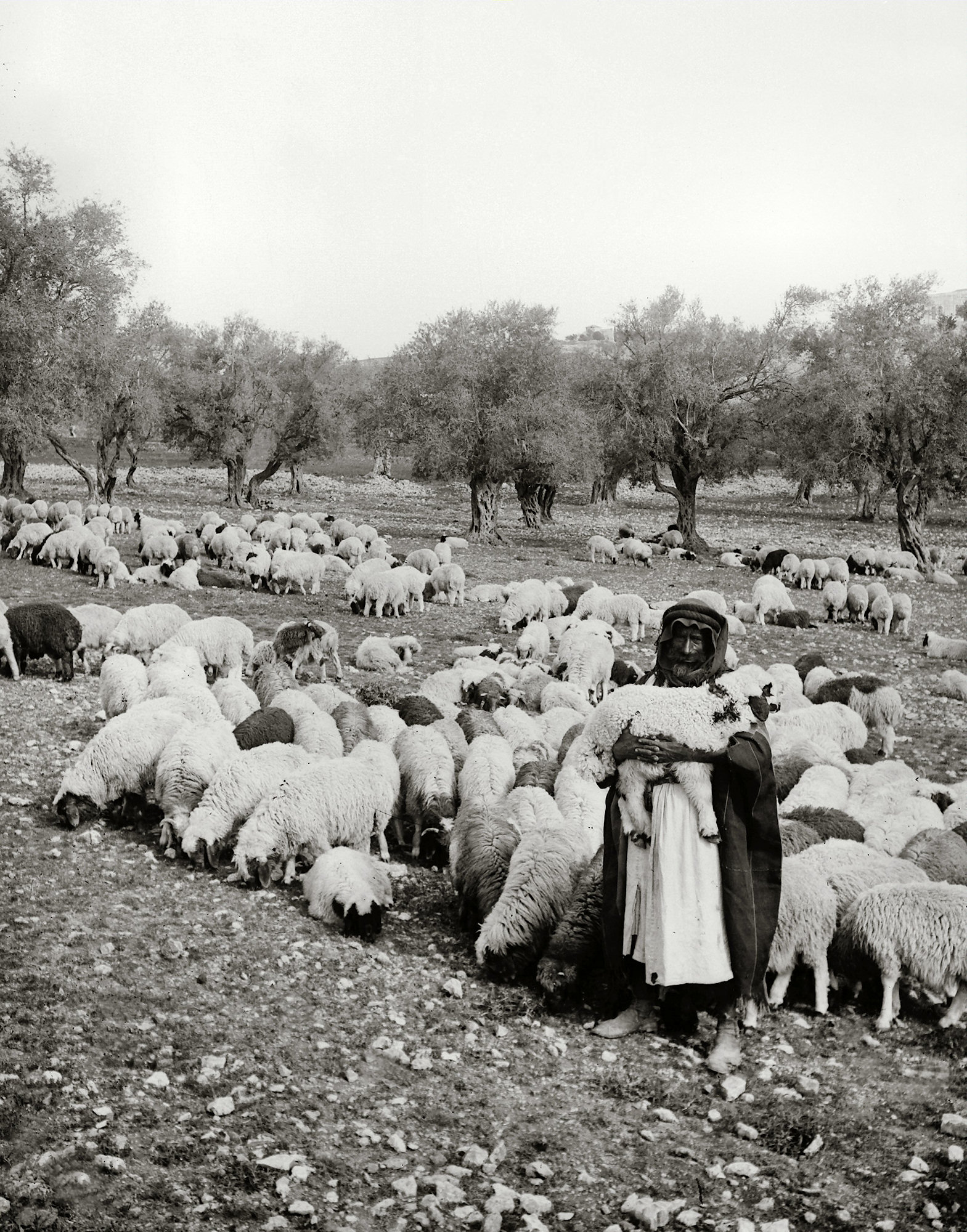
God Is My Shepherd

Sheep with their shepherd, mat01285The Lord is my shepherd; I shall not want. He makes me to lie down in green pastures; He leads me beside the still waters. He restores my soul; He leads me in the paths of righteousness for His name’s sake. Yea, though I walk through the valley of the shadow of death, I will fear no evil; for You are with me; Your rod and Your staff, they comfort me. You prepare a table before me in the presence of my enemies; You anoint my head with oil; my cup runs over. Surely goodness and mercy shall follow me all the days of my life; and I will dwell in the house of the Lord forever. (Psalm 23)

God Is My Shepherd

The twenty-third Psalm is one of the most visible passages of scripture. It is often quoted and numerous arrangements have been sung to the beauty of its simple message. David knew everything there was to know about being a shepherd and he could see how the heavenly Father was like a shepherd. Written in a brief style the psalmist captures the life of one who guards, protects, provides and sustains creatures that have no defense and no guidance. Sheep are animals that have many enemies. They do not have any form of defense and must rely upon the shepherds care for defense. The sheep are unable to find green pastures or still waters on their own and need a guiding hand to take them to where they will find life. Sheep are completely dependent upon the shepherd. Without the work of the shepherd the sheep will die.

Shepherds know their role is to care for every sheep in the fold. Unlike a hireling who is only in it for the money a shepherd will take the time to look after each and every sheep. He provides them abundant fields of greenery. Waters that rush across the rocks will not help the sheep so the shepherd finds still waters. When the roar of a bear echoes across the hills the sheep crowd close to the shepherd because they know he will protect them. There is no fear in the flock. From time to time a sheep will wander away. He is lost among the crags and valleys with no defense. His bleating will reach the ears of his shepherd and with great joy sees his protector coming to rescue him. What a wonderful feeling to know the arms of the shepherd will carry him to safety and back to the fold. There is peace with the sheep because of the shepherd.

David realized the God was the great shepherd. Living for God each day will bring a peace that passes understanding. Only by the hand of the Lord God are provisions given for daily food, raiment and the needs of life. Hearing the voice of God daily is a way to follow the path of righteousness. There is no fear in the hearts of a child of God because he knows the will of God will guard his life, protect him from the roaring lion and comfort him in times of storm. If life takes a difficult toll and one wanders from the truth he knows that a loving Father will forgive and receive back the prodigal son with great joy.

There are too many Christians who know the twenty-third psalm but have never known the great Shepherd of the psalm. David had a personal relationship with the Father and He could feel the joy of the great Shepherd in his life every day. Our Father is longing for us to know Him, trust Him, live for Him each day and He will take care of us. As we worship God today let us lift up our voices of praise to the Shepherd of our salvation. Thank you God for being my Father. Thank you God for being my Shepherd.

The highest lesson God wants to teach us is to “trust Him regardless.” If everything made sense to our understanding we would need no faith. (Vance Havner; 1901-1986)

Posted in Character Study, Christian, David, God, Psalms | Leave a comment

Weeping Over A City

tearsNow as He drew near, He saw the city and wept over it, saying, “If you had known, even you, especially in this your day, the things that make for your peace! But now they are hidden from your eyes. For days will come upon you when your enemies will build an embankment around you, surround you and close you in on every side, and level you, and your children within you, to the ground; and they will not leave in you one stone upon another, because you did not know the time of your visitation.” (Luke 19:41-44)

Weeping For A City

The Mount of Olives offered a panorama view of Jerusalem. As Jesus drew near the city of David His heart filled with the tragic sadness of its history, the present condition of blindness to the Son of God and the final destruction that was less than forty years away. It was from the Mount of Olives all of the city could be seen with the Temple the central figure in the many buildings that dotted the landscape. The city of Jerusalem was the Holy mountain of the Lord, the city of Righteousness, City of Truth; the place Daniel had opened his window and prayed toward. Jesus was overwhelmed by what He saw. It was in Jerusalem that God had placed the Temple to show the children of Abraham His glory. The heart of the people did not long rest in the mercy of the Lord but turned the Temple into a place of wickedness. When Jesus stood on the Mount of Olives the once beautiful city of God had been destroyed by the Babylonians, rebuilt and seven hundred years later under the guard of the Roman Empire. The Jews were looking for the promised Messiah but could not see the Christ in a man from Nazareth.

Destruction would come in 70 AD when the Roman army under Titus would level the city and destroy its inhabitants. It is said that so complete was the destruction that Titus had the Temple plowed under. Jesus wept because He knew what was coming. He cried tears of sorrow because while the city went about its busy day of the hustle and bustle of life judgment was coming. A terrible judgment was coming. His Father had longed for the city to see the glory of the Son of God but to no avail. They rejected the prophets of old and they were about to kill the Redeemer of the world. Albert Barnes wrote, “The national wickedness is too great; the cup is full: mercy is exhausted; and Jerusalem, with all her pride and splendor, the glory of her temple, and the pomp of her service, ‘must perish!’”

Jesus wept over a city. There are many reasons to sorrow in life. Generally it is connected with a death of a loved one. Jerusalem was a loved one of God. But it was more than a city. It was a story. One that began in the Garden of Eden and continues to this day. A story of the destructive hand of Satan. Looking down on Jerusalem the Lord could see all the people busy about their lives and many unaware of the coming judgment. Sin had filled the lives of all men and there was a need for a Savior. Jesus knew as He looked upon the city what price would be paid to redeem Jerusalem. That price would be paid outside the city gates like a lamb bearing the sins of the people. He wept for their sins, He wept for their sorrows soon to be found at the end of a Roman sword and He wept because what was to happen was the will of His Father – and nothing was going to change what would take place.

There is a need to weep over sin. The world has changed the view of sin but until we gain the proper insight of its tragedy tears will never come to our hearts. Jesus shows the proper attitude toward rejecting His Father. Sin is separation from the grace of God. It destroys and kills the soul. The result of sin is an eternal damnation of unbelievable horror. There may be a brief time of enjoyment in the arms of sin but the end is death – every time. Sin has killed our loved ones. The mark of sin will destroy many more lives. Jesus wept over sin and we can do no less when we see its tragic results. Godly sorrow is where repentance comes from and godly sorrow must always be at the forefront of how we view sin. We need to weep over sin. This sorrow must lead us to share the good news of salvation with a world given over to sin. Like Jesus looking upon Jerusalem with tears we should look around our community and weep over the lost souls that have no hope.

Weeping brings joy when a sinner turns from his way. Tears of sorrow are turned to tears of joy. May we have a heart of compassion for lost souls. Look deep into the lives of those we know and ask the question: “Is there joy?” Can we look upon them with happiness or with tears? Judgment is coming. It will be worse than what the Romans brought to the Jews. This judgment is final and its consequences are eternal. A great day is coming. Weep. Mourn. Sorrow over sin. Change hearts. Lead others to Christ. That is the greatest story ever told.

The real trouble with our times is not the multiplication of sinners; it is the disappearance of sin. (Etienne Gilson, Ensign, March, 1952)

Posted in Bible, Character Study, Christian, God, Jerusalem, Jesus Christ, Judgement, Prophets | Leave a comment

The Angry Prophet

AngerThen God saw their works, that they turned from their evil way; and God relented from the disaster that He had said He would bring upon them, and He did not do it. But it displeased Jonah exceedingly, and he became angry. So he prayed to the Lord, and said, “Ah, Lord, was not this what I said when I was still in my country? Therefore I fled previously to Tarshish; for I know that You are a gracious and merciful God, slow to anger and abundant in lovingkindness, One who relents from doing harm. Therefore now, O Lord, please take my life from me, for it is better for me to die than to live!” Then the Lord said, “Is it right for you to be angry?” So Jonah went out of the city and sat on the east side of the city. There he made himself a shelter and sat under it in the shade, till he might see what would become of the city. And the Lord God prepared a plant and made it come up over Jonah, that it might be shade for his head to deliver him from his misery. So Jonah was very grateful for the plant. But as morning dawned the next day God prepared a worm, and it so damaged the plant that it withered. And it happened, when the sun arose, that God prepared a vehement east wind; and the sun beat on Jonah’s head, so that he grew faint. Then he wished death for himself, and said, “It is better for me to die than to live.” Then God said to Jonah, “Is it right for you to be angry about the plant?” And he said, “It is right for me to be angry, even to death!” But the Lord said, “You have had pity on the plant for which you have not labored, nor made it grow, which came up in a night and perished in a night. And should I not pity Nineveh, that great city, in which are more than one hundred and twenty thousand persons who cannot discern between their right hand and their left–and much livestock? (Jonah 3:10-4:11)

The Angry Prophet

There are many ways for the Lord to work among men. In the book of Jonah an extraordinary story of a remarkable man is given of the providence of God working among the Gentile nations. Nineveh was a great city in those days. Founded during the time of the tower at Babel it would serve as the capital of the Assyrian empire in generations to come. In the book of Jonah we are told it took Jonah three days to walk its length and housed at least 120,000 people. The city was a Gentile city but God directed Jonah to go and preach to that great city. At first the prophet was reluctant refusing to go. As he fled to Tarshish he was cast into the sea and spent three days and nights in the bowels of a great fish. Receiving his second command to go to Nineveh Jonah went and preached the doom of the great city. Remarkably the king heard the message and sought forgiveness from God. Proclaiming a fast the Gentile ruler implored the whole city to turn to the Lord in the hope the city would not perish. God relented. This should be a time of praise and glory for Jonah but quite the contrary.

Jonah reveals why he fled to Tarshish in the beginning. As a preacher of truth his message to the people of Nineveh was powerful. Peter and the apostles were blessed to experience the new birth of three thousand souls on the day of Pentecost but the son of Amittai brought a whole city to its knees. It is easy to see why God choose Jonah to cry out against the wicked city. His preaching was the truth of the Lord and his presentation was like the brand of Amos. When the Lord told Jonah He had relented from His judgment Jonah was exceedingly displeased and he became angry. He fled to Tarshish (or tried to) because he did not want these people to be saved. His righteous indignation was hot against the wicked people. He decided that God did not know what He was doing so the prophet decided to go as far away to the ends of the earth as he could. The mistake of the man of God was to think he could ever go somewhere the Lord was not. He may have been an effective preacher of truth but his heart was not where it should be.

Jonah was angry. The Lord prepared the plant to cover Jonah and the prophet enjoyed the shade. When the plant died Jonah was again angry. When God spoke to Jonah the prophet replied to the Lord with anger. The book ends abruptly with the Savior of men reminding Jonah that as wicked as the people of Nineveh were; He, God,  had compassion on their hearts because they repented. Jonah could not see that. His plan was for the Lord to wipe out Nineveh in a blast from Heaven much like Sodom and Gomorrah. His anger blinded him from God’s grace.

Sin is ugly. It is easy for God’s people to hate the sinner more than the sin but while God hates sin He loves the broken lives of those who need guidance. The Lord never condoned sin because of His love for the sinner. Jesus told the woman caught in adultery to go and sin no more. What is revealed in that story is the hatred of men for the woman detesting what she had done rather than try to save her soul. The grace of God is measured by our own lives. What Jonah needed to realize is there was no difference between his life and the lives of those in Nineveh. He had rebelled against God refusing to go to Nineveh. The Lord wanted to save Nineveh and gave him a second chance to do what he was commanded. Why would he be angry if the Lord relented from punishing this great city? Mercy extended. Grace imparted. Love shown.

Sin is ugly in my life. I have been redeemed from the stain of sin. My sin is no different than the sin of others. All men sin. Jesus shed His blood for every sin and every sinner. All men need the grace of God no matter whether they are murderers, homosexuals, sexually immoral or tell a small lie once in a while. Grace comes from the blood of Jesus Christ. Jonah needed to have pity on the people of Nineveh. He should rejoice that a city as wicked as Nineveh could come to the Lord. There are a lot of Ninevites walking among us. Are you angry or are you ….

When thinking of sinners we shall never go wrong to include ourselves. (Aelred Graham, Christian Thoughts and Action, 1951)

Posted in Uncategorized | Leave a comment

The Joy Of Being Like-Minded

agape_-_darkTherefore if there is any consolation in Christ, if any comfort of love, if any fellowship of the Spirit, if any affection and mercy, fulfill my joy by being like-minded, having the same love, being of one accord, of one mind. Let nothing be done through selfish ambition or conceit, but in lowliness of mind let each esteem others better than himself. Let each of you look out not only for his own interests, but also for the interests of others. (Philippians 2:1-4)

The Joy Of Being Like-Minded

It’s not about me. The hardest part in relationships is to remember that it is not always about what I want but what is important for the other person. Marriage is not a one way road. It takes two people caring for the other person to make a marriage to find fulfillment. If jealousy sparks the heart to my wishes and my demands the other person will suffer. The deepest relationship we have in Christ is when we find a spirit of like-minded concern with my brethren. While the world hawks the wares of selfishness and self-centered arrogance the principles of God establish relationships of a lowly mind.

People of God are to love one another. This love is the same love for each member of the body of Christ. There is a union of spirit because we serve the same God. The mind is one in purpose as we live after the same word. So often the nature of quarrelling and hatred permeates within the fabric of the church causing division and discord. Brethren will strive with one another over trivial things holding grudges for years. Bitterness roots itself in hurt feelings. Anger lies just below the level of civility creating an undercurrent or resentment. God does not want His children to behave in such a manner. The joy of the Holy Spirit and Jesus Christ is for the people of God to have a like-mind and learn to love one another.

The first thing that must be done is for self to be removed. Jesus died for our sins – not just my sins. God loved the world – not just me. When I seek to have my way because of my own selfish desires or party spirit I deny the purpose of God sending His Son. Paul exhorts the brethren at Philippi that nothing should be done through selfish ambition or conceit. Nothing means nothing. Not one thing. Nada. Everything I do is about my brother. Showing a mind of humility I esteem others better than myself. That is strong language for some to accept. Reading the text again and again will not change the force of the argument. Nothing is to be done for my own self-seeking gratification. Removing my will to the will of the Lord demands a humble heart. I cannot lift up my brother until I bow myself lower than him. That is what Jesus did.

Every individual has a need to care for his own good but we must never lose sight of the needs of others. Helping one another, praying for one another, exhorting one another comes from the language of one another. Marriage is about ‘our’ relationship and in the marriage of spiritual relationships in Christ it is about looking after the needs of others. Jesus taught His disciples that to be great one had to learn to be a servant. When we learn the principles of servanthood we learn how to serve others. It is not easy to serve. Hard work is involved. Patience. Love. Can I do less than what Jesus did for me? He left glory to die a servant on the cross. From His example I learn how to find the comfort of love in the body of Christ and the fellowship of the Spirit. Seek opportunities to serve others. That is the joy of being like-minded.

You must act in your friend’s interest whether it pleases him or not; the object of love is to serve, not to win. (Woodrow Wilson, Address, Princeton, May 9, 1907)

Posted in Character Study, Christian, Jesus Christ, Philippians | 2 Comments

The Aborted Life

tombstonesThere is an evil that I have seen under the sun, and it lies heavy on mankind: a man to whom God gives wealth, possessions, and honor, so that he lacks nothing of all that he desires, yet God does not give him power to enjoy them, but a stranger enjoys them. This is vanity; it is a grievous evil. If a man fathers a hundred children and lives many years, so that the days of his years are many, but his soul is not satisfied with life’s good things, and he also has no burial, I say that a stillborn child is better off than he. For it comes in vanity and goes in darkness, and in darkness its name is covered. Moreover, it has not seen the sun or known anything, yet it finds rest rather than he. Even though he should live a thousand years twice over, yet enjoy no good–do not all go to the one place? All the toil of man is for his mouth, yet his appetite is not satisfied. For what advantage has the wise man over the fool? And what does the poor man have who knows how to conduct himself before the living? Better is the sight of the eyes than the wandering of the appetite: this also is vanity and a striving after wind. (Ecclesiastes 6:1-9)

The Aborted Life

It is unusual to compare life to an aborted child but the reality of life without purpose is the same conclusion. The son of David makes a startling conclusion about the nature of life lived to its fullest but life empty of meaning. The single goal of most men is to gain every benefit in life possible. Wealth, power and pleasure is the Bermuda triangle of vanity that drives men to do whatever is necessary to have the trinkets of material desire. Lives will be dedicated to building up affluence. Position and prestige drive men to gain power in the business world or political ambitions. The flesh enjoys every sensual pleasure in reckless abandonment. From the view of the world these are successful and happy people because they have so much. The wise man observes this life is no different than a child that dies before birth.

Time does not change the truth of the vanity of life. If a man has a hundred children to establish some kind of dynasty he still will die in vain. It is amazing to think of those in the Bible that lived nearly a thousand years but the truth of life is no different to a man who lives forty years than a man who lives two thousand years. So often the view of life is tainted by the false belief that life is about the here and now. Men work all their lives to fill their pockets and dreams with empty promises and then they die. What then? Sadly it is no different than a child that never sees the light of day. Death comes to them both and both die with no worldly advantage than the other. In death they have a common end.

The lesson for the living is to take to heart the truth of man’s existence. Solomon’s conclusion at the end of this great book is for man to fear God and keep His commandments because that is all man has to gain. What else is there? Seeking all the frills of life is vanity. Seeking the Lord in righteousness is eternal. The nature of man does not change. Our world is filled with more glorifications of man’s wisdom, power and wealth than in many generations past. The simple truth remains the same: life without God is vain. Gaining all the wealth of this world will do you no good in the life to come. Attaining great measures of power and fame today will be lost in the dust bins of tomorrow. Pleasure is fleeting. Age takes care of that and death ends it.

There is one thing to note about the lives of vain men and aborted children. Those who spend their lives seeking salvation in worldly pleasures will lose their soul in eternal darkness. The stillborn child who never sees the light of day will find the light of God in death. They are neither rich in this world nor powerful and never enjoy the pleasures of life. What they do have is eternal life! And that is all that matters! Something to think about. Lessons to learn for living.

The great use of life is to spend it for something that outlasts it. (William James; 1842-1910; quoted in Thought and Character of William James, by Ralph Barton Perry)

Posted in Character Study, Christian, Ecclesiastes, Judgement, Morality, Psalms, Social Issues | Leave a comment

The Sadness Of Error

errorTherefore, beloved, looking forward to these things, be diligent to be found by Him in peace, without spot and blameless; and consider that the longsuffering of our Lord is salvation–as also our beloved brother Paul, according to the wisdom given to him, has written to you, as also in all his epistles, speaking in them of these things, in which are some things hard to understand, which untaught and unstable people twist to their own destruction, as they do also the rest of the Scriptures. You therefore, beloved, since you know this beforehand, beware lest you also fall from your own steadfastness, being led away with the error of the wicked; but grow in the grace and knowledge of our Lord and Savior Jesus Christ. To Him be the glory both now and forever. Amen. (2 Peter 3:14-18)

The Sadness Of Error

When Peter was writing his second epistle he faced the sad reality of false teachers that were bringing their destructive heresies among God’s people. Satan has never rested in his efforts to malign, confuse, destroy and change the doctrine of the Lord from truth to his vile tonic of lies. What the apostle dealt with two thousand years ago is alive and well in our world today. False teachers abound. They flourish among multitudes of people who are deceived by their smooth words of scripture quoting Bible toting vibrant experiences of so-called spirit led worship. Predominate among the charismatics are the ploys of spiritual gifts deceiving thousands at healing services that are no more than carnival tricks of lies. Myriads of honest people are being taught the damning philosophies of error to their own destruction. Huge throngs of disciples blindly follow the antics of slick pressed con men (and women) who charm the world with doctrines of good feeling no judgment God is love dogma with no greater appeal than living anyway you desire lifestyles. Let’s face it: there is nothing more sad than the reality of what error is doing to the hearts of God’s creation.

The answer to error is found in our text. Peter lived in a world given over to false teachers but he exhorted the people of God to do a simple yet powerful thing: grow in the grace and knowledge of Jesus Christ. The sadness of error is – it is unnecessary. The truth has been revealed in the word of God. As Paul reminded the brethren at Ephesus we have but only to read and understand what is written. It is there. Error comes from those who appeal more to the fleshly lusts of pleasure rather than the spiritual ideals of knowledge. How sad to stand before God in the final day and realize that truth was revealed in written form yet rejected for the antics of a false teacher.

Ignorance of scripture will bring about an eternal destiny of horror. There is a need for diligence to be found in Christ without spot and to be found blameless. Steadfastness is the clarion call of the hour to realize false teachers abound and every soul must be found faithful to the knowledge of Jesus Christ. Growing in this knowledge is what defeats false teaching. Earlier Peter had admonished his readers to be mindful of the words which were spoken by the holy prophets and commandment of the apostles of Christ. Scoffers were coming walking according to their own lusts. Stay to the Book. Anchor upon the words of truth. Do not let false teachers allure the faithful away from the hope of salvation by a gospel falsely called. Error is real and error is destructive.

The greatest sadness of error is the final realization of hopelessness when it is too late to change. There is nothing more paramount to the salvation of the soul than to examine oneself whether they are in the faith. Not because of what parents have said, favorite preachers have taught, society has embraced or how I think things should be. It is clearly whether or not I am growing in His grace increasing in His knowledge according to His will. Not everyone who says “Lord, Lord” will be saved. Only those who do the will of the Father. Error brings sadness. Truth gives gladness.

Be not content to know the Truth; rouse your heart to love it. (B. W. Maturin, Self-Knowledge and Self-Discipline, 1905)

Posted in Bible, Christian, Church, error, God, Judgement, obedience, salvation | Leave a comment

Which Seed Are You?

wheat-shutterstockThen Jesus sent the multitude away and went into the house. And His disciples came to Him, saying, “Explain to us the parable of the tares of the field.” He answered and said to them: “He who sows the good seed is the Son of Man. The field is the world, the good seeds are the sons of the kingdom, but the tares are the sons of the wicked one. The enemy who sowed them is the devil, the harvest is the end of the age, and the reapers are the angels. Therefore as the tares are gathered and burned in the fire, so it will be at the end of this age. The Son of Man will send out His angels, and they will gather out of His kingdom all things that offend, and those who practice lawlessness, and will cast them into the furnace of fire. There will be wailing and gnashing of teeth. Then the righteous will shine forth as the sun in the kingdom of their Father. He who has ears to hear, let him hear! (Matthew 13:36-43)

Which Seed Are You?

Jesus used mental ‘Power Point’ to impress upon His disciples the teaching of His Father. Through means of parables He was able to embed in the hearts of those who hungered for the word of God the deeper meaning of discipleship. The parable of the wheat and tares is a vivid account of the whole of man’s existence and the grace of God to save.

Jesus came to bring the message of redemption through His blood. His teaching was the good seed that would bring forth blessings in good hearts. All humanity would be offered this seed of grace as the word was spread to the four corners of the earth. When Jesus commissioned His apostles to teach the gospel He charged them to go into all the world and teach. Seeds of the gospel were spread in Jerusalem, Judea and Samaria and to the end of the earth. At the same time, Satan realized what this good seed would do to the hearts of men so he began a campaign of spreading the tares of his wares among the people. A tare is a noxious weed. It is useless, poisonous and destroys the ground. The agents of the devil spread these toxic weeds in the hearts of men destroying the goodness in their hearts.

The Lord is coming back to bring all men to judgment. Jesus pictured the day of judgment in many ways but in this parable it takes on the form of an agricultural story. When men sow good seeds of wheat the expectation is to receive a bounty of harvest. Their enemies, not wanting them to have such a harvest, sow seeds of tares among the wheat so they can grow up together. The servants want to immediately tear out the tares but for harming the good seed are prohibited. Instead the master waits until the day of harvest and separates the good from the bad. Jesus shows how the devil is the one who plants the seeds of error in the hearts of men but in the day of harvest the angels will reap the good plants from the bad. The evil hearts of men (tares) will be gathered together and cast into the fire where there will be the weeping and gnashing of teeth. The good seed that grew to maturity in Christ will be gathered in the barn of God.

The lesson of the parable is simple. Jesus came to bring the good news and the devil comes to bring the bad news. As the world continues – the mixing of the word of God and the efforts of Satan to destroy the righteous are allowed to continue. There is a great day coming. A great day when the Lord in flaming fire will come with His angels to bring judgment upon the world. The separation of evil men from good men will be the judgment. Those who refused to know God and obey the gospel of Jesus Christ will be cast into Hell. Jesus teaches the severity of punishment as something very real. The angels will take the righteous to the promise of God for eternal life where they will shine forth in the glory of the Father.

Not everyone will be saved. Jesus taught that most men will be lost. There are only two kinds of people in the world: those who are the good seed and those who are the tares. The question you must answer (and you know the answer) is which seed are you? Only one seed goes to Heaven. Be the good seed. Follow the will of the Father.

The humblest citizen of all the land, when clad in the armor of a righteous cause, is stronger than all the hosts of error. (William Jennings Bryan, Speech, 1896)

Posted in Angels, Bible, Harvest, Jesus Christ, Judgement, Matthew, New Testament, parable, salvation, Wheat | Leave a comment

Trust The Cloud

songsonpowerpoint_com_019Now on the day that the tabernacle was raised up, the cloud covered the tabernacle, the tent of the Testimony; from evening until morning it was above the tabernacle like the appearance of fire. So it was always: the cloud covered it by day, and the appearance of fire by night. Whenever the cloud was taken up from above the tabernacle, after that the children of Israel would journey; and in the place where the cloud settled, there the children of Israel would pitch their tents. At the command of the Lord the children of Israel would journey, and at the command of the Lord they would camp; as long as the cloud stayed above the tabernacle they remained encamped. Even when the cloud continued long, many days above the tabernacle, the children of Israel kept the charge of the Lord and did not journey. So it was, when the cloud was above the tabernacle a few days: according to the command of the Lord they would remain encamped, and according to the command of the Lord they would journey. So it was, when the cloud remained only from evening until morning: when the cloud was taken up in the morning, then they would journey; whether by day or by night, whenever the cloud was taken up, they would journey. Whether it was two days, a month, or a year that the cloud remained above the tabernacle, the children of Israel would remain encamped and not journey; but when it was taken up, they would journey. At the command of the Lord they remained encamped, and at the command of the Lord they journeyed; they kept the charge of the Lord, at the command of the Lord by the hand of Moses. (Numbers 9:15-23)

Trust The Cloud

Jehovah God has always revealed Himself to man. One of the most glorious manners of His revelation is when He guided the children of Israel out of Egypt and through the wilderness wanderings. The Lord went before them as a comforting cover of cloud in the day and a cloud of fire at night for security and guidance. When Pharaoh came after the people at the Red Sea God put His cloud between the army and His people creating a cloud of darkness for the Egyptians but a cloud of light for the Hebrews. At Mount Sinai the Lord spoke from the cloud with thundering and lightening to Moses. When the Tabernacle was constructed God filled it with His cloud. In the day it was a cloud of covering and at night it was a cloud of fire protecting the people. The cloud of the Lord was not just a cloud but a way the Lord expected the people to trust in Him.

The Law of Moses was specific about the nature of the cloud of God. Trusting in the Lord would come from the evidence of the cloud. During the heat of the day they would be protected by the presence of the Lord. At night without guidance and direction they had only but to see the cloud of fire to feel the spirit of comfort in the presence of God. This cloud also became their GPS guiding them through the wilderness for forty years. Whenever the cloud moved east, west, north or south the people would pack up their tents and follow the cloud. Like their father Abraham of old they did not know where they were going but they were to trust the cloud. If the cloud stopped for a day, a week, a month or a year they were to remain in place until the cloud moved. Following the cloud was following the command of the Lord. Ignoring the cloud was disobedience and death. If a family decided to not trust the cloud and stay in one place while the cloud moved they would perish from the heat and be lost in the wilderness. Survival was dependent upon obedience to follow the cloud and trust the cloud. Did it make any sense to human wisdom to tell people to follow a cloud? Only if you wanted to live.

Without God man is lost. Today the cloud of the Lord is in a different form. It still provides a cover of comfort by day and a light at night. We call it the Bible. Like the cloud of Moses’ day God reveals Himself to man as comfort and direction. It will protect us from Satan as the word of God keeps the adversary in the darkness and allows God’s people to dwell in light. Following the word of God is like following the cloud. The Bible can be trusted because it is the presence of the Lord showering man with the shadow of His mercy. During the dark nights of life the presence of the heavenly Father provides security and protection like a light. There is nothing to fear when we have the cloud of God surrounding us.

He speaks to us from this cloud. Sometimes it is a gentle rain and sometimes it is the fury of thunder. Looking at this cloud we can see the grace of a loving God when He tells us to rise up and take our journey. At times He wants us to stay still and know that He is God. Whenever the Bible tells us to go from one place to another we follow those commands. His will is accomplished in the cloud as the Bible reveals the will of the Father. We obey because we trust the cloud. For people in the world they laugh and scoff that we would follow the Bible. Like the days of the Hebrews survival depended on following the cloud. So it is today. The wisdom of the world cannot understand what the cloud of the Lord means until they stand in the midst of God. As for me and my house we will follow the cloud.

Today is a day of worship. Take a look at the clouds today. Make each day a day of cloud watching. Teach your children that God is in the clouds. More important show your children the God of the Bible. Trust the cloud.

If we don’t know where we are going, we don’t know what to do where we are … Blessed is the man who finds out which way God is moving and then gets going in the same direction. (Vance Havner; 1901-1986)

Posted in Bible, Christian, Cloud, Law of Moses, Mercy, Moses, obedience, Old Testament, salvation | Leave a comment

The Shoulders Of Giants

bible openThe Shoulders of Giants

(Paul R. Blake)

“We are like dwarfs sitting on the shoulders of giants. We see more, and things that are more distant, than they did, not because our sight is superior or because we are taller than they, but because they raise us up, and by their great stature add to ours.” (John of Salisbury, Metalogicon, 1159)

John of Salisbury wrote this in his treatise on logic in recognition of the work done by those who went before him. If a businessman can travel to Japan and close a billion dollar deal, and on the flight there and back direct matters at his home and office by means of a smart phone, he is able to do so because of the work of those who went before him. It required the efforts of inventors, engineers, entrepreneurs, statesmen, and investors to create the international relations, the global trade environment, intercontinental flight, worldwide communications network, etc. that made it work. Each consecutive generation builds on the knowledge and work of all of the generations that went before them. If we do greater things that those who went before us, it is because they created an environment that made it possible for us to excel. As John of Salisbury said, “And by their great stature, add to ours.”

Forgetting this leads to overweening pride. We believe we have done great things by our own strength and knowledge without a thought for those who made it possible. Our pride then becomes our shame.

However, too much focus on the efforts of those who went before us can lead us into unwillingness to go forward and build on their work. Too high a regard for the men of the past can result in a contemporary form of idolatry or ancestor worship. Afraid of insulting the memory of great men in the past, our efforts become limited to maintaining their works, and we refuse to grow beyond or build upon their work.

This principle applies in spiritual matters. Great Bible students in years gone by made great strides in the work of restoration, but they were limited by the constraints of time and their own developing knowledge. Most of them understood this and wanted successive generations to continue the work of restoration. While a number of disciples went too far and created new doctrines and denominations, others went to the extreme of crystallizing the work of their ancestors and refusing to build on it. This form of conservatism is not approved in scripture. God’s word demands courage to take advantage of the opportunities presented us.

We honor the memories of Alexander Campbell and Barton W. Stone, but we remember that these men had doctrinal feet of clay. Campbell was a post-millennialist and a borderline ecumenicalist, and Stone’s primitivism created prohibitions not found in the scriptures. Subsequent Bible students examined their work, held onto what was right and built up the brotherhood’s understanding of more Bible doctrines. Each generation must examine what the previous generation taught and stand on their growing understanding of sound doctrine and study in order to increase that understanding. And if we know more and see farther than Campbell, Stone, et ai, it is because we are standing on their shoulders.

Another way of putting this is that it is not necessary to re-invent the wheel. Car makers understand the principle of the wheel and the mechanism of the internal combustion engine, and therefore do not need to start with inventing them. They simply improve on them. Likewise with our understanding of first principles regarding salvation, personal morality, and the nature of the Lord’s church, things well known and surely believed among faithful Christians. They do not need to start all over again from the perspective of an alien sinner or abject denominationalist. In more recent times, we can be thankful for the work of such men as Roy Cogdill, Clinton Hamilton, et al. My generation can take advantage of the opportunities made available because these men developed and published studies that answer digressions on the work, worship and organization of the church. And just as they stood on the shoulders of giants who went before them in order to see as far as they did, likewise they would want us to stand on their shoulders as we grow in our own knowledge of truth.    .

And as with generations in the past, some Christians crystallize the work of respected men and are afraid to deepen their study and increase their understanding. When Roy Cogdill wrote his study “The New Testament Church,” he performed an incalculable service for us. But neither he nor others who did similar work would want us to treat their efforts as equal to the word of God. They would want us to examine their work in the light of scripture and refine their arguments where possible in order to be more effective students and teachers of the word. Nevertheless, I often hear in response to a closer examination of a Bible matter: “Well, old brother _____ said _____, and that’s good enough for me.” It may be good enough for them, but that spirit is not good enough for the Lord (2 Timothy 2:15). Conscientious Bible students do not merit criticism from lazy, partisan brethren who seem to be making idols of past giants. For example:

Brethren use command, example, and necessary inference to establish Bible authority, and rightly so. Yet this is less accurate than what subsequent students have learned through experience teaching in the field; that is, command, divinely approved example, and divine implication. Dealing with errorists made it necessary to refine arguments. Example needs to give way to divinely approved example to distinguish between incidental actions and divinely authorized actions. Necessary inference needs to give way to Divine implication, because God must first imply a thing before man can draw the expected inference, and because it makes ineffective all charges of subjectivity. But because ol’ brother So-and-so didn’t write it, some refuse to consider it and grow.

I have seen this happen multiple times over the years on a number of different Bible matters, brethren using weak or dated arguments because their ancestors used them, rather than growing in understanding and making stronger arguments against sin and error. Would they insist on cutting their lawns with a scythe because that’s how it was done in the past or would they do it faster with a lawn mower? Would they take a horse and buggy to the grocery store because that’s how they did it years ago, or would they use an automobile? More to the point, given the choice would they want to break the ice in the river to be baptized, or would they choose to use the baptistery in a heated building? At one time, brethren believed baptisms must occur in running water. Where would we baptize today if serious Bible students refused to study deeper than their predecessors?

Do not let Alexander Campbell, Barton W. Stone, Roy Cogdill, Clinton Hamilton, or any other person become the end of your study in any Bible matter. The scriptures are the final word on all spiritual things. The Lord wants you, like the Bereans (Acts 17:11), to examine the word on your own, even if it is the apostle Paul doing the preaching. Yes, we are blessed with the opportunity to see farther by standing on the shoulders of giants; but, we must not become lazy or partisan and refuse to look further.


Posted in Bible, Church, Gospels, New Testament | Tagged , , , | 2 Comments

It Happened In A Heavy Rain

fear of the lordNow while Ezra was praying, and while he was confessing, weeping, and bowing down before the house of God, a very large assembly of men, women, and children gathered to him from Israel; for the people wept very bitterly. And Shechaniah the son of Jehiel, one of the sons of Elam, spoke up and said to Ezra, “We have trespassed against our God, and have taken pagan wives from the peoples of the land; yet now there is hope in Israel in spite of this. Now therefore, let us make a covenant with our God to put away all these wives and those who have been born to them, according to the advice of my master and of those who tremble at the commandment of our God; and let it be done according to the law. Arise, for this matter is your responsibility. We also are with you. Be of good courage, and do it.”

Then Ezra arose, and made the leaders of the priests, the Levites, and all Israel swear an oath that they would do according to this word. So they swore an oath. Then Ezra rose up from before the house of God, and went into the chamber of Jehohanan the son of Eliashib; and when he came there, he ate no bread and drank no water, for he mourned because of the guilt of those from the captivity. And they issued a proclamation throughout Judah and Jerusalem to all the descendants of the captivity, that they must gather at Jerusalem, and that whoever would not come within three days, according to the instructions of the leaders and elders, all his property would be confiscated, and he himself would be separated from the assembly of those from the captivity.

So all the men of Judah and Benjamin gathered at Jerusalem within three days. It was the ninth month, on the twentieth of the month; and all the people sat in the open square of the house of God, trembling because of this matter and because of heavy rain. Then Ezra the priest stood up and said to them, “You have transgressed and have taken pagan wives, adding to the guilt of Israel. Now therefore, make confession to the LORD God of your fathers, and do His will; separate yourselves from the peoples of the land, and from the pagan wives.” Then all the assembly answered and said with a loud voice, “Yes! As you have said, so we must do. But there are many people; it is the season for heavy rain, and we are not able to stand outside. Nor is this the work of one or two days, for there are many of us who have transgressed in this matter. Please, let the leaders of our entire assembly stand; and let all those in our cities who have taken pagan wives come at appointed times, together with the elders and judges of their cities, until the fierce wrath of our God is turned away from us in this matter.” Only Jonathan the son of Asahel and Jahaziah the son of Tikvah opposed this, and Meshullam and Shabbethai the Levite gave them support. Then the descendants of the captivity did so.

And Ezra the priest, with certain heads of the fathers’ households, were set apart by the fathers’ households, each of them by name; and they sat down on the first day of the tenth month to examine the matter. By the first day of the first month they finished questioning all the men who had taken pagan wives. And among the sons of the priests who had taken pagan wives the following were found of the sons of Jeshua the son of Jozadak, and his brothers: Maaseiah, Eliezer, Jarib, and Gedaliah. And they gave their promise that they would put away their wives; and being guilty, they presented a ram of the flock as their trespass offering.  

Also of the sons of Immer: Hanani and Zebadiah; of the sons of Harim: Maaseiah, Elijah, Shemaiah, Jehiel, and Uzziah; of the sons of Pashhur: Elioenai, Maaseiah, Ishmael, Nethanel, Jozabad, and Elasah. Also of the Levites: Jozabad, Shimei, Kelaiah (the same is Kelita), Pethahiah, Judah, and Eliezer. Also of the singers: Eliashib; and of the gatekeepers: Shallum, Telem, and Uri. And others of Israel: of the sons of Parosh: Ramiah, Jeziah, Malchiah, Mijamin, Eleazar, Malchijah, and Benaiah; of the sons of Elam: Mattaniah, Zechariah, Jehiel, Abdi, Jeremoth, and Eliah; of the sons of Zattu: Elioenai, Eliashib, Mattaniah, Jeremoth, Zabad, and Aziza; of the sons of Bebai: Jehohanan, Hananiah, Zabbai, and Athlai; of the sons of Bani: Meshullam, Malluch, Adaiah, Jashub, Sheal, and Ramoth; of the sons of Pahath-Moab: Adna, Chelal, Benaiah, Maaseiah, Mattaniah, Bezalel, Binnui, and Manasseh; of the sons of Harim: Eliezer, Ishijah, Malchijah, Shemaiah, Shimeon, Benjamin, Malluch, and Shemariah; of the sons of Hashum: Mattenai, Mattattah, Zabad, Eliphelet, Jeremai, Manasseh, and Shimei; of the sons of Bani: Maadai, Amram, Uel, Benaiah, Bedeiah, Cheluh, Vaniah, Meremoth, Eliashib, Mattaniah, Mattenai, Jaasai, Bani, Binnui, Shimei, Shelemiah, Nathan, Adaiah, Machnadebai, Shashai, Sharai, Azarel, Shelemiah, Shemariah, Shallum, Amariah, and Joseph; of the sons of Nebo: Jeiel, Mattithiah, Zabad, Zebina, Jaddai, Joel, and Benaiah.

All these had taken pagan wives, and some of them had wives by whom they had children. (Ezra 10)

It Happened In A Heavy Rain

There are some remarkable stories in scripture. Few can measure to the incredible story found in the final chapter of Ezra. The people of God have been in captivity for seven decades. By the hand of God a remnant has been restored to the land. Through a great struggle the Temple has been rebuilt and the spirit of the people is turned to worship the Lord. As Ezra was in the house of God confessing, weeping and bowing down a multitude of people came before him with an amazing story. The hearts of God’s people had been touched with His grace and mercy and they had realized their need of repentance. This was not the sin of stealing or lying or profaning the Sabbath. The people came to Ezra and confessed they were in unscriptural marriages. Moses had clearly written in the Law God’s forbiddance to intermingle with pagan wives. The people trembled. They were afraid of what the Lord would do. They begged Ezra to assemble all of Israel and establish the covenant with God once again and they would put away their pagan wives.

A message went out to all Israel that in three days everyone would assemble. If any person refused the command their properties would be confiscated and they would be cut off from Israel. Everyone came. And it rained. The rain came down hard. It was a fearful time because of the commandment of the Lord and the intensity of the rain. But they did not move. They did not shirk their oath. Standing in a pouring deluge the people listened to the words of Ezra. He told them to confess their sins and to separate themselves from their pagan wives and the peoples of the land. The process began and the book of Ezra closes with the testimony of a righteous people following the command of Jehovah God. The people put away their pagan wives including the children.

There are some things to note in this story. The people came to Ezra. They wanted to change their lives and they admitted their marriages were displeasing to God. Whatever it took to reconcile their hearts with the Lord they would do – even putting away their pagan wives and children. They trembled at the word of God. Marriage relationships are so close yet their relationship with the word of God moved them with greater fear. Hope was in their sorrow over sin and willingness to change their lives totally for the Lord. A covenant of faith was established that day. The people did not condemn the preacher for their unlawful marriage but told him they would encourage him to help the people do what was right. When the day came the people sat in the open square of the house of God trembling at the word of God and the heavy rain. That was dedication of a contrite heart.

What a blessing it would be to find people like those in the days of Ezra. Read the last paragraph again and see if that would happen today with God’s people. Are you willing to stand before the Lord trembling at His word? Are you willing to stand in an open court in a heavy rain to fulfill the law of God? Are you willing to do whatever it takes to be pleasing to God – including your marriage? This is a remarkable story.

The word of God is a red-hot iron. (Georges Bernanos, The Diary of a Country Priest, 1937)

Posted in Uncategorized | Leave a comment