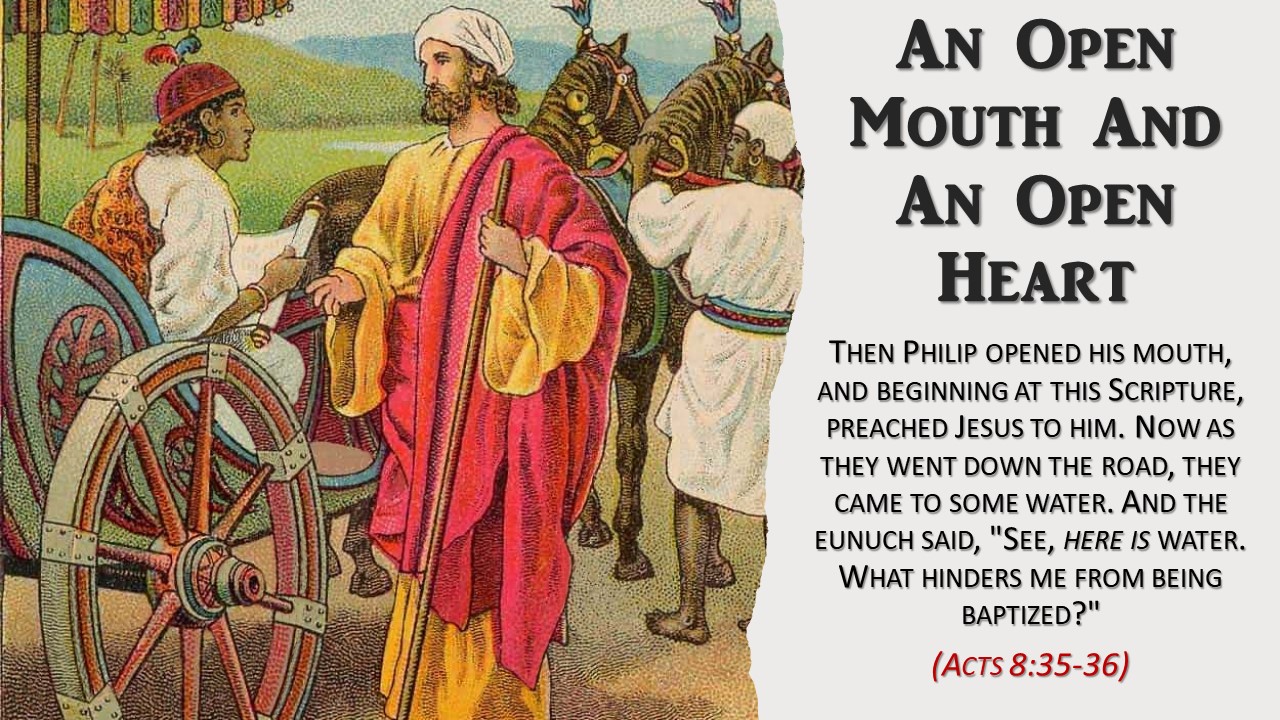

An Open Mouth And An Open Heart

So Philip ran to him, and heard him reading the prophet Isaiah, and said, “Do you understand what you are reading?” And he said, “How can I, unless someone guides me?” And he asked Philip to come up and sit with him. The place in the Scripture which he read was this: “He was led as a sheep to the slaughter; and as a lamb before its shearer is silent, so he opened not his mouth. In his humiliation his justice was taken away, and who will declare his generation? For his life is taken from the earth.” So the eunuch answered Philip and said, “I ask you, of whom does the prophet say this, of himself or of some other man?” Then Philip opened his mouth, and beginning at this Scripture, preached Jesus to him. Now as they went down the road, they came to some water. And the eunuch said, “See, here is water. What hinders me from being baptized?” Then Philip said, “If you believe with all your heart, you may.” And he answered and said, “I believe that Jesus Christ is the Son of God.” So he commanded the chariot to stand still. And both Philip and the eunuch went down into the water, and he baptized him. (Acts 8:30-38)

An Open Mouth And An Open Heart

Stories of conversion are divine testimonies to the changing power of the word of God. There is nothing more thrilling to read than the manner the gospel moves in a man’s heart to accept the mercy and grace of God and the forgiveness of sins. Luke fills the Acts of the Apostles with story after story of first-century converts from three thousand in Jerusalem to towns and cities throughout the Roman Empire. Multitudes of men and women believe and obey the call of redemption through Jesus Christ. Evangelists like Phillip, a man full of faith, face the onslaught of persecution with the courage to go everywhere preaching the word. An angel of the Lord tells Phillip of an opportunity to teach a man from Ethiopia returning to his home after going to Jerusalem to worship. Phillip finds the Ethiopian along the road which goes down from Jerusalem to Gaza.

The man of Ethiopia was a person of great authority under Candace, the queen of the Ethiopians, who had charge of her treasury. He was a man of faith who believed in Jehovah God and spent many hours examining the scriptures from prophets like Isaiah. As the Ethiopian is reading Isaiah, Phillip approaches the chariot and asks him if he understood what he was reading. The treasurer was eager to have someone explain the text to him, and he invited Phillip to join him in his chariot. Sitting together with the scroll of Isaiah open before them, the evangelists opened his mouth and taught the Ethiopian the story of Jesus Christ. The record does not say how long they talked. As the story of the suffering servant opened up before the Ethiopian, his heart began to open to a message he had never heard before, and it thrilled him to his soul. Phillip told the story of Jesus of Nazareth, a man attested by God by miracles, wonders and signs, and His message of love and sacrifice. The evangelists wove the plan of God’s redemption throughout the scriptures to show that Jesus had risen from the dead and salvation was no longer found in keeping the Law of Moses. Instead, there was a new covenant through the blood of Christ.

There is no record of what Phillip told the Ethiopian, but there are bookends that fill the gap of his message that day. Phillip began at Isaiah 53 and preached Jesus. As the two men sat and talked of scripture, the Ethiopian understood that God now desired men to believe and be baptized. It was the Ethiopian who suggested they stop when they came to some water. His heart had opened to the story of Jesus that commanded water baptism for salvation, and he asked Phillip what hindered him from being baptized. Phillip responded the only thing at that point was to believe with all the heart the word of God, and the Ethiopian agreed. So the Ethiopian commanded his chariot to stop, and he and Phillip went down into the water, and Phillip baptized the man from Ethiopia.

The story of the Ethiopian treasurer is one of an open mouth teaching a man with an open heart. An angel sent a man to teach a lost sinner. The angel did not teach the man. In the plan of salvation, men must teach men. No divine being will come to earth to save a man. Later, Jesus would appear to Saul of Tarsus, but Saul was not saved until a man came to teach him the word. Cornelius was told by an angel what to do to have words of salvation. He sent to Joppa for Peter, and the apostles came and taught the household the word of God. Evangelism requires an open mouth willing to find opportunities to teach others.

Through the grace of God, an open heart will be receptive to the word of God. There could have many arguments the Ethiopian could have used to dissuade the teaching of Phillip about the Christ. It was the open heart of the man from Ethiopia to accept that he was the subject of Isaiah. In the story of Jesus, Phillip told the Ethiopian that he must be born again in the waters of baptism. The man from Ethiopia embraced the necessity of baptism without reservation. He commanded the chariot to stand still, and he wanted Phillip to baptize him immediately. The Ethiopian went on his way rejoicing because he was a Christian, bound to Christ through the waters of baptism. An open mouth taught an open heart, and that is where stories of conversion come from. Thank God for open mouths and open hearts.

Posted in Uncategorized | Leave a comment

Right God. Wrong God.

And in Lystra a certain man without strength in his feet was sitting, a cripple from his mother’s womb, who had never walked. This man heard Paul speaking. Paul, observing him intently and seeing that he had faith to be healed, said with a loud voice, “Stand up straight on your feet!” And he leaped and walked. Now when the people saw what Paul had done, they raised their voices, saying in the Lycaonian language, “The gods have come down to us in the likeness of men!” And Barnabas they called Zeus, and Paul, Hermes, because he was the chief speaker. Then the priest of Zeus, whose temple was in front of their city, brought oxen and garlands to the gates, intending to sacrifice with the multitudes. But when the apostles Barnabas and Paul heard this, they tore their clothes and ran in among the multitude, crying out and saying, “Men, why are you doing these things? We also are men with the same nature as you and preach to you that you should turn from these useless things to the living God, who made the heaven, the earth, the sea, and all things that are in them, who in bygone generations allowed all nations to walk in their own ways. Nevertheless, He did not leave Himself without witness, in that He did good, gave us rain from heaven and fruitful seasons, filling our hearts with food and gladness.” And with these sayings, they could scarcely restrain the multitudes from sacrificing to them. (Acts 14:8-18)

Right God. Wrong God.

The missionary journeys of Paul, Barnabas, and Silas established many churches and brought many souls to Christ. Their preaching was forceful and plain, and often facing persecution for the clarity of their message. Paul preached to Jews and Gentiles, often teaching in Synagogues and the marketplaces. With the accompanying signs of the Holy Spirit, Paul opened the word of God with proof of divine inspiration showing powers no man could do. These miracles confirmed the word bringing people to know the gospel. But the miracles did not always get the desired result, with people seeing the working of the Lord God and coming to see the saving power of Christ.

In the city of Lystra, a city of Lycaonia, a man who had been crippled in his feet since birth sat begging. Paul took any opportunity to preach to a crowd, and during one of those times, he observed the lamb man listening intently to his message. Few in the crowd took notice of this nobody among them. He had been forgotten by society as a cripple with little regard for his existence. He caught the eye of the apostle, who could tell this man was hungering for the truth. As Paul examined the man, he could tell he had the faith to be healed. He cried out to the crippled man from birth to stand up straight on his feet. And he did. This astonished the multitude to see a man crippled from birth immediately standing and walking and leaping about with joy. A great miracle had been done through the power of God. Paul had shown the city of Lystra something they had not seen before. What they witnessed was a sure testimony of Jesus Christ. What they did was not.

Seeing the man leaping about, the people raised their voices praising the power of the gods that came in the likeness of men. Instead of giving honor to God the Father, the people worshiped Paul and Barnabas, calling them gods. Barnabas, they called Zeus, and Paul, Hermes. The priest of Zeus brought oxen and garlands to the gates to offer sacrifices with the multitudes. Everyone in the city came to sacrifice to the gods in human form for the wondrous miracle that was done. The man who had been healed was ignored, and attention was given to Paul and Barnabas. While the festivities were going on, Paul and Barnabas tore their clothes, running in among the multitudes trying to stop the people from worshiping them. Paul pleaded with them to turn from the useless things to the living God and know the gospel of Jesus Christ. It was to no avail. The people would not listen. Paul and Barnabas could scarcely constrain the people. Shortly afterward, Jews from Antioch and Iconium came and dissuaded the crowds, who then took Paul out of the city, stoning him and leaving him for dead. One moment they worship him as Hermes, and the next, they are killing him.

The right God was shown to the people who embraced the wrong god. Paul would survive his stoning – not because he was a god – but through the providence of the true God. The evidence was clear and demonstrative for the city of Lystra to know the living God. A miracle of unparalleled power was done, and all they could see was the work of the wrong gods. The man had been crippled from birth, and everyone in the city knew this fact. No one could have imagined how such a man could be healed in an instant. When Paul spoke to him (without touching him), and the man stood and leaped about, the multitudes should have bowed on their knees to praise the work of the one true living God. Instead, they hardened their hearts and gave glory to their useless gods. When the Jews from Antioch and Iconium came and persuaded the people Paul was not a god, they stoned him.

There is an incredible amount of evidence of the one true God. Throughout the universe and the known world, the handprint of the Creator is everywhere. Creation testifies to a Creator. The Bible exalts the word of God as divine. No book has ever matched its power and glory, and no doctrine or faith will merit consideration compared to the Bible. The New Testament church is the kingdom of God ruled by His Son as King of Kings and Lord of Lords. No kingdom is greater than the church belonging to Christ. The message of the resurrection is the greatest miracle in the history of humanity and the redemption through the Son of God the greatest hope. Everything man needs to find eternity is found in Jesus Christ’s message, yet men still reject him for their own gods. Those gods can be a false religion, pleasures of the flesh, pride, riches, fame, and the mistaken belief there is no God. When the final day of judgment comes for all men, there will be two things known to all: the right God and the wrong God. Which one do you serve?

Posted in Uncategorized | Leave a comment

Spirit Fruit: Self-Control

But the fruit of the Spirit is love, joy, peace, longsuffering, kindness, goodness, faithfulness, gentleness, self-control. Against such there is no law. (Galatians 5:22-23)

Spirit Fruit: Self-Control

There are a lot of members of the “Self” family. Self-abnegation, self-complacency, self-conquest, self-deception, self-defense, self-denial, self-esteem, self-interest, selfishness, self-love, self-reliance, self-respect, and a host of other cousins of the grandfather of all, Self. The word implies controlling the emotions, impulses, and actions of the human spirit. One of the most challenging of the self characteristics is self-control or self-restraint. Shannon Fife said self-restraint is “feeling your oats without sowing them.” The New Testament defines the word as “having power over oneself, temperance, and self-mastery.” The final fruit of the Holy Spirit is self-control and yet one of the essential virtues of the Christian life.

Sin derives its nature from the lack of self-control. Eve was tempted to eat the fruit, but the sin was not in the temptation. The tragedy came when she saw the fruit was good to eat and to make her wise, and she refused to stay her feelings. It was not reckless abandonment as some may view sin, but because of her lack of self-restraint, she disobeyed the command of God. Sin was the fruit of her lack of self-control. Eating the forbidden fruit was a sin derived from a failure to control the impulses of the human spirit leading to the fall of man. Centuries later, Jesus would die as a man who completely controlled his emotions and desires and yet without sin. The epitome, perfection, and example of the Son of God was His ability to control self by the fruit of the Holy Spirit fully.

Paul describes self-control as a fruit of the Holy Spirit. It is not an easily mastered art in the human soul. Trying to rein in the emotions of a volatile spirit requires divine assistance. Exercising control of the human spirit without the Holy Spirit is trying to stop a runaway horse without a rein. It cannot be done. The strength and appeal of a sinful life is the lack of self-control. There are no boundaries when there is no control. Living in the Holy Spirit breaks the uncontrolled spirit of passion to be conformed to the image of Jesus Christ. A gentle spirit comes from a spirit under control. Showing love, joy, peace, longsuffering, kindness, goodness, and faithfulness is a fruit of the Holy Spirit measured by the power of self-restraint. Without self-control, love becomes hate, joy turns into fear, peace is turned into war, and so forth. All of the attributes of the works of the flesh come from the lack of self-control, such as sexual immorality, idolatry, hatred, outbursts of wrath, and selfish ambitions.

Self-control comes from righteousness and the knowledge of judgment to come. Doing those things that are right in the eyes of God will diminish the desire to serve self. Understanding there will be consequences to actions and emotions left unprotected, the heart will find strength against unrestrained spirits. The fear of punishment is a powerful inducement to measure the actions of self against the wrath of God. From the Holy Spirit, the fruit of self-control keeps the soul safe from the wiles of the devil. Self-control is a learned experience requiring great patience and a willingness to seek the help of the Divine. As a fruit of the Holy Spirit, self-control becomes a badge of identity for the Christian. It is the strength of divine power that controls the passions of the flesh, the lust of the eyes, and the pride of life. The lack of self-control can only be blamed on one person: self. God’s final judgment is very personal because the only person being judged is self – not a neighbor, friend, or family member. When all humanity gathers for the final day of judgment before the throne of the Lord God, everyone will be standing alone with self to answer for self and whether or not self-controlled the right person. How are you doing self?

Posted in Uncategorized | Leave a comment

The Humility Of Job

Then Job answered the Lord and said: “I know that You can do everything and that no purpose of Yours can be withheld from You. You asked, ‘Who is this who hides counsel without knowledge?’ Therefore I have uttered what I did not understand, things too wonderful for me, which I did not know. Listen, please, and let me speak; You said, ‘I will question you, and you shall answer Me.’ “I have heard of You by the hearing of the ear, but now my eye sees You. Therefore I abhor myself, and repent in dust and ashes.” (Job 42:1-6)

The Humility Of Job

If there is one man in scripture that is the definition of suffering, courage, faith, and patience, the man Job is at the top of the list. The Holy Spirit dedicated more than ten thousand words to tell his story. It began with a conversation between the Lord God and Satan. The story ends with a conversation between the Lord God and Job. In between the two bookends is a sad story of loss, grief unimaginable, suffering almost unbearable, and the counsel of friends that often was misguided, cruel, judgmental, and without mercy. Quietly sitting with the four older men was a younger man with deeper counsel and spiritual insight. As an epic drama, the book of Job is poetic yet formed as a debate on the character of God and the plight of man. No final analysis is derived from the discussions, but God is recognized as omnipotent, omniscient, full of justice, righteousness, and truth. One of the great mysteries of the book is while the calamity of events that came upon Job and his family were enormous, nothing is presented at the end of the story where God explains why those things that occurred to Job happened. And Job never asked. It did not matter. He trusted in God.

Job’s faith struggled. He did not quietly take the loss of his family and his health without bemoaning his birth, his place in life, and the unfair counsel of his friends. The faith of Job sought to argue with God – with respect – but argue nonetheless. He persistently appeals to God for help, answers, guidance, and mercy. When the friends ceased answering Job, Elihu spoke up in anger. His wrath was because Job justified himself rather than God, and Elihu was also angry with Job’s three friends, for they made God appear to be wrong by their inability to answer Job’s arguments. When Elihu finished, the Lord took up the baton against Job telling him to stand up and face the Creator’s wrath and a righteous God. The Lord’s rebuke was a blistering barrage of righteous indignation. It moved Job to say he was vile and worthless. The rebuke continued. Finally, at the end of the Divine declaration, Job realized his folly and sought the kind mercy of the Lord God, seeking His love filled with a heart of repentance.

It is hard to debate the voice of God proceeding from a whirlwind. Job did not try to excuse himself. He did not blame his three friends. His plight was not something he could seek mercy from God as a pitiful man of no degree. The voice of defiance was never heard. His heart was not filled with anger at God. There were many emotions Job could experience when it all came to an end, but the one thing Job possessed was a heart of humility. He did not understand why everything that happened to him came about. His friends were not evil men. They had tried to comfort their friend with whom they had sat for a week in silence. Human wisdom failed, but those three friends were there with Job, and that mattered to him. They brought some comfort because of their presence. Job appreciated the wisdom of youth as he listened to Elihu, a daysman sent by God. Foremost, the man from Uz heard the voice of God as he had never heard before. He knew he was in the presence of the Almighty. He approached God with a humble heart.

The catastrophes that happened to Job would destroy most men. He learned patience and humility. Job acknowledged that he was not in a place to accuse God. His heart was filled with remorse not to have greater faith and trust in the presence of his heavenly Father. Bad things happen to people, and God still rules. Long after Job died, the Son of God came and suffered more than Job could imagine. Where was God when His Son was being tortured? The same place He was when Job was suffering. The humility of Job came from a character of suffering to trust in God and His will – whether he understood the answers or not. Job said he spoke what he did not understand, and he repented. As Job looked back over the conversation with his friends, he was ashamed because he had not given glory to God. Humility begins by saying, “I know that You can do everything and that no purpose of Yours can be withheld from You.” That is a heart subject to the will of God in the face of bearing a cross for Jesus Christ.

Posted in Uncategorized | Leave a comment

Hard Preaching

Then Jesus spoke to the multitudes and to His disciples, saying: “The scribes and the Pharisees sit in Moses’ seat. Therefore whatever they tell you to observe, that observe and do, but do not do according to their works; for they say, and do not do.” (Matthew 23:1-3)

Hard Preaching

The Sermon on the Mount is one of the most famous sermons in history. It is a hallmark of the teaching of Jesus as a collection of teachings foundational to the ministry of Jesus. Great multitudes came to hear the man from Nazareth, and when His disciples came to Him, Jesus opened His mouth and delivered the preamble of the Christian constitution that would define the kingdom of God. There would be many times in the short span of His ministry, Jesus would gather disciples around Him and expound on the mysteries of the coming kingdom. His popularity brought criticism, envy, and a concerted effort by the Jewish leadership to discredit and destroy Him. The religious sect of the Pharisees and the scribes were the harshest critics of Jesus, often trying to trap Jesus in His teaching. When Jesus finished the sermon on the mountain, the people were astonished at the authority of Jesus, for He taught them as one having authority and not as the scribes. The popularity of Jesus was high at the beginning of His ministry, but that would change in just a few years.

In one of His last public discourses before His crucifixion, Jesus spoke to the multitudes and His disciples of the influence of the scribes and Pharisees. This sermon would be the antithesis of the sermon delivered on the mountain, at least in character. While the sermon mountain was challenging and thoughtful, the message in the temple courts would be a harsh, stinging rebuke of Jewish hypocrisy. Jesus knew His hour had come to glorify the Father. He knew He would be killed from the envy of the Jewish leaders who wanted Him dead. The scribes and Pharisees would be glad to be rid of the man from Nazareth, but Jesus had one last message to the people about the Jewish leadership. The sermon of Jesus is one of the harshest, brutal, severest criticism of their hypocrisy. It is a message that resonates with the wrath of God.

Jesus warns the people to reject the example of the Pharisees and scribes. He recognized the harsh treatment the leadership burdened the people with and revealed their motives as self-serving. Pride exalted the hearts of the scribes to seek the honors of men and glory of power. They were not interested in the welfare of the people but in their own pockets filled with money. Jesus would call them hypocrites, blind guides, fools, serpents, brood of vipers, and murderers. His language was plain and unyielding. He charged them with loving the best places and greetings of human glory and to be called by titles. The Pharisees and scribes bound heavy burdens on the people to fill their coffers. They traveled land and sea to make a proselyte and made him twice as much a child of hell as themselves. He calls the leaders whitewashed tombs which appear beautiful outwardly, but inside are full of dead men’s bones and all uncleanness. They seemed to be righteous to men but inwardly were hypocrites and lawless—hard preaching.

There is a false image of Jesus Christ that He was never critical or harsh toward others. This is contrary to the doctrine of God, who is full of goodness but also filled with wrath against those who refused to obey Him. Jesus preached powerful lessons and sermons on love, grace, mercy, and truth. The Son of God also addressed the sins of the world and especially those found among His own people. There is a time for hard preaching when the subject matter is hardened hearts. The scriptures will bring joy and hope to the pure in heart, and the same word will bring judgment and condemnation to those who will not submit to Christ. Harsh preaching is not done in spite but in the holiness of the character of God who demands righteousness without hypocrisy. There will be a judgment, and all men will find the goodness and severity of God. To those who abide in the word of God, there will be a blessing. For those who reject the Lord, severity. That is the message of preaching the gospel of Jesus Christ.

Posted in Uncategorized | Leave a comment

Give Attention To The Whole Body

My son, give attention to my words; incline your ear to my sayings. Do not let them depart from your eyes; keep them in the midst of your heart; for they are life to those who find them, and health to all their flesh. Keep your heart with all diligence, for out of it spring the issues of life. Put away from you a deceitful mouth, and put perverse lips far from you. Let your eyes look straight ahead, and your eyelids look right before you. Ponder the path of your feet, and let all your ways be established. Do not turn to the right or the left; remove your foot from evil. (Proverbs 4:20-27)

Give Attention To The Whole Body

Serving the Lord takes the whole body. The wisdom literature weaves a beautiful picture of the man of God consumed by the word of God. He shows the importance of keeping wisdom at the forefront of life to guide the heart, protect the eyes, fill the ears, correct the tongue and examine the path of the feet. All of the body working together to harmonize the soul to the will of the Father is where the perfection of character is found. It begins by paying attention to what the Lord says. God has spoken to man from the beginning of time, and the problems arise when men stop listening to His word. Satan began his attack on Eve by challenging what God said. Listening carefully to the words of the Lord will bring health and joy to the soul. The ear must tune to the right things. Wisdom must always be before the eyes. The heart keeps the word of God in the midst of the soul penetrating deep with the grace of the Lord. This is where true life comes from. It glorifies the Father as the whole body bends to the will of the Lord. Health is found in the nourishment of the Divine.

The character of a man comes from what is found in the heart. Jesus would later tell His disciples that everything that comes out of the mouth is first found in the heart. Good water comes from good springs, and good words come from good hearts. Evil comes from an evil heart. Adultery, murder, envy, and hatred do not grow from soil fertile in the love of God. The heart is the soul’s barometer, and if it is not guarded carefully, life will end in heartache. Wisdom is found in keeping the heart with all diligence. It requires daily care to manage the heart and the courage to daily measure the heart with the word of God. The issues of life come from the heart and goodness, or evil will come from a good or evil heart. Giving attention to the heart determines the course of life.

Keep the heart with all diligence by training the mouth, perfecting the eyes, and watching the feet. The mouth must refrain from perverse talking and corrupt speech. Deceitful tongues are filled with poison that gossip, murmur, and defraud. Anger can bring sin. Lying is a grievous abomination before the Lord. A heart guided by the word of God will learn to control the tongue and become a measure of blessing to hearers. The focus of life is found when the eyes are looking straight ahead, fixed on the Father’s will. God created the body with the perfection of form for the eyes to look ahead so the feet would not stumble. Pondering the path is done when life is marked out by the word of God, seeking how the Lord wants a man to live. Staying on the safe path of righteousness brings happiness. There can be no deviation to the right or the left. God’s word is sure, trustworthy, steadfast, and will bring a man to the throne of God. Changing direction or seeking another path will not bring a man to the throne of God.

It takes the whole body to work together to bring harmony. In the spiritual world, the ears must listen to the word of God, the eyes looking to Jesus, the heart attuned to the Father, the mouth guarded with grace, lips seasoned with salt, eyes looking straight ahead, and the feet on the narrow way of truth and righteousness without variance. When the whole body, working together under the guidance of the Father’s will, conforms to the desires of God, joy, and happiness are found in this life and the life to come. Good health is essential, but good spiritual health is eternal.

Posted in Uncategorized | Leave a comment

I Am God

Look to Me, and be saved, all you ends of the earth! For I am God, and there is no other. (Isaiah 45:22)

I Am God

There is no God like the Holy God of the Bible. Many gods appeal to human wisdom like Zeus, Ganesh, Kali, Buddha, Indra, and Odin. In the days of Israel, as they struggled against the tide of idolatry, Ashtoreth, Baal, Chemosh, and Dagon were the gods of choice. The Lord warned His people when they came into the land of Canaan to destroy the people of the land lest they pollute them with their idolatry. History was fulfilled in the people’s disobedience to follow after the gods of the nations around them to destroy the nation. Assyria brought their gods of Ashur, Ishtar, and Shamash and defeated the northern tribes. The Assyrians did not understand that the God they fought against allowed them to conquer His people to serve His purpose. Nebuchadnezzar came with the Babylonian gods of Marduk and Nergal and defeated the tribes of Judah and Benjamin. The king burned the Temple of God and destroyed the city of Jerusalem. He believed it was his power that brought Israel to its knees, knowing nothing about the plan of God to use him to punish His people. Yahweh, the God of the Hebrews, permitted the Assyrians and the Babylonians to inflict great harm to His people to serve His design and purpose.

Isaiah prophesied during the turbulent days of the Assyrian onslaught against the northern tribes. The social evils abounded under the rule of Ahaz, king of Judah, with some respite with Hezekiah becoming king. Isaiah announced the destruction of Jerusalem that would be accomplished in 586 B.C. Like the other prophets, Isaiah preached a message of repentance to a godless and unrepentant nation. The appeal of Jehovah was for the people to turn away from the gods of men and seek His grace and mercy. Throughout the book of Isaiah, the prophet declares the character of God as being like none other. The idols worshiped by the people could not save them. They were blind and dumb and powerless. Idol worship was folly because no idol could speak or hear and save the one who worshiped it. The Lord God was a God who created the light and darkness, made peace and brought calamity, created the heavens, and could tell the future. No other god could do what the true God could do. There was none like Him.

The appeal of Jehovah God has always been for men to seek Him and be saved. There is no other way a man can save himself. The gods of men have never saved. Seeking after the wisdom of men, the economies of humanity, and the pleasures of the flesh will not bring happiness. Only by the power of the One who formed man from the dust of the ground will a man find the reason for his existence and purpose in life. The Lord begs men to see Him to be saved because He alone is God, and there is none beside Him. All the gods of men have failed. They are mere totems of the whims of human wisdom made of sand. The Lord brings nations into power and removes them by the measure of His hand. Despots rise and fall at the word of the Lord. Woe to him who argues with his Creator. Isaiah says it’s like a clay pot arguing with its maker. There is no God like the God of the Bible that made the heavens and earth, worked His will among the affairs of men, and sent His only begotten Son to die for all men. Who can compare? There is none like Him.

Posted in Uncategorized | Leave a comment

Just One Thing

Now as He was going out on the road, one came running, knelt before Him, and asked Him, “Good Teacher, what shall I do that I may inherit eternal life?” So Jesus said to him, “Why do you call Me good? No one is good but One, that is, God. You know the commandments: ‘Do not commit adultery,’ ‘Do not murder,’ ‘Do not steal,’ ‘Do not bear false witness,’ ‘Do not defraud,’ ‘Honor your father and your mother.'” And he answered and said to Him, “Teacher, all these things I have kept from my youth.” Then Jesus, looking at him, loved him, and said to him, “One thing you lack: Go your way, sell whatever you have and give to the poor, and you will have treasure in heaven; and come, take up the cross, and follow Me.” But he was sad at this word and went away sorrowful, for he had great possessions. (Mark 10:17-22)

Just One Thing

When all men stand before the Lord, there will be things that are found hindering salvation. For some men, the list is legion. Others may have only a few things that prohibit grace from being extended for eternal glory. Imagine the dismay of the young man who came to Jesus seeking eternal life and, because of one thing, turned away from the only hope he would find in this life. It is clear the young man’s motivation was to find what all men long for, and that is eternal life. His question was right, and he was asking the right person. For all reasons, it can be accepted the young man was a devout Jew who kept the law. He had not been guilty of adultery, murder, stealing, bearing false witness, and defrauding any man. His parents were blessed with such a noble and righteous son. In every part of his life, he had perfected the role of the Hebrew to be a model of integrity and a holy character.

The disciples will give a glimpse into how men like the rich young man were viewed. They were surprised he could not be saved as Jesus exhorted. They were astonished at the teaching of Jesus. Incredulously they asked if this young Hebrew could not be saved, then who could find true salvation. The problem lay deeper than what was seen in the external evidence. Jesus had looked into the heart of the young man and found a troubling spirit that was filled with covetousness. In every part of the law, the young man had been diligent as any devout Jew could be, but there was one thing and one thing alone that hindered him genuinely serving the Lord in purity and holiness. He loved his wealth more than God. His wealth came through the blessings of the Father, but the young man had fallen in love with his possession more than loving God. On the outside, he looked like the epitome of what a child of God would look be.

Lacking one thing would have been a sign of how well the young man had given his life to serving God, but the one thing he lacked became the albatross of his eternal demise. Because of one thing, he turned away sorrowful, refusing to obey Jesus. One thing. He had only to remove one thing in his life, and it would have been complete and whole before God. Eternal life hinged upon one thing, and he could not let go of the one thing. For many, having one thing to accomplish to gain eternal life would have been a dream. He only had one thing to do. It was a powerful force in his life. His riches were the one thing that kept him from eternal life. Riches were not sinful, but the desire to be rich is what condemned him. Jesus told him to sell all he had and give to the poor. He could not sell half or part – it required all before he could follow Jesus. This one thing he could not do. It was only one thing. One.

The greatest tragedy came when the young man died and faced Jesus again. When that time came, Jesus did not tell him he lacked one thing. It was too late for any change. The decision to keep the one thing had now brought him before Jesus the second time. He wanted to know what he must do to gain eternal life, but in death, no questions were seeking the truth. The young man knew all the truth that had to be known. Because of one thing, he knew he was lost. All the riches he held so tightly slipped from his fingers as death overcame him. Nothing he treasured in this life came with him into eternity. The one thing he gave his life to retain was ripped from his dead fingers. Now, what of the one thing? Sadness filled his heart as he realized too late that one thing had kept him from eternal life—one thing. Despair turned to terror. He had lived an exemplary life as a devout Jew hanging on to his riches. The one thing he loved more than God condemned him.

You may have one thing that keeps you from serving the Lord. It may be a refusal to obey His word because of your parents, grandparents, friends, or family. Like the rich young ruler, your heart may be so immersed in the world you cannot let go, and the one thing you enjoy now will be taken away in death. Consider this somber reminder of the rich young ruler. He kept the one thing in his life, and in his death, he regretted holding on to the one thing. It condemned him to eternal fire and torment. How sad to see him crying out in torment – for one thing. What is your one thing?

Posted in Uncategorized | Leave a comment

The Eyes Of The Lord

The eyes of the Lord are in every place, keeping watch on the evil and the good. (Proverbs 15:3)

The Eyes Of The Lord

It takes a beam of sunlight 490 seconds at the Sun’s closest distance to reach earth and seventeen seconds longer at its farthest distance. The earth is dwarfed by the size of the Sun, but at its greatest peak, the Sun can only shine upon half the earth. While one part is full of sunshine, the opposite side is cloaked in darkness. Much of the land bathed in sunlight is hidden in the darkness of mountains, deep valleys, and caves. The brilliance of the Sun only penetrates less than 50% of the earth’s surface. There are limitations to the ability of man to see around the world. The sphere of the earth’s surface only allows man to see about two to three miles with the human eye. Eagles and other birds of prey can see four to five times farther than the average human can. Technology can help men see further, but limitations remain because of the nature of the earth’s globe.

It is impossible to fully appreciate or understand the knowledge that God can see in every place. Part of the problem rests in the inability of the human mind to grasp the concept of a Being that can see a child in China eating rice and at the same time watch a woman in Glasgow, Montana deliver mail. Two opposite geographic points are six thousand miles apart, and God sees everything simultaneously with no deviation or blurring. He is God. His omniscience is testimony to His character and power. In the thousands of years of human existence, there has never been a time when man could match the all-seeing eye of the Creator. The Lord saw Cain kill his brother Abel. Abraham lied about Sarah being his wife, and God heard him. David tried to cover up the murder of Uriah following his adultery with Bathsheba, but the Lord knew everything. Jesus told Nathanael He saw him sitting under the fig tree. The Lord God is in every place at all times.

There is bad news for those who seek to hide their actions from the Lord. The eyes of the Lord are watching everywhere and seeing what the wicked do and what they say. No man will escape the judgment of God because He knows everything an evil man has done, what he has said, how he has cheated others, and what he has tried to hide. Everything done in darkness is done in the light of God’s eyes. Judgment is complete for all men because it sees everything all men do. If a person is condemned to perdition, it is because of the full knowledge of God seeing what they have done (or not done). The righteousness of God is determined by His ability to see everything and in every place. Whatever sin goes unpunished in this life will not be forgotten by the eyes of the Lord in eternity.

The good news for the righteous is the eyes of the Lord are in every place, seeing the glory His people give Him. There is a sense of trepidation to know God sees everything, but it is an invitation of inquiry, investigation, and examination for the man of holy character. There is nothing to be hidden. The pang of failure will always be present in sinful man, but through the grace of God, He sees the good in the heart and a willingness to be faithful. No child of God (without exception) is forgotten by the Father. Whatever trials a Christian may endure in Vietnam is known to the same God that sees the troubles of His faithful people in Nicaragua. The ever-present eyes of the Lord are a blessing to know He sees, He cares, He desires, and He longs to help His children. It can seem like a cold and dark world where no one cares. This will not be the case for the people of God who look up into the heavens and declare the omniscience of a loving God who knows everything about them. What a glorious thought. How inspiring to believe in God’s love.

The eyes of the Lord are in every place, keeping watch on the evil and the good, and that is good, and that is bad. There is glory for those who open their hearts to the eyes of the Lord. Suffering and horror will come to those who try to hide from a God that cannot be hidden and will not be hidden from. No mountain top or valley deep will hide man from the eyes of the Lord. The deepest oceans are drops of water compared to the vision of what God sees. Darkness is as bright as the Sun to the eyes of God. He sees everything. What does He see in your life? One day it will matter when eternity begins what the eyes of the Creator have seen. Let Him see your heart in obedience to His word and your life in faithful service to His Son, Jesus Christ. Open your eyes and see God.

Posted in Uncategorized | Leave a comment

The Doctrine Of Hell

Then He will also say to those on the left hand, “Depart from Me, you cursed, into the everlasting fire prepared for the devil and his angels.” (Matthew 25:41)

The Doctrine Of Hell

Eternal damnation is not a popular subject. Statisticians try to quantitate the beliefs of humanity about Hell, but the reality since the beginning of time is that accepting a consequence to sin has never been popular. The early world of Noah proves that all but eight people accepted the teaching of divine judgment. Critics point out that the Old Testament seldom refers to Hell, yet men like Abraham, Moses, David, and Daniel were moved to live righteous lives. If there were no consequences to sinful lives, why live holy lives? The Hebrew writer pointed out that faith believes God is, and He is a rewarder of those who diligently seek Him. What if a man does not seek God – is there a punishment? Hell is a Bible doctrine from beginning to end.

What is remarkable about the doctrine of Hell is the preacher of righteousness that said more about Hell than any other character in the Bible is Jesus Christ. Noah would have been a good choice considering the world he lived in. The prophet Amos is a frontrunner for fire and brimstone, and John the Baptist was man with a clear purpose in address the hypocrisy of the Jewish leaders. Paul wrote most of what is preserved in the New Testament, but his writings do not carry as much information about Hell as the words of Jesus. The doctrine of Hell is real because Jesus is real. If 48% of the population believes in Hell, that means only 48% of the people believe in Jesus. Whatever the number is, to deny the doctrine of Hell is to deny the word of Jesus Christ. Most polls show many people believing in Heaven, yet on the same study, most deny Hell. The contradiction is enormous.

Whether a person believes and accepts the doctrine of Hell is immaterial to its reality. It is imperative to embrace the idea of eternal torment because, according to Jesus, most people will be cast into outer darkness where there is the weeping and gnashing of teeth. That is a hard lesson to consider and not readily accepted. Why are most people going to Hell? Most people deny the word of God. Rejecting the Bible as the word of God will judge a man to perdition. Refusing to believe Jesus is the Son of God condemns a person to eternal damnation. Not doing the will of the Father will send most honest people to the lake of fire. Hell will be filled with fornicators, idolaters, adulterers, homosexuals, sodomites, thieves, drunkards, extortioners, liars, murderers, and all those who deny the authority of Jesus Christ as King and Lord. Jesus told the eleven to preach the gospel to every creature under heaven, and those who refused to be baptized would be judged with eternal damnation or condemned.

If Hell is not real, why did Jesus die such a miserable death? What did He come to save man from if there is not a judgment of condemnation waiting for the unbelieving, unrepentant, and unloving? The doctrine of Hell is as real as the hope of Heaven. There is a type of fear that convicts men of sin, and Hell would be one of those fears. Salvation is not gained through fear of Hell. The hope of Heaven is found in the grace of God to remove His wrath from the predicament of man. Jesus preached a lot on Hell to show how much His Father loves humanity. The cost of eternal life comes through the price of obedience. Hell is real. Jesus said so more than any other man. Believe in His words and obey His word. Heaven waits.

Posted in Uncategorized | Leave a comment