Things Improper For God’s Children

But fornication and all uncleanness or covetousness let it not even be named among you, as is fitting for saints; neither filthiness, nor foolish talking, nor coarse jesting, which are not fitting, but rather giving of thanks. For this you know, that no fornicator, unclean person, nor covetous man, who is an idolater, has any inheritance in the kingdom of Christ and God. (Ephesians 5:3-5)

Things Improper For God’s Children

Certain things should never be part of the Christian’s life. This has always been true how a child of God should live separate from the world’s influences. Saints are those who are in covenant with God through the blood of Christ, living above the standards of the world. It is not uncommon for the carnal mind to accept fornication as a part of life. Covetousness is an engine that drives the soul to look for happiness in material gain. The lottery is so popular because it is covetousness. Obscenities fill the airwaves, movie screens, social media and have become the language of the world. Foolish talking or coarse jesting is the speech of the worldly mouth engaging in the language of Ashdod. However, the Christian will not accept the standards of the world as their framework for life.

Ephesus was the capital of proconsular Asia. Paul visited the city near the end of his second missionary journey and established a church. There were many things in the city destructive to the character of the first disciples of the church. The Temple of Diana had been prominent in the city, with sexual immorality at the center of the religion. Ephesus was such a wealthy city, they rejected the coffers of Alexander the Great to rebuild the city destroyed by fire and paid for the project out of their own pockets. The background of Ephesus is strong in Paul’s letter to the church at Ephesus. He admonishes them to reject the lifestyle of the Ephesians. Fornication may be acceptable to the Ephesian culture, but no one called a child of God should engage in such immorality. Premarital sex was sinful. No Christian should be accused of such degradation.

Covetousness is the quiet sin that is often overshadowed by perceived larger sins. Ephesus was a town filled with wealth and materialism. Material gain was the goal of a city filled with riches. Everyone lived prosperous lives with an abundance of fine homes, servants, food, wine, expensive clothing, and a couple of Lexus chariots parked out front. Wealth was not the problem. The heart longing for and desiring those things is where sin produced a bumper crop of covetousness. Paul pleads with the Ephesians saints to not be known as greedy, materialistic people in the midst of the dark, sinful world of Ephesus. They were to stand apart from that kind of greed. The saint was also to be distinguished by the nature of his speech. It is easy to fall into the speech of the world to fit in with the world. The saint must change his speech to mold itself perfectly with the language of God. Filthiness, foolish talking, and coarse jesting do not the Christian make.

Paul’s plea is a strong warning. He desires for God’s people not to let those things that defile even be named among the church, as is fitting for saints. This same plea is needed today for Christians to refrain from activities associated with the world that identify them with the world. The people of God (saints) should not engage in sexual immorality. Do not engage in such activity that would bring shame and reproach to the church of Christ. Let the conduct of life (speech especially) be filled with the grace of God and not the language of the world. Paul makes it clear that those who engage in such activities will not inherit the kingdom of God. Engaging in sexual immorality, covetousness, and uncharacteristic speech will damn a soul to hell. The saint does not act that way. They set themselves above the pollutions of the world to be near the heart of God. There are things proper for the child of God, and there are things improper. A Christian makes a distinction.
Posted in Uncategorized | Leave a comment

It Begins With Desire

Then He said to them all, “If anyone desires to come after Me, let him deny himself, and take up his cross daily, and follow Me.” (Luke 9:23)

It Begins With Desire

Carrying a cross would not have been an appealing thought to the first-century disciples following Christ. Crucifixion was a common occurrence. The Romans perfected the craft of slowly killing a man with surgical precision with thousands nailed to crosses all across the empire. Golgotha was a place of crucifixion stinking with the smell of death. Many had suffered the cruel privations of humiliation and torture in the place where Jesus was crucified. The cross of Jesus was a frequently used piece of wood that had the blood of men filling its gaps and crevices. Birds flocked around the place of the skull feeding on the rotting remains of previous criminals left to die. Everything about the picture of crucifixion was a scene of horror, incredible suffering, and intense smells revolting to the nostrils of everyone.

Jesus called me to Him with an appeal to carry a figurative cross. The illusion of the price paid in cross bearing was the cost a man would pay to be a disciple of Jesus. This would not be a matter of choice whether to take up a cross or not. The only way – with no exceptions – to be a follower of the Son of God was to take up a cross daily and follow Jesus. A. W. Tozer explained the price of crucifixion when he wrote, “To be crucified means, first: the man on the cross is facing only one direction; second: he is not going back; and third: he has no further plan of his own.” The sanitized version of this crucifixion has led many to believe they can follow Jesus without taking up a cross. There is not only a price to be paid to be a Christian; it is a high cost. The will of man has become void, empty, and of no worth. Any man who comes to Jesus must empty himself of everything. Taking up a cross demands surrendering the total will.

The picture of the cross is the invitation Jesus used, drawing men to His kingdom. Before the cost of the cross is accepted, there must first be the desire of the heart to bear a cross, experience the suffering of crucifixion, and the willingness to endure until the end. Desire is where it must begin. Jesus said, “If anyone desires to come after Me.” Until this commitment is met, there will be no cross bearing. When the heart is not dedicated to suffering for Christ, they bear a plastic cross with wheels. There is no suffering. A cost has not been paid. The desire is to follow Jesus on the easy path. If there are conflicts involved, the heart is unwilling to comply. Desire is the total dedication of facing Jesus and asking for a cross.

The Romans gave Jesus His cross, but now the Lord delivers His cross to His followers and demands they desire it. Before a man is nailed to the cross of Jesus, he must confess his desire to be crucified. The irony of discipleship is Jesus had no choice when He was crucified and now demands all who come to Him choose to take a cross. That is where desire comes in. God will not force anyone to bear a cross. The cross of the Christian is one taken with a fervent desire to be like their King who suffered on a Roman cross and was without sin. Desire demands a choice. Bearing a cross is the ultimate sacrifice of self. When the desire is lacking, the commitment fails.

Picture for a moment standing at the cross of Jesus and seeing His suffering. As the Son of God dies, Joseph and Nicodemus come and take the body down. You raise your hand and tell the Roman centurion that you would like to be nailed to a cross. He asked you why and you tell him your heart’s desire is to be crucified like the man from Nazareth. The Romans comply. Your desire is fulfilled. Glory to God. Like Jesus was buried and arose, you suffer crucifixion and one day die so that you also can raise from the dead to the glory of the Father. And that was your desire at the beginning.

Posted in Uncategorized | Leave a comment

Kindness Toward The Unkind

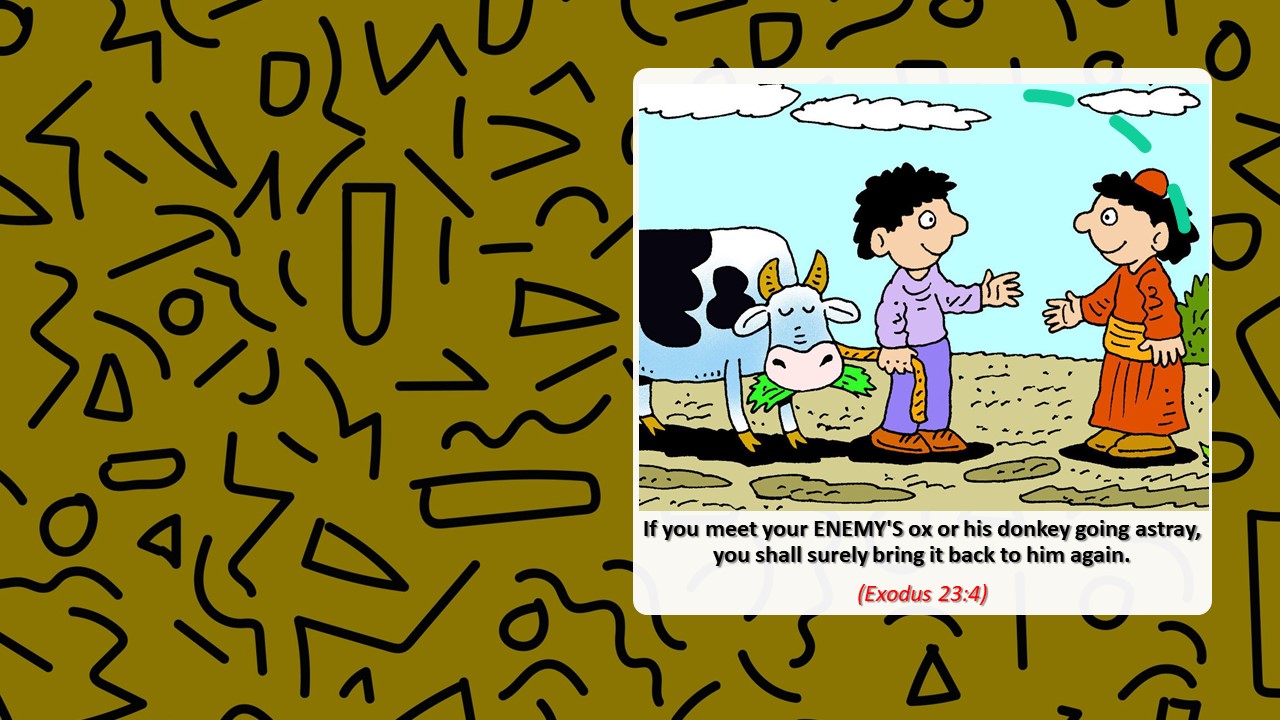
If you meet your enemy’s ox or his donkey going astray, you shall surely bring it back to him again. If you see the donkey of one who hates you lying under its burden, and you would refrain from helping it, you shall surely help him with it. (Exodus 23:4-5)

Kindness Toward The Unkind

An enemy is someone antagonistic to another, seeking to injure, overthrow, or bring harm to another. To have enemies is to know that relationships are strained to the breaking point of anger and hatred. Since the beginning of time, the world has been filled with individuals that seek harm to others and nations that go to war against perceived enemies. Jealousy, envy, strife, and selfishness have led to families becoming enemies of one another, nations dividing into a civil war where brother fights against brother, and among the people of God, friendships deteriorating to hostility (King Saul and David). Among the many commands of the Law of Moses, God required His people to treat their enemies with compassion.

The natural response when a man finds the animal of his enemy going astray is to help it go in the wrong direction or to make sure the animal never returns to its master. That would bring satisfaction of revenge against the one who seeks to injure the person. A man walks down the road and finds the donkey of his enemy collapsed under a heavy load crying out in pain, unable to gain its footing. It would be easy to laugh at the plight of the stricken animal and allow it to die because it belonged to an enemy. That would teach the enemy a lesson and bring pain to him. God forbids the act of vengeance against an enemy. Moses is not writing about good suggestions for learning how to get along with an enemy. What he writes down in the law are commands, judgments, and statutes requiring the individual not to have feelings of hatred toward their enemies.

Using animals as an illustration of compassion shows the depth of love and concern a child of God must have for their enemies. An animal can be abused at the enemy’s expense, but God forbids the child of God to allow such abuse. Two things happen when the law is followed. The animal is relieved, and the enemy is shown compassion. Then animal does not learn any lesson, but the enemy does. This is a character-building and humbling experience. Imagine the surprise on a man’s face when he looks out over the field and sees his enemy leading his ox back to the corral. In an agrarian society, animals are the lifeblood of survival. They are not pets. These animals are necessary for life itself. As a beast of burden, a donkey is a machine to move vital goods to market. Finding a donkey of an enemy lying under a burden could be financial ruin for him. God commands holy people to help the enemy and bring a blessing to the enemy.

Jesus instructs His disciples to love their enemies and do good to them. This is not a new command, but now the example of love for enemies is found in the sacrifice of Jesus Christ. Humanity had gone astray in a rebellious spirit of defiance against God and became burdened with the weight of sin. Like the donkey, which could not lift the burden, sin oppressed the soul of man with no relief. There was no help. God did not look upon humanity with hatred and malice. Mankind was the enemy of God. Make no mistake about the putridity of man’s condition before a righteous Lord. Only through the benevolent love of a gracious God was the burden of sin lifted and man restored to the sheepfold of God. What God did for man is what God demands men do for one another.

The world has a view of enemies that is based on revenge. Anyone who is an enemy deserves all the harm that can be done to be brought upon them with full force. No quarter and no relief. If that were the view of God, the world would have been destroyed long ago. An example of God’s love is how holy people view their enemies. When we were enemies of a righteousness God, we were reconciled to God through the death of His Son. Because God loved humanity (enemies), in Christ, we have been reconciled and saved by His life. In this world, there will be those who seek the harm of God’s people. Let no animosity or hatred spring up in the hearts of those devoted to the love of God. Be kind to the unkind, and you will find the forgiving grace of God.

Posted in Uncategorized | Leave a comment

The Winds And The Sea Obey Him But Not Men

Now when He got into a boat, His disciples followed Him. And suddenly a great tempest arose on the sea so that the boat was covered with the waves. But He was asleep. Then His disciples came to Him and awoke Him, saying, “Lord, save us! We are perishing!” But He said to them, “Why are you fearful, O you of little faith?” Then He arose and rebuked the winds and the sea, and there was a great calm. So the men marveled, saying, “Who can this be, that even the winds and the sea obey Him?” (Matthew 8:23-27)

The Winds And The Sea Obey Him But Not Men

Jesus proved He was the Son of God through the miracles, signs, and wonders He did in the presence of the people. There was never a doubt a miracle happened with the harshest critics of Jesus acknowledging a miracle had taken place. The variety of wonders performed by the hand of the Lord established His dominion over nature, time, distance, quantity, disease, and death. Jesus was not limited by His miracles. He took five loaves of bread to two fishes and fed more than five thousand people. His rising from the dead exalted His place as a divine being sent from the Father. Walking on water was natural for the One who created the seas.

It was a challenge for the peers of Jesus to see Him as anything but a man. Even the disciples of Jesus, while witnessing the power of Jesus to heal lepers, a centurion’s servant (long distance), the mother-in-law of Peter, demon-possessed people, and all who were sick could not grasp the enormity of His power. Peter, Andrew, James, and John were seasoned sailors accustomed to the dangers of the open water. Leaving the multitudes and seeking solitude on the sea, Jesus and the twelve find themselves in a great tempest with waves covering the boat. The Lord is exhausted from His work and has taken refuge on the boat, falling fast asleep. As the storm rages, the Lord sleeps but not so with the twelve. The violence of the storm brought great fear to their hearts believing they would perish. They are so fearful; they wake Jesus to warn Him of the impending doom.

Rising from sleep, Jesus is frustrated with the faith of His disciples. If they had seen the miracles by His hand earlier, what reason would there be to fear a storm? Miracles, signs, and wonders confirm deity, and if Jesus could do all manner of signs, what fear would there be for the disciples who saw Jesus sleeping in the storm. They may not have been able to sleep but looking at Jesus asleep in such a violent storm should have assured them that nothing would happen to them. Jesus arose and rebuked the winds and the sea, and immediately, all was calm. That must have been an incredibly powerful moment from terrifying chaos and impending death to the Sun shining, calm seas, and safety. The twelve stood in awe at the power of Jesus. Why should they wonder who the man before them was, but they did? Who else could calm a storm but the Son of God?

The faith of the disciples had a long process to understand the power of Jesus. Eleven of those terrified men would go on to preach the gospel to the world, and ten would die a martyr’s death. They were unsure how powerful Jesus was, but they learned there were no limitations to His power. Belief overwhelmed them when they saw the miracles. Jesus performed many miracles, but eventually, most men denied the Lord and refused to walk with Him. The winds and the waves obeyed the voice of the Lord because they understood who held dominion over them. Sadly, most men today hear the voice of Jesus and refuse to acknowledge Him. The miracles of Jesus proved Him to be the Son of God, instilling faith in honest hearts to obey Him. Nature cries forth with obedience from its Creator and Maker, and the one creature made in the image of God denies Him. When the Lord returns, the winds and the waves will be destroyed. Man will not. He will stand before the judgment bar of God to answer for how he accepted or rejected the power of Jesus. Who can this be, that even the winds and the sea obey Him? Jesus Christ is His name.

Posted in Uncategorized | Leave a comment

I Love To Go To God’s House

I was glad when they said to me, “Let us go into the house of the Lord.” (A song of ascents. Of David. Psalm 122:1)

I Love To Go To God’s House

The heart of David was entirely devoted to the worship of God. There was a pure sense of dedication to the spirit of David that reflected in his memorial as a man after God’s own heart. The closeness, intimacy, familiarity, and deep love David shared with the heavenly Father did not come from his intellectual knowledge of the Divine. His purpose in life was worship, and his favorite place to be was the house of the Lord. When the time came to go to the Temple and enjoy the fellowship of spiritual feasting with the people of God, David was at the head of the line. The Hebrew word David used to describe his joy was SAMACH, meaning “to brighten up,” “glee,” “cheer,” filled with joy, and made merry. This was not a frivolous kind of gladness. The spirit of David loved to go to the house of the Lord to sing praise, hear the powerful word of God spoken, listen to devout prayers, and witness the faithful making sacrifice.

There was no drudgery to David’s journey to the house of the Lord. When the time came to go, there was no question where he would be going. His time at the house of the Lord was not settled by a clock as if on a timer. The day of worship was a joyful occasion for David. Along with the thousands of worshipers, David was a common man bowing in reverence to the blessings of a benevolent God. He was king of Israel, but at the house of God, he was a humble man of faith. Mingling with the common people of Israel, David was like a gentle shepherd tending his flock. The union of faith united the hearts of everyone to the joy of worshipping the Lord at the house of God.

The house of God is no longer in Jerusalem, but in many communities throughout the world, a house of God can be found. Jesus built His church to be the body of the saved, the bride of Christ, a house of God, and a place of worship. Every first day of the week, the early disciples gathered together in a place to worship God. It may have been in a home, by a riverbank, in a cave, or in the catacombs of Rome the church would meet, but they gathered together as the house of God for a single purpose. The desire of all those who came together in one place was to worship the Lord.

“Going to church” is a similar phrase used in the modern setting, describing being in a particular place for worship. David said he was glad when they said, “Let’s go to the house of the Lord.” Sadly, there are many in the church today that have no gladness in assembling with the saints. Many want to stay home with a myriad list of excuses of why they cannot join with fellow Christians in the worship of Jesus Christ. Social media has spoiled many to become “Mattress Christian” or “Couch Members” who enjoy the show rather than the worship. There is no joy to go to the house of the Lord when the convenience of Dan and Bethel are offered. The spirit of David was pure joy to go to the house of the Lord, and nothing would hinder his journey. There must be the spirit of David among God’s people who love to go to the house of the Lord.

It is sad when children grow up never knowing if they are going to church or not. That is an indication the parents have taught them well the carnal materialism of the world is more important than worship. Any excuse will keep some from going to the house of the Lord. When the children grow up and leave the faith, there should be no surprise because they were never taught to love to go to the house of the Lord. There is nothing more important for a child of God to do in life than to go to the house of the Lord. Sitting in a church building will not save a person, but it is where devotion to God begins. The Lord commands His people to assemble, and to neglect the assembly brings the wrath of God. Under the Law of Moses, the Sabbath was not to be trifled with. The joy of going to the house of the Lord is why we assemble every first day of the week. What is your joy? Where do you want to find joy? Are you glad when it is time to go to the house of the Lord?

Posted in Uncategorized | Leave a comment

Walking In The Shade Of God

I will lift up my eyes to the hills — from whence comes my help? My help comes from the Lord, who made heaven and earth. He will not allow your foot to be moved; He who keeps you will not slumber. Behold, He who keeps Israel shall neither slumber nor sleep. The Lord is your keeper; the Lord is your shade at your right hand. The Sun shall not strike you by day, nor the moon by night. The Lord shall preserve you from all evil; He shall preserve your soul. The Lord shall preserve your going out and your coming in from this time forth, and even forevermore. (A song of ascents. Psalm 121)

Walking In The Shade Of God

The Sun can be an unbearable burden in the heat of the day as it radiates its power over the earth. Deserts are scorching wastelands baked by the intense rays of an unshaded world. Being cast adrift on the oceans of water, men are desperate to find shade from the burning Sun. When God created light, He also created shade as a reflection of light on a solid mass. There is relief in the shadow of a tree or the cleft of a rock. The atmosphere was created at an exact density and makeup to allow sufficient rays of sunlight to penetrate but to protect the inhabitants from overexposure to dangerous radiation of ultraviolet light from the Sun. God created shade to allow relief from the heat of the Sun. Since the beginning of time, men have recognized the blessing of a little shade to relieve the suffering of heat.

As the Hebrews made their way to Jerusalem to worship the Lord God, they sang familiar psalms and hymns passed down from generation to generation. Songs of ascent describe the attitude of heart of God’s people preparing to worship. One of those psalms is a declaration of trust and faith in the providing care of the Lord God. Throngs of crowds moved toward the house of God, singing of their trust in the providential care of the Lord, singing their only help came from the Creator of the universe. There is no greater help than the Lord who made heaven and earth. Trusting in idols was foolishness. Seeking help from idols was folly. Looking for help from the Lord God of creation was the only true hope.

Trusting in God gives assurance that no harm can befall those who seek Him. He will not allow His children to stumble. The joy of walking in the light is seeing the things that will cause a man to stumble and avoiding them. God lights the way not allowing His children to be tempted beyond their abilities. Sin comes when we ignore the lighted path and stumble anyway. The overshadowing of the Lord is constant because He never slumbers, sleeps, or closes His eyes. Nothing can overwhelm the child of God when they are walking in the light of God.

Worshipping the Lord brings comfort from the heat of the world that bears down upon the soul like the heat of the noonday sun. The Lord watches over His children and shades them from the cruel heat of the day. Like the cooling shade on a hot day, God overshadows His children with a blanket of grace and love to soothe their troubled souls bringing comfort and hope. He will stand next to His children and protect them. The imagery of the Lord being a shade at the right hand is a powerful testimony that nothing is lacking in the protection of God. Being at the right hand is a place of ultimate protection. When a foe comes, those on the right hand are the defenders and protectors. God stands at the right hand of His children, protecting them as a shade in the day. He will not allow the Sun to strike His child nor the moon by night. The soul is preserved from evil by the shade of God’s grace.

Standing in the shade of God’s grace is a choice. Remaining in the heat of the noonday sun will bring death. The world stands in the burning Sun while few have found sanctuary in the shade of God’s protection. Every child of God who submits their will to the Father will find the cooling shade of grace flow over their lives, protecting them from the travails of a sun-drenched world dying of thirst. Jesus invites all men to come to the fountain of water springing up into everlasting life.  That fountain is found in the shade of God.

Posted in Uncategorized | Leave a comment

Especially Those In The Family Of Faith

And let us not grow weary while doing good, for in due season we shall reap if we do not lose heart. Therefore, as we have opportunity, let us do good to all, especially to those who are of the household of faith. (Galatians 6:9-10)

Especially Those In The Family Of Faith

The early disciples were a close-knit band of brethren willing to share and provide for everyone as they had need. Luke writes about how following the conversion of three thousand saints on the day of Pentecost, all who believed were together and had all things in common, selling possessions and goods to divide among all, as anyone had need. The early church began with devout hearts dedicated to the spiritual feast of unity in the body of Christ with gladness and simplicity of heart. God was praised through the benevolent acts between saints. The need to care for one another was a foundational character of the church of Christ.

As the church began to grow, there were needs that had to be met among the brethren. No one lacked among the saints for all who had possessions of lands or houses sold them to care for the brethren who were in need. The church was not a civic organization to care for the poor and needy of the world, as the work of the church was limited to the needs of the saints. Every example of the New Testament church’s authority to care for others is limited to the members of the body of Christ. Individual responsibilities cared for others, but the church was not to be burdened with worldwide benevolent needs. The focus was saints giving preference to saints. When the great famine throughout the world came in the days of Claudius Caesar, the disciples determined to send relief to the brethren dwelling in Judea. This they did and sent it to the elders by the hands of Barnabas and Saul.

Corinth was a church of God filled with strife and immorality because they had lost the love and care for their fellow brethren. Division marred the church as factions fought against one another through envy, jealousy of gifts, and general lack of love for one another. There was a man with his father’s wife, and the brethren did not show love by rebuking his sin. It seems the central problem of Corinth was everyone was looking after their own needs. Writing to the churches of Galatia, the apostle Paul admonished the brethren always to give preference to the saints and members of the body of Christ.

Life can be filled with so much hardship, and the heart can become weary. Paul admonished the brethren not to get tired of what is good and, whenever the opportunity arose, do good to everyone but especially to those in the family of faith. Christians should do good to all men, but their first obligation is the care for their fellow brethren. One of the sterling characters of a Christian is their example of being good to all men. The world should see the Christian as a kind, compassionate, giving, and loving individual. While this is an important part of being a godly example, the Holy Spirit directs the saints receive a “double portion.” Saints should especially give preference to their brethren.

In the local church, brethren receive priority. This can be seen in the type of business we conduct, helping saints in a benevolent way, making sure the saints of a local congregation are cared for in their needs and a host of other things that always put the welfare of a fellow saint above the care of the world. There is a time and place to show the world a benevolent spirit, but it must begin in the household of faith. What would the world see when fellow saints are neglected by their own brethren? The Christian must do good to all men but especially those of the household of faith.

Posted in Uncategorized | Leave a comment

The Two Greatest Words

After these things He went out and saw a tax collector named Levi, sitting at the tax office. And He said to him, “Follow Me.” So he left all, rose up, and followed Him. (Luke 5:27-28)

The Two Greatest Words

When Jesus called disciples to Him, He used a powerful and concise statement to draw men to Him or send them away. There was little fanfare to the appeal of Jesus. He never spent long hours trying to convince people to follow Him and accept His teachings. Jesus’s words were two simple words: Follow Me. Matthew (or Levi) was a man of importance in the Jewish and Roman world. His brethren did not like him as he was used by the Romans. Being a tax collector came with its own distrust, dishonesty, and oppression. It was not uncommon for tax collectors to ask more than demanded by the Romans to line their own pockets. Zacchaeus was a chief tax collector who admitted to being dishonest. Matthew was sitting at his place of business collecting taxes when Jesus came by. Jesus said, “Follow me.” Matthew rose and followed Jesus for the rest of his life.

There was some background to Jesus and Matthew, and the appeal was that powerful. It was not as if Matthew had no understanding of who Jesus was. When the time came for Matthew to dedicate his life to the Lord, he acted like a man who fully trusted with no doubting in the truth that Jesus was the Son of God. When Jesus was walking by the Sea of Galilee, He saw Simon and Andrew casting a net into the sea as they had done all their life. They were fishermen working the family business for generations. Jesus said, “Follow Me,” and they did. When Jesus found Philip, He told him to follow Him, and Philip obeyed. All these men gave up their lives to follow a man who claimed to be the Son of God. These same men would give their lives in martyrdom because they followed Jesus. Following Jesus was not for entertainment or worldly gain, or notoriety among men. Jesus demands His disciples to follow Him without doubting and in complete faith.

Following Jesus requires two things. First, a follower of Jesus is subject to everything the Lord demands. There are no options, democratic voting, or selecting which parts are desirable and which are not. When Jesus calls a man to follow Him, it demands a full heart of obedience to everything the Lord requires. Secondly, there is only one way to follow, one truth to accept, and one life to live. Jesus is the way, the truth, and the life and to follow Jesus requires allegiance to Jesus only – no one else. Many who want to follow Jesus will only do so on their terms. They claim to be followers of Jesus but deny Him in their obedience. Following Jesus is either all or nothing.

Not everyone Jesus invites to follow Him accepts His invitation. Being a disciple of Jesus requires taking up a cross, and few are willing to accept self-crucifixion. A rich young ruler came to Jesus seeking eternal life. Jesus tells him to sell all he had and give to the poor and to follow Jesus. The man went away sorrowful because while he desired to follow Jesus, he was unwilling to pay the price. Men try to make excuses when Jesus calls them. Jesus urges a man to follow him, but he excuses himself so he can bury his father. This ritual was probably what the Jews did a year after a loved one died by going into the tomb to bury the bones. Following Jesus cannot be done beginning with excuses. After this man rebuffed the invitation of the Lord, someone comes to Jesus and tells Him he would follow Him, but first, he must tell his family goodbye. Again, Jesus explains that to follow Him requires a man not looking back.

The two greatest words given by Jesus is asking men to “Follow Me.” When a man accepts the invitation of Jesus, he will hear two more words when judgment comes as the Father will say, “Well done.” To finalize the greatest joy a man will hear are two words: “Enter in.” Two words. First to follow, then to be commended, and finally to enter in. What a joy. Praise God (two more words).

Posted in Uncategorized | Leave a comment

Judged By A Plumb Line

Thus He showed me: Behold, the Lord stood on a wall made with a plumb line, with a plumb line in His hand. And the Lord said to me, “Amos, what do you see?” And I said, “A plumb line.” Then the Lord said: “Behold, I am setting a plumb line in the midst of My people Israel; I will not pass by them anymore. The high places of Isaac shall be desolate, and the sanctuaries of Israel shall be laid waste. I will rise with the sword against the house of Jeroboam.” (Amos 7:7-9)

Judged By A Plumb Line

There is no certainty when the plumb line was invented, but Cain, son of Adam and Eve, built a city and named it after his son, Enoch. Building a city requires mathematics, science, and an understanding of foundations, structures, and walls. A wall can be constructed, but the key is to make sure the structure is secure and stable. Making certain the wall is at the proper angles vertically and horizontally would be required. Whatever means Cain used in building the city of Enoch is unknown, but it can be surmised a pattern of a plumb line would be necessary. Early in the genealogy of humanity, workers of iron and bronze are shown lending the creation of tools as rather advanced for the beginnings of the world. A plumb line would be one of the oldest tools still used today, and it accomplishes the same purpose as it would have in the days of Cain.

Amos was not a prophet, nor was he the son of a prophet, but God called him to speak to the wicked people of Israel seeking to bring them back from destruction. The prophet brings severe warnings to Israel for their idolatry and desire to be like the nations around them. All the kings of Israel (the ten northern tribes) did evil in the sight of the Lord. Amos delivers a blistering condemnation of their wickedness ending with four visions of locusts, fire, a plumb line, and a basket of summer fruit. The Lord stood on a wall He created with a plum line. Israel is the wall. When the Hebrews cried out to God in Egypt, the Lord God delivered them with a mighty hand, raising them to be a great nation. He gave them a law that would be their plumb line to know what is right and wrong. Everything they needed was contained in the Law of Moses with the promise that if they obeyed the commands, statutes, and laws, God would bless them without measure. Less than seven hundred years later, the Lord stands with a plumb line to see where the people stand, and the wall is nearly fallen over.

The word of God is the plumb line remaining constant and true through each generation. God’s word has not changed any more than gravity changed from the Egyptians who built the pyramids to modern-day skyscrapers. Israel had moved away from the word of God. The divine plumb line exposed their wickedness. They could argue and try to persuade the Lord they were still obedient, but the evidence was clear when God held up the plumb line on the wall He had built – they were out of line – in a huge way. The wall was leaning so far off center it was about to fall. In 722 B.C., the wall collapsed when the Assyrians captured Samaria and destroyed the ten tribes of Israel. Warnings were given. Measurements showed the wall in danger of falling. The people ignored the warnings, and then the wall fell. The plumb line of God was true.

God gives a plumb line to the world that will show the destruction as in the days of Israel if not heeded. Gravity has not changed since it was created by the hand of the Creator. A plumb line will show the purity of science of a continuous vertical line. Mathematics is the purest of sciences because one plus one has always equaled two and will never change. The plumb line of God’s word is the purest of doctrines because it has remained unchanged and unmoved by the whims of human wisdom.

Nothing will change the word of God settled in Heaven. The Bible is the plumb line of God judging nations, churches, and individuals. When a nation no longer fears God, they will fall because the plumb line of the Lord no longer centers them. Churches that refuse to model themselves after the New Testament pattern deny the model of the early church building the wall of truth in accordance with the divine plumb line. All of humanity will be judged by the Father, who holds the plumb line of truth in His hand. There is only one judge who holds the only plumb line that will judge the hearts of men. Either the heart is in line with truth, or it is not. The word of God is the plumb line of redemption. Jesus is the plumb on the vertical line of the Word. Do you measure up?

Posted in Uncategorized | Leave a comment

The Doctrine Of Christ

Whoever transgresses and does not abide in the doctrine of Christ does not have God. He who abides in the doctrine of Christ has both the Father and the Son. If anyone comes to you and does not bring this doctrine, do not receive him into your house nor greet him; for he who greets him shares in his evil deeds. (2 John 9-11)

The Doctrine Of Christ

What is the doctrine of Christ? A doctrine is a body of beliefs or principles of law established by teaching or instruction. The doctrine of Christ is the formation of the laws of God concerning the salvation of man. Throughout His ministry, Jesus spoke of His words as the words of the Father. After His death, the disciples of Jesus took the words of their Lord and taught them to others who were disciples or learners of the doctrine of Christ. The complete body of truth is found in the doctrine given by God through His Son Jesus Christ and Him alone. There is no other true doctrine. If a belief or teaching is not according to the doctrine of Jesus Christ, there is no truth.

John makes it clear that not abiding within the teachings of Jesus would bring the disfavor of God. When a man does walk according to the precepts of Christ, he has no relationship with God. Fellowship with the Father demands obedience to the word of Christ. Someone can’t claim to be a Christian and refuse to follow the law of God in Christ. Jesus reminded His disciples in the mountain sermon that calling Him “Lord, Lord” did not suggest salvation. Truth must be founded upon the will of the Father, and without obedience to the law, there is no salvation. Since there is only one Lord, there can only be one doctrine.

John made it very clear to the early disciples of Christ, accepting any other gospel than that which was delivered to the saints would bring the wrath of God. There was to be no fellowship with those who refused to abide in the doctrine of Christ. In the first century church, there were no other doctrines accepted. Apostasy came from doctrines such as John writes about in the Revelation, like the doctrine of the Nicolaitans (which God hated) and the doctrine of Balaam. These were doctrines contrary to the doctrine of Christ. There was only one church and one doctrine. Accepting any other doctrine was sinful. John goes further to tell the saints not to allow false doctrines to come into the home. There can be no harmony between the doctrines of men and the doctrine of Christ. Accepting a person who teaches error is to join in their evil deeds.

Religion has become more of a compromise than a distinct set of doctrines. In a ‘cancel’ world of denying distinct laws of authority, people look at the many churches and faiths as an expression of the will of men serving the will of God. Prayers are offered thanking God for the diversity of religion that abounds in the world. The apostle John, by authority of the Holy Spirit, writes that to abide in any doctrine other than the doctrine of Christ will not bring blessing but wrath. There is only one doctrine, one faith, one church (body), one Lord, and there is only one God (authority). Rejecting the teachings and instructions of Jesus Christ will not bring joy. Accepting the doctrines of men does not please the Lord. Abiding in the doctrine of Christ brings the blessing of the Father and the Son. There is only one doctrine: Jesus Christ.

Posted in Uncategorized | Leave a comment