
I thank my God upon every remembrance of you, always in every prayer of mine making request for you all with joy, for your fellowship in the gospel from the first day until now, being confident of this very thing, that He who has begun a good work in you will complete it until the day of Jesus Christ; just as it is right for me to think this of you all, because I have you in my heart, inasmuch as both in my chains and in the defense and confirmation of the gospel, you all are partakers with me of grace. (Philippians 1:3-7)
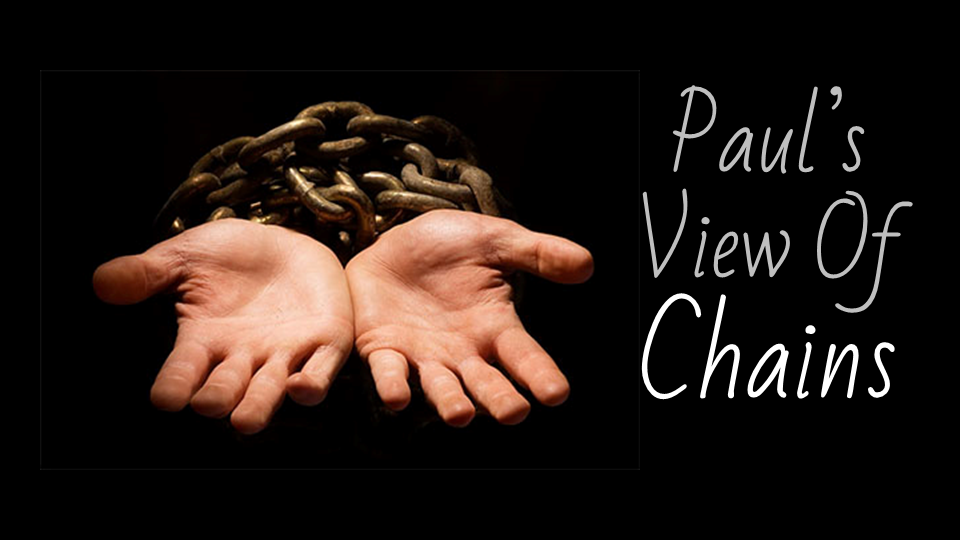
Paul’s View Of Chains
Roman prisons in the first century were filthy, hot, dark, and musty, with poor ventilation. There were few separate cells for prisoners as most had groups chained together in a single room. Most of the time the prisons were overcrowded. The stench would almost be overpowering. Stocks were used to secure the feet of the prisoners, making movement difficult. Few prisons had long-term inmates as the use of the prison was a holding place before execution. It would not be uncommon to hear screams from parts of the prison as the guards tortured the unfortunate. Food was not regularly supplied because friends and family were expected to bring food to care for the prisoner.
Paul was familiar with the Roman prison. Before he became a Christian, his familiarity was the men and women he dragged to prison for following Christ. He used the prisons as a weapon to persecute the church with vigor. How different for the former persecutor to be thrown into a prison, chained with other men, and left in the dark. His former wealth, prestige, and comfortable life were replaced with poverty, humiliation, and suffering. He did all of that for the cause of Christ. Faced with the repeated trips to prison, the apostle developed a positive view of his chains for the glory of God.
Philippians is an epistle to the Philippian church about joy and rejoicing. The epistle is remarkable because Paul was in a Roman prison (jail) at the time of writing. His bonds were the chains on his hands and probably his feet. He was not free to go where he wanted and do what he so desired – preach the gospel. There was plenty to discourage the apostle as he languished in a dark and dreary prison. Paul refused to let his circumstances define his situation. He tells the saints his chains were for the furtherance of the gospel. Looking down at his chains, he did not see discouragement or failure. Paul realized why he was in bondage – in the defense and confirmation of the gospel.
Chains can bind a man or set his heart free. Paul knew no chains could separate him from the love of God, which is in Christ Jesus. Paul’s spirit soared in the face of persecution. He knew his life was spent in the declaration of the gospel, and spending time in prison confirmed his love for God. Learning to look beyond the iron chains secured on his hands and the painful wooded stocks binding his feet is how Paul made sense of where he was and why. Paul’s final days were spent in prison before the executioner severed his head.
A positive view of life is learning to look beyond those things that seek to shackle the spirit to a dark world. There were many unpleasant reasons to stay away from the Roman prison. His Roman citizenship protected him from being beaten or scourged. Enduring the difficulties of prison life became common for Paul. He focused his mind above and beyond the place where he found himself. Things in life can shackle the heart, but the key has always been to look beyond those things to Jesus Christ.
Whatever challenges we face can make us stronger. Trusting in God and looking at the chains of life as the link to eternal life will help the soul overcome discouragement. Nothing can defeat those who walk in Christ. God has never forsaken His people, and He never will. Paul sat in prison thinking about how God was to be glorified through him. He kept his focus on the work of the Lord. Changing the mind to overcome chains is done when the heart is filled with the word of God and the feet are busy with the kingdom’s work.
 The Heaton File