
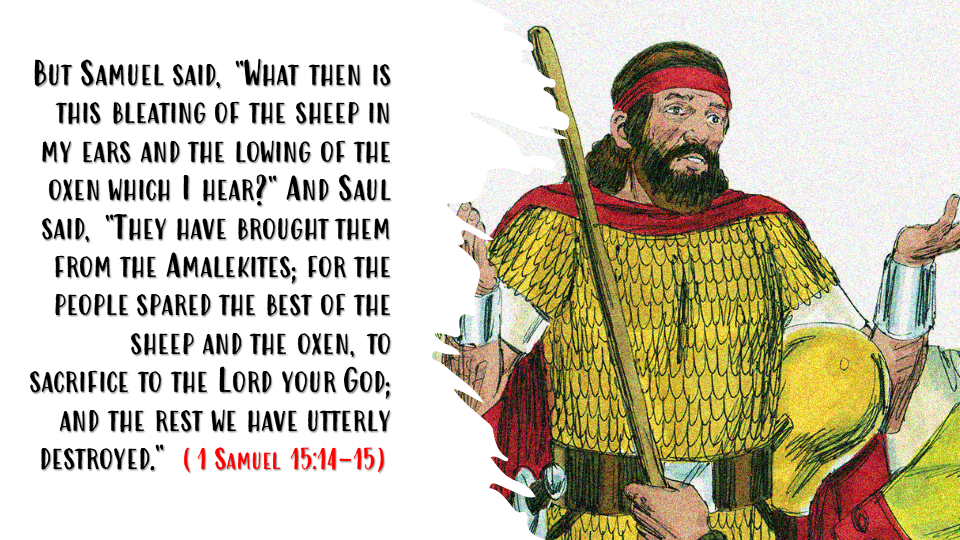
But Samuel said, “What then is this bleating of the sheep in my ears and the lowing of the oxen which I hear?” And Saul said, “They have brought them from the Amalekites; for the people spared the best of the sheep and the oxen, to sacrifice to the Lord your God; and the rest we have utterly destroyed.” (1 Samuel 15:14-15)
Refusing To Accept Blame
King Saul was the first king of Israel. He was tall and handsome and the son of Kish, whose great-grandfather was a mighty man of power. Samuel the prophet was disappointed the people desired a king, but the Lord assured him it was in keeping with the divine plan. The reign of Saul did not begin well as Saul took it upon himself to offer a sacrifice as he impatiently waited for Samuel. This was against the commandment of the Lord, and Samuel rebuked the king for his unlawful act.
Sometime later, Samuel came to Saul and told him to punish Amalek for what he did to Israel when he ambushed the people of God when they came up from Egypt. Samuel instructed the king to utterly destroy all that they had and not to spare anyone. This demanded killing man and woman, infant and nursing child, ox, sheep, camel and donkey. Saul was to destroy all the Amalekites, sparing nothing and no one. The king gathered his army of two hundred thousand foot soldiers and ten thousand men of Judah and attacked the city of Amalek. He took Agag, king of the Amalekites alive and utterly destroyed all the people with the edge of the sword. The best of the sheep, oxen, fatlings, lambs, and all that was good was spared. Saul was unwilling to destroy them. Everything despised and worthless, he destroyed.
The word of the Lord came to Samuel, regretting He had made Saul king. Saul had refused to obey the voice of the Lord by sparing Agag and all the good things. Samuel comes to Saul, and the king acts as if everything he has done has glorified the Lord and that he has done the commandment of the Lord. The prophet asks the king what the bleating of the sheep and the lowing of the oxen means. Saul immediately turns the blame upon the people, telling Samuel the people brought the flocks from the Amalekites. It was the people that spared the best of the sheep and the oxen. Saul suggests what the people were seeking was to glorify God and do a good thing to spare all of the best of the flocks. The animals could be used for sacrifice to the Lord. He reminds Samuel all of the rest had been destroyed.
Saul was to blame, and he turned the blame on everyone but himself. He was king, and his decisions spared Agag and the best of the flocks. As the leader of the people, he should have taken ownership of his failure to obey the word of the Lord. He alone had decided to disobey what Samuel had told him to do. Worse, he would not accept blame for what he had done, charging the people for what had happened and explaining away his actions by glorifying the Lord. As the leader of the people, he stood above accusations of blame in his eyes. He was only seeking the good of the nation.
What Saul believed in his heart did not change the word of God. Blaming others instead of accepting the blame for his own actions did not change the word of God. Leadership fails when those in authority deflect responsibility for their actions. After Saul died in battle, David became king of Israel. When David sinned with Bathsheba and Nathan the prophet came to him, David did not follow in the steps of Saul. He could have blamed Bathsheba. David could have excused his actions away, suggesting the wars had weakened his spirit. There were many whom David could lay the blame for his failure. David took responsibility for his actions. So David said to Nathan, “I have sinned against the Lord.” That is true leadership.
Failures become greater failures when men refuse to acknowledge and accept blame. Deflecting the blame is the greatest weakness of leadership. Accepting responsibility is the greatest strength of leadership. Men of God who excelled were men who faced their own failures with courage. Saul blamed everyone but himself and lost everything. Samuel told Saul the problem was in the heart of the king, who allowed pride to distort the truth. Saul was a better man when he was little in his own eyes. David accepted his failure and became a greater man. Refusing to accept blame does not glorify God.
 The Heaton File