The Perfect Genealogy

Now Jesus Himself began His ministry at about thirty years of age, being (as was supposed) the son of Joseph, the son of Heli, the son of Matthat, the son of Levi, the son of Melchi, the son of Janna, the son of Joseph, the son of Mattathiah, the son of Amos, the son of Nahum, the son of Esli, the son of Naggai, the son of Maath, the son of Mattathiah, the son of Semei, the son of Joseph, the son of Judah, the son of Joannas, the son of Rhesa, the son of Zerubbabel, the son of Shealtiel, the son of Neri, the son of Melchi, the son of Addi, the son of Cosam, the son of Elmodam, the son of Er, the son of Jose, the son of Eliezer, the son of Jorim, the son of Matthat, the son of Levi, the son of Simeon, the son of Judah, the son of Joseph, the son of Jonan, the son of Eliakim, the son of Melea, the son of Menan, the son of Mattathah, the son of Nathan, the son of David, the son of Jesse, the son of Obed, the son of Boaz, the son of Salmon, the son of Nahshon, the son of Amminadab, the son of Ram, the son of Hezron, the son of Perez, the son of Judah, the son of Jacob, the son of Isaac, the son of Abraham, the son of Terah, the son of Nahor, the son of Serug, the son of Reu, the son of Peleg, the son of Eber, the son of Shelah, the son of Cainan, the son of Arphaxad, the son of Shem, the son of Noah, the son of Lamech, the son of Methuselah, the son of Enoch, the son of Jared, the son of Mahalalel, the son of Cainan, the son of Enosh, the son of Seth, the son of Adam, the son of God. (Luke 3:23-38)

The Perfect Genealogy

The study of family lineage has always been a part of the human landscape. From early times, charting the course of a seed line has been a vital part of establishing bloodlines and kinships, whether to determine a monarchy or family curiosity. With the recent death of Queen Elizabeth II, the question of succession to whom would receive the crown was foremost on the minds of the world. Queen Elizabeth can trace her ancestry as a direct descendent of Henry VII (1457-1509). Through Victoria (1837-1901) and several other of her great-great-grandparents, Elizabeth is directly descended from many British royals. However, tracing her lineage throughout the generations back to the first man Adam is impossible. Many lineages show a lengthy course of history, but none compared to the genealogy of Jesus Christ.

Genealogy comes from the Greek meaning “the making of a pedigree.” The family tree of Jesus is given by the gospel writers Matthew and Luke. Matthew’s gospel is directed toward the Jewish mind proving that Jesus was a descendant of Abraham. Jesus was of the tribe of Judah, the fourth son of Jacob and Leah. The pedigree of Jesus of Nazareth was necessary to establish the change in the priesthood, as pointed out in the book of Hebrews. As the High Priest of the new covenant, Jesus would disannul the Law of Moses through the priesthood of Melchizedek instead of Levi. Luke presents the humanity of Jesus, tracing his lineage back to Adam. As a first-rate historian, Luke thoroughly investigated the story of Jesus but knowing the family tree of Jesus would only come through divine knowledge. The Holy Spirit outlined the complete historical genealogy of Jesus to show that Jesus was the answer to humanity’s lost condition. Jesus emptied Himself of the divine to dwell on the earth as a man experiencing all of the trials and travails of human flesh. It would mean little if Jesus was not a man. The genealogy presented by Luke shows the incredible sacrifice Jesus made.

How many people can trace their pedigree without interruption to the Garden of Eden? The only man who has ever shown His genealogical history in complete form is Jesus Christ. His family pedigree is one of the testimonies of the divine nature of the word of God. The Jews valued genealogy to a level of worshiping lineages. Paul warned the early Christians against putting too much stock in foolish discussions about spiritual pedigrees or quarrels and fights about obedience to Jewish laws. The lineage of Jesus in Matthew and Luke’s gospel is the thumbprint of the Lord God to show divine royalty. Only through God’s divine providence can the lineage of Jesus be perfected through the word passed down from generation to generation. The past of Jesus affirms our future. He is the Son of God. Check His pedigree. It’s perfect.

Posted in Uncategorized | Leave a comment

Why Do People Do Evil?

Thus King Rehoboam strengthened himself in Jerusalem and reigned. Now Rehoboam was forty-one years old when he became king; and he reigned seventeen years in Jerusalem, the city which the Lord had chosen out of all the tribes of Israel to put His name there. His mother’s name was Naamah, an Ammonitess. And he did evil because he did not prepare his heart to seek the Lord. (2 Chronicles 12:13-14)

Why Do People Do Evil?

After the death of Solomon, Rehoboam, his son, reigned in his place. Under David and Solomon, the nation of Israel united and became the greatest nation in the world. The Lord blessed Solomon with great wisdom, power, prestige, and possessions but the son of David let his foreign wives carry away his heart. As the grandson of David and son of Solomon, Rehoboam should have seen the power of God working in the lives of these two great men. Israel was a prosperous nation through the grace of God. When his father died, Rehoboam began dismantling the nation with his oppression of the people leading to a civil war. Jeroboam, the son of Nebat, led a revolt against Rehoboam and tore ten tribes away from Judah and Benjamin. The fractured kingdom would never recover.

When Rehoboam established himself as king, he abandoned the law of God, and the people followed his apostasy. After Shishak, king of Egypt, came against Jerusalem, the Lord did not permit the Egyptians to conquer Rehoboam, but Shishak ransacked the treasuries of the Lord’s Temple and the royal palace. He stole everything, including all the gold shields Solomon had made. Rehoboam humbled himself, but his heart was not devoted to the Lord. The legacy of Rehoboam was he did evil in the sight of the Lord because he did not prepare his heart to seek the Lord. He did not seek after God with all his heart. The nature of sin strongly influences men to rebel against the Lord God. Rehoboam’s evil came through neglect of preparing his heart to heed the word of God.

The first words of the devil to Eve were to challenge the word of God. Satan knows that if he can keep the heart from giving devotion to the Lord, he has a measure of success that can lead to total destruction. What did Rehoboam lack in knowing the word of God? Everything needed to follow the word of the Lord was available for the king to read and heed, but he allowed evil to cover his heart. Evil comes when men do not prepare their hearts to seek the word of the Lord. There are only two choices a man can make: serve God or rebel against the word of God. Evil comes when men choose to follow their will.

Human wisdom tries to rationalize where evil comes from, but the origin of evil is when the heart rejects God. Sin is the problem. Sexual immorality is not because of some psychological failings or mental condition. It is a matter of the heart. Anger and hatred grow from evil hearts. Addictions come from hearts unprepared to face the reality of sin. Men try to find answers to why evil exists, and some will blame God. The reason evil exists is that the heart of men grows worse and worse. In the days of Noah, God saw that every intent of the thoughts of the heart was only evil continually. Pharoah was evil because he hardened his heart. Satan entered the heart of Judas to betray Jesus. Peter condemned Ananias and Sapphira because they conceived evil in their hearts. Evil hearts come from those who refuse to prepare their hearts for God. Rehoboam should have listened to his father, who wrote that men must keep the heart will all diligence, for out of it spring the issues of life. A heart left unguarded will fail.

Posted in Uncategorized | Leave a comment

Elders Like Joshua

Then Moses spoke to the Lord, saying: “Let the Lord, the God of the spirits of all flesh, set a man over the congregation, who may go out before them and go in before them, who may lead them out and bring them in, that the congregation of the Lord may not be like sheep which have no shepherd.” (Numbers 27:15-17)

Elders Like Joshua

The children of Israel had been free from Egypt for more than forty years. Only Joshua and Caleb remained to enter the land of promise of the adults twenty years and above that walked through the Red Sea. Moses was forbidden to enter Canaan, and a new leader must be chosen. He knew he would die, and the people would possess the land without his leadership. Choosing a man to lead Israel was a daunting task, and few men would be able to meet the challenge. Moses implores the Lord to choose a man to take his place, and the Lord selects Joshua, son of Nun.

Moses has endured the challenges of the wilderness for forty years. After the failed invasion at Kadesh Barnea, he guided a rebellious, complaining, and murmuring nation of discontents. As the nation’s leader, Moses knew the complexities required to guide the people of God across the Jordan and the challenges of driving out the people of Canaan. The nation needed a man that could take the role of leadership and accomplish what the Lord committed to him. Joshua was a strong candidate for the role of leading the people of God. The son of Nun would take the nation across Jordan and complete the conquest in less than seven years.

When Moses described the work of the one who would lead the nation, he described a unique man of specific qualities. The leader would go out before the people. His task would be to guide God’s people and lead them into battle. This man would also go in before them to engage with them. Like a shepherd leading his flock, the leader of Israel would guide the flock of the Lord through the conquest of Canaan. Joshua took the mantle of leadership and became the leader of God’s people. He shepherded the nation to defeat the stronghold of Jericho and to build up the faith of the people after the losses at Ai. His faith guided the armies of God to win victory after victory as the Canaanites fled before the presence of the nation of God. He went out before them, and he went in before them. His role is much like the roles found in the leadership of the church.

Jesus Christ is the head of the church. His authority is absolute. The Father gave Jesus all authority, and through that authority and the work of the Holy Spirit, the New Testament church was established and organized according to the plan of God. One of the pivotal roles in the church is that of leadership. Strong leadership is needed to guide the local church for the purpose designed by God before time began. The New Testament describes the leaders of the church as elders, pastors, bishops, overseers, and shepherds. Each one of these qualities of character defines the work of the leaders of the church. Like Joshua of old, the elders have an immense task ahead of them as they lead the people of God to conquer the world with the gospel of Jesus Christ. And like Joshua (but in the multiple), they must be men willing to go out before the brethren and to go in before them. Joshua led by example and authority. He went before the people for all to see. His leadership was visible to the congregation. Joshua went in before them, engaging with them. He was personal. His work was a success because he knew the quality of leadership was to be among his people.

Elders must learn the craft of shepherding. Smelling like the sheep requires engagement with the sheep. The constant nourishment and care of the shepherd’s hands upon the flock will endear them to the flock. When battles must be fought, the overseers take the lead in directing the defense of the church with truth and righteousness. There will be times of defeat, as Joshua experienced at Ai. Rooting out sin is a most difficult task, but men of faith must take action. Joshua did not give up or give in. At the end of his life, Joshua said that not one thing had failed of all the good things which the Lord had promised. He guided the people with the courage of a faithful heart to go before them and go among them. The work of an eldership shepherding the flock of God must have the same zeal. Go before them and go among them. Let the people see and know you care for them and will protect them. Rise up and be like Joshua.

Posted in Uncategorized | Leave a comment

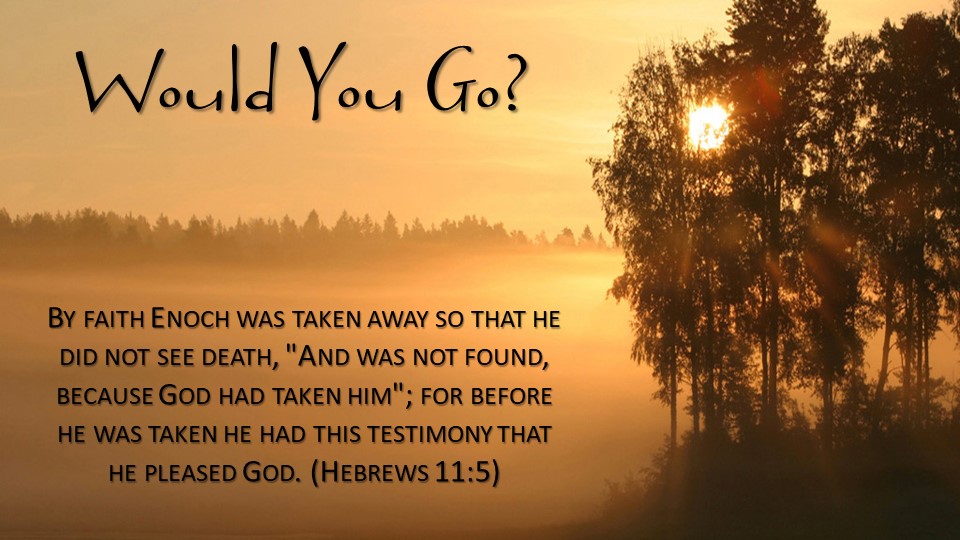
Would You Go?

By faith Enoch was taken away so that he did not see death, “And was not found, because God had taken him”; for before he was taken he had this testimony that he pleased God. (Hebrews 11:5)

Would You Go?

The Bible reveals little about Enoch, son of Jared. He was in the seventh generation from Adam, and considering Adam lived 930 years, Enoch would have lived at the same time as his great-great-grandfather Adam, the first man. The world changed a lot in the days of Enoch. Instead of turning to the Lord, the world began to turn into a corrupt, brutal, and wicked world. Enoch’s son would become famous for living the longest recorded age of 969 years – Methuselah. Moses gives a brief notation about Enoch walking with God, and he was not, for God took him. Enoch is part of the genealogy of Jesus as recorded by the gospel writer Luke. Paul and Jude are the only New Testament writers that mention Enoch helping the disciple know more about this man of mystery.

In the book of Hebrews, Paul exhorts the struggling Christians to keep their faith, using many examples of men and women who faced uncertainty but retained their faith in God. Enoch was mentioned as one who did not see death because God had taken him. The Holy Spirit reveals the only insight into the decision of taking Enoch when He says that Enoch had a testimony that he pleased God. Jude will write that Enoch was a prophet who spoke against the ungodly of his day. Following these two references, the scriptures fall silent. But there is one question that begs an answer: would you be willing to leave and go with God?

A story is told of a little girl who was asked to tell the story of Enoch. She said that God and Enoch were taking a walk one day, and God asked Enoch if he would like to go home with Him. Enoch said yes, and so he did. If God came into my life and gave me the option to forgo the dying process and just go straight to heaven, would there be any hesitation? There are many factors to consider of which family is the first. Would I be willing to leave everything I know here and everything that makes life comfortable? If God asked me to leave, would I beg for a few days to say goodbye to family or a few months to put my house in order; or would I immediately say yes without explaining to anyone? In other words, I would die without explanation and leave everything. Is that what happened to Enoch? What did Methuselah know about what happened to his father? Did the Lord let others know what He did for Enoch?

The question of life and death is not changed from the story of Enoch. God gave Enoch an opportunity to eternal life without experiencing the pangs of death, but he still left this world for eternity. Death has the same message. It is unknown in its timing, but it is real. Enoch walked with God and was not; we must walk with God and be prepared for “not.” Paul struggled with his life in wanting to be with the Lord and yet remain to bless the work at Philippi. He was torn between staying to do a fruitful work with the Christians or going and being with the Lord. How many of us struggle on this level? Would you go? Are you ready to go?

Posted in Uncategorized | Leave a comment

The Right Kind Of Heart

Now when they heard this, they were cut to the heart and said to Peter and the rest of the apostles, “Men and brethren, what shall we do?” (Acts 2:37)

The Right Kind Of Heart

Peter’s sermon at Pentecost was about eight minutes in length. He had responded to the crowd gathering when a mighty rushing wind filled the house they were in, and the manifestation of the Holy Spirit was evident upon the twelve. The multitude was drawn to the startling events of the morning, wondering what was going on. As the twelve apostles stood before the crowd, they began speaking in the many dialects and languages of those gathered for Pentecost. People from Mesopotamia, Judea, Cappadocia, Pontus, and Asia, Phrygia and Pamphylia, Egypt, and the parts of Libya adjoining Cyrene were present. Some came from Rome, both Jews and proselytes, Cretans and Arabs. The multitude was amazed and perplexed at what they saw and heard.

It was a scene of chaos as the multitude tried to understand what was happening. Standing up with his fellow apostles, Peter spoke first and explained what was happening. Some thought the twelve men were drunk, and Peter said that would not be the case at 9:00 o’clock in the morning. He did go on to explain what had just happened was what Joel said would take place when the Spirit of the Lord would be poured out with prophecy, visions, and dreams. Peter then changes direction to remind the crowd of an event that occurred a little over a month earlier. The killing of Jesus of Nazareth was still on the lips and minds of those gathered in Jerusalem. Peter explained the Jesus whom the Jews had killed was the long-promised Messiah confirmed by the prophecy of David. The conclusion of the fulfilled prophecy was the Jesus whom they had crucified fifty days earlier was Lord and Christ.

Peter’s sermon was a succinct, moving, powerful, and complete testimony of the scheme of redemption through Jesus Christ. The body of the message was less than ten minutes. There were no bands, no singing, no frills, no entertainment, no appeal, and no pressure on the crowd. With just over five hundred words, Peter preached the first gospel sermon. What is remarkable about the events at Pentecost was not that three thousand souls were added to the church that day. It was not remarkable the apostles spoke in languages and had fire upon their heads. What is important to see in the Pentecost events is the listeners’ heart. They were devout men from every nation. Peter spoke for about eight minutes, and their hearts were pricked with his message. Hearing the Jesus who was killed earlier was the Son of God cut the men to their core. They were moved by the message of the man Jesus of Nazareth.

One of the challenges of preaching is storming the will of the hearts gathered to hear the message of salvation. What made the events of Pentecost powerful were hearts that were open to receive the story of redemption in Jesus Christ. For those who obeyed the gospel that day, there were no long debates about the nature of the words Peter spoke. No one challenged the interpretation of Joel’s prophecy and the psalms by David. Many more than three thousand refused to accept Peter’s words, but the hearts of the honest people readily accepted, believed, and obeyed the gospel. People do not respond to the gospel often because of their hearts, not the preaching. A man can speak passionately about the death of Jesus Christ and watch a crowd of lost souls walk aimlessly away. The preaching was sound, powerful, and according to truth, but when the heart is unprepared, uncultivated, and unwilling to accept the word immediately, men walk away.

The world needs more hearts willing to be cut and pricked with the simple story of Jesus Christ. Satan has done well to harden the hearts of those who want to debate the question of salvation, the merits of baptism, the identity of the church, and a host of useless wranglings – all the while remaining lost in the kingdom of perdition. Many souls will be lost not because of some evil they have committed, like murder, adultery, homosexuality, or lying. Most souls will be lost because they did nothing. Their hearts were never moved to move to salvation. When the few gathered on Pentecost heard the story of Jesus Christ, they were cut to the heart and asked what they needed to do to be saved. May the hearts of more men be opened to the grace of God.

Posted in Uncategorized | Leave a comment

The Small And Great

Then I saw a great white throne and Him who sat on it, from whose face the earth and the heaven fled away. And there was found no place for them. And I saw the dead, small and great, standing before God, and books were opened. And another book was opened, which is the Book of Life. And the dead were judged according to their works, by the things which were written in the books. (Revelation 20:11-12)

The Small And Great

Death is the great equalizer. The world is filled with the young and old, rich and poor, masters and slaves, righteous and wicked, leaders and followers, despots and tyrants, and all the human families of the small and great. Conditions of life separate humanity from one another through birth, privilege, economics, fear, love, wisdom, and a host of traits that elevate some and oppress others. Life is often unfair in the measure of blessings given to some and withheld from others. It is a man that creates the disparity among the peoples of the earth because the small and great come into the world in the same manner, and the small and great leave this world exactly the same.

The first equalizer is birth. Everyone is born in the same manner. Through God’s creative power, a child comes from a woman’s womb. Rich women give birth to children in the same way a poor woman gives birth. The circumstances and surroundings may be different, but birth remains the same. Life is what makes a person great or small. Human wisdom creates inequality with perceptions of greatness personified through pride. All men come from Adam and share the same biological seed created when Eve was brought to the man. Thomas Jefferson and Benjamin Franklin did not pen a new doctrine when they stylized the phrase of all men being equal, endowed by God with certain unalienable rights, among which are life, liberty, and the pursuit of happiness. The Bible established the equality of all men when Moses wrote that God created man in His image. All men are equal because all men share in the image of their Creator.

Equality in life is a tenuous pursuit. Men will spend a lifetime seeking fame, fortune, wisdom, and power. The irony is the amount of effort put into making a name for oneself only to face the chasm of death where names are forgotten. Riches amassed in life are left behind. The greatest wisdom a man can achieve will not extend his life one moment. Great men rise to rule their worlds only to find that death easily comes into their fortified citadels. No man escapes death, whether great or small. Death is the final equalizer because all men die the same way. The door of death is the same reality for every man who has lived. Methuselah lived for 969 years and he died. The poorest man living today will live a certain amount of years and, like Methuselah, die. Equality.

What makes death the great equalizer is the knowledge of how death changes the station of a person’s place in the eternal scheme. In life, there are the small and the great, but in death, there are the saved and the lost. What makes a man different in life ends in death. How a man faces eternity is the manner of life he lives before death. The time on earth is very short, but on that slim vapor of life, eternity depends. All men will stand before the great white throne as equals, whether small or great. What separates men in eternity is written in the Book of Life. The dead are judged according to their works and the things written in the book by the Finger of God. Whether a man is small or great in life matters not in the mind of God. What matters in the mind of God is whether that small or great man has his name in the book.

The devil’s great lie in mortals’ hearts is to seek greatness and power in this life. There is no consciousness of the eternal, and most men seek greatness in wealth, fame, pleasure, and wisdom. Death takes all that away and bares the soul before a just and wrathful God. What matters in life is what matters in eternity. The great and the small will stand on the same parcel of eternity and be judged by one book and one book alone. Every heart will know the answer of the eternal ages when they die. All the dead, small and great, stand before God.

Posted in Uncategorized | Leave a comment

He Gave Them Power

And when He had called His twelve disciples to Him, He gave them power over unclean spirits, to cast them out, and to heal all kinds of sickness and all kinds of disease. Now the names of the twelve apostles are these: first, Simon, who is called Peter, and Andrew his brother; James the son of Zebedee, and John his brother; Philip and Bartholomew; Thomas and Matthew the tax collector; James the son of Alphaeus, and Lebbaeus, whose surname was Thaddaeus; Simon the Cananite, and Judas Iscariot, who also betrayed Him. (Matthew 10:1-4)

He Gave Them Power

Sickness and disease is a consequence of sin. When God placed Adam and Eve in the Garden of Eden, there was no sickness, disease, or death. As a consequence of eating the forbidden fruit, God removed access to the tree of life to Adam and Eve and drove them from the garden. Death reigned as disease spread throughout the world. The wisdom of men sought remedies for the maladies of the human body, but the power of disease continued destroying lives. Nothing could be done for Rachel, the wife of Jacob, when she died in childbirth. Leprosy was common in the Bible lands, but there was no cure. Thousands of men and women died from plagues. Sickness and disease have taken lives too early, too often, and too many. There was little anyone could do but offer solace and comforting words. And then Jesus came.

The Son of God did not come to take away the disease of the body. In the thirty years of Jesus’ early life, sickness infected the people, and many died from disease as it had done from time beginning. During the ministry of Jesus, He healed thousands of people with every known disease, sickness, and plague without exception. Jesus raised the dead and cast out demons. There was no disease that Jesus could not heal completely. His healing was not a temporary fix but a complete cure. When the Lord gathered His twelve apostles, He gave them the power to do the same thing. They had the power of unclean spirits to cast them out and to heal all kinds of sicknesses and all kinds of diseases. There was nothing the power of the Holy Spirit could not work through the hands of the apostles. The power was unlimited. Twelve men had incredible power – the power of God.

After Jesus commissioned His apostles, the twelve men went out preaching, teaching, and casting out unclean spirits. They healed every kind of disease and illness without exception. Peter healed a man of disease. Matthew cast out a demon. And believe it or not – Judas healed people of sickness. John gave relief to lepers. The power of God flowed through the twelve apostles as they healed sick people and made them whole. It must have been an amazing experience to come into a city and find a number of sick people who were miserable, lonely, hopeless, and afflicted. Peter would walk to the crowd and put his hand on the sick, feeling God’s power taking away their affliction. The smiles on the faces of the thousands healed from the infirmities of the flesh had to resonate in the hearts of the twelve men. Jesus gave them the power of God to heal, and they healed people, casting out demons and raising the dead. What an incredible power to have in their hands.

What is remarkable about the story of the twelve apostles is that they possessed God’s power and experienced God’s power in using that power. Yet, they continued to struggle in their faith to understand the will of God. The power of God was theirs, and they did not understand what they possessed. It is easy to judge the twelve and not understand how they could possess such power and not be full of faith in the work of the Lord. But they healed people, raised the dead, and still doubted and failed in their devotion to God. The answer to the dilemma of their faith is found in the faith of those in the body of Christ who possess the power of God. Miracles and gifts of healing ended nearly two thousand years ago. No one has the power to heal sickness, cast out demons, or raise the dead. While that power is gone, a greater power remains and is forgotten.

God sent His Son to help men fight the disease of sin. Physical disease will kill the body, but spiritual disease destroys a soul for eternity. Medicines can stave off disease for a time, and then death comes. Dying from sin will never change. The gospel of God is the greatest power man has ever known. The twelve apostles had the power of physical healing and spiritual healing. The Bible is the message of divine healing placed in the hands of God’s people to share with others. Did the apostles take for granted their power to heal all sickness? We can and often take for granted the power of the gospel to heal what is truly wrong with man – sin. Having the power and using it for its purpose is where we fail. We have the power. Share the gospel. Save a soul.

Posted in Uncategorized | Leave a comment

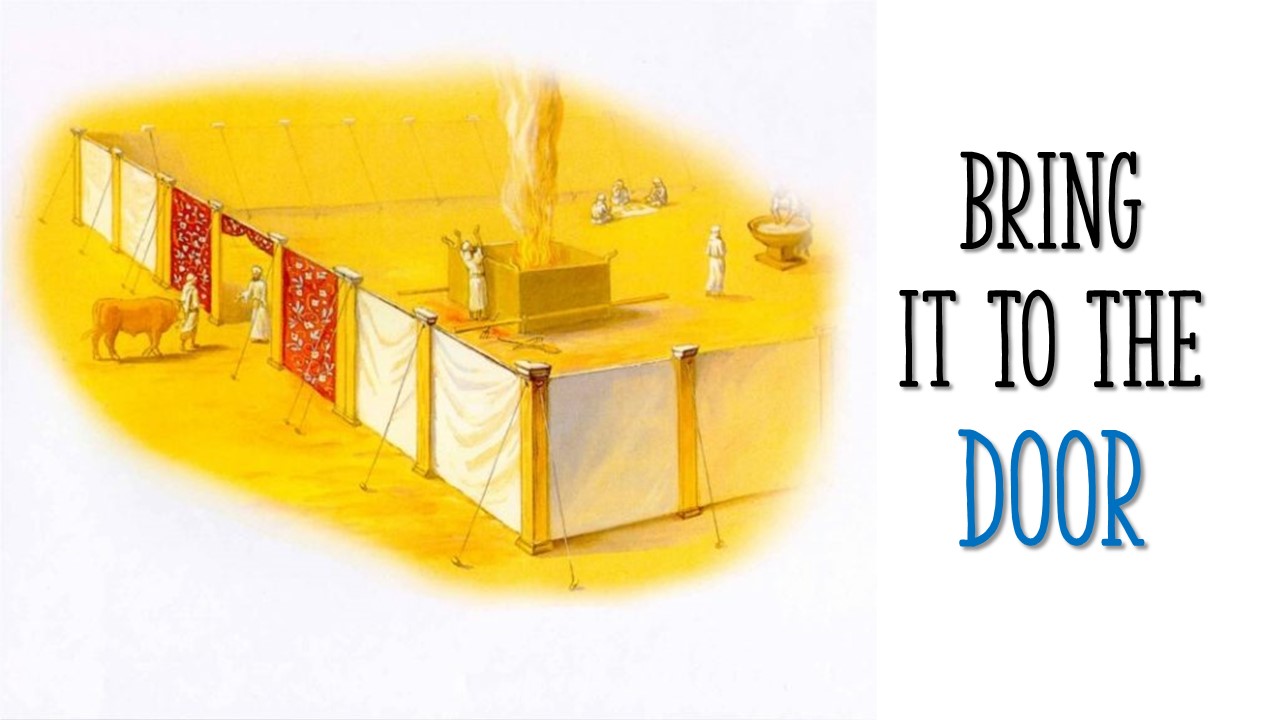
Bring It To The Door

Whatever man of the house of Israel who kills an ox or lamb or goat in the camp, or who kills it outside the camp, and does not bring it to the door of the tabernacle of meeting to offer an offering to the Lord before the tabernacle of the Lord, the guilt of bloodshed shall be imputed to that man. He has shed blood; and that man shall be cut off from among his people, to the end that the children of Israel may bring their sacrifices which they offer in the open field, that they may bring them to the Lord at the door of the tabernacle of meeting, to the priest, and offer them as peace offerings to the Lord. (Leviticus 17:3-5)

Bring It To The Door

Central to the history of the nation of Israel was the center of worship during the wilderness wanderings and early history of the young nation. Moses received the Law from God at Sinai, including constructing a place where God would commune with His people. It was vital to the relationship of God to be near His people, and the Tabernacle or Tent of Meeting would serve that purpose. The tabernacle was made up of many parts, including the Ark of the Covenant, the Lampstand and Table of Shewbread, the Altar of Incense, and the Brazen Altar. Constructed as a portable tent, the tabernacle was set up at the center of twelve tribes, with the tribe of Levi responsible for the care and moving of the place of worship.

Moses was given specific instructions on how to build the tabernacle. When Moses was getting ready to build the tabernacle, God warned him to make everything according to the pattern He had shown him on the mountain. Moses obeyed the will of the Lord exactly as commanded. The worship also contained certain commandments that must be followed. One of those had to do with bringing the sacrifice to the door of the tabernacle. The door of the tabernacle was where God communed with Israel. When Moses entered the tabernacle, the pillar of cloud descended and stood at the door of the tabernacle, and the Lord talked with Moses. When Aaron and his sons were consecrated, the congregation gathered at the door of the tabernacle of meeting. They were told to remain at the door of the tabernacle day and night for seven days until their consecration was complete. Aaron and his sons did all the things God commanded.

The people were also commanded with respect to the door of the tabernacle to bring their offerings to the door. God told Moses if a man killed an ox or lamb or goat in the camp and he did not bring the sacrifice to the door of the tabernacle of meeting to offer as an offering to the Lord, the man would be held guilty of unholy blood. The penalty would be that man is cut off from the people of God. To be cut off from the people was to treat the man as an outlaw or one who rebelled against the law. If a man kills an ox or lamb or goat outside the camp and does not bring the offering to the door of the tabernacle, he will be held guilty of the blood and cast out from among the people. If a man offers a burnt offering or sacrifice and does not bring it to the door of the tabernacle of meeting to offer it to the Lord, that man will be cut off from the covenant of God.

It might seem a trivial thing whether a man brings the offering to the door of the tabernacle. If a man makes a sacrifice to the Lord by offering up an ox, lamb, or goat, he can believe he is worshiping the Lord and be pleasing to God by his sacrifice. Everything seems to be in order as a sacrifice is made, and a burnt offering or sacrifice is made in the name of the Lord. The Law of Moses demanded the sacrifice be brought to the door of the tabernacle. When Israel camped around the tabernacle, more than a million people were pitching their tents around the tabernacle. If someone from one of the outlying tribes made a sacrifice, they had to go to the trouble to take their sacrifice through the thousands of people standing between them and the tabernacle. They could not offer acceptable worship at the door of their tent. Salvation required them to do what God said – take the sacrifice to the door of the tabernacle.

Many churches today offer similar sacrifices to what is found in the Bible. Sadly, they have chosen to make their sacrifices where they are, refusing to come to the door of the tabernacle. The religious world teaches baptism is not necessary for salvation. In other words, a man can be saved without going to the door of the tabernacle. Taking a sacrifice to the door of the tabernacle may not make a lot of sense, but if a man refused to obey the word of God, he was cut off. God requires assembly to worship. Many refuse to come to the door. Marriage is sacred in the eyes of the Lord, and God hates divorce. Men ignore God’s law. The Lord forbids sexual immorality, and the church turns a blind eye. It is easy for men to pick and choose which commands they will follow. They worship God in form but refuse to come to the door. If a man does not come to the door here, the door of Heaven will be shut there. Come to the door. Eternity depends on it.

Posted in Uncategorized | Leave a comment

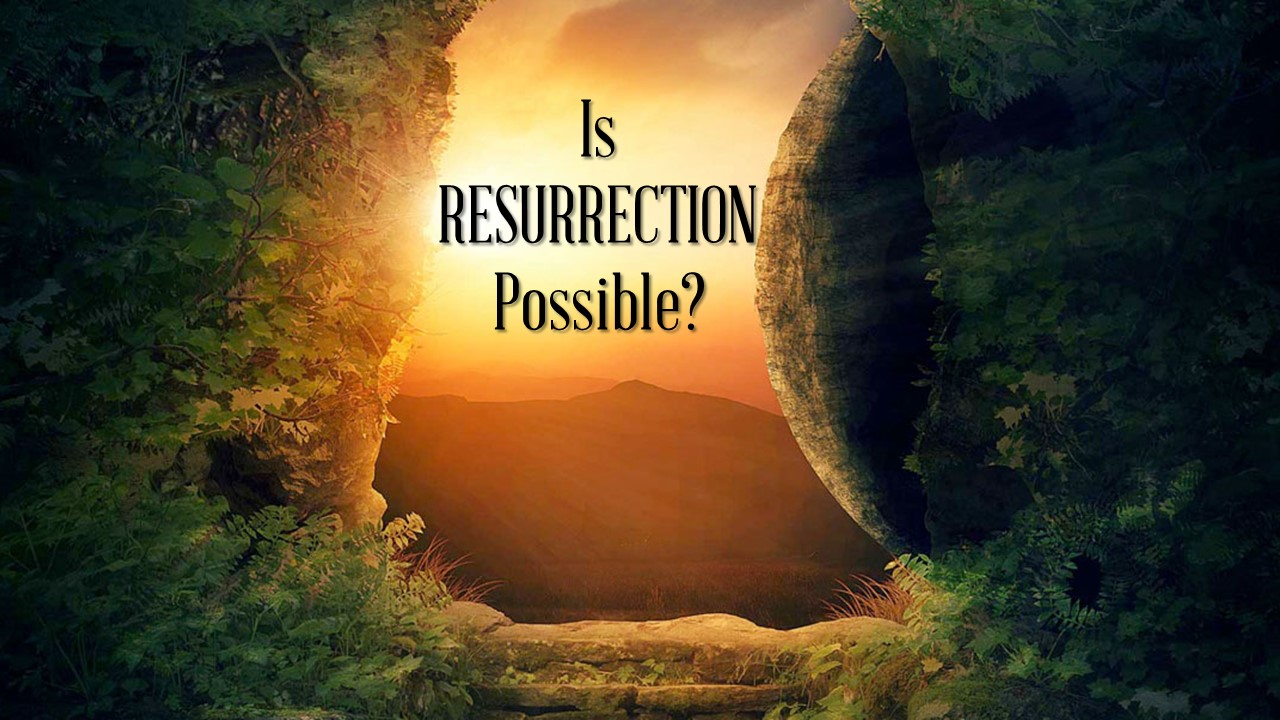
Is Resurrection Possible?

But someone will say, “How are the dead raised up? And with what body do they come?” Foolish one, what you sow is not made alive unless it dies. And what you sow, you do not sow that body that shall be, but mere grain—perhaps wheat or some other grain. But God gives it a body as He pleases, and to each seed its own body. (1 Corinthians 15:35-38)

Is Resurrection Possible?

The belief in life after death did not come from the wisdom of human judgment but the divine word of God. Nothing in humanity’s arsenal would suggest what is beyond death because man cannot see beyond the grave. No matter how advanced science or technology will become, peering into the realm before and after life will be impossible. The suggestion of eternity comes from the revelation of God. Through the power of the Creator, life is given to a man and woman to create life. There is no instrument to declare the beginning of life, only the mind of God. When a man dies, he cannot return. The Lord has established the habitation of man that limits his power. Death is final; whatever is beyond death cannot be known from human wisdom.

Resurrection has been accepted by believers in the one true God since the beginning. Abraham believed God had the power to raise his dead son and acted in faith, believing the Lord would perform such an act. Saul spoke to Samuel from the grave. Hananiah, Mishael, and Azariah defied the orders of King Nebuchadnezzar because they believed the fiery furnace would not end their life and their God would deliver them. Jesus rose Lazarus from the dead after four days. The apostles performed miracles, including raising saints from the dead. Believing in the resurrection was challenged in the first-century church as the people of God wrestled with the questions of how and what. The church of God at Corinth was rocked by disbelief that the dead could rise again because some began to doubt Jesus Christ had risen from the dead.

Some were asking how the dead were raised. It was an honest question. The curious mind of man wants to understand the mechanics of how something is done, and bringing a dead body back to life was a huge concern. Death is final. Nothing in the wisdom of man could change that. To witness Dorcas raised from the dead defied logic and human understanding, but Peter brought her back from the dead. The question by the Corinthians was valid. How are the dead raised up? Paul used the illustration of sowing seed as an example of God’s power. A seed is planted in the ground in one form, dies, and breaks the soil in another form. How does that happen? God makes it happen. If God can show his power in the wheat seed, why can He not raise up the body of a man? How are the dead raised up? By the power of God.

If a man accepts that God can raise someone from the dead, the second question is, what kind of body will they have? The answer to this question is more vague than the first because it requires an understanding that is beyond the wisdom of human logic. Using the illustration of the seed planted in the ground, Paul shows that a new body comes from the tiny seed. When wheat comes out of the earth, it does not have the form of the seed. The seed died and transformed into another body – so it will be with the human body. A man will die in one form and, in the resurrection, arise in another body. Defining what the image of the heavenly man will be is difficult to describe. That does not suggest there is no resurrection. Understanding what kind of body a man will have in eternity is challenging, but this does not deny the resurrection.

A change occurs in death when a body removes the tabernacle of flesh and lives on in the eternal spirit. Most people do not understand that death does not make one an eternal creature. Every human being is created in the image of God. A man does not possess a soul; instead, he is an eternal creature first who inhabits a fleshly body. The spirit a man possesses from creation will never cease. That spirit takes on a new body, a house not made with hands, eternal in the heavens. Mortality will be swallowed up by everlasting life. That new body will never die. Eternity comes to all men, good or bad. The difference will be how that eternal body will spend time without end. Most will be in darkness and endless pain. The faithful will rest in the bosom of God in peace. Are you ready for the resurrection?

Posted in Uncategorized | Leave a comment

What God Sees In The Blood

But the blood on your doorposts will serve as a sign, marking the houses where you are staying. When I see the blood, I will pass over you. This plague of death will not touch you when I strike the land of Egypt. (Exodus 12:13)

What God Sees In The Blood

Blood to the naked eye does not look different, whether human blood or animal blood. The blood of humans is always red, and most animals have red blood. Typing blood (A, B, and O) was not discovered until 1901. Science has unlocked many mysteries about blood, including the makeup of human blood consisting of red blood cells, white blood cells, and platelets. When the Hebrews were preparing to leave Egypt, nothing was known about blood at the cellular level. A man’s blood did not look much different than the blood of an animal. Distinguishing between the blood of a camel, bull, or goat was not possible. Smearing blood on a piece of wood would further hide any evidence about the origins of the blood. The blood looked the same to the human eye with no distinguishing marks.

God told Moses the final plague against Pharaoh and the people of Egypt would be the death of the firstborn. The Lord instructs Moses to say to the congregation of Israel to take a one-year-old male lamb with no blemish or defect as the sacrifice. On the fourteenth day of the first month, the lamb (taken from the sheep or goats) will be killed. The people shall smear some of the blood on the sides and top of the house’s doorframes. They will eat the flesh that night roasted in fire, with unleavened bread and bitter herbs. None of the animal shall remain; if any is left, it is to be burned in the fire. The people are to have a belt on their waist, sandals on their feet, and a staff in their hand. When the Lord passes through the land of Egypt on that night, He will strike all the firstborn in the land of Egypt, both man and beast.

The blood commanded by God to be put on the doorposts and lintels would be a sign, and when the Lord saw the blood, He would pass over the house and not kill the firstborn. As the Hebrews prepared for the night of death, the question of the blood must be answered. When the blood was put on the doorposts, what difference did it make what kind of blood was there? Who could tell the difference in the blood that was smeared on the wood? As far as the human eye could see, the blood of a camel and the blood of a lamb were the same, and smearing camel’s blood on the door would look just like the neighbor who put a lamb’s blood on the doorpost. If a man decided to put camel’s blood on his house, what would happen to his firstborn? They would die! Did it make a difference in the blood? It may not have looked different to the human eye, but to the eye of the Lord God, it made a difference.

When the Lord passed over the land of Egypt, He was not looking for blood on the doorposts and lintel; He was looking for obedience. God could tell if the blood was from a lamb without blemish through the divine eye of discernment. Even modern science cannot tell from blood if a lamb has a broken leg or some blemish. God could make that discernment. The Lord wanted to see the blood of a male of the first year that had been killed on the fourteenth day of the first month. With all the science of modern technology, can forensic science determine on what day a lamb is killed? God can. The lamb must be killed at twilight. Where in the study of blood can scientists know what time of day it is killed? When the Lord saw the blood, He knew if it was killed at twilight or the third hour.

The religious world tries to fool God into believing it does not matter what kind of blood is smeared on the doorposts of the house. To the religious world, one blood is as good as another. Churches fill the landscape of every community with the false doctrine that nothing really matters to the Lord and variety is accepted. If the religious leaders today lived in Egypt with the Hebrews, they would tell people, “Choose the blood of your choice.” People are being led astray with the false doctrine of the wrong kind of blood. They go through the motions and believe the blood will save them. Then the night comes with the judgment of God, and they die. Did God see the blood? Yes, He saw the blood, but He knew it was the wrong kind of blood. Does it matter what type of blood the Hebrews put on their houses? If you asked those who lived through the terrible night of death, rest assured they emphasized how important the one blood was to their salvation. They may have been ridiculed for believing in the one blood, but salvation was in their house when morning came. What blood have you put on your house? There is only one blood, and it matters when God sees the blood!

Posted in Uncategorized | Leave a comment