Jesus – The Universal Language

Now Pilate wrote a title and put it on the cross. And the writing was: JESUS OF NAZARETH, THE KING OF THE JEWS. Then many of the Jews read this title, for the place where Jesus was crucified was near the city; and it was written in Hebrew, Greek, and Latin. (John 19:19-20)

Jesus – The Universal Language

Everything about the crucifixion of Jesus Christ testifies to the completeness of the plan of God to redeem man. Three crosses represented redemption, rejection, and redemption. The Son of God, hanging between heaven and earth, seeks to bring all men to the Father. Suffering would bring hope. Death brings life. The joy of the cross becomes the joy of salvation. There are images throughout the story of the cross that is emblazoned on the scriptures as testimonials of the will of God to save all men.

It was customary for an inscription to accompany a condemned man. Jesus had a title placed on His cross so that all passing by would know His crime. He was not a murderer, rebel, zealot, or political foe. Pilate wrote above the head of Jesus, “Jesus of Nazareth, the King of the Jews.” The chief priests and Jews took exception to what Pilate wrote, but he would not be dissuaded. He had grown tired of their meddling. What he had written would stay. Jesus said He was King of the Jews, and that is how Pilate ended the story. Pilate’s phrasing was a powerful sermon to the truth, which had been denied earlier when Pilate sought for truth. Standing before him was the Son of God, who had all authority. Placing the title above the head of Jesus affirmed (without Pilate’s recognition) that Jesus Christ was King of Kings and Lord of Lords.

The language Pilate used was not by chance. Jesus came in the fullness of time when the gospel would have a greater course of success than at any time in history. Everything was in place for the Son of God to come to earth and the church to spread through the world. One of the reasons the church would grow so quickly was the absence of language barriers. Pilate wrote the title above Jesus in three languages: Hebrew, Greek, and Latin. The title was meant to be read. Latin was the legal and official language of the Roman Empire. Hebrew (Aramaic) would benefit the people of Jerusalem of the Hebrew faith, and Greek for everyone who did not understand Hebrew. Jesus was the king for all men of all languages.

The irony of the act of Pilate was the man he condemned to die was the One who came to a place in Shinar where early man wanted to build a tower to the heavens and confused the language of humanity. The Lord had seen what man would do and scattered them abroad from there over the face of all the earth. The name of the place was called Babel because there the Lord confused the language of all the earth; and from there, the Lord scattered them abroad over the face of the earth. Thousands of years later, Pilate wrote a title in three languages showing that God sent His Son into the world to bring all men back as one to the Lord God. Under Jesus Christ, men could be united. The gospel would be for everyone, regardless of skin color, nationality, and language.

When early men wanted to build the tower of Babel, they worshipped themselves. Jesus was raised up on a hill called Golgotha to show men worship belonged to God alone. The gospel was not for the Jew alone but for everyone. It would not matter if someone were Jew or Gentile, free or slave, male or female, young or old. All those who would come to the man at Golgotha could find the grace of God. There is no language barrier to the love of God. The Bible has been translated into every language known to man. Three languages bore the testimony of Jesus Christ that day. The language of love was established when God raised His Son from the dead.


Posted in Uncategorized | Leave a comment

You Were Not Willing

O Jerusalem, Jerusalem, the one who kills the prophets and stones those who are sent to her! How often I wanted to gather your children together, as a hen gathers her chicks under her wings, but you were not willing! (Matthew 23:37)

You Were Not Willing

The city of Jerusalem was destroyed by the Romans in 70 AD. General Titus brought the Roman Army to Judea and, after a five-month siege, destroyed the city and the Temple. It would end the Jewish nation, never to be restored. The prophets and Jesus Christ foretold the destruction of Jerusalem. When Jesus was near the end of His ministry, knowing He would go to Jerusalem to die, He wept over the city and the future fate of the citizens. It was a painful lesson of God’s grace and man’s rejection. Throughout the history of Israel, God extended immeasurable grace to His people through the voices of the prophets. He pleaded with them to return to Him, but they refused. Jesus stood before the great city of the Lord’s heritage and could only see the city through His tears.

There was nothing more deeply felt in the heart of Jesus than to protect the innocent of Jerusalem. Jesus expressed an endearing love for the people as he exclaimed His desire like a mother hen protecting her chicks under her wing. He wanted more than anything to see the people find blessing in God’s love. His Father had done so much for Israel. Jerusalem would fall in forty years, and there was nothing Jesus could do. The fate of the holy city was sealed. He desired to gather the people together to Him, but there was a problem. The people were unwilling to submit to the grace of God.

A stark contrast is found in the picture of Jesus standing before the city. The Son of God wept for the city, sincerely desiring to save them. He had the power to keep His people safe, but this would not happen. Thousands of people would be slaughtered in the conquest of Jerusalem. Jesus could not save Jerusalem because the people were unwilling to repent. Shortly after Jesus stood before the city weeping, He was taken to Golgotha and killed. In a matter of days, the people would pour out their wrath against Jesus, crying out, “Crucify Him, crucify Him. We have no king but Caesar.” The people He had wept over killed Him.

The human heart more easily blames God when it is their own rebellion. Jesus pointed out the flaw in the Jewish nation as the cause of the misery that would come. Jerusalem was destroyed because of the refusal of the people to accept Jesus as the Son of God. They had long fought against the word of the Lord, unwilling to subject themselves to His authority. When the judgment came in the form of the Roman army destroying the city, the only ones to blame were themselves. They were unwilling.

People refuse to believe in the Creator. They reject the Bible as the divine word of God. Misery accompanies a society that rejects God as men pursue their godless desires. Trying to make sense of their heartache, men blame God and accuse Him. The truth lies in the words of Jesus. The hearts of the people are unwilling to submit to God. Jesus told a parable of those invited to a wedding feast, and many were unwilling to come. When the Jews sought to kill Jesus when He healed a man on the Sabbath, Jesus reminded them that they were unwilling to come to the Lord to have life. When men stand condemned before the Divine Judge, it will not be the grace of God that is lacking or the love of God with empty promises. All men will be judged whether they are willing to submit to Jesus Christ as the Son of God. Most are unwilling. Are you?

Posted in Uncategorized | Leave a comment

No Baptism, No Covenant, And No Hope

In Him you were also circumcised with the circumcision made without hands, by putting off the body of the sins of the flesh, by the circumcision of Christ, buried with Him in baptism, in which you also were raised with Him through faith in the working of God, who raised Him from the dead. (Colossians 2:11-12)

No Baptism, No Covenant, And No Hope

Circumcision was nothing to trifle about. God made a covenant with Abraham that was clear and demonstrative. He told the aged patriarch that circumcision was the sign of the covenant between God and Abraham. Every male child in his family must be circumcised. On the eighth day of the child’s life, he must be circumcised in the flesh of his foreskin as a sign of the covenant between God and the people of Abraham. The uncircumcised male child will be cut off from the people because he has broken the covenant of the Lord. Abraham understood and obeyed. At the age of ninety-nine, Abraham was circumcised along with his thirteen-year-old son, Ishmael, and all the men of his house. None were excluded. If anyone had refused to be circumcised, they would have been cast out of the family.

The Law of Moses included the commandment of God to circumcise every male child at the age of eight days. Every male born to a Jewish family was circumcised to establish the covenant of Abraham. Without the act of circumcision, there would be no covenant, and without the covenant with God, there would be no hope. Circumcision became a problem in the early church when Judaizing teachers taught unless one was circumcised according to the custom of Moses, they could not be saved. When the apostles, elders, and leading men among the brethren discussed the matter, it was concluded, according to the Holy Spirit; circumcision had no bearing on salvation. No commandment was given in the early church, requiring anyone to be circumcised to be saved.

Paul uses the teaching of circumcision to make a strong point about how salvation is found in Christ. He had argued to the Roman brethren the death, burial, and resurrection of Jesus was the same fashion of the need to be baptized in water. Like Jesus’ death, burial, and resurrection, the penitent individual dies to his sins, is buried in water, and is raised up in newness of life to a new creation. Writing to the saints at Colosse, the apostle Paul affirms with no doubt the relationship of being in covenant with God and baptism. The circumcision Paul speaks of is not the literal cutting of the foreskin but the operation of the Spirit on the heart.

In Christ, one is circumcised with the circumcision made without hands. The circumcision of Abraham was a physical act of mutilation. Being circumcised in Christ is a spiritual act of purification. Baptism is putting off the body of sin by the circumcision of Christ. When someone is buried in Christ, they have cut off the foreskin of damnation in having their sins washed away. A man is buried with Christ in immersion (baptism), in which they are raised with Christ through faith in the working of God.

When Abraham was told at the age of ninety-nine to circumcise himself, his son, and all the men in his house; did he argue and fuss and debate the issue? What will cutting off some foreskins have to do with eternal life? Abraham believed in the working of God. He obeyed. Paul declares that baptism is circumcision in the kingdom of God. When a man refuses to be baptized for the remission of his sins, he denies the working of God. Without baptism (circumcision), there is no covenant, and if there is no covenant – there is no hope. If you have not been baptized into Christ for the remission of sins, you have no hope. Faith alone cannot save. Grace alone will not save you. Obedience to the working of God is the only hope you have. Have you been circumcised in Christ?

Posted in Uncategorized | Leave a comment

Would You Eat Peanut Butter For Forty Years?

And the people spoke against God and against Moses: “Why have you brought us up out of Egypt to die in the wilderness? For there is no food and no water, and our soul loathes this worthless bread.” (Numbers 21:5)

Would You Eat Peanut Butter For Forty Years?

The children of Israel had a complaint against God. He had made them eat peanut butter for nearly forty years, and they were tired of it. It was provided to them free of charge without any effort on their part. They did not have to grow peanuts from seed. There was no need to harvest the peanuts, shell, cook, mash, and create the ingredients for extra-crunchy peanut butter. The only thing they had to do each day was wake up, and the peanut butter was there. They had plenty of water to wash it down. In the forty years the people walked around the wilderness, peanut butter was provided so they would never go hungry. And they never went hungry. There was never a day when they could complain to the Lord for food and water. God provided everything the people needed for life – food and water.

Eating peanut butter for forty years was a test. Shortly after leaving Sinai, the people complained about the food. They complained to the Lord, and He became angry. So the fire of the Lord burned among them, and many people died. The people wanted meat to eat. They remembered the fish that was in abundance in Egypt when they were in bondage. The bounty of their Egyptian bondage was so severe they said they had to eat cucumbers, melons, leeks, onions, and garlic; or at least that is how they wanted to remember the oppression of the Egyptians against them. As their hearts turned back to Egypt, they loathed the peanut butter God gave them. They felt like they were shriveling away to nothing, eating all that peanut butter.

Years later, when they were going around the land of Edom, the soul of the people once again became disheartened eating the peanut butter. They complained to Moses he had brought them from the palaces of Egypt to die in the wilderness with no food and water. The peanut butter was a loathsome and worthless meal. As the Lord heard their continual complaints, He sent serpents among the people, killing many. God provided everything they needed to sustain life. They had never known the hunger of the real Egyptian experience. God humbled them and made them feel the pains of hunger so He could feed them with peanut butter, which they did not know, nor their fathers knew. The reason God gave the people peanut butter all those years was to teach them life is not about peanut butter but God’s care for them.

It would be hard to imagine eating peanut butter for forty years. You know, of course, God gave them manna (along with water and quail) and not peanut butter. Imagine being told you had to eat peanut butter for forty years. After the first few weeks, it might become tiresome. The problem with the children of Israel and the manna was they failed to see God gave them what they needed, not what they wanted. If they ate the manna, they would live. It would not be a sirloin steak or a rack of ribs or a big piece of coconut cream pie, but they had food to live on. God was showing them how to trust Him as He provided manna for them every day without fail.

God understood how tiresome the manna could be, but it was life. It came from God’s storehouse of blessings. Man does not live by the selfish desires of his fleshy wants. Only when men become dissatisfied with the blessings of God as monotonous and boring do they die. Jesus told Satan man does not live by bread alone but by every word that proceeds from the mouth of God. If the only thing a man had to eat was peanut butter for the rest of his life, he would have food. God gave the people manna. They needed to be thankful. He gave them all the water they needed and threw in some quail. The lesson is this: everything came by the hand of God! They still complained.

When we become focused on our own needs and wants, we can easily fail to appreciate all the blessings God has given us. The house may not be the best, but it’s a home. Our jobs may not be what we dreamed of, but we have a job. Life may not be the ultimate fulfillment of everything we dreamed of, but if we are content in the Lord Jesus Christ, what else is there? Eat the peanut butter. Be thankful. It could be liver.

Posted in Uncategorized | Leave a comment

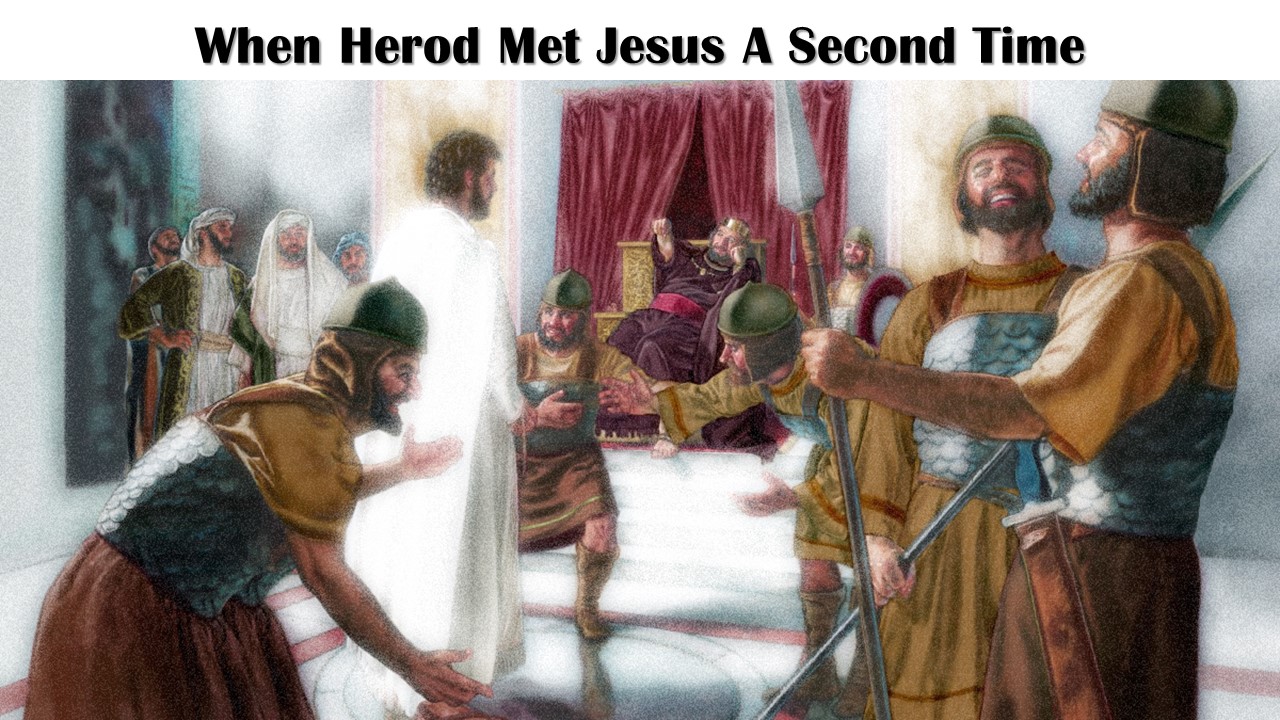
When Herod Met Jesus A Second Time

Then Herod, with his men of war, treated Him with contempt and mocked Him, arrayed Him in a gorgeous robe, and sent Him back to Pilate. (Luke 23:11)

When Herod Met Jesus A Second Time

The dynasty of the Herods fills the pages of scripture. Herod the Great ordered the slaughter of the young males in Bethlehem, where Jesus was born. His son, Herod Antipas, murdered John the Baptist. Herod Antipas had heard of the fame of Jesus but never met Him. He wanted to see Jesus, and the opportunity never came. When the early church began, Herod Agrippa, grandson of Herod the Great (the son of Aristobulus, whom Herod had put to death), had James killed. Agrippa would die a horrible death of worms for taking on the glory of God. Three Herod families filled the land with violence, hatred, and murder. The second Herod finally had his day when he could meet Jesus face to face. It would be a day he would never forget.

After His arrest, Jesus endured the trials by the Jewish leadership and was taken to Pilate. Hearing that Jesus was from Galilee, Pilate pawned Jesus off to Herod, hoping to wash his hands of the case. Herod was excited to see Jesus as he had desired to meet him. Herod had been hoping for a long time to see Jesus perform a miracle. When the Lord came before King Herod, he asked Jesus question after question, but Jesus refused to answer. All the while, Jesus stood before Herod; the Jews shouted their accusations against Him. Jesus remained silent. Herod was not accustomed to men ignoring him and called his soldiers in to punish the man from Nazareth.

Herod began to mock and ridicule Jesus. His soldiers treated Jesus with contempt. As men of war, they had no compassion for the little man in front of them who remained silent. Their insults were cruel as they spit upon Him, slapped Him, laughed at Him, and cruelly taunted their victim. They put a gorgeous robe on Him to make the picture more humiliating. Tired of their taunts, Herod sent Jesus back to Pilate, thinking he would never see Jesus again. Jesus was condemned to die and crucified as an enemy of the Roman state. Herod probably read the report and was glad to have the matter settled.

The rule of Herod did not end well. He was banished by Caligula and died in exile around 39 A.D. On the scale of human history, Herod Antipas was an insignificant part of Roman history. He and his soldiers had the Son of God standing before them, and they treated Him with the most contempt and vile manner as any despot. What changed was when Herod and his men woke in eternity and saw face to face the One they had treated so cruelly. They were no longer taunting, jeering, spitting on, slapping, or laughing. The dark reality of torment lunged before their faces as they stood before the great I Am. He was their victim in life, but now He is their judge.

Herod thought he was a man of power, and, for a time, he was. What makes the stories of despots so futile is the realization that when they stand before the Creator, they are dust. The mercy and grace of God were offered to these men, but they refused. They treated men cruelly and viciously, but a day of judgment is where a greater One judges them in righteousness and truth. There is much sorrow and pain inflicted by men in this world. God does not forget. When Herod saw Jesus the second time, Herod was on his knees. Jesus did not treat Herod with contempt. It saddened the heart of the Lord to see the despot kneeling before Him, but God’s wrath is against all ungodliness. The cry of those in darkness will fill the vastness of eternity when they meet the One who judges all men.

Posted in Uncategorized | Leave a comment

God Got Angry

Therefore, as the Holy Spirit says: “Today, if you will hear His voice, do not harden your hearts as in the rebellion, in the day of trial in the wilderness, where your fathers tested Me, tried Me, and saw My works forty years. Therefore, I was angry with that generation and said, ‘They always go astray in their heart, and they have not known My ways.’ So I swore in My wrath, ‘They shall not enter my rest.'” (Hebrews 3:7-11)

God Got Angry

It is easy to think of the Lord God as a kind, benevolent old man with white hair sitting on a white throne, smiling at the world and passing out harps to little angels circling His throne. Everything known about God is found in the Bible, yet the imagination of human wisdom has recreated God into an image of the totem of human wisdom. The Bible is full of the love of God, His mercy and grace, and His benevolent spirit. There is no doubt about the goodness of the Lord. What is often overlooked for purposes of denying the truth of God’s character is the truth that God can get angry and punish His creation.

The reason the severity of God is not accepted is that it makes men accountable for their actions. If God is only a God of love, man can do whatever he wants to do, and God will love him and accept him. Nothing is further from the truth. It does not matter how a person lives; everyone goes to heaven. Men struggle with the notion that God would send anyone to a place of eternal torment because that is beyond the wisdom of human reasoning. How could a God so full of love be so cruel to damn a soul to perdition? A loving God can never become so angry He would destroy His creation.

Human wisdom cannot accept the anger of God because men refuse to accept the Bible as the divine word. The history of Israel is preserved in scripture to lay bare the failure of human wisdom and make clear the demonstrative anger of the Lord against those who oppose Him. Blame does not begin with God but with Israel. It was the nation of Israel that hardened their hearts in rebellion. The people of God tested the Lord, tried His patience, and refused to obey His word. God is the one who parted the Red Sea and rescued the Hebrews. It was by the power of God the Amalekites were defeated. Israel never lost a battle in the forty years of wandering, except when Israel made a futile attempt to invade Canaan at Hormah. God provided food, water, and clothing for forty years. Israel still rebelled with all the signs God gave them.

God was angry. The Hebrew writer testifies to the word of the Holy Spirit that God became angry with Israel and made a decision that would change the people forever. Israel turned their hearts away from the Lord. They refused to do what God told them, and He punished them. The Lord God swore in His wrath the rebellious would not enter the promised land, and they did not. Everyone from the age of twenty years and above died in the wilderness. The only two men who did not die were Joshua and Caleb. God was angry and punished His special people. Yes, God will punish those who do not obey His word. That judgment has not changed.

The history of Israel is left for men to read and understand the goodness and severity of God. There is much about the love of God that saves men, but there is much about the wrath of God that will destroy the disobedient. No one gets a free pass to eternal life because they are good, religious, or breathing air. The only people in heaven are those who follow the will of the Father. God’s wrath is real. There is a place called Hell. It is prepared for the devil and his angels, but it will be full of the majority of humanity because men refuse to obey God. The anger of God is real. Take note. Wake up. Jesus came to take away God’s wrath, but His sacrifice means nothing if you do not obey His word. There is a great day coming. Prepare to meet your God.

Posted in Uncategorized | Leave a comment

The Devil Can Be Beaten

Be sober, be vigilant; because your adversary the devil walks about like a roaring lion, seeking whom he may devour. Resist him, steadfast in the faith, knowing that the same sufferings are experienced by your brotherhood in the world. (1 Peter 5:8-9)

The Devil Can Be Beaten

Fear can only be measured by the amount of courage we lack to stand against something bigger than ourselves. The devil is a powerful and consuming adversary that stops at nothing to devour his prey. When the prey stops praying, fear takes hold, and the soul is lost. Satan convinces the heart there is no hope, no answers, and no power to resist him. That is a lie. It should not surprise the people of God when the devil lies, as he is the father of all lies. The truth lies in the eternal fact that when the people of God are alert and watching out for the great enemy, he can be beaten – and badly.

There is little doubt Satan is like a hungry and devouring lion. He cares not whom he consumes, and his greatest delicacy is the soul of God’s people. Prowling like a lion, ready to pounce with a roar that brings fear into his victim, the devil uses his wiles and deceits to destroy faith, hope, and trust. The devil can be beaten when the heart stands firm against him with strong faith. Everyone suffers under the hand of the devil. From the moment he first spoke to Eve in Eden until the final day when Jesus Christ returns with the heavenly hosts of angels, Satan will find ways to destroy righteous hearts. God wants His people to know Satan is defeated. He will be defeated in judgment when the Lord casts the devil into a lake of fire, which is the second death. Hell was prepared for the devil and his angels – and he knows it. Before that time, he will make every effort to take as many people with him as possible – and he is doing an incredible job. Most people fall prey to his wiles because they do not know Satan is defeated and can be beaten.

Faith assures the heart that God is greater than Satan. The Father does not make idle promises. He has said He will not allow His people to be tempted beyond their ability to resist. There is a hedge placed around the family of God to protect them. When the little foxes of doubt and despair come into the heart, the hedge of protection is compromised. Satan begins to whittle away at the heart. The Christian must be sober and stay alert with vigilance. The devil is walking about. Stand firm against him and resist him. He can be beaten. Standing steadfast in the faith of Jesus Christ will protect the heart from the devil’s wiles.

When the roaring lion of Satan’s breath blows its evil deceit in your face, stand firm and look the devil in the eye and tell him he is beaten. Shake your righteous fist in his face and tell him to go away – and he will – he has no choice. He can be resisted. Satan can be beaten. The devil is not greater than the spirit of faith residing in the heart of God’s righteous people. He will chip away at our lives, seeking to destroy us, but there is no condemnation in Christ Jesus. Satan plants seeds of doubt in our minds that must be destroyed. Jesus did not die to offer a weak promise of hope but a courageous faith of trust, knowing that I am a child of God and Satan will not have his way with me. Get away from me, Satan. You are beaten. You are defeated. You are crushed. It is not I that lives, but Christ Jesus that lives in me.

Posted in Uncategorized | Leave a comment

Three Point Life Sermon

Let love be without hypocrisy. Abhor what is evil. Cling to what is good. (Romans 12:9)

Three Point Life Sermon

Many nuggets in scripture are designed for a simple pattern of learning. The scripture divisions are always interesting, and there is nothing to indicate how and why Robert Stephanus (1551) chose to divide the New Testament as he did. Chapters and verses have made it easier to study the Bible. Often a single verse will present a basic lesson on Christian living. It is much easier when it becomes a three-point sermon. Three things are noted in the ninth verse of Romans 12: real love, abhorring, and clinging. Living by these principles (commands) will change the heart to be devoted to the will of the Father.

Love is the basis of human relationships. There are many definitions of love expressed in many different ways. The Greek language effectively divided the word into concrete ideas to discern the correct meaning. In the English language, the same word is used for many opposite ideas of what love is. A man can be in love with his wife and love her apple pie, but those two loves are supposed to be different from one another. The love Paul writes about in Romans 12:9 is the Greek, ‘AGAPE.’ This type of love differs from the ‘PHILEO’ love, similar to the English word for ‘friendship.’ A Christian’s love for others is the spirit of goodwill toward all mankind. Paul explains this kind of love must be sincere and honest love.

It is easy to love in a spirit of hypocrisy. Showing love or telling someone of their love can be couched within a heart of mistrust and hatred. The smile on the outside can mask the hatred on the inside. Love must be complete. Words do not suffice when love is expressed. Action rather than words best define love. Jesus said He loved the word, but until He gave His life on the cross, He had not expressed that divine love. God loved the world and showed His love by sending His Son. How can the love from a child of God be any less? Love should not be pretended to or unfeigned.

The second point is the appeal to abhor or hate what is evil. That is simple. There is little to unpack from the message. If something is evil – hate it, despise it, run away from it, and consider it vile. Abhorring something is not disliking something. To abhor a thing is to look at it with complete disgust and to be repulsed by it. There are things in life that, by their nature, are detestable. Evil is to be considered something that is not a laughing matter; it is not acceptable even if approved by society, or ‘just the way the world turns’ kind of thing. Evil is evil and should be abhorred immensely. Any middle ground of evil is the broad way of falsehood.

In response to evil, the Christian must hold tightly to that which is good. Hating one thing and loving intensely something else is how responsive the heart must be to putting wickedness out of the spirit and embracing all that is righteous. Clinging to something is to embrace it with a tight hold. The Greek word comes from the idea of glue or sticking to something. When the heart clings to all that is good, love will be without pretense, and evil will find its place on the dung heap. Goodness will rule the heart. All that the eye can see is the goodness of a thing.

It must be noted the only way to love without hypocrisy, abhor evil and cling to that which is good is to know how to affect these attributes in the heart. Love is defined by how God defines love. Evil is determined by the mind of God. Righteousness and goodness can only come from the Holy Spirit. Loved defined by the world fails. The world calls evil good and good evil and cannot be trusted. When the child of God seeks the word of God in his life, he will find the answers to love, evil, and what is good. Then, and only then, can he be found pleasing to the Father. Do you need a life formula? Have sincere love, run away from evil, and embrace goodness with all your might.

Posted in Uncategorized | Leave a comment

Reading The Law Every Seven Years

So Moses wrote this law and delivered it to the priests, the sons of Levi, who bore the ark of the covenant of the Lord, and to all the elders of Israel. And Moses commanded them, saying: “At the end of every seven years, at the appointed time in the year of release, at the Feast of Tabernacles, when all Israel comes to appear before the Lord your God in the place which He chooses, you shall read this law before all Israel in their hearing. Gather the people together, men and women and little ones, and the stranger who is within your gates, that they may hear and that they may learn to fear the Lord your God and carefully observe all the words of this law, and that their children, who have not known it, may hear and learn to fear the Lord your God as long as you live in the land which you cross the Jordan to possess.” (Deuteronomy 31:9-13)

Reading The Law Every Seven Years

Moses was one hundred twenty years old when he brought the children of Israel to the borders of Canaan a second time. Four decades earlier, the people rebelled against God when they did not believe the Lord could deliver them from the hand of the people of Canaan. Moses would not be allowed to enter the promised land and gave the nation’s leadership to Joshua, son of Nun. God promised to fight for the people to destroy all the nations as He did to Sihon and Og, kings of the Amorites and their land, which He destroyed. The people needed faith and courage that God would fight for them, giving them victory on every hand. All the promises of God were true and faithful. The Lord would never leave them or forsake His people.

Before crossing the Jordan, Moses wrote the law and delivered it to the priests, the sons of Levi, and to all the elders of Israel. The Law of Moses was the word of God instructing the people in their obedience to the will of the Lord. It contained all the requirements and blessings of God’s overshadowing plan to bless Israel above all nations of the earth. If the people obeyed the word of the Lord, God would bless them immensely. The warnings against disobedience were harsh. When Moses delivered the written law to the people, he included a caveat that was a part of the law. Every seven years, at the Feast of Tabernacles, all Israel must come before the Lord and listen to the law read to them. All of the men, women, and children and the strangers among them must gather together to hear and learn to fear the Lord God through the reading of the law. The reading would remind them to observe all the words of the law. This reading was not a choice but a command that must be obeyed.

A secondary reason for the reading of the law was to teach the children who did not know the word of the Lord. Every generation would hear the whole law read in its completeness at the end of each seven years. If a man lived to be seventy years of age, he would have heard the reading of the law seven times. Children would listen to the reading of the law. Husbands and wives had no excuse to understand the law. Masters and slaves heard the law being read. Young men and women learned the blessings and penalties of the law. Hearing the law every seven years would help to engrain the message of God within the hearts of the people.

The history of Israel does not indicate how long this practice was kept, but it is evident by the failed efforts of the nation; the reading of the law every seven years did not take long to be forgotten. Israel’s history is what happens when the word of the Lord is ignored and put aside. During the period of the Judges, every man did what was right in his own eyes. King Saul did not take much stock in reading the law. Solomon allowed his foreign wives to hinder his reading. During the days of the divided kingdom, few kings knew the law. Israel was destroyed for lack of knowledge.

Jesus Christ established His church and gave the law of God to His people. It is evident by the example of Israel the need for continual reading of the law. Every Christian should make it a permanent part of their life to read the word of God. They should not wait every seven years to read the book. A daily meditation on God’s word will create healthy, vibrant, faith-filled lives. Children who grow up with parents who do not read the Bible to them are many, which is why young people walk away from God. They never saw Him in their homes. Reading the word of God is where faith comes from. If there is no reading, there is no faith. Israel was given as an example of what happens when a generation comes that does not know the law of God. Read the Bible. Your eternal life depends on it.

Posted in Uncategorized | Leave a comment

What The World Needs Are Broken Hearts

Now when they heard this, they were cut to the heart, and said to Peter and the rest of the apostles, “Men and brethren, what shall we do?” (Acts 2:37)

What The World Needs Are Broken Hearts

Devout Jews from every nation came together in Jerusalem as they had done for centuries. The Day of Pentecost was one of three feasts requiring an annual pilgrimage to Jerusalem. This feast was during the barley harvest, lasting until the end of March in the lower Jordan Valley to the beginning of May in the mountains. It was also called the Feast of Harvest. Seven weeks after the death of Jesus, the city of Jerusalem was filled with pilgrims from every nation under heaven. When the Holy Spirit came upon the twelve apostles with a sound from heaven, as of a rushing mighty wind filling the whole house, a large crowd gathered to see the spectacle. They were amazed to hear the Galileans speaking various languages and preaching about a risen Christ.

The apostle Peter took center stage, explaining what was happening fulfilled the prophecy of Joel. He continued to explain that Jesus of Nazareth, a Man attested by God by miracles, wonders, and signs, was the promised Messiah whom God raised up to sit at the right hand of the Lord. Peter explained how David had foretold the coming of Christ. He affirmed that God had made Jesus both Lord and Christ. The multitude responded to the powerful message from the apostle Peter. Luke records that the people, hearing these words, were cut to the heart and begged Peter to tell them what to do to be saved. They had killed the Prince of Life, the Holy One, and the Just One.

Peter tells the multitude to repent and be baptized for the remission of their sins. The promise of the Holy Spirit was given to all who obeyed the word of the Lord. On that day, three thousand people were baptized for the remission of their sins. They gladly received the words of the apostles and obeyed. And they continued to devote themselves to the apostles’ teaching, and fellowship, and the Lord’s Supper, and to prayer. The early church had begun with three thousand open-hearted, receptive, excited, and devoted people.

What makes the story of Pentecost so remarkable is the open hearts of those who obeyed. Three thousand seems a large number, and while it is an incredible crowd to begin the church, many more thousands did not obey. What made these saints special was the kind of heart they had. Many people had a hard heart on that day, refusing to submit to the gospel of Jesus Christ. The open-hearted Jews readily accepted the truth as the word of God. There was no argument or dissent in the simple sermon of Peter. They were cut to the heart when they realized they had killed the Son of God. There was no effort to rest on their religion as a reason to refuse the invitation of Peter. No one argued salvation by faith only or grace alone. When the three thousand were baptized, they were immersed; not sprinkled or poured and misted with water.

On the Day of Pentecost, three thousand open hearts obeyed the gospel of Jesus Christ without delay. That same sermon is preached today, and people reject it as salvation by works. Hearts are not as tender as they were on the Day of Pentecost. The invitation of Jesus is given, and few respond. It is not because the gospel has been diminished, but the hearts of the people have grown hard. False doctrines like “just accept Christ as your personal Savior” are readily accepted because the heart is hardened to truth. Those devout Jews two thousand years ago had a heart that changed the world. What the world needs now is a heart willing to listen to the word of God and respond. When will men stop arguing with God? It is a no-win situation. The word of the Lord remains the same. “Repent, and let every one of you be baptized in the name of Jesus Christ for the remission of sins; and you shall receive the gift of the Holy Spirit. For the promise is to you and to your children, and to all who are afar off, as many as the Lord our God will call.” What will your heart do with this?

Posted in Uncategorized | Leave a comment