Then Peter Said To Them

Then Peter said to them, “Repent, and let every one of you be baptized in the name of Jesus Christ for the remission of sins.” (Acts 2:38)

Then Peter Said To Them

Five simple words were written by Luke that changed the world. Peter and the eleven were in Jerusalem as instructed by Jesus Christ. The Holy Spirit had come upon the twelve as the church promised by Jesus was beginning its foundation of grace. Jesus had ascended to the Father as the resurrected Christ. Twelve men were commissioned to take the gospel of grace to the world. On Pentecost, devout Jews from all over the world had come together and were listening to the words of Peter. In just over five hundred words, Peter convicted the hearts of many in the audience that Jesus of Nazareth was the expected Christ. The crowd realized they had killed the Son of God just over a month ago. They were cut to the heart. There was desperation in their voices as they cried to Peter and the rest of the apostles, “Men and brethren, what shall we do?” This was a moment of decision. Realizing the immensity of their crime, the crowd burst forth with a fervent desire to find hope in what they had done. How would God answer them for killing His Son? It was a time of uncertainty and fear.

Five words. Luke opens the portals of heavenly grace with five words. No drumbeat or trumpets were blaring. All that Luke records are the words, “Then Peter said to them.” The apostle Jesus had promised would be given the keys to the kingdom and had just been granted the divine privilege. At that singular moment in the history of humanity, God’s grace was about to sing forth the wonderful news of salvation. From the depths of man’s failure in the Garden of Eden, the cry for salvation was heard from generation to generation. Noah believed and prepared the ark for the saving of his household, but he could not have imagined what Peter would say. Abraham was given the threefold promise, and he would only see the promise of a son. Moses took the Hebrews to the promised land and never saw the fulfillment of the Christ. David and the prophets wrote about their longings for the Messiah, but that message was centuries away. It was at Pentecost the angels held their breaths as the question was asked, “What must we do to be saved?”

The words of Peter shouted salvation through the halls of heaven. Three thousand souls heard the words of Peter and did not doubt what he said. There were no arguments. No one asked about the thief crucified with Jesus. ‘Faith only’ was not suggested as an alternative. None of the twelve apostles claimed allegiance to any church not ordained by the Holy Spirit. No scholars were pouring over the definition of the Greek words, whether baptism was necessary or not. At that great moment when the crowd burst forth with their desperate plea, Peter said to them, “Repent and let every one of you be baptized in the name of Jesus Christ for the remission of sins; and you shall receive the gift of the Holy Spirit. For the promise is to you and to your children, and to all who are afar off, as many as the Lord our God will call.” Peter continued to preach to the crowd, telling them to be saved, and what they did was remarkable. They obeyed. Three thousand obeyed and never argued.

It is sad to hear so many disagree with the necessity of baptism. There are many examples of the necessity of baptism, but for now, focus on what Peter said the first time the question was asked. The crowd wanted to know what to do, and Peter told them what to do, and three thousand people did what Peter told them to do. Why is that so hard to accept? The Jews on Pentecost had less to go on than the modern man who has sixty-six books of divine revelation, and they were baptized for the remission of sins – no questions asked. Believers increasingly were added to the Lord, multitudes of both men and women, without denying the necessity of baptism. The people of Samaria did not argue. Saul of Tarsus did not deny baptism. Neither did the man from Ethiopia, Cornelius and his household, the people of Asia Minor, Thessalonica, Ephesus, Athens, Philippi – and the list is endless.

Let me ask you a question – why do you always resist the Holy Spirit? Then Peter said to them … you read the rest.

Posted in Uncategorized | Leave a comment

No Retirement

And I will say to my soul, “Soul, you have many goods laid up for many years; take your ease; eat, drink, and be merry.” (Luke 12:19)

No Retirement

The idea of retirement is a relatively new phenomenon in the modern world. For thousands of years, there has never been a time in life when the mass of people could attain a place where work was not required. When Adam lost his paradise home, he was forced to work by the sweat of his brow for his livelihood. The daily struggle of life was measured by the constant need to provide food, clothing, and shelter. Only for the wealthy was the privilege of taking one’s ease a possibility. With the advent of government programs and financial packages companies offer, retiring has become a common practice. Most people look forward to when they can stop working and spend their final days with ease and pleasure.

While the privilege of retiring is a blessing in the work field, there is one area where there is no retirement. A war has been waged that will never stop until a person dies. Early in life, the spirit of a man learns accountability to God, and sins begin their vicious attack. The knowledge of good and evil separates a man as an eternal creature accountable to God. This spiritual battle never stops and is not measured by years. Only death will bring an end to the constant warfare of overcoming the wiles of the devil. Fighting against evil never stops. There is no retirement from the battlefield. No gold watches are given to those who succeed after twenty, thirty, or forty years. The reward will only come on the other side of the grave.

Retirement is a time to take one’s ease, eat, drink, and be merry. Jesus told the parable about a rich fool who positioned himself in a place where he thought his life was set for good. His failure was not preparing his eternal spirit for death. God had blessed him with great wealth that he decided to horde for himself. He thought he would live out his days in pleasure and ease. God called him “Fool” because he died that same night. He wanted to retire in splendor. His death changed everything. There is never a time in life when the soul must not work diligently to keep itself pure from the influences of evil. Sin is a constant threat to all men.

One of the sad things that happen in the church is when people retire from their secular job and decide they can retire from the church as well. They no longer teach classes, help with the work of the church, open their homes for Bible studies, attend classes during the week, or do other church activities. The older are told to teach the younger because there is never a time a person should retire from the work of the Lord. Some saints use their retirement to do more for the Lord. Not burdened with a daily job, they spend themselves helping the local church prosper in number and spirit. The work of the church will continue to need people to man the stations of evangelism, benevolence, and exhortation as long as the world stands. Retirement is a blessing to be used for the glory of God. Becoming like the rich fool in the parable of Jesus has no meaning to the man’s life. He wanted to sit back and take his ease, and he died that night. If a man must die, let him die busy for the Lord instead of lying around doing nothing. Enjoy retirement, but please do not retire from your spiritual battles and the work of the church. We need all hands on deck – those still working and those who are retired.

Posted in Uncategorized | Leave a comment

Distrust In The New Member

And when Saul had come to Jerusalem, he tried to join the disciples; but they were all afraid of him and did not believe that he was a disciple. But Barnabas took him and brought him to the apostles. And he declared to them how he had seen the Lord on the road, and that He had spoken to him, and how he had preached boldly at Damascus in the name of Jesus. So he was with them at Jerusalem, coming in and going out. (Acts 9:26-28)

Distrust In The New Member

Saul of Tarsus was feared among the saints of the early church. Following the murder of Stephen, Saul took it upon himself to seek every means possible to wipe out those who were of the Way. He persecuted the church in foreign cities arresting men and women and locking them in prison. If a vote was taken on whether to execute someone, Saul cast his vote for death. There was a zealous cause burning inside Saul to destroy those who taught Jesus of Nazareth was Christ. Many of the saints lost their lives under the persecution of Saul. The apostles feared what the man from Tarsus could do.

The grace of God saw something good in Saul. On a journey to the city of Damascus, where Saul planned to arrest the saints of the city, the Lord appeared to Saul and changed his direction. Three days later, Ananias baptized Saul into water for the remission of his sins, and Saul became a valiant servant of the Lord for the cause of the church. Saul’s passion had not diminished, only his message. He now disputed with his fellow countrymen with scripture showing Jesus of Nazareth, a man attested by God through signs and wonders that He was the Christ. This made enemies of his former colleagues and fearful suspicions of those in the church. When Saul came to Jerusalem to become part of the church, the church resisted. It was difficult to believe Saul was a disciple of Christ. There were many, including the apostles, who did not trust Saul.

Saul must have understood the reasons the brethren were skeptical. He had brought much misery to the church and now wanted to be part of the church? This was hard to believe. They could not believe Saul had become a follower of Jesus Christ. Barnabas heard about the plight of Saul and came to his rescue. Taking Saul before the apostles, Barnabas explains how the Lord had chosen the leader of the great persecution to become one of his great preachers. The apostles rejoiced in the wonderful news of God’s grace. Saul of Tarsus was a teacher of Jesus Christ. There must have been many who were amazed at the news. Saul remained in Jerusalem preaching boldly until a plot to kill him was discovered. The brethren took Saul to Caesarea and then back to his hometown of Tarsus.

The lesson about Saul’s experience in Jerusalem shows the importance of the local work. Saul knew he needed to be part of the local congregation. However, his background had tainted the brethren to distrust the man who had been so bold to denounce the church. There was good reason to distrust Saul, but there was a better reason to accept Saul. It was true that background of Saul was troubling, and he lived with that knowledge all his life. Later, he would tell the brethren at Philippi that he had put that all behind him as he looked for the eternal crown. But now the brethren could rejoice and worship with the man who was a blasphemer and troubler of the church. His sins were washed away in baptism. He was now a child of God. Whatever he did in his past was gone. God forgave him for the murder of Stephen. The grace of God took an insolent man and made him an incredible part of the early missionary work of preaching the gospel to the whole world. Saul was a Christian. God be praised.

Posted in Uncategorized | Leave a comment

To Be A Cretan

One of them, a prophet of their own, said, “Cretans are always liars, evil beasts, lazy gluttons.” (Titus 1:12)

To Be A Cretan

Reputations can be very positive, or they can be viewed with great disdain. The Corinthians were known as very immoral people and to live like a Corinthian was to live a life of debauchery. Located two hundred miles south of Athens, Crete is an island whose inhabitants bore the distinction of being liars, evil beasts, and lazy gluttons. Paul left Titus on the island of Crete to set in order those things lacking in the church and to appoint elders in every city. There seems to be a contrast of a thriving community of Christians on an island of only 3,260 square miles with a population bearing the reputation of everything opposite the Christian character.

Paul and his companions (including Luke) stayed on Crete when Paul was being transported to Rome for his appeal to Caesar. Paul mentions Titus often in his letters as a close friend and fellow worker in his missionary journeys. Titus was left on Crete to accomplish the work of establishing the church and building up the brethren in the word of the Lord. Establishing elders was paramount to the work of Titus but considering the kind of people that Cretans were known as, it must have been a monumental task to find men with the qualities of righteousness needed to serve as bishops of the Lord’s church. Paul was familiar with the secular writers among the Cretans as one of their own prophets described the island people as less than reputable.

The gospel can change anyone, including a Cretan. Paul told Titus to establish elders in every city and there is little doubt Titus worked diligently to accomplish that task. Titus was instructed to teach the older men and women to guide the hearts and minds of the young men and women. The grace of God was given to all men to save their souls – including the island people of Crete who were known as liars, evil beasts, and lazy gluttons. The Cretan Christians were reminded to obey the powers of government and to be ready for every good work. They were not to speak evil of others, to be peaceable, gentle, and showing humility to all men. Paul begged the Christians of Crete to learn to maintain good works, meet those urgent needs among the brethren, and to be fruitful in the work of the Lord.

There are some people that seem to have greater challenges in obedience to the gospel than others. To some, evangelizing a Cretan would have the same impact as trying to convert a Corinthian. Why waste time on people that are known by their own people as liars, evil beasts, and lazy gluttons? There was a church of the Lord in the city of Corinth filled with saints of God seeking to do the will of the Lord in the face of great difficulty. The Holy Spirit preserves two letters Paul wrote to the Christians in Corinth showing it is possible to evangelize a Corinthian. Titus was working on an island with a people that had a disreputable character on three levels. They were known as liars who could not speak the truth. One of their prophets referred to the Cretans as animals with evil hearts. And they were known as worthless bums who were lazy gluttons. Paul tells Titus the Cretans needed the gospel. Churches were established. Elders were ordained. The gospel of Christ was firmly planted on the island of Crete.

The world is filled with Cretans. It does not take long to look around and find people fitting the mold of a Cretan. God does not dismiss these liars, evil beasts, and lazy gluttons. He offers them the blessed hope and promise of eternal life. Paul tells Titus the gospel can change a Cretan heart to deny ungodliness and worldly lusts, living soberly, righteously and godly in this present life. The gospel can change anyone willing to subject themselves to the saving grace of God. Are you a Cretan? Let the gospel change your heart.

Posted in Uncategorized | Leave a comment

The Nature Of Hope

And all these, having obtained a good testimony through faith, did not receive the promise, God having provided something better for us, that they should not be made perfect apart from us. (Hebrews 11:39-40)

The Nature Of Hope

Faith is not a guarantee that life will be rewarded in the here and now. The Hebrew writer outlines the lives of many of the champions of faith and leaves unnamed a host of saints who, through faith, subdued kingdoms, worked righteousness, obtained promises, escaped persecution, and lived lives of hardship and peril. Like Moses, the faithful of God were not looking for a reward in the material world but the reward that comes from the eternal blessings of glory. Even though the faithful had received a good testimony through faith, they did not receive the promise in this life. Life for these dear saints looked forward to something after death.

It is hard to imagine living each day knowing the reality of a promise you live for will probably not be achieved. There is a deep desire to embrace a promise and to enjoy that promise. The reward of living a Christian life is found in the promises made through the grace of God. It is natural to look for those promises to be enjoyed in this life. For some, the only joy they will find is when death separates them from the physical world. Life is hard, filled with persecution and trials. The Hebrew writer talks of those who were tortured and faced trials of mocking and scourging, chains, and imprisonment. God’s people were stoned, sawn in two, tempted to give up, slaughtered, and made to wander the earth as vagabonds. This is not the kind of life one would picture for the child of God. The world is not worthy of people like this.

The picture of the Christian life is filled with joy and happiness. There is truth to this picture, as all of God’s people have reason to live in delight and contentment. But the reality is that for many of God’s people, the nature of their hope comes in what happens after death, not before. God never promised that all good things would come now. Even though Christians can live a joyful life with a good testimony, they may not receive the joy of the promises of God now. What the Hebrew writer wanted his readers to understand is that God’s promises are realized in what He has prepared for them.

Hope is not what is seen but the devotion of the promises yet seen. Every child of God who has faith as the centerpiece of their life knows the promises of eternal life far outweigh the reception of promises in this life. Noah looked beyond the ark in hope. Abraham believed in promises that would not be fully realized for future generations. Moses lived in a world of power, prestige, wealth, and fame, yet he turned his back on all of it to live for the promises of God. He led the Israelites for forty years and did not get to step foot in the promised land. His faith was in the promises of God not yet seen. Our faith must embrace the promises of God, whether they are realized now or in the life to come. Whatever promises are received in this life cannot be compared to what is coming. God has promised many things, and the greatest is eternal life.

Posted in Uncategorized | Leave a comment

Take Careful Heed

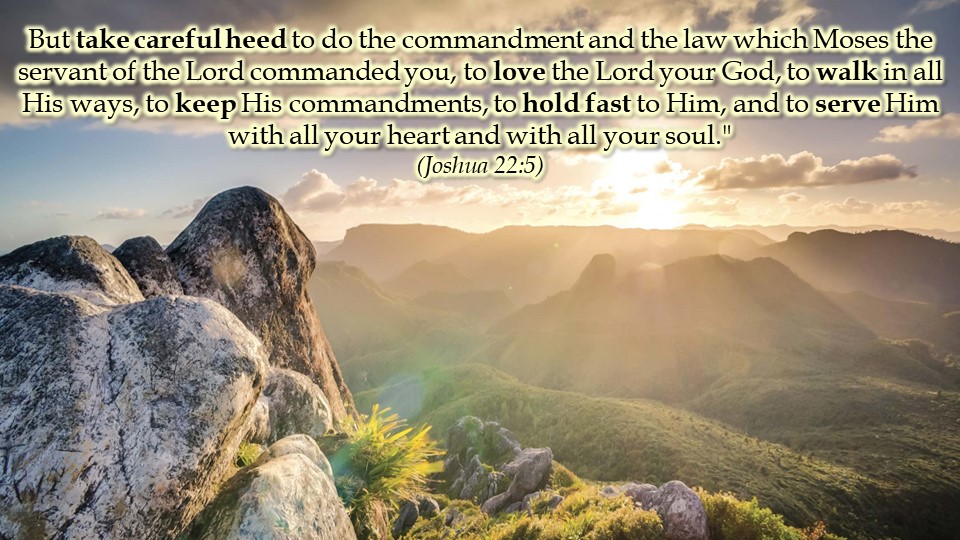
But take careful heed to do the commandment and the law which Moses the servant of the Lord commanded you, to love the Lord your God, to walk in all His ways, to keep His commandments, to hold fast to Him, and to serve Him with all your heart and with all your soul.” (Joshua 22:5)

Take Careful Heed

Following seven years of conquest in the land of Canaan, Joshua sends the tribes of the Reubenites, Gadites, and the half tribe of Manasseh to the eastern side of the Jordan, where they will settle as part of the nation of Israel. The language Joshua uses is an important outline of how God has desired the faithful among His people to serve Him. Five elements of obedience are outlined by the son of Nun. Joshua reminds the people to take careful heed to follow the word of the Lord. He does not suggest only they should take heed, but they should take careful heed to the commandments of God. This draws a fine line of distinction to watch closely how a man walks before the word of the Lord. When a surgeon is performing a delicate and life-saving operation, they not only take heed to their work, they take careful heed to what they are doing with great intent. So must the word of God be viewed.

Taking careful heed of the word of God demands the heart to love the Lord. Love is not a casual emotion but a deep and abiding feeling of dependence and willingness to listen to the word of the Lord. Many will say they love God but never do His will. Love demands taking careful heed to all the commandments and laws of God. If a man refuses to obey the Lord, he does not love the Lord. Love and obedience go hand in hand. There is an open heart that does not question the word of God. A willing heart immediately seeks to please the Lord in all things.

Love motivates the soul to show love by walking in all the ways of the Lord. It is easy to say one loves another, but love is best defined by action. What kind of man loves his wife and never shows it? How can a man say he loves God and never walk according to the word of the Lord? Love and action are mutually dependent on one another. A man loves God because he walks in the will of the Lord, and he walks in the will of the Lord because he loves God. Walking in the ways of the Lord is giving the heart over to whatever is needed for obedience. When a man spends more time arguing about what he needs to do or not do, he is showing how little he loves God. The immediate response of love is a willingness to walk as far and long as the word of God demands with no complaints. Taking careful heed to do the commandments is walking in the light of the Lord.

Commandments are given to be kept. People of God are commandment keepers. The religious world frowns on salvation by works contrary to everything God has expected from the beginning. Joshua told the people to be commandment keepers after he told them to love the Lord and walk in his ways. Commandment keeping alone does not save, but failing to keep the commandments will jeopardize the soul. Taking careful heed to do the commandments of the Lord is to keep those commandments. The Ten Commandments were not ten suggestions. God does not give His law as a recommendation for good living. Sin is a transgression of the law of God, and failing to keep the law of God results in condemnation. Taking careful heed recognizes the need to keep the law.

Holding fast is what a man does when he clasps onto the word. Keeping is the beginning; holding fast is what endures. Serving the Lord is a lifetime of love. There is no ‘one and done’ kind of obedience in the kingdom of God. Endurance is holding fast to the word of God with love, obedience (walking), keeping (perseverance), and holding tightly to the commandments of the Lord. A man of God should never let go of the word. God’s word should be a permanent part of the heart of the faithful. Taking careful heed is to grab the word and hold on with all one’s might.

Finally, taking careful heed is to serve the Lord God with all the heart and soul a man possesses. The road will be long and difficult. Satan will often try to discourage the heart, but the man who takes careful heed of the way of the Lord will put all his heart and soul into the promises of God. Joshua reminded the people of God’s faithfulness fifty years before when He delivered the Hebrews from Egypt. They must show their faithfulness to God by pouring all of their heart and soul into the will of the Lord. Sadly, Israel left the word of the Lord because they could never serve Him with all their heart and souls. When a child of God loses their love for the Lord, they will lose their heart to the wiles of the devil. Taking careful heed requires loving, walking, keeping, holding, and serving. Will you take careful heed?

Posted in Uncategorized | Leave a comment

Individual Accountability

But the children of the murderers he did not execute, according to what is written in the Book of the Law of Moses, in which the Lord commanded, saying, “Fathers shall not be put to death for their children, nor shall children be put to death for their fathers; but a person shall be put to death for his own sin.” (2 Kings 14:6)

Individual Accountability

Adam blamed Eve for taking the fruit, and Eve blamed the serpent, but, in the end, it was Adam and Eve who lost Eden. God did not accept the arguments of blame given to someone else. Adam lost Paradise because Adam sinned, and he would work by the sweat of his brow to survive. Eve lost Paradise because Eve was deceived, and she was punished with submission to man and pain in childbirth. The Lord punished accordingly the sin of the individual. When Moses gave the law to the children of Israel, God accounted for sin to the individual. Fathers could not be put to death for their children, nor children be put to death for their fathers. The law states a person shall be put to death for his own sin.

When the children of Israel began the conquest of Canaan, Achan took spoils from the city of Jericho, which was against the word of God. The crime was discovered, and Israel took Achan, his sons, and his daughters and stoned them to death. Achan took the spoil when he helped ransack Jericho, but the family was indicted for knowing he buried the treasure in the midst of his tent. During the reign of Amaziah in Judah, the king executed the men that assassinated his father, Joash. Servants of King Joash had killed the king in the house of the Millo (the landfill). The assassins were Jozacar, son of Shimeath, and Jehozabad, son of Shomer—both trusted advisers. In an act of clemency, Amaziah followed the Law of Moses and executed Jozacar and Jehozabad, but not their children.

Ezekiel was the prophet to the people of God in the bondage of Babylon. The hearts of the people were angered by their captivity. And they blamed their fathers. There was a proverb that said, “The fathers have eaten sour grapes, and the children’s teeth are set on edge.” God’s people were blaming others for why God punished them severely. Ezekiel reminded the people they were the reason they were being punished because they were sinful. The prophet declared the word of God that said the soul that sins shall die. Sons will not bear the guilt of the father, nor the father, the sins of their offspring. The righteousness of the righteous shall be upon himself, and the wickedness of the wicked shall be upon himself. A person shall be punished for their own sin.

The world always blames someone else for their troubles. Prisons are filled with innocent people, and society must bear the blame for the ills of the individual. Few accept responsibility for their actions – seeking to blame anything and anyone other than themselves. This becomes the pattern in a world where guilt is never accepted. And this is why so few people believe they are in danger of God’s wrath because they do not believe they are guilty of anything. Everyone goes to heaven. It matters not how a person lives; the conclusion is that all men “rest in peace” because no one is guilty. Individual accountability disappears in death. Nothing is further from the truth.

Individual accountability is the greatest reality men refuse to acknowledge. When all men stand before God in judgment, they will be standing with the uncountable billions of souls that have lived – and they will be standing all alone – bare, naked, and exposed before the great God Almighty. No one will plead the case, defend the cause, and blame someone else. All souls that sin will die. Parents cannot defend children, spouses will not answer for the other, and society will not be on the docket for witnesses. YOU will not blame someone else. Only YOU will be standing before GOD. Your LIFE will be up for discussion. If YOU lose your soul, it will be because YOU rebelled against God. And YOU will know the righteousness of God.

Posted in Uncategorized | Leave a comment

Why The Children

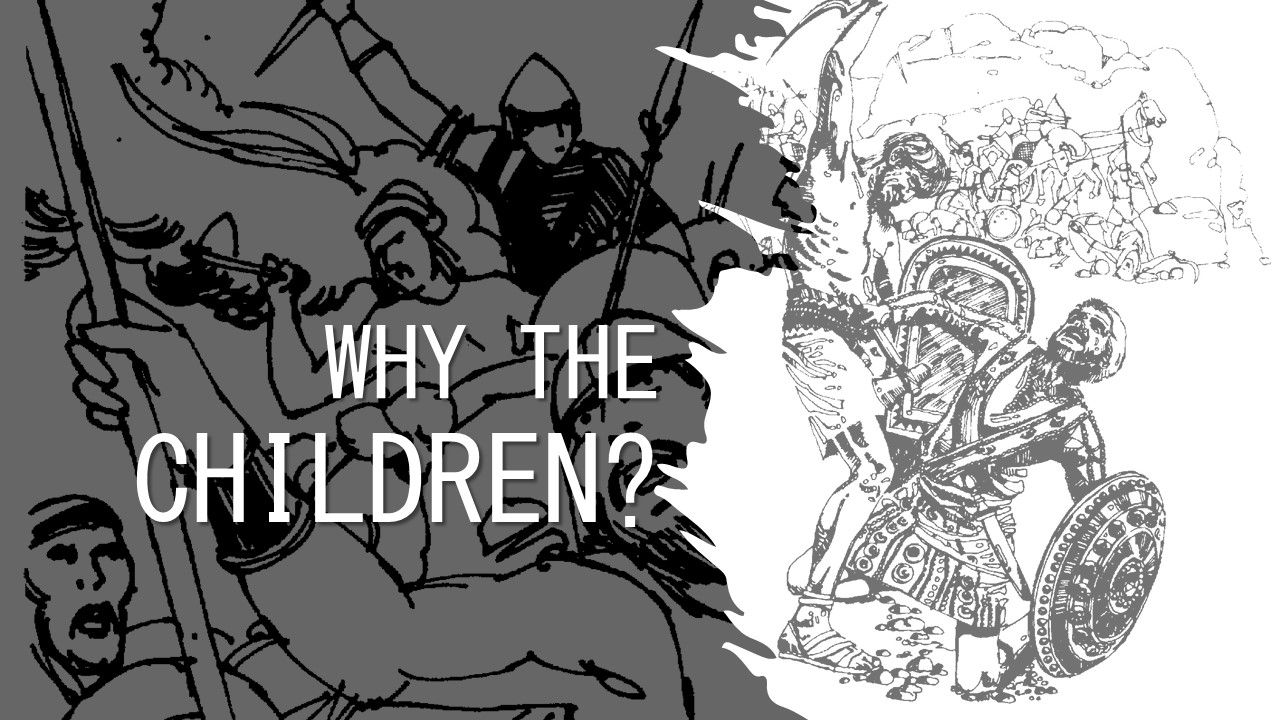
Thus says the Lord of hosts: “I will punish Amalek for what he did to Israel, how he ambushed him on the way when he came up from Egypt. Now go and attack Amalek, and utterly destroy all that they have, and do not spare them. But kill both man and woman, infant and nursing child, ox and sheep, camel, and donkey.” (1 Samuel 15:2-3)

Why The Children?

The wrath of God is not a respecter of persons. It is difficult for the human mind to grasp the infinite wisdom and righteousness of God because the will of God is so much higher than man. The reality that human wisdom cannot rationalize is how purposeful the plan of God is in carrying out righteous judgment. Adam and Eve were expelled from the garden because they questioned the righteousness of the Lord. In the days of Noah, every person on the planet died in the flood who were outside the ark. The world had become so wicked the wrath of God declared final judgment measured by grace to destroy all who had the breath of life and save eight souls. Those outside the ark included children. Mothers pregnant with babies died in the flood. Infants drowned in the waters. Young children struggled before they also died. When God brought death to the firstborn of Egypt, young boys and girls died without respect of persons.

Abraham was told he would not inherit the land of Canaan because the iniquity of the people was not complete or deserving of the wrath of God. Joshua fulfilled that promise when he led the nation of Israel across the Jordan River and began to conquer the Canaanite cities. Jericho was the first to feel the wrath of God as a city doomed for destruction. This included everyone in the city, young and old. On the seventh day, the people destroyed Jericho, including man and woman, young and old, ox and sheep and donkey, with the edge of the sword. Only Rahab and her family were spared. Twelve thousand died in the city of Ai as the Israelites utterly destroyed all the inhabitants.

Joshua utterly destroyed cities like Makkedah, Libnah, Lachish, Gezer, Eglon, Hebron, the mountain country, and the South; he left none remaining but utterly destroyed all that breathed, as the Lord God of Israel had commanded. In seven years, Israel subdued Canaan, killing most of its inhabitants – including the children. Nearly four hundred years later, God tells King Saul to attack Amalek and utterly destroy everything they have, sparing no one. God commands them to kill both man and woman, infant and nursing child, ox and sheep, camel, and donkey. Everyone must die. The punishment against the Amalekites is judgment as retribution for the attack Amalek brought against the Hebrews when they came out of Egypt. The iniquity of the people was full in the days of Saul, and judgment was to be brought against the people. King Saul failed in his mission, but the command did not change.

The judgments of the Lord are true and righteous altogether. That means that everything God does is right. The righteousness of the Lord is not based on human reasoning but on the eternal nature of the divine. When God destroyed the children in the flood, the conquest of Canaan, and judgment against nations, He did so as a righteous act of wrath and mercy. Killing the infants and children served a purpose with an eternal design. God told Saul to kill the Amalekite children allowing the innocent to leave a pagan world and find eternal joy in the bosom of Abraham. The death of a child is sad, but they are sinless and will enjoy eternal life. Secondly, killing the children removes the seeds of future generations of the culture bent on destruction.

God told Israel to annihilate the people of Canaan. They failed in this command, and the people of the land became an irritant in the eyes of the people and a thorn in the flesh. Purity demands the complete removal of all that offends. God warned the Israelites if they did not remove the pagan influence from the land, the temptation to become like the nations around them would destroy them. Israel’s history is written on the pages of its failure to kill all the people. This failure included allowing the children (the future generation) to remain. God’s wrath demanded young and old die without exception. Man will disagree and charge the Lord with cruelty, but he does so at the expense of his soul. God is righteous, and all He does (without exception) is holy, right, true, and perfect.

Posted in Uncategorized | Leave a comment

I Will Bring You Down

The pride of your heart has deceived you, you who dwell in the clefts of the rock, whose habitation is high; you who say in your heart, ‘Who will bring me down to the ground?’ Though you ascend as high as the eagle, and though you set your nest among the stars, from there I will bring you down,” says the Lord. (Obadiah 3-4)

I Will Bring You Down

Before the flood in the days of Noah, the world was not divided into nations. Everyone spoke the same language and speech. The flood destroyed all life, and only eight souls were saved. From the sons of Noah, the world was populated again. There was unity among the people, and their pride led them to decide to build a city and a tower whose top was in the heavens. The people came to the plain of Shinar to build a great tower. When the Lord saw the heart of man was lifted in pride, He went among the people and confused their language, scattering them abroad from there over the face of the earth. Nations were formed as people gathered with people of the same language.

The tower of Babel was stopped because God stopped the work of the people. As the Creator of the world, the Lord directs the affairs of men as He sees fit. The attempt to build the tower whose top is in the heavens shows what man can do to dominate the world. God’s interference with man’s pride shows what God can do to rule the world. Because of what happened at the tower of Babel, no nation or people will ever rule over the world. The fear of world domination has always challenged the wisdom of men. Many nations have tried, and all have failed. The Roman Empire was an expansive nation but never dominated the whole world (and never came close). In recent history, the Germans and Japanese tried to spread their empires across the globe and were defeated. The history of the British Empire has its influence on a global scale but never a time of world domination.

God has put in order His will among the nations. Obadiah wrote his message specifically directed to the kingdom of Edom. Like many nations, Edom believed they could never be defeated. The ruins of Petra stand as testimony to the arrogance of their security, believing they could never be conquered. There was a feeling of pride because they lived in a rock fortress and made their home high in the mountains. They did not think anyone could reach them as high as they were. No one could bring them down. They dwelt among the eagles and lived among the stars. Edom is a vanished nation that few know about. God brought them down.

Obadiah reminds the nations of the world that while they can enjoy prominence and power for a time, God will bring them down. Nations are nothing but dust on the scale of God’s justice. It is within the will of God whether a nation will rise or fall. The news is filled with the fear of what China will do in the world. There are concerns about Russia. After the tragic events of September 11, 2001, there was fear Islam would spread worldwide. Obadiah is the answer to the fears of men. No nation will rule over the earth, and no kingdom will replace the kingdom of God, the church.

A nation can become very powerful, and if God decides, and when God decides they are to be brought down, history will record their fall. This reality includes the United States of America. The United States is a young nation of only 247 years. There is no guarantee it will last for another 247 years. That is in the mind of God. The decision to bring down America may be determined by how America brings itself down. It seems to be doing a pretty good job at self-destruction. Is there anything to fear about global domination? Read the story of the tower of Babel or the book of Obadiah, and you will find your answer. If you read the Bible, you will find the only kingdom that will survive is the kingdom of God. It’s been around for more than two thousand years and going strong. Praise God.

Posted in Uncategorized | Leave a comment

Irritants In Your Eyes

But if you do not drive out the inhabitants of the land from before you, then it shall be that those whom you let remain shall be irritants in your eyes and thorns in your sides, and they shall harass you in the land where you dwell. Moreover it shall be that I will do to you as I thought to do to them. (Numbers 33:55-56)

Irritants In Your Eyes

Purity has always been a hallmark of the people of God. When Israel was given the land of Canaan, God gave them authority to drive out all the inhabitants of the land. Many generations before, the Lord promised the land to Abraham but told him he could not have the land because the iniquity of the people was not full. God would not punish the inhabitants until there was justification for their destruction. The mercy of the Lord always allows men to find salvation, and when the final hour comes of the rebellion of man, God will punish. When Abraham walked through the land of Canaan, the sins of the people did not justify their destruction. The Hebrews had been rescued from Egypt and given the land of Canaan because the time had come for their destruction.

God told the Israelites to utterly destroy the people of Canaan. The Lord did not intend for any remnant of evil to be left in the land. When Joshua led the people against the city of Jericho, they completely destroyed everything in it with their swords. They killed men and women, young and old, cattle, sheep, goats, and donkeys. This was the plan for all of Canaan. God warned Israel if they refused to annihilate the people, they would be as irritants in their eyes and thorns in their sides. The expulsion of the Canaanites and the destruction of their monuments of idolatry was demanded by the Lord. God did not want a repeat offense of the people when they committed harlotry with the women of Moab. The people sacrificed to the gods, eating and bowing down to the gods of Moab and joining to Baal of Peor. Twenty-four thousand Hebrews died that day.

Purity requires the removal of those things that will irritate and bring pain to the hearts of God’s people. Jesus said a man cannot serve God and mammon. The problem with the human heart is the desire to serve the Lord and the temptation to partake of the forbidden fruit at the same time. Purity demands the removal of those things that bring harm. Sinful practices are splinters in the eye and thorns in the side, causing agony. They must be removed. Israel was told to remove those things that would tempt them. They refused and were destroyed. When the child of God seeks to worship the Lord shackled to the desires of the flesh and mind, God is not well pleased. Paul reminded the Corinthians they should not be yoked together with the attractions of the world. Righteousness has no fellowship with unrighteousness. There is no communion of light and darkness. If Christ has no accord with Belial (Satan – all that is evil), what harmony is there for the Christian to engage in works of the flesh?

Israel was warned if they did not remove the inhabitants of the land and their idols, those things would become their tormentors. Like the continual pricking in the eye, sin will harass the soul and torment the heart trying to find God. It has been said, “That which we are willing should tempt us, we shall find will vex us.” A Christian has enough to fight against the wiles of the devil when stone sober. How much more difficult when allowances of worldliness are allowed to trouble the spirit leading to destruction? What will it profit a man if he gains all the world’s pleasures and loses his soul? Are the irritants going to be worth it? Eternal life is all there is that will bring joy. Remove the irritants. Have a clear vision. See God in purity.

Posted in Uncategorized | Leave a comment