The Command Of Jesus

He who believes and is baptized will be saved; but he who does not believe will be condemned. (Mark 16:16)

The Command Of Jesus

Before Jesus returned to His Father, He spent forty days with the eleven and other disciples, teaching them about the kingdom of God. The establishment of the church and furtherance of the gospel would rest on the shoulders of twelve men and the first disciples. God has always revealed to men what they must do to be saved. Abraham believed God, and it was accounted to him for righteousness. God gave a law to the Hebrews under the leadership of Moses. Before the coming of Jesus, salvation for the Gentile came from the Abrahamic faith, and salvation for the Jew came from keeping the Law. When Jesus died and rose from the dead, salvation was only possible through Him.

What the resurrection of Jesus accomplished was the removal of the Law of Moses and the law of faith the Gentiles lived by. No man can be justified by keeping the old law. It is impossible to live outside Christ’s law and be saved. Jesus did not leave His disciples without the divine instructions of what a man must do to be saved. The grace of God provided the avenue of divine mercy to open a door of salvation for all who would believe and obey. God’s love made it possible that all men could know the path to salvation. All that a man needed to know to be saved came from the revelation of the Holy Spirit.

Before Jesus returned to the Father, He commanded the eleven. He told them that if someone believed in the gospel of Jesus Christ and were immersed in water for the forgiveness of their sins, they would be saved. This is what Jesus commanded. Men did not create these instructions. Jesus said if a man believed and was baptized, he would be saved. That is not a hard sentence to follow. His command is easy to understand.

If a person has no desire to believe Jesus is the Christ, the Son of the Living God, they will refuse to do anything else. There is no need to add to the command if a man does not believe and is not baptized, he will be condemned. That is the logical conclusion. Disbelief leads to disobedience. A man will have no desire to repent, make a confession of Christ as Lord, or be immersed in water if he does not believe. The command of Jesus is straightforward, simple, and powerful.

Most people in the religious world reject the need for baptism. They say baptism is not necessary for salvation but essential (which is a conflict). So many have accepted the lie of false doctrine to believe that if someone accepts Jesus into their heart as their personal Savior, they will be saved because that is all they must do (doctrine of faith only). How does that fit the command of Jesus that says salvation does not come until after immersion? Jesus said, “He that believeth AND is baptized will be saved.” Written two thousand years ago, that command has never changed.

The sad reality in the religious world today is that so many churches claim to tell people what they must do to be saved, and they tell them in a way that will condemn them. There are untold myriads of souls that die, expecting to see eternal life – based on the false testimony of those who deny immersion as essential for salvation – and find Jesus was right. How tragic and incredibly sad. Jesus did not deny telling His disciples about grace, love, mercy, forgiveness, etc. Baptism does not eliminate the power of God working to save man. But refusing to accept and teach Mark 16:16 denies God, His Son, and the Holy Spirit.

If a person does not believe, he will not obey. When a person refuses to obey, they will be condemned – lost. There is no good deed a man can do to justify himself without obedience to the will of God. Jesus explained that most people will be lost. One reason is because they believe the lie told them by false teachers who deny Mark 16:16. It is sad to see those who believe in Jesus and refuse to follow His word. The command of Jesus is plain. Reading Mark 16:16 a thousand times will not change the command of Jesus. The disciples went out and preached the command of Jesus everywhere.

Posted in Uncategorized | Tagged , , , , , , , , , , , , , , , , , , , , , , , , , , , , , , , , , , | Leave a comment

The Bible Teaches Me To Hate

Through Your precepts I get understanding; therefore I hate every false way. (Psalm 119:104)

The Bible Teaches Me To Hate

Everything God wants man to know is found in the Bible. Established over 1500 years, the Bible has become the complete revelation of God’s will, instructing men what to do to be saved. There is no other book that has changed the world more than the Bible. From Genesis to the Revelation, all of God’s words are true. Everything about the sixty-six books of the Bible is the power of God unto salvation, revealing the righteousness and wrath of God. Through the precepts and teachings of the word of God, everyone can understand the way of truth.

Something else happens when one devotes one’s life to the word of God. They develop a hatred for every false way and wrong path. This kind of hatred is not sinful arrogance but the righteous character of discerning right and wrong. The more the heart fills with the word of God, the keener the heart becomes to detest, abhor, and despise the path of unrighteousness. There is an opening of the eyes to the consequences of sin. The Bible exposes sin as an abhorrence to the character of a righteous God. The psalmist proclaimed his love for the truth of God and that in that truth, he hated every false way.

Hating sin does not produce prejudice against a person. Having a hatred formed of the word of God is developing a heart that demands the word of God be taught in its pure form. Joseph refused to engage in sexual immorality with Potiphar’s wife because he hated sin. He did not reject her advances because of Potiphar finding out or the compromising consequences of their actions. He abhorred evil and refused to be held a slave to sin. Job is recorded as a man who was blameless and upright and one who feared God and shunned evil. Hating sin is how a man becomes blameless and upright. Fearing God will help to shun evil.

The Bible is the divine manual to hate all things that God hates. God’s law will teach a hatred for false teaching, lying, stealing, sexual immorality, hypocrisy, and ungodliness. The world does not recognize right and wrong as the Lord defines right and wrong. Devoting the heart to a study of the law of God clearly defines what is right because God is right. Sin is not excused or ignored. The Bible shows the faults of men like David, who sinned with Bathsheba. He repented because he hated sin, and he hated how he had allowed sin to entrap him.

There is no greater message than found within the pages of the Bible to learn the love of God. The irony of knowing the love of God is to learn to hate every false way. Loving God is accepting His righteousness as the path of life. Walking in the light will put a man in contrast to the darkness. Men love the darkness. The Christian loves the light and hates the darkness. Learning about the sacrifice of Jesus and the cost of your redemption should cause you to hate every false way with a divine hatred. Read the Bible. It will change your life.

Posted in Uncategorized | Tagged , , , , , , , , , , , , , , , , , , , , , , , , , , , , , , , , , , , , , , , , , | Leave a comment

The Stubborn Egyptian Heart

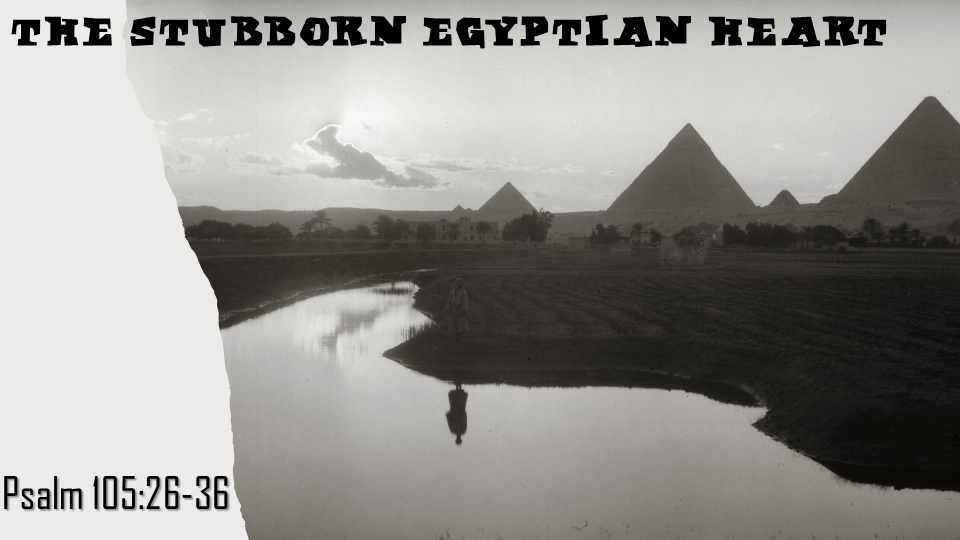
He sent Moses His servant, and Aaron whom He had chosen. They performed His signs among them, and wonders in the land of Ham. He sent darkness, and made it dark; and they did not rebel against His word. He turned their waters into blood, and killed their fish. Their land abounded with frogs, even in the chambers of their kings. He spoke, and there came swarms of flies, and lice in all their territory. He gave them hail for rain, and flaming fire in their land. He struck their vines also, and their fig trees, and splintered the trees of their territory. He spoke, and locusts came, young locusts without number, and ate up all the vegetation in their land, and devoured the fruit of their ground. He also destroyed all the firstborn in their land, the first of all their strength. (Psalm 105:26-36)

The Stubborn Egyptian Heart

Egypt was the superpower of its day in ancient times. There was no greater nation than Egypt as the Pharaoh assembled vast armies to destroy adversaries. It became the breadbasket of the world. The wonders of Egypt continue to astound modern scholars. It is one of the oldest nations still in existence today. During the period of the “New Kingdom,” a band of Hebrews migrated to Egypt in the time of a famine. Many years later, a young Hebrew infant was taken by the daughter of Pharaoh and raised among all the splendors of Egypt.

Moses was taken by the daughter of Pharaoh and became the adopted son. He was taught the wisdom of the Egyptians and was mighty in words and deeds. At the age of forty, he killed an Egyptian who was beating a Hebrew. The next day, Moses learned his deed did not go unnoticed, and he fled the country for forty years. At the age of eighty, Moses returned to Egypt through God’s divine call, who instructed Moses to plead with Pharaoh to free the Hebrews from their bondage. Moses warned the Pharaoh great calamities would fall upon the nation if he refused. Pharaoh refused.

To show the power of God over the gods of Egypt, the Lord sent ten plagues upon the nation of Egypt. These plagues consumed the whole of the Egyptian population. The Hebrews were spared any effects of the plagues. God sent the darkness upon the land, turned the water to blood, and killed their fish. The land was consumed with frogs, flies, and lice in all their territories. The Lord rained down hail and flaming fire on the land, destroying the fines, fig-trees, and the trees of their territory. God spoke, and young locusts came without number, ate up all the vegetation, and devoured the fruit of the ground. The final plague was the most terrible of all. The Lord God killed every firstborn in the homes of the Egyptians, including the firstborn among the animals.

What nation could endure such an onslaught of devastation and disaster? The economy of Egypt was destroyed. There is no competition between the gods of Egypt and the God of the Hebrews. Families were ripped apart with the loss of children. No vegetation or trees were remaining on the land. It looked like a moonscape. Fires simmered from the hail and flaming fire. The stench of dead frogs and locusts filled the land. And Egypt remained defiant against the knowledge of the one true God.

Moses went to Pharaoh to argue his case, but the people of Egypt suffered the most. They endured the terrible plagues at the hand of their ruler, whom they called and revered as a god. Every plague proved the Lord God’s might, and yet Egypt’s heart remained steadfast, believing in the false gods. Soon after the Hebrews left Egypt, Pharaoh sent his army to bring them back. His false religion so corrupted the mind of Pharaoh he believed he could defeat the Lord God, who had just destroyed his nation. How arrogant! His pride closed his eyes to what a greater power can do against human wisdom.

The Bible is the testimony of the Lord God. There are no plagues today brought by the hand of the Lord to punish the people who refuse to submit to Him. All of the majesty and power of God is found in the word of God, declaring how much greater He is than all that man has. There is no greater evidence of the power of God than the living word that testifies Jesus is the Christ, the Son of the Living God. Most of the world, like Pharaoh and the nation of Egypt, scoff, mock, and laugh at the Bible. In the same manner as the misguided king of Egypt, they think they have greater wisdom than God. And when they send their armies of humanism against the power of God, He destroys them like He destroyed the Egyptian army in the Red Sea.

Israel failed to learn the lessons of Egypt. They did not suffer the plagues but saw the devastation that spread across the land. There should have been everyday object lessons for them to learn from and correct their lives. Throughout the wilderness wanderings, they complained and murmured against God, and most of them died in the wilderness. Egypt is a powerful story to show the failure of those who deny God. The stubborn Egyptian heart is still alive today. Do you believe in the power of God? Are you willing to change your life?

Posted in Uncategorized | Tagged , , , , , , , , , , , , , , , , , , , , , , , , , , , , | Leave a comment

The Social Gospel

Preach the word! Be ready in season and out of season. Convince, rebuke, exhort, with all longsuffering and teaching. For the time will come when they will not endure sound doctrine, but according to their own desires, because they have itching ears, they will heap up for themselves teachers; and they will turn their ears away from the truth, and be turned aside to fables. (2 Timothy 4:2-4)

The Social Gospel

Satan always likes to make things fun, enjoyable, and pleasing to the flesh. One of his greatest tactics is to take something good and wholesome and turn it against the will of God. He appeals to the nature of the heart to seek the betterment of others as a ploy to change the purpose and design of authority for his own malicious ends. It is a difficult issue to discuss because of the emotional baggage of the social gospel. There is a feeling of doing good for others. Good people aim to do good things in the name of God. Who can blame a person for this kind of philosophy?

The ‘Social Gospel’ is the gospel of Christ driven by the community’s social needs. As the church began to grow, men sought ways to embrace more people with a greater effort to become like the world around them. The church began to be a place of benevolence to all the poor. Programs were established to feed, clothe, and care for everyone. Leaders of the church began to embrace a political role in the community to further their cause. The church services changed to appeal to what the people enjoyed. A time of social preaching, tickling the ears of the respondents, grew churches in great numbers.

Nothing is sinful about feeding people in need, setting programs up to care for others, and creating opportunities for fun and frolic. The challenge the church faces is how to preach the gospel of Jesus Christ without the social gospel of health, wealth, and prosperity. Someone identified the social gospel as a social movement applying ethics to social problems, especially issues of social justice such as economic inequality, poverty, alcoholism, crime, racial tensions, slums, unclean environment, child labor, lack of unionization, poor schools, and the dangers of war. All noble causes, but to what end must the church include this in its work?

Another part of the movement of the social gospel, but according to the social gospel, is that Jesus didn’t complete our salvation. Instead, it’s up to humanity to achieve Jesus’s mission and bring salvation at a societal level. To this end, many churches spend more time on the social aspect of the work of the church instead of the fundamental purpose of the church to save souls. The rise of the social gospel has changed the message of the gospel of Christ to be less abrasive. If social programs bring in all different types of people, it would be unwise to preach the truth about sin because it would offend them. Preaching the social gospel excludes the message of the gospel of Christ. The two cannot dwell in the same space.

Feeding a man a loaf of bread will not save his soul, but giving them the Bread of Life (Jesus) will. Jesus could have built His kingdom on the social gospel when He fed five thousand men (not counting women and children), but He refused. When the crowds came to Him the next day (John 6), they were offended that the miracle bread maker was out of business. He upset them by demanding they change their hearts. Many turned and walked with Jesus no more. Jesus did not preach the social gospel. Many churches use the “carrot at the end of the stick,” trying to draw people by it. Jesus had the greatest carrot in the world to offer the people. They wanted to make Him their king. Jesus refused because that was not the purpose of His work.

The church is limited in what it has the authority to do because the word of God defines the work of the church. This does not suggest individuals do not have obligations. Jesus pictures the judgment scene in Matthew 25 as one of benevolence from the individual. The mission of the church is not to feed the poor of the world. An adage from the pioneer days of preaching suggested if the church brings someone in with fried chicken, ice cream, and sweet tea, they have people as dead as the chicken, cold as the ice cream, and weak as the tea. What drew believers to Christ in the first century was the preaching of the gospel.

Many churches have ‘Fellowship Halls’ where great kitchens and dining areas are found. A study of the word “fellowship” in the New Testament church shows it never refers to the eating of a meal, with one exception. The Lord’s Supper is called a fellowship. No other passages use the word “fellowship” in the context found in churches today. Gymnasiums are built to bring in the social gospel advocates to tickle the fancies of the youth. Softening the gospel helps the crowds grow in number. Sin is no longer a bad thing. The Bible is barely opened and read. Devotees to the social gospel become social Christians who have a zeal for God but not according to knowledge (Romans 10:2).

Kyle Pope writes, “Man is a spiritual creature dwelling within a physical body. The focus of the gospel and the primary responsibility of the church is to address man’s spiritual needs. There are responsibilities that the church has to assist Christians in need, but it is not the work of the church to attempt to feed, clothe, and provide medical treatment to the world. The word of the truth of the gospel is God’s means of drawing people to Himself.”

Posted in Uncategorized | Tagged , , , , , , , , , , , , , , , , , , , , , , , , , , , , , , , , , , , | Leave a comment

He Can Melt Mt. Everest

The mountains melt like wax at the presence of the Lord, at the presence of the Lord of the whole earth. (Psalm 97:5)

He Can Melt Mt. Everest

The highest mountain in the world is found on the border of China and Nepal in the Himalayas. It towers to a height of 29,031 feet elevation above sea level. Mt. Everest is a huge mountain. God created Mt. Everest as a powerful testimony of the grandeur of the earth’s topography. From the first time that man gazed upon its beauty, the mountain symbolized nature’s incredible majesty. The Tibetan name for the mountain is “Holy Mother.” Mt. Everest is so high it reaches into the upper troposphere and stratosphere. The air is very thin, with freezing winds that can go as high as 100 miles per hour.

As magnificent as Mt. Everest is, the One who made the mountain is greater. The psalmist made a startling statement when he wrote about the power of the sovereign Lord. He says God reigns with power that can melt the mountains like wax. Imagine a mountain so vast as Everest melting like wax before a flame. The only thing it takes to destroy the highest mountain on earth is the presence of the Lord. If God can melt Mt. Everest, what can He do with Sugarloaf Mountain in Florida (312 feet above sea level)?

The contrast the psalmist makes is between the power of God and idols. There is no comparison. God can melt any mountain on earth by His presence, but an idol cannot melt a candle. An idol is a dumb (without a voice) god. He is carved by man to be his god. What boast is there in an idol when an idol cannot speak? Men fall before their images, seeking their man-made gods to deliver them. The one true God can melt a mountain. What comparison is there?

When the psalmist wrote his poem thousands of years ago, he addressed the gods of wood, stone, and metal. There are many gods served today that take on another form of worship. A man’s job can become his god when he spends his life working to gain wealth to live a comfortable life, and then he dies. When a man dies, he does not wish for more time to spend at his job. It has become a futile god. Pleasure is the god of many. They live seeking all the pleasures of life and worshiping the joys of the flesh, and they die. What purpose did their life serve with pleasures that are no more? A failed god.

Serving the one true God that can melt mountains is the greatest joy a man can find in life. He serves the Creator of the mountains, oceans, stars, and planets. Everything in the world is formed by the word of the one who can melt mountains. Imagine for a moment standing at the foot of the towering Mt. Everest and watching it melt away like a fading candle. Would you not serve the One who can do that? His name is Jehovah God, and He can melt mountains. What He wants to do is melt your heart with His love.

God so loved the world He gave His only begotten Son to die for you. You did not know Jesus, but you can know Jesus. God has provided a testimony of His Son that you can read and understand the knowledge of salvation found only in Jesus Christ. He will not melt Mt. Everest. It is just that He is that powerful. If you obey Him, He will remove your sins as far as the East is from the West. There is nothing He will not forgive if you are willing to repent. Mt. Everest is not important to God in the scheme of redemption, but you are. The Lord reigns; let the earth rejoice; let the multitude of isles be glad.

Posted in Uncategorized | Tagged , , , , , , , , , , , , , , , , , , , , , , , , , , , , , , , , , , , , , , , , , , , | Leave a comment

Formed Of Dust

For He knows our frame; He remembers that we are dust. As for man, his days are like grass; as a flower of the field, so he flourishes. For the wind passes over it, and it is gone, and its place remembers it no more. (Psalm 103:14-16)

Formed Of Dust

On the way home from church, a little boy asked his mother, “Is it true, Mommy, that we are made of dust?” “Yes, darling.” “And do we go back to dust again when we die?” “Yes.” “Well, Mommy, when I said my prayers last night and looked under the bed, I found someone who is either coming or going.”

Moses writes, “And the Lord God formed man of the dust of the ground and breathed into his nostrils the breath of life; and man became a living being” (Genesis 2:7). The human body is made up of oxygen, carbon, hydrogen, and nitrogen. Calcium, phosphorus, magnesium, sodium, potassium, chlorine, and sulfur are macronutrients or elements the body needs in a significant amount. Some suggest the value of the chemicals in the human body is worth about five dollars.

What makes the human body amazing is that in the life of a man living seventy years, his heart pumps blood through the veins for 613,200 hours – nonstop. The brain processes incredible amounts of information that can be recalled for many years. A child is conceived in the womb and grows into nine months to a baby born through an amazing process. That little bundle of arms and legs begins to grow into an adult, with body changes marking the age of growth. Old age comes, and then the body dies. All of this in a lifetime measured in less than ten decades.

Everyone dies. Men have tried for ages to find a cure for death, and there is none. The body is made of dust, and to dust it will return. If a man possessed all the money in the world, it could not buy him one minute more of life. Men will spend a lifetime living in pleasure and still grow old and die. The body is created to die. Graves fill the earth’s landscape, reminding men of life’s brevity.

Man is dust, but he possesses something that no other creature has – an eternal spirit. God created man from the dust of the ground, but He created man in His own image. The body returns to the dust, but the eternal spirit lives on. When an animal dies, that is the end of its existence. Death places man into the realm of the eternal, where there is no end. This can be a time of joy or a time of horror; but it is reality! If a man lives for the pleasure of the flesh, he lives for the pleasure of dust. When a man sees his eternal spirit, he will live to find eternal life in Jesus Christ.

The Bible shows us the path to true happiness. We are worth more than $5.00. Jesus died to save us because we are more than dust.

Posted in Uncategorized | Tagged , , , , , , , , , , , , , , , , , , , , , , , , , , , , , , , , , , | Leave a comment

The Church

Jesus answered and said to him, “Blessed are you, Simon Bar-Jonah, for flesh and blood has not revealed this to you, but My Father who is in heaven. And I also say to you that you are Peter, and on this rock, I will build My church, and the gates of Hades shall not prevail against it. And I will give you the keys of the kingdom of heaven, and whatever you bind on earth will be bound in heaven, and whatever you loose on earth will be loosed in heaven.” (Matthew 16:17-19)

The Church

Jesus made a promise that would change the world and usher in the most amazing family on earth. That promise was made when Peter confessed Jesus to be the Christ, the Son of the Living God. This promise was not an idle thought of last resort or something to substitute for a plan gone wrong. The promise Jesus made to build His church was ordained before time began. Long before the world was formed in its perfection, the perfection of the church of Christ Jesus was in the mind of the Father, His Son, and the Holy Spirit.

The church is the divine institution of God’s plan to save men. When the twelve apostles preached to the multitude gathered at Pentecost, three thousand souls were saved as God added them to the church. Luke writes extensively about the church promised by Jesus. There was a church in Jerusalem. Saul of Tarsus persecuted the church or, as it was known, the “Way.” There were many churches throughout Judea, Galilee, and Samaria. These were groups of the faithful of God assembling together to worship and praise the Lord.

Defining the matter of the church is simply the idea of a group of people called out for a special purpose or reason. The Greek derivation is EKKLESIA, from “out of” and “a calling.” How appropriate for Jesus to promise to build His “out of” and “a calling” to signify the group of saved souls. Luke signifies the saved are in the church or called out people of God. To be outside the church is to be lost. Jesus purchased the church with His blood. Paul talked about the church as a people called together in the same place. He described the church coming together to worship. This would be the public gathering of the saved to carry out the commands of God to worship in spirit and truth.

The church could mean a group of people in a certain place, a gathering of churches in an area, or the universal assembly of the saints. There were churches in the cities of Jerusalem, Rome, Corinth, Ephesus, Corinth, Thessalonica, Miletus, Cenchrea, and many other places. Sometimes, the scriptures refer to churches in areas such as the churches throughout Judea, Galilee, and Samaria. There were churches in Syria, Cilicia, among the Gentiles, churches of Christ, Galatia, and of Asia.

Jesus is head over all things to the church. This is in a universal sense of all believers found in the haven of salvation, the church. Jesus died for the church, representing all those who were first added to the church on the day of Pentecost; to all those through the centuries who were saved in the body of Christ, and all those who will be a part of the house of God until the Lord returns. The church is important because it is where the saved are. Many people view the church as unnecessary, but that is not the pattern of the New Testament. If the church is not important, why is Jesus the head? Why would the Lord give His blood for something that is not essential? Those in Christ are in the church. To not be in the church is to not be in Christ. Without the cleansing blood of Jesus, there is no salvation.

Paul’s letter to Ephesus is about the glory of the church. He explains how the church was in the mind of God before time. The relationships of the members one to another show the necessity of the church. A final note about the church is that Paul wrote there is only one church. The church is the body of Christ. Jesus is the head of the body, as He is the head of the church. There is only one body and one church. It is clear from the New Testament only one church existed. There was no diversity of churches with different names, patterns of worship, avenues of salvation, and varied forms of leadership. The New Testament is the pattern of the one true church. It makes a difference what church I belong to because Christ is only head of one church, and there is only one church that God adds the saved.

Posted in Uncategorized | Tagged , , , , , , , , , , , , , , , , , , , , , , , , , , , , , , , , , , , , , , , , , , , , | Leave a comment

Called To Be A Blessing

Finally, all of you be of one mind, having compassion for one another; love as brothers, be tenderhearted, be courteous; not returning evil for evil or reviling for reviling, but on the contrary blessing, knowing that you were called to this, that you may inherit a blessing. (1 Peter 3:8-9)

Called To Be A Blessing

When a man obeys the gospel of Jesus Christ, they are called to a higher calling. The idea of a calling is how a man uses the blessings given to him for the glory of the one who has blessed him. There is no greater gift God has given to the world than the sacrifice of His Son and, through His Son, eternal life. Those who embrace the calling of God must live a life of blessing to others. This calling begins with self. If there is no joy in being a Christian, there will be no joy to share with others.

Peter knew the heartache of denying the Lord. The apostle writes to the dispersed Christians to show Jesus in their lives by being of one mind, sympathizing with others, and loving those in the body of Christ as brothers and sisters. Obeying the gospel is to have sins washed away but also to recreate the person’s life to be a light to others. Salvation is not totally wrapped up in one act but the actions of a lifetime. Jesus died for sinful men to let them be a blessing in a dark world.

The Christian is tenderhearted and humble. That is in contrast to a world that is harsh and proud. Being called to be a blessing shows how Christ changes the pride of the heart to a love for others with tenderness and humility. The remnant of God’s people is the salt that flavors the world with its love for God and compassion for others. Salt is very small, but it has a tremendous taste. A small amount of salt can make a difference. Salt is a blessing to a juicy steak that is medium rare and steaming. The life of a Christian must be a blessing to others.

There is a negative side to how God wants His people to act. Returning evil for evil is not being a blessing to others. The world expects if a man is confronted and challenged, he should respond in kind, if not with greater force. A Christian is a blessing by not repaying an evil act with more evil. If someone is verbally accosted, the blessing of the Christian is not to return in kind. Jesus was severely treated with evil and contempt; and He never responded in kind. He was a blessing to those who saw a humble man refuse to react with vengeance and anger. The centurion realized when Jesus died that He truly was a righteous man.

It is hard to be a blessing, but training the heart, soul, and mind to show a tender spirit without the revenge of worldly wisdom is how each Christian is a blessing. First, love is shown toward the family of God. When the world brings its heavy burden of sin, the Christian becomes a blessing by offering forgiveness and kindness. God wants His people to be a blessing in every part of their lives. Jesus died and suffered so that His citizens would be a blessing. This can only be done by making God’s word the day’s first blessing. Let the word of Christ dwell in you richly. Be a blessing to the family of God. Learn how to be a blessing to the world. You are called to be a blessing. Let the calling of the Lord Jesus Christ change your heart to show Christ to others. The world needs more blessings. Let it begin at the house of God.

Posted in Uncategorized | Tagged , , , , , , , , , , , , , , , , , , , , , , , , , , , , , | Leave a comment

The Eldership Of The Church

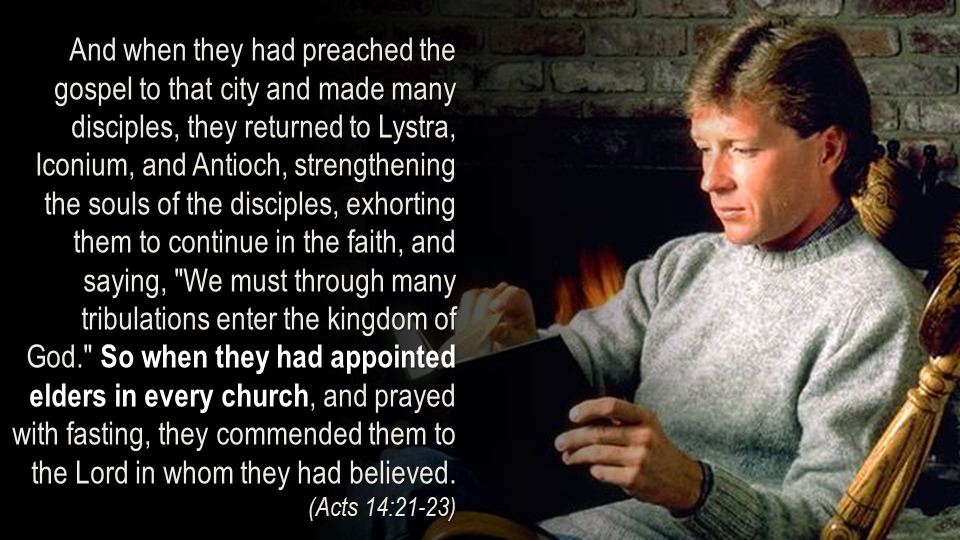
And when they had preached the gospel to that city and made many disciples, they returned to Lystra, Iconium, and Antioch, strengthening the souls of the disciples, exhorting them to continue in the faith, and saying, “We must through many tribulations enter the kingdom of God.” So when they had appointed elders in every church, and prayed with fasting, they commended them to the Lord in whom they had believed. (Acts 14:21-23)

The Eldership Of The Church[1]

When Moses was leading the children of Israel to Mount Sinai, he was overcome by the immensity of the burden of leadership. The man of God was trying to deal with all the people’s problems, and it was too much. His father-in-law, Jethro, saw how Moses struggled and advised him to appoint others to make decisions and Moses to address the weightier problems. The key was organization, and it made things work much easier for Moses.

The church was in the mind of God before time began, and the Lord had a plan for its organization. Jesus would be the head of the church. Through the Holy Spirit, the early church learned of the pattern of worship, the authority of the church, and the organization that would define the church of Christ as an autonomous body of believers. The first reference to one of the key elements of the first-century church is found less than ten years after its beginning. Peter had opened the keys of the kingdom to the Gentiles, and Barnabas had brought Saul from Tarsus to the church at Antioch, Syria, to evangelize.

A prophet named Agabus spoke of a great famine worldwide, and the disciples determined to send relief to the saints dwelling in Judea. Luke first mentions how the brethren sent the relief to the elders by the hands of Barnabas and Saul. On the first missionary journey of Paul and Barnabas, the evangelists appointed elders in every church. When the question of circumcision was addressed in Jerusalem, the apostles and elders came together to consider the matter.

Paul called the elders of Ephesus to meet him in Miletus, where he reminded them to fulfill the work given to them by the Holy Spirit. They are called overseers who shepherd the church of God. Paul warned them to be watchful of false doctrines creeping among them. A few years after Luke wrote his book on the early church, Paul wrote to Timothy and Titus, outlining certain qualities necessary for those seeking to serve in the work of the bishop. This was not the first time these qualities had been discussed, as elderships existed many years before the letters to Timothy and Titus.

The qualities described in Paul’s letters are two similar but different lists. There are sixteen qualities given in 1 Timothy and seventeen in Titus. Six are the same, six are similar, and four qualities are found in Timothy that are not in Titus and four in Titus not found in Timothy. God wants His people to see the summation of these qualities to describe the kind of men who will lead the flock. These are not suggestions but requirements. And these are not qualifications as much as qualities that define the man’s character and his work. The qualities of the wives are also under consideration as essential.

Elders are men who serve the Lord. The pattern of leadership in the church is not held by one man but by a plurality of men. They are charged with leading the flock as a shepherd, not driving cattle like a cowboy. The overseer’s work is to see over the flock’s spiritual needs. As a bishop, the elder(s) will seek to mold the members into the image of Christ. As husbands, they will be called on to guide families in distress. God desires an elder to be a father so that he will be able to guide parents in the raising of their children. Having believing children illustrates the capability of the man to guide his family in the way of truth. He will need abundant patience, temperance, self-control, and wisdom to watch over the family of God.

Peter was an apostle and a preacher and served as an elder. He was married and had children. He writes to other men who served as bishops, reminding them to serve not by compulsion but willingly, not for dishonest gain but eagerly. They are not to lord over the flock or rule as an authoritarian figure. Their lives should be examples to others in their manner of life. Those men who are elders are shepherds who will receive the crown of glory from the Chief Shepherd, Jesus Christ. The brethren must obey those who rule over them and submit to them as men who watch out for their souls. There is a harsher judgment for those who serve as elders as they must give account of the work they do in the church.

There have been abuses of leadership in the church over the centuries. The first apostasy came from among elders who walked away from the divine pattern of organization. As a result of the apostasy, the Catholic church was born. In the modern world of denominationalism, the concept of New Testament organization is ignored. Among the churches of Christ, many congregations go for years without an eldership and have no plans to establish an eldership, contrary to the command of God.

The divine wisdom of God created the church in a perfect design, and failing to follow that pattern denies the word of God. What the church needs today are men and women willing to give their lives to serve in the leadership of the church. It takes time and a great spiritual awakening in the souls of young men and women to live so that one day, they can be called upon to serve in the leadership role.

Posted in Uncategorized | Tagged , , , , , , , , , , , , , , , , , , , , , , , , , , , , , , , , , , , , , , | 2 Comments

They Did Not Believe

And when they heard that He was alive and had been seen by her, they did not believe. After that, He appeared in another form to two of them as they walked and went into the country. And they went and told it to the rest, but they did not believe them either. Later He appeared to the eleven as they sat at the table; and He rebuked their unbelief and hardness of heart because they did not believe those who had seen Him after He had risen. (Mark 16:11-14)

They Did Not Believe

Resurrection was not a new idea to the early disciples of Jesus. At least they could believe in the possibility of raising the dead from the story of Abraham and Isaac. During the ministry of Jesus, people were raised from the dead. The apostles had the power to raise the dead. Lazarus had been in the tomb after the body decayed and Jesus raised him. Nearing the end of His ministry, Jesus often told His disciples that He would go to Jerusalem, suffer many things from the elders and chief priests and scribes, and be killed and raised on the third day. It seems no one was listening.

After His resurrection, Jesus appeared to Mary Magdalene, out of whom He had cast seven demons. She went to the disciples who were still reeling from the sudden death of Jesus and told them He was alive. They would not believe her. She pleaded with them to believe she saw Jesus and talked with him, but they were too distraught to accept it. Jesus appeared to some men on the road to Emmaus and spoke with them at length. The men returned and told the eleven what happened on the road and how He was made known to them in the breaking of bread. No one believed the two men. They thought what the witnesses were saying were idle words.

Jesus appeared to ten apostles on the evening of His resurrection, and they believed. Thomas was not there when Jesus came the first time. A week later, when Thomas was with the ten, Jesus again appeared and spoke directly to Thomas. He wanted to see the scars identifying Jesus as Lord. Thomas believed when shown the evidence. The eleven (and others) must have seemed foolish in not believing Mary and the others who testified they had seen Jesus but were rebuffed.

The testimony of those who had seen and talked with Jesus came from credible sources. These were not the enemies of Jesus but disciples of the Lord. They must have been discouraged from being so excited about seeing their Lord and the apostles not believing. Maybe that is why Jesus first appeared to them and not the eleven. Their faith readily believed what they saw with their eyes and heard with their ears that Jesus was alive. As impossible as that seemed, it was real.

Faith is more than a shallow acceptance of a few facts. To have a deep faith, the heart sometimes must believe in the impossible. For Mary and the two men, they were talking to a man who had been killed by the Romans three days earlier. They knew Jesus was dead, buried, and guarded by a complement of Roman soldiers. Jesus did not fain death. He was dead. There was no question. The empty tomb puzzled Peter and John but left them disbelieving the testimonies of those who saw Jesus alive. Jesus was alive. How difficult it would be for those who saw Jesus to be unable to convince others of the truth. They saw the truth and testified of the truth. No one believed them. The unbelief of the apostles did not change the truth. Jesus was alive.

The Bible is the divine revelation of God. All truth is found within its pages. It is a testimony created over 1500 years by forty individuals with diverse backgrounds and lives. The Bible is a complete harmony of context, purpose, and design. It shows the story of Jesus Christ from Genesis to the Revelation. Sadly, the message of salvation told from the pages of the Bible is treated as a children’s story or a fanciful myth. People do not believe. Their unbelief does not change the fact the Bible is all truth. When Jesus appears, then they will know His word is truth. What do you believe?

Posted in Uncategorized | Tagged , , , , , , , , , , , , , , , , , , , , , , , , , , , , , , , , , , , , , , , , , , , , , , | Leave a comment