When Faith is Shipwrecked

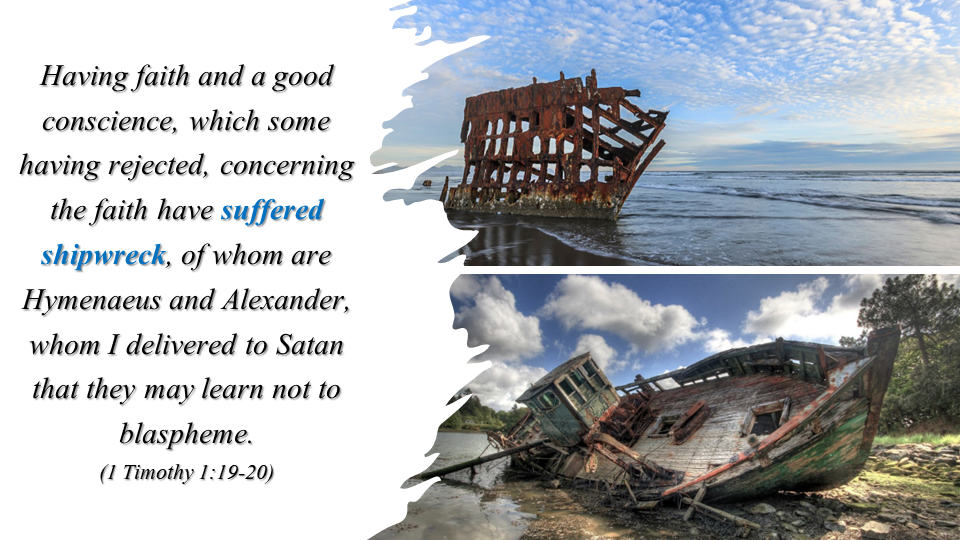
This charge I commit to you, son Timothy, according to the prophecies previously made concerning you, that by them you may wage the good warfare, having faith and a good conscience, which some having rejected, concerning the faith have suffered shipwreck, of whom are Hymenaeus and Alexander, whom I delivered to Satan that they may learn not to blaspheme. (1 Timothy 1:18-20)

When Faith Is Shipwrecked

Faith is the central characteristic of the heart to believe that God is and that He is a rewarder of those who diligently seek Him. Without faith, there is no hope. A dead faith is a life that has no works to show its faith. Believing Jesus is the Son of God requires faith to accept the life of a man that lived and died two thousand years ago, and that was reported to have risen from the grave by many witnesses. There is no physical proof of Jesus’s life apart from the scriptures’ testimony. The empty tomb of Jesus has long been lost to the centuries of time. When a man accepts the truth of Jesus to follow the will of the Father, he does so by faith.

There is no doubt that faith is necessary for salvation. What is also defined in scripture is the possibility of those who once named the name of Christ and obeyed the gospel of Christ to turn away from God’s grace for the attraction of the world. Obedience to the gospel is a necessary part of the Christian’s life. Washing sins away in baptism will not guarantee salvation alone. Only those who do the will of the Father will be saved. If a man refuses to obey the will of God, he has cast aside his faith to embrace the will of the carnal mind.

Ships sail on the waters, moving from one place to another. They are sturdy and seaworthy to make long voyages and carry great loads. There is something majestic about a ship sailing on the wide open spaces of the ocean. The greatest tragedy to befall a ship is to experience a shipwreck. This is where the ship is lost and irretrievably damaged. Over the centuries, many ships have been lost to neglect, accidents, wars, and human error. The remnants of a shipwreck can be discovered, but the ship can never be returned to service.

Paul uses the image of a shipwreck to describe the condition of the hearts of two Christians. Hymenaeus and Alexander suffered shipwreck of their faith, as Paul says he delivered them to Satan so that they may learn not to blaspheme. What happened to Hymenaeus and Alexander was not damaged by running into a rock or suffering the loss of the mizzen, main mast, or foremast. Shipwreck shows the totality of the condition. The faith of these two Christians was destroyed. It is unknown how or why this happened, but the sad reality is that it did happen and can happen.

Ships endure many things in the harsh waters of the world, and a good sailing crew will continually make repairs to keep the ship afloat and useful. When a ship suffers a shipwreck, there is nothing more to repair. It is beyond hope. Faith will endure many hardships in life. The spirit of the devoted Christian will continually repair the damage brought on by the evil one. Sadly, some of God’s children allow the trappings of the world and the lies of Satan to shipwreck their faith, leaving them with no hope.

Rejecting sound doctrine will shipwreck a soul. Giving up the warfare against the lust of the flesh will sink a Christian life. Allowing a good conscience to be filled with the desires of the world brings the soul to the depths of sin. A life shipwrecked is a life ruined. Sin will continue to beat upon the soul of the Christian. Unless the ship is found on the rock of Jesus Christ, it will be destroyed. There is nothing left to hope for.

Faith must be secured in God’s promises to survive life’s storms regardless of how bad conditions become. God will not allow the heart of His child to be destroyed if that child will continue to trust in Him. Storms will come, and some will have great winds of fear. Trusting in the Lord will keep the ship secure. Do not let Satan bring your life to shipwreck. There is nothing worse than a child of God suffering shipwreck. Stay the course. Trust in God. He will guide you to the fair haven of rest.


Posted in Uncategorized | Leave a comment

A Devout Man Who Was Lost

There was a certain man in Caesarea called Cornelius, a centurion of what was called the Italian Regiment, a devout man and one who feared God with all his household, who gave alms generously to the people, and prayed to God always. (Acts 10:1-2)

A Devout Man Who Was Lost

To be devout is to be devoted to a pursuit or movement. A devout football fan is “religious” about their fanaticism towards a team. In the business world, an employee can be a devoted team member, spending many hours on the job. Primarily, a devout person is identified by their deep faith in a religious movement, identifying them as a spiritual and religious person seeking an eternal reward.

The gospel writer Luke tells the story of a devout man in the days of the early church that was a model example of a spiritually religious soul. What made the man unusual was that he was a member of the Roman Army, serving in a regiment composed of soldiers from Italy. As a centurion, Cornelius commanded a division in the Roman army consisting of one hundred men. He was a man of great authority and responsibility. Stationed in the region of Palestine was not the most glamorous posting.

Luke describes Cornelius as an amazing person. He calls the centurion a devout man. A profoundly religious belief characterized his life. Cornelius feared God as the only true God in a world that more commonly accepted the worship of multiple gods. This trait alone would have separated Cornelius from many of his fellow officers, commanders, and soldiers under his command. The fear of God also characterized the family of Cornelius. As the leader of his home, he was leading his family to believe in the one true God. He was very generous, giving alms to the people and caring for the poor. The benevolence of the family of Cornelius blessed the community of Caesarea.

As a God-fearing man, Cornelius was a man of prayer. He prayed regularly to God. His home was an altar of prayer to the Lord God. The life of the Roman centurion was guided by a humble spirit of piety toward God in his words, deeds, and heart. Everyone who knew Cornelius recognized a man as religiously devout as any other man. The impression left by the example of Cornelius was profound. To anyone looking at the home of the Roman centurion, all would accept the fact that Cornelius was on the right track and bound for salvation.

The Holy Spirit had a different view of Cornelius. Everything Luke said about the man was true to his nature, but one essential key was missing in the life of Cornelius and his household. They were not saved by the blood of Christ and were not children of God. For all the good works the family did and all the prayers lifted by Cornelius and his family, they were not saved. An outward expression of being devout does not mean a person is saved. Salvation does not come from the religious acts of a devout man. To be redeemed is to be bought by the blood of Jesus Christ; Cornelius and his household had never experienced that saving grace.

An angel comes to Cornelius and instructs him to send to Joppa for a man named Peter. When the apostle Peter recounts the story later, he tells the Jerusalem church how an angel had appeared to Cornelius in his home and had told him to send messengers to Joppa and summon Peter and that Peter would tell them what to do to be saved. According to Peter, Cornelius and his household were lost. He went to Cornelius’s home to share the gospel so they could know what to do to be saved. As religious as the household of Cornelius was, they were still lost in their sins. Only after Peter came and taught them the gospel of Jesus Christ and baptized them in water for the remission of their sins did Cornelius and his household find salvation.

Being religious will not save. Having a good heart will not save. Going to church and being pious will not save. Salvation is not determined by the devout heart doing the right things. Jesus taught that calling Him “Lord” will not save a man if he refuses to do the will of the Father. Obedience is demanded for salvation; without an obedient heart, there is no salvation. Cornelius stands as a monument to those who think they are saved because they are religious but are lost because they have not done the will of the Father. Love the Lord and keep His commandments.

Posted in Uncategorized | Leave a comment

Why Is John 3:16 Famous?

For God so loved the world that He gave His only begotten Son, that whoever believes in Him should not perish but have everlasting life. (John 3:16)

Why Is John 3:16 Famous?

The Bible comprises sixty-six books written by forty different authors who lived within a space of 1600 years in different parts of the world. When Moses penned the first five books, he began the revelation of God’s word in written form to be kept until the end of time. As history progressed, other books were added to the divine canon of God’s revelation. When Jesus came to earth, the Old Testament, as known today, had been complete for more than four hundred years. Alexander the Great had the Hebrew text translated into Greek.

After the death of Jesus, the church began to spread all over the world. In keeping with the divine revelation of God’s word, books were written about the life of Jesus, and letters written by early Christians began to be preserved. Paul wrote seven letters before the first gospel of Jesus was written. Over time, the Holy Spirit collected twenty-seven books to be included in the New Testament canon to form God’s perfect will. There have been many more books and letters written by the people of God since Moses, but the Father selected sixty-six books to be retained for His glory.

It was not until 1228 that the Bible was divided into chapters. The verse division occurred in 1448 (Old Testament) and 1551 (New Testament). The entire Bible divided into chapters and verses, first appeared in the Geneva Bible of 1560. Using chapters and verses has uniquely directed the reader to a specific part of the scripture. Still, it has also created a division of teaching that leaves some things greatly lacking in application.

The apostle John wrote a book about the deity of Jesus Christ. His focus was to prove that Jesus was the Son of God. John’s gospel is the third largest among the four gospels. When the book was divided into verses, one out of 878 verses became one of the most famous verses in the annals of history. Many people know very little about the Bible, but many know that John 3:16 is in the Bible, and a few can quote the verse. What has made John 3:16 such a powerful draw? Why has one verse out of thousands in the Bible become one of the most recognizable verses in the Bible? What are the implications of John 3:16?

One of the key lessons of Bible study is the importance of context. The proverb says, “A text without a context is a pretext.” Examining one verse without the support of the other verses creates a conclusion denying the text’s meaning. John 3:16 is supported by fifteen verses preceding it and five verses following it. The context of the passage contains the whole of John 3:1-21 where Jesus is conversing with a man of the Pharisees named Nicodemus, a ruler of the Jews. Nicodemus has come to Jesus seeking answers. Jesus uses the time to show the ruler of the Jews the way to the Father. The Lord tells Nicodemus he must be born again and explains what He means by the new birth.

Jesus tells Nicodemus the Son of Man must be lifted up like Moses lifted up the serpent in the wilderness. Whoever believes on the Son of Man (Jesus) will not perish but have eternal life. Then Jesus tells him of God’s love to send Jesus to die for the world. Jesus continues telling Nicodemus He came to save the world as the light of the world. The problem with the world is they like to stay in the darkness, away from the light, lest their deeds be exposed. Those who practice evil love the darkness. Those who believe in Jesus love the light, so their deeds may be clearly seen, that they have been done in God.

John 3:16, taken alone, hints that a man can be saved by belief (faith) alone. The reason John 3:16 is famous is because it becomes the proof text that all a man has to do to be saved is to believe. Jesus never taught salvation by faith alone. The context of John 3 shows the need for a man to be born of the water and the Spirit, obedience to the word of God, accept the truth that Jesus shed His blood for the remission of sins, believing Jesus is the Christ, walking in the light, and how works are a part of salvation. All of this is found in the context of John 3:1-21.

When the Jews asked Peter on the day of Pentecost what to do to be saved, Peter did not quote John 3:16. There is no example of conversion in the New Testament where someone quoted John 3:16 as a prerequisite for salvation. The elements of John 3:1-21 are found throughout the stories of conversion in the book of Acts and the writings of the early disciples. John 3:16 is not a proof text; John 3:1-21 is a good beginning. Be careful when men deceive you into believing only part of the truth. There is so much more than just one verse in the plan of redemption.

Posted in Uncategorized | 2 Comments

Jesus Has All Power

Now it happened on the next day, when they had come down from the mountain, that a great multitude met Him. Suddenly a man from the multitude cried out, saying, “Teacher, I implore You, look on my son, for he is my only child. And behold, a spirit seizes him, and he suddenly cries out; it convulses him so that he foams at the mouth; and it departs from him with great difficulty, bruising him. So I implored Your disciples to cast it out, but they could not.” Then Jesus answered and said, “O faithless and perverse generation, how long shall I be with you and bear with you? Bring your son here.” And as he was still coming, the demon threw him down and convulsed him. Then Jesus rebuked the unclean spirit, healed the child, and gave him back to his father. (Luke 9:37-42)

Jesus Has All Power

When Jesus sent the twelve apostles into the mission field, He gave them the power of the Holy Spirit to heal the sick, cleanse the lepers, raise the dead, and cast out demons. Their authority was extensive to cure any disease known to man, cleanse lepers of a disease that was certain death with no cure, do the incredible task of raising people from the dead, and finally, exercise the authority over the realm of the evil demons sent by Satan. This package of divine Holy Spirit power was to prove the word of God measured by the will of the Holy Spirit. The twelve would only exercise the power through the authority of God.

A man had an only child who was possessed by a spirit that caused him much harm and distress. An evil spirit would seize the child, making him scream. It threw him into convulsions so that he foamed at the mouth. The spirit would abuse the child violently and hardly ever leave him alone. When the father heard of the apostles, he implored them to heal his son. To the amazement of the twelve, they could not heal the child. Vainly, they tried to cast the demon out with no success. When the father brought the child to Jesus, the Lord rebuked the unclean spirit, and the child was healed.

The healing of the child was a puzzlement to the twelve. They had been given the power of the Holy Spirit, but the Holy Spirit had refused to act through them. The power of healing was not indiscriminately done by men. Only by the will of the Holy Spirit and His authority were miracles performed by men. Jesus rebuked His apostles for not exercising the faith needed to heal the child, explaining why the Holy Spirit would not allow the power to be used. It also proved that Jesus had all faith, authority, and power to heal anyone of anything. The faith of men weakened for reasons unknown, but Jesus demonstrated His complete power over all things – including the unclean spirits.

Jesus is the Son of God, proven through the miracles He performed with no exceptions. There is nothing Jesus could not do. He had power over the world to change water, curse a tree, walk on water, and calm the storm. His power over any disease was complete. Death had no power when Jesus commanded the dead to rise. During the time of Jesus and the early days of the church, God allowed the demon world to exact its curse on humanity to show the power of Jesus and the Holy Spirit. When did a miracle of Jesus fail? Never. The failure of the apostles reminded them that Jesus had all the power to heal everything.

Central to the story of the child’s healing is the need for greater faith. Had they taken for granted their power and tried to use it in a careless way? Jesus was angry with the apostles for their lack of faith. The apostles had allowed the carnal mind to cloud their ability to show the power of God in healing the child. They needed deeper faith to heal the child. Had they not prayed about their failure? Jesus healed the child immediately, showing His complete power to do everything, establishing the difference between the Son of God and men.

Men fail when they do not trust in God. Eleven of the men would learn greater faith when they began to preach the gospel at Pentecost, and ten of the men would die martyrdom for the cause of Jesus Christ. Faith must grow, but sometimes it grows best in the field of failure. What made the men great was not the power to heal the body but the power to heal the soul. Curing a man of leprosy will not save him, but removing the stain of sin will. Jesus has all power to work in your life to take away the guilt of sin. Let Him, who has all power, give you greater faith to accomplish the will of God in your life. Jesus never fails.

Posted in Uncategorized | Leave a comment

Proving Jesus Is The Son Of God

But Saul increased all the more in strength, and confounded the Jews who dwelt in Damascus, proving that this Jesus is the Christ. (Acts 9:22)

Proving Jesus Is The Son Of God

Saul of Tarsus was a force to be reckoned with. He had made a personal mission of destroying all those who followed Jesus of Nazareth. There was nothing he would not do to show his zeal for God in persecuting those of the Way. Saul had the authority to arrest anyone who opposed him and, if need be, to cast his vote in favor of their execution. The historian Luke said Saul wreaked havoc on the early church as fear spread among the faithful of the man from Tarsus. Saul was going everywhere to destroy the church. He went from house to house, dragging out both men and women to throw them into prison.

Damascus had become a hotbed of disciples of Jesus. Saul took letters addressed to the synagogues in Damascus, asking for their cooperation in arresting any followers of the Way he found there. With the blessing of the Jewish leaders in Jerusalem, Saul took his police force to the city of Damascus. He wanted to bring men and women back to Jerusalem in chains that were disciples of Jesus. As he approached the city, a bright light shone around him. He fell to the ground and heard a voice crying out to him. The Lord appeared to Saul telling him to go into the city, and it would be told him what he must do. As he stood, Saul realized he was blind.

The companions of Saul helped him into the city to the house of Judas, a disciple of Jesus. For three days and nights, Saul fasted and prayed, waiting on the word of the Lord. Ananias came to restore Saul’s sight and baptized him for the remission of sins. And immediately, he began preaching about Jesus in the synagogues. The man who formerly was a blasphemer and leader of the persecution now preached Jesus was the Son of God. All were amazed at the change in Saul.

Saul’s preaching was powerful. The Jews in Damascus could not refute the message Saul preached that Jesus was the longed-for Messiah. Using the scriptures, Saul challenged the thinking of the Jews that Jesus of Nazareth was proven by God by miracles, wonders, and signs to be the Son of God, the Messiah. Saul proved with the word of God that Jesus was who He said He was. There was no doubt, and the Jews of Jerusalem could not refute or challenge the preaching of Saul.

Less than ten years after Jesus had been crucified outside of Jerusalem, Saul became a preacher of Jesus Christ. There were many people who could testify to seeing Jesus alive after that fateful day at Golgotha. Saul used the scriptures to prove Jesus was the Son of God. It has been more than two thousand years since the death of Jesus, but the same method used by Saul can be used today to prove Jesus is the Christ the Son of God. The word of God testifies that Jesus is the Christ. Saul, later called Paul, would write to the disciples in Corinth, reminding them that hundreds of people could testify to seeing Jesus, but the proof came from the scriptures. Jesus is the Son of God because the word of God testifies to His power, miracles, signs, and wonders that God was with Him.

There were many who did not believe that Jesus was the Son of God. They could not be convinced Jesus of Nazareth was anything special. The majority of the world will not accept that Jesus is anything more than a good man who did good deeds. Sadly, the rejection of the word of God will end in an eternal rejection by the One whom they deny is God. Jesus is the Son of God. There is no doubt of this fact. The Bible is the testimony of the divine nature of Jesus of Nazareth. If a man refuses to accept this truth, there is no hope. Except you believe that Jesus is Christ, you will die in your sins. Saul proved it, and no one could challenge him. How about you?

Posted in Uncategorized | Leave a comment

Broken Walls For Ninety-Two Years

The words of Nehemiah the son of Hachaliah. It came to pass in the month of Chislev, in the twentieth year, as I was in Shushan the citadel, that Hanani one of my brethren came with men from Judah; and I asked them concerning the Jews who had escaped, who had survived the captivity, and concerning Jerusalem. And they said to me, “The survivors who are left from the captivity in the province are there in great distress and reproach. The wall of Jerusalem is also broken down, and its gates are burned with fire.” (Nehemiah 1:1-3)

Broken Walls For Ninety-Two Years

In the year 586 B.C., Nebuchadnezzar, king of Babylon, burned the house of God, broke down the wall of Jerusalem, and burned all its palaces with fire. The king of the Chaldeans killed the young men with the sword without mercy and slaughtered the virgins along with the old and the weak. Those who escaped the sword were bound in chains and taken to Babylon. For seventy years, according to the word of Jeremiah, the prophet, the people of Judah remained until the rule of the kingdom of Persia. In the first year of Cyrus, king of Persia, a remnant was allowed to return to Jerusalem to rebuild the Temple of God. The work on the temple was completed in 516 B.C.

When the temple’s foundation was finished, there was great joy in praise to God mingled with voices of sadness for those who remembered the first temple. Many shouted aloud for joy so that the people could not discern the noise of the shout of joy from the noise of the weeping of the people. Over a period of twenty years, the temple remained unfinished because of opposition from critics. Through the work of Haggai, Zechariah, and Zerubbabel, the people had a mind to work and finish the temple. While the city rejoiced at the completion of the second temple in Jerusalem, the walls and city gates remained broken and burned. They would remain broken for seventy-two years; ninety-two years after the first group returned from Persia.

The story of the returning Jews building the temple before repairing the walls illustrates a need to trust in God first. Rebuilding the temple established the sovereignty of the Lord over His people again. What the remnant failed to do was make any effort to restore the walls of Jerusalem. For almost one hundred years, the people walked around and over the broken-down walls and burned gates. No one took the initiative to begin repairing the walls. They had grown accustomed to a world of broken walls. It was inconvenient, but it was not a worry. The task seemed too great, and no one made the effort. A city without walls was susceptible to attacks, but no one cared. It seems everyone thought it was someone else’s job to repair the walls, not their own.

It would take the heart of a man who had never seen Jerusalem to change the city. He was not an engineer, ruler, or prominent man of his day. The man who changed the city of Jerusalem was a cupbearer for the Persian king. What separated Nehemiah from the Jews of Jerusalem was his heart. He mourned over the condition of the city while the inhabitants moved over the ruins of the city. Nehemiah had a plan and purpose and believed in the power of God. Through his leadership, the city walls were repaired in 52 days. It was a remarkable feat through the power of God. Nehemiah accomplished in less than two months what everyone had ignored for nearly one hundred years.

Nehemiah saw a need and immediately began the task of rebuilding. The people of Jerusalem saw the same ruins but did not care. Nehemiah cared for Jerusalem, but the people had become complacent. Too many churches live among broken walls with little or no concern for the lost. It becomes easy to live among the ruins. Year after year, the same group meets and goes through the motions of scriptural worship and sound doctrine. Like the people of Jerusalem, they walk around the lost but never seek to tell them the story of Jesus. Praise God, we are the spiritual city of Jerusalem with broken walls and burned gates; but we have a temple!

The cupbearer for the king did not accomplish the task of building the walls alone. He gathered the faithful together and worked under harsh conditions, believing the work was the will of God. Nehemiah did not care what the norm was or how the brethren had done things for the past ninety-two years. He was there to build. Either lend a helping hand or get out of the way. What the church needs today are men and women like Nehemiah – not the people who sat around for ninety-two years doing nothing. Let us rise up and build. Then they set their hands to this good work. Are you willing?

Posted in Uncategorized | Leave a comment

The Character Of Nehemiah

And it came to pass in the month of Nisan, in the twentieth year of King Artaxerxes, when wine was before him, that I took the wine and gave it to the king. Now I had never been sad in his presence before. (Nehemiah 2:1)

The Character Of Nehemiah

Henry Hancock said, “Out of our beliefs are born deeds. Out of our deeds we form habits; out of our habits grow our characters; and on our character, we build our destination.” (Alpha Xi Delta Magazine, 1957). Nehemiah was the son of Hachaliah, and both were born in the land of bondage, far from the land of promise. Nehemiah’s grandfather would have been part of the first captivity when Babylon conquered Judah. Two generations later, the nation of Persia ruled the remnant of the Hebrews under King Artaxerxes. Nehemiah heard stories of the golden days of Israel and the magnificence of Solomon’s Temple. The city of Jerusalem was a fairy tale told by the few who had seen its glory.

Nehemiah was a cupbearer for Artaxerxes in the capital city, Shushan (Susa). He had never traveled to Jerusalem, but his heart was intent on knowing of its plight. When Hanani told Nehemiah how the walls of Jerusalem were broken down and the gates burned with fire, he wept and mourned for many days as he fasted and prayed to the Lord. Nehemiah’s first prayer was one of repentance. The condition of the city weighed heavy on his mind as he went about his duties with the king. It was on a certain day as he served the king Nehemiah’s downtrodden countenance drew the attention of the king. When the king asked his cupbearer why he was sorrowful, Nehemiah told his master his desire to go to Judah to rebuild the city.

The picture of Artaxerxes and a Hebrew slave was a remarkable paradox. In an amazing turn of events, the cupbearer asks the most powerful king on earth to allow him to travel 850 miles to Jerusalem and remain for a time. Nehemiah was born as a captive and served the king as his servant. The king of Persia was a powerful man who would rule his kingdom for forty-five years. Through the providential care of the Lord, King Artaxerxes permitted Nehemiah to go to Jerusalem with letters of authority and permission to gather wood from the king’s keeper of the king’s forest for building.

Requesting the king’s permission to leave Shushan and travel to Jerusalem was a bold move characterized by the faith of a man of God accustomed to praying to the Father. Nehemiah was taking a risk, asking permission. He was a man of prayer who believed in the outpouring of God’s blessings through divine petitions. It required the consent of the king to allow Nehemiah to go. The remarkable part of the story is the king and queen were pleased to let their most trusted servant leave.

There is evidence of God’s providence in allowing Nehemiah to leave. Still, it cannot be lost that the character of Nehemiah, serving before a pagan king who did not worship the one true God, was critical to the story. Artaxerxes trusted Nehemiah because the Hebrew slave had demonstrated his loyalty to God as Joseph had done many generations before in the court of Pharaoh. Character meant something to Nehemiah. He may not have realized the value of his example of faith until the time came when he needed to go to Jerusalem. Dwight L. Moody was right when he said, “Character is what you are in the dark” (1837-1899). The king knew Nehemiah’s character was trustworthy.

Nehemiah’s example must be built upon for the Christian who lives among a perverse and crooked generation. There is a need for men and women (and young people) of character to stand tall before the people of the world and show Jesus Christ. Nehemiah’s character was sterling, allowing him to etch his name in the divine record as a great man of faith. He went to Jerusalem and, under his leadership, rebuilt the walls of Jerusalem in fifty-two days. It was God’s work he went to accomplish because his character was built upon God’s wall of faith. Live in such a manner that the king of Persia would be pleased to allow you to undertake a great task. Better yet, live in such a manner the King of Kings and Lord of Lords sees your faith and speaks your name to the Father.

Posted in Uncategorized | Leave a comment

Teaching Children To Worship

We will not hide them from their children, telling to the generation to come the praises of the Lord, His strength, and His wonderful works that He has done. (Psalm 78:4)

Teaching Children To Worship

Children are sponges who take in everything around them as they build their characters and impressions of what they will become in adulthood. Children learn a language not because they are born in a geographical location but what they hear as they form their language. A child born in Russia raised in France will speak French. They learn from the world around them and are influenced by the teaching and instructions of their parents and the world at large.

Inherent in the duties of parents is the responsibility to teach their children about God. This knowledge is more than recognizing God; it is also about understanding the value of worship. The children will develop their knowledge of God as they mature. The Lord has always desired for man to approach Him with reverence and awe due His name. He is to be glorified and honored as the Creator, Provider, and Sustainer of all things in life. Children should learn from an early age the praises of the Lord and all He has done.

Training for children begins at home. The nucleus of any community is the home; as the home goes, so goes the world. This is also true of the church. The strengths and weaknesses of the church are determined by the value of the teaching done in the home by parents who are teaching their children about God.

From the beginning, the parents have been the headwaters of a child’s understanding of who God is and what He has done for man. Fathers and mothers are instructed to teach their children the word of the Lord. The Jews were particularly commanded not to hide the story of God from their children but to teach them daily the commandments, judgments, and statutes of the Lord. Parents today can do no less than guide their children’s hearts to honor God.

Teaching children about God comes first from the home. It is here they learn to reverence the Lord and worship Him. The church gathers on the first day of the week to worship God, and it is here where the fruits of the home labor are seen. Children learn to sing praises to the Lord in the home so that when they gather with the body of Christ, they will learn to sing with the congregation.

Prayer is a vital part of the home as the father leads the devotions in prayer and meditation of the word. Children will be prepared when it is time to pray in worship to bow their heads and sit quietly in reverence as the speaker directs the minds of the church toward the throne of God. Reading the Bible in the home is where the knowledge of God begins in the heart. Parents reading the stories of scripture to their children are developing hearts that will be devoted to the will of the Lord.

School homework is essential, but Bible homework is eternal. Every child should have their own Bible, and the fathers should lead the discussion of reading the scriptures and impressing upon the child’s minds the glory of God’s word. During worship time, when the word is being preached, children should be learning to sit quietly and take notes or read passages being discussed.

The Lord’s Supper is one of the most wonderful remembrances of our worship. It is a time when the mind reflects upon the immense suffering of the Lord as He died on the cross. Two emblems show the body and blood of Jesus as a memorial to His great love and willingness to die on the cross for our sins. Children learn about this sacrifice at home so that when they come to worship, they see the reverence and solemnity of the occasion. This will significantly influence their perception of the Lord’s Supper as they grow into adulthood and appreciate the remembrance of the sacrifice.

The worship of the Lord should not be hidden from our children. Why we worship, how we worship, and what worship means should be embedded in our children from an early age. Hiding the importance of worship from our children allows them to frolic and play during the worship, read books, laugh, giggle, and play on iPads, smartphones, and computers. It will be difficult to impress on a child’s mind the vastness of God’s glory in worship when we allow them to ignore His glory during worship.

Children can learn to sit quietly during worship, respecting the name of the Lord. They can sit for an hour without being fed, watered, or going to the bathroom every five minutes. And they can learn this from an early age. Respecting worship is important to learn, and it must begin at home. What we do in our worship to God is very serious. There are too many examples of how God dealt with those who disrespected Him. Let all of us, as parents and grandparents, teach our children the praises of the Lord, His strength, and the wonderful works He has done.

Posted in Uncategorized | 1 Comment

What’s Your Aim In Life?

Therefore we make it our aim, whether present or absent, to be well pleasing to Him. (2 Corinthians 5:9)

What’s Your Aim In Life?

Everyone has an aim in life. A man who desires to do nothing with his life has defined his purpose for living. Those who seek to attain great things in life will set their goals to reach the pinnacles of success by constantly examining what they aim at. An archer constantly hones his skill to place the arrow in the center of the target through much practice. Professional athletes spend endless hours perfecting their craft to be their best. Scholars spend endless hours seeking higher knowledge to establish their minds on the goals of deeper wisdom. Many people find an occupation to carry them through a lifetime of work so they can retire comfortably. Setting goals is as old as the world.

What separates all men is what they seek for in life, what the aim of life must be. Goals and values are different. Having a purpose in life and being motivated to attain that goal is important. The values and interests of a man’s heart make the man’s personality. History is filled with the stories of ordinary men who championed a cause to change the world. They devoted their lives to the purpose they believed vital to their world. Some men rose to prominence as world leaders. Men of industry changed the world with their tenacious spirit of labor. Those who gained great wealth spent their lives building roads of commerce and financial success. The Hall of Fame is filled with those who had a singular aim in life and achieved great success for the most part.

Humanity’s greatest question is not whether a person has gained success in this life but what a man has done to seek a higher goal in what happens after death. To attain the trappings of this life has value to them, but few men recognize that all that is gained in this life is never taken with the person in death. No one takes their fame to the grave. Their possessions remain in this world for others to divide up the spoil. To conquer the world is to find an empty coffin at the end of life. There is nothing that a man can gain in this life that has any value or purpose. The tragic end of man is when his aim in life is something he can never take with him in death.

Paul wrote the single most important question a man can ask. He asked the eternal question, “What is your aim in life?” The answer is eternal. There is nothing more relevant to man’s eternal nature than seeking to be well-pleasing to God. Nothing else matters. The aim of life is singular. There is an eternal consequence to the question. If the objective of life is not to please God, the result is severe. When the heart has accepted the will of the Lord, seeking in every part of life to please God, the consequences are beyond description. A man can have riches but must use his wealth to please God. There is nothing wrong with becoming a highly accomplished person if life’s purpose is to please God. The first goal in life is to please God, and the rest comes after that.

What is your aim in life as a husband or wife? To please God. When you go to work, what is your aim in life? To please God. Everything we do must be measured by the divine rule of what pleases God. Great success can be found only when life’s aim is to do what pleases God. That knowledge comes from the word of God. How do you respond if someone asks you what the most important thing in life is? To please God. What is your aim in life? How you answer that question will determine answers found in eternity.

Posted in Uncategorized | Leave a comment

Singing A New Song

I waited patiently for the Lord; and He inclined to me, and heard my cry. He also brought me up out of a horrible pit, out of the miry clay, and set my feet upon a rock, and established my steps. He has put a new song in my mouth—praise to our God; many will see it and fear, and will trust in the Lord. (Psalm 40:1-3)

Singing A New Song

There were many occasions when David, son of Jesse, was troubled by trials and afflictions. His relationship with King Saul was tenuous at best. Saul tried on numerous occasions to kill the man whom he deemed his rival. David loved Saul and would never hurt the anointed of God, but he spent many years running from Saul and his jealousy. There were personal failures in David’s life, most notably the affair with Bathsheba, wife of Uriah. David was not unlike most men who faced the days of being cast into a deep pit of despair and fear.

Whatever the occasion for writing his mournful psalm, David had experienced an exceptionally low place where he cried out to the Lord for relief. He describes his dilemma as a horrible pit of destruction and confusion. It was bad. David’s faith in God led him to know that God was faithful and would not allow his circumstances to defeat him if he would but trust in the power of the Lord to deliver. There was an expectation of deliverance for David. He had known the power of God’s intercession in the valley of Elah when he killed the giant, Goliath. His faith as a shepherd instilled in him the trust that Jehovah would always deliver.

Sinking into the pit of despair, David looked to his Savior for salvation. He cried to the only One that could deliver him. His prayer was answered as the Lord gently lifted David from the mire and placed his feet on solid ground. This metaphorical language describes the incredible joy of trusting in the Lord to deliver His children from the trials of life. David did not try to save himself with his own wisdom and did not trust in the wisdom of men. His trust was entirely placed in the Lord to bring light to the darkness of his life.

When David was delivered, he sang a song of joy. He was no longer mired in the clay of despair. His life had been transformed into the rock of salvation with established steps of faith. The joy of being rescued from the bottomless pit of despair lifted him to the throne of the Father with songs of praise and wonder. David’s life was transformed. He knew the cleansing power of God’s love. There was joy in his heart to feel the embrace of the Father who cared for His child in times of deep distress. Hallelujah, the soul rejoiced in the spirit of deliverance.

Many pits are found on the road of life. Some can be avoided, while others cannot. The question is not whether the pits are found in life but what must the child of God do about those pits. David trusted in God and knew His power of deliverance. He called out to the Lord for help. It takes patience and fortitude to trust in the plan of God to unfold with the will of the Father. God knows the plight of His children and the need of the hour. He will make a way of escape if the heart only trusts in the Father’s love.

David cried out to the Lord for mercy, and God delivered abundantly. God did not just bring David out of the pit. He set his feet on a rock and established his steps. David’s life was firmly standing on the grace of God. When the heart trusts in the Lord, the mouth will sing a new song praising God for His deliverance. The new song is thanksgiving and proclamation. Many will see the heart mired in the pit of despair lifted high by God’s love with fear and trust in the Lord. A new song creates a new hope in the lives of those filled with despair.

Posted in Uncategorized | Leave a comment