There Is No One Like Jehovah

Who has declared from the beginning, that we may know? And former times, that we may say, “He is righteous”? Surely there is no one who shows, surely there is no one who declares, surely there is no one who hears your words. (Isaiah 41:26)

There Is No One Like Jehovah

An idol is made of wood, stone, or metal with no voice, possesses no knowledge, and cannot foretell the future. There is a futility in how an idol is created when a man cuts down a tree, uses some of the wood to build a fire and warm himself, and uses the remaining wood to carve an idol and fall down and worship it. It is folly. The nation of Israel was destroyed for seeking after idols. Through the word of the prophets, the Lord showed the uselessness of seeking after human totems of false gods compared to the power of the Divine. Idols could not tell the future, but God could. Isaiah describes how the Lord will punish His people but then raise up a man named Cyrus to bring His people back. Cyrus will be named by the prophet Isaiah as the shepherd of the Lord to perform all the pleasure of God’s will. Only the Lord can declare from the beginning what will come.

Foretelling the future is a trait left only to the will of Jehovah God. The prediction of Cyrus was made 150 years before it came to pass. Throughout the Old Testament, prophecies were made that could not have been imagined by the wisest of men. Prophecies concerning the Messiah fill the pages of the Old Testament. David spoke of Jesus one thousand years before His birth. Isaiah declares the glory of the suffering servant seven centuries before Calvary. The prophet Zechariah spoke of prophecies to be found in the life of Jesus five hundred years before his death. Within 24 hours of the betrayal, trial, and crucifixion of Jesus, at least sixteen prophecies were fulfilled by the word of David, Isaiah, and Zechariah. All of this came through the mouth of God to his holy prophets.

Nations that include Israel, Babylon, Persia, Greece, Rome, and Egypt fill the Old Testament pages with prophecies from the word of the Lord. Moses declared the future of Israel before the nation crossed the Jordan River. Everything came to pass as the Lord had spoken. Daniel told Nebuchadnezzar the kingdom of Babylon would fall to the Persians, and in 539 B.C., Cyrus the Mede captured the city of Babylon. Daniel’s dreams of the beasts are direct prophecies of Babylon, Persia, Greece, and Rome. In one of Daniel’s dreams, Gabriel interprets the ram as the kings of Media and Persia and the male goat as the kingdom of Greece. Cities like Nineveh, Babylon, and Tyre all find their futures declared by the Lord through the prophets Ezekiel, Isaiah, Zephaniah, Nahum, and Jeremiah.

God asks through Isaiah, “Who has declared from the beginning, that we may know?” That question must be answered in today’s world of skepticism and doubt. The Bible is not a book of cleverly devised fables but a declarative book of divine truth. Humanity may not worship a wooden image or stone god, but the Bible is the only hope of salvation. The righteousness of God is fully declared in the Bible as truth because there is no one who shows and who can declare the future of nations and cities like Jehovah. Human wisdom is like a stone god – there is no one who hears what they say because it is folly and grasping for the wind. Jesus said that He was the only way to God, He was the only truth of the Divine, and that only through His blood will eternal life be granted. There is none like Jehovah. He gave His Son to die for you and proved He was the Almighty.

Posted in Uncategorized | Leave a comment

Casting God Behind The Back

Go, tell Jeroboam, “Thus says the Lord God of Israel: Because I exalted you from among the people, and made you ruler over My people Israel, and tore the kingdom away from the house of David, and gave it to you; and yet you have not been as My servant David, who kept My commandments and who followed Me with all his heart, to do only what was right in My eyes; but you have done more evil than all who were before you, for you have gone and made for yourself other gods and molded images to provoke Me to anger, and have cast Me behind your back.” (1 Kings 14:7-9)

Casting God Behind The Back

Jeroboam, the son of Nebat, was the usurper of the throne of Israel. After the death of Solomon, Rehoboam, his son, reigned in his place. Following the advice of younger counselors, Rehoboam caused the people of Israel to turn against him, and Jeroboam was made king over Israel. Only the house of Judah followed Rehoboam. To secure his rule firmly, Jeroboam set up calves of gold in Bethel and Dan and changed the feast to the fifteenth day of the eighth month. He made priests of every class of people who were not sons of Levi. The people flocked to the reign of Jeroboam as he turned the nation to the wickedness of idolatry. His reign would last twenty-two years when he would die shortly after the prophetic death of his son, Abijah.

When the son of Jeroboam became sick, Jeroboam sent his wife in disguise to find from the prophet Ahijah whether their son would recover. God told Ahijah who the woman was, and the prophet proclaimed a curse upon the family of Jeroboam. The child Abijah would die the day his mother stepped on the threshold of her home. Shortly after that, Jeroboam would die. God brought judgment upon the house of Jeroboam because the king did not live after the commandments of the Lord as David had done. The king had led the people of God into idolatry and done more evil than any man before him. In charging Jeroboam, the Lord declares the king had gone and made for the people other gods and molded images to provoke the wrath of God and cast God behind the back.

Sin is a rejection of God. To walk in the way of wickedness is to cast the Lord behind the back. Figuratively, this is a symbol of contempt, hatred, disdain, and disrespect of God. Rejecting God’s will is to willfully disobey the command of the Lord with a spirit of despising the nature of the Divine. Jeroboam had fully sought to please himself and his carnal nature satisfying his lusts and desires with no regard to God. His heart was so firmly set on the evil he had no pleasure in righteousness. Rebellion can lead to a soul hardened with the deceitfulness of sin where there is no return. Casting God behind the back is the final act of defiance against a righteous and just God.

Jeroboam had gone so far away from the path of truth, he could not be redeemed. Sin is a transgression of God’s law, but the son of Nebat had totally turned his back on God and sought salvation in his own way. There is no hope when a man goes that far. Turning away from the only source of salvation is the greatest tragedy of men.

It is difficult to battle sin on a daily basis and find victory at every turn. The constant battle of a child of God is to seek the mercies of the Lord while fighting the dangers of sin. Through the grace of God, forgiveness is granted to penitent hearts and willing minds ready to seek the Lord. Jeroboam is an example of a man who had gone so far away from God no redemption could be found. Casting God behind the back is a final act of disdain. He had turned his life away from the will of the Father. Sin can affect God’s children to the point of destruction. Satan is seeking to destroy the life of the Christian, and his great success is when he can convince a child of God to turn his back on God. Once accomplished, the soul is lost, and Satan has gained a minion.

The lesson would be to keep the Lord before the heart, always seeking the favors and mercies of God to forgive sins, obeying the commandments of the Lord, and living as close to the Divine nature as possible. It is easy for a soul to cast God behind them and what danger awaits those who reject the will of God. Jeroboam lost his child, his life, and his soul. He may have cast God behind his back, but the Lord God will be in front of him on judgment day, and there will be no place to cast God anywhere. Sadly, it is Jeroboam who will be cast away. Where is God in your life?

Posted in Uncategorized | Leave a comment

Mistakes Of Newborns

And when Simon saw that through the laying on of the apostles’ hands the Holy Spirit was given, he offered them money, saying, “Give me this power also, that anyone on whom I lay hands may receive the Holy Spirit.” But Peter said to him, “Your money perish with you because you thought that the gift of God could be purchased with money! You have neither part nor portion in this matter, for your heart is not right in the sight of God. Repent therefore of this your wickedness, and pray God if perhaps the thought of your heart may be forgiven you. For I see that you are poisoned by bitterness and bound by iniquity.” Then Simon answered and said, “Pray to the Lord for me, that none of the things which you have spoken may come upon me.” (Acts 8:18-24)

Mistakes Of Newborns

Babies are perfect, but that does not mean they will not make mistakes. When a child is small, he does not understand the world’s complexities and can often find himself in a difficult place. His knowledge does not prepare him to realize what he is doing may be harmful or a habit that is not appropriate. The characteristic of an infant is used in scripture to describe the child of God. Jesus told Nicodemus a man must be born again to enter the kingdom of God. This suggests a new birth as an infant who has realized the grace of God but still knows very little about the word of God. Peter exhorts the disciples to desire the sincere milk of the word like babies long for milk. Clearly, a man who obeys the gospel has much to learn in the years to come. It is just as crucial for older siblings of the new child of God to realize the process of growth in a new Christian.

The evangelist Philip brought the good news of Jesus Christ to the city of Samaria, and there was great joy in that city. One of the converts was a prominent magician named Simon, who had done great things before all the people. Hearing the preaching Philip, Simon himself believed and was baptized. He continued with Philip being astonished at the miracles and signs which Philip was doing. Later, Peter and John came to Samaria to pass along the spiritual gifts given to them by the Holy Spirit. Simon was impressed by the power of Peter and John to pass along the Holy Spirit. Through the laying on of hands, he saw the Holy Spirit was given, allowing some to perform miracles and work signs. As a former magician, this intrigued Simon, and he wanted to have that power.

In the world of Simon, the sorcerer, offering money to learn the craft of another artist was common. With his background, Simon went to Peter and John and asked for the Holy Spirit’s power, offering them money. He wanted the ability to give the Holy Spirit to others. He was a babe in Christ with little understanding of what the Holy Spirit did and how the power was given to other men. Peter’s rebuke was with a specific purpose to correct the false notion Simon had about the Holy Spirit. Peter did not condescendingly rebuke Simon but, as a newborn babe in Christ, he needed to know and understand the importance of the Holy Spirit. The apostle tells Simon that money cannot buy the Holy Spirit because Simon’s heart was not right before the Lord. There were still remnants of the old world in the heart of Simon, and it needs to be purged out. Peter told Simon to repent of his wickedness. The heart of Simon had obeyed the gospel, but he had many things to rid himself of to perfect himself in the image of Christ.

Simon is often viewed with disdain for his desire to buy the Holy Spirit’s power. Peter rightfully rebuked the new Christian for his action, and sin should be addressed in the manner that is needed. But what is often overlooked in the story of Simon is that he did have a good heart begging Peter to pray for him to help him be forgiven for his sin. Luke leaves the story at the appeal of Simon for forgiveness which can only be assumed Peter then prayed for Simon, and in the hope of God’s grace, Simon became a productive and vital part of the church in Samaria. Simon did a terrible thing, but how many new Christians have found themselves following the old man of sin in the early days before they could learn deeper lessons from the word? The mistakes of new Christians should not be viewed in the same manner as one who is a seasoned soldier of the cross. New Christians will make a lot of mistakes. Sometimes they make some pretty big mistakes – like Simon. He asked for something that was not possible – motivated by the wrong things with the wrong intent. Peter correctly rebuked him for his sin and challenged him to repent. The strength of the story is that Simon did repent and beg forgiveness. He did not get mad and turn away. Luke leaves the story with Simon seeking the Lord, and that is the kind of man Simon proved himself to be.

It takes a lot of patience to train young children. They have curious minds and often find themselves doing things, saying things, and going places they should not. There is a need for gentle correction and sometimes harsh discipline to drive the point home. Such is the case for young Christians that often say and do the wrong things because they have not grown up in Christ yet. It is easy to rebuke a young Christian, who is often doing what an older Christian does. Both should be rebuked, but hope should be given to encourage and exhort them to be better disciples of the Lord and learn how to walk in Christ. Thank you, Simon, for your faith and example of repentance.

Posted in Uncategorized | Leave a comment

Paul’s Divine Inspiration

So now, brethren, I commend you to God and to the word of His grace, which is able to build you up and give you an inheritance among all those who are sanctified. I have coveted no one’s silver or gold or apparel. Yes, you yourselves know that these hands have provided for my necessities and for those who were with me. I have shown you in every way, by laboring like this, that you must support the weak. And remember the words of the Lord Jesus, that He said, “It is more blessed to give than to receive.” (Acts 20:32-35)

Paul’s Divine Inspiration

The apostle Paul was born in the city of Tarsus, the capital of Cilicia. Tarsus was a free city of the Roman Empire, governed by its own laws and magistrates. It stood on the banks of the river Cydnus, about 12 miles north of the Mediterranean. Paul was named Saul and was brought up in the strict teaching of the Law of Moses. His father was a Roman citizen by some means when Paul was born, granting him the birthright of Roman citizenship. He learned the trade of tentmaking that would serve him often in life, although his family was blessed with a certain status of wealth to send their son to Jerusalem to study at the feet of Gamaliel. His training in Jerusalem would introduce him to the sect of the Pharisees, where he would rise to a place of prominence. As a noted member of the tribe of Benjamin, Paul possessed a zealousness unmatched by many of his contemporaries.

It is impossible to know the parallels in the life of Saul of Tarsus and Jesus of Nazareth. Their lives did cross the historical time together. Jesus was thirty years of age when He began His ministry and was crucified three years later. By the time of the establishment of the church, Paul was already a man of influence. Within a year of Pentecost, the young man Saul was consenting to the death of Stephen. He began a severe persecution of the church to eradicate the teachings of Jesus Christ, having the authority of chief priests in Jerusalem. Nothing suggests Saul met Jesus or heard Him teach. Their lives were separate from one another, with Saul coming later on the scene of divine history. It is here the pattern of divine inspiration is found in the writings of Paul.

During the final days of Paul’s third missionary journey, he sends for the elders of the church of Ephesus to meet him in Miletus. His bond with the shepherds of the Ephesian church is strong, and he embraces them with great passion as he knows his work will carry him far away from his endearing brethren. In his final words of goodbye, Paul reminds them of the words of Jesus that said it was more blessed to give than to receive. What is remarkable about this quotation is that Paul was not present when Jesus uttered those words, and none of the four gospel writers record these words. Peter could have quoted these words of Jesus, and it would have been accepted because the apostle spent many hours with Jesus. Paul never sat at the feet of Jesus as a disciple. Paul’s quote of Jesus was a pure example of divine inspiration. There were other examples of inspiration when Paul quoted the words of Jesus during the last supper. The gospel writers record these words in detail. What Paul told the Ephesian elders was a direct quote from the mouth of God unknown by other writings of the early disciples.

The Bible is not a jumbled book of human wisdom written by men who conspired to deceive the world. Luke, as a historian, tells the story of the early church with exacting detail through the inspiration of the Holy Spirit. Peter will later affirm that all of God’s word was the work of holy men of God speaking as the Holy Spirit moved them. The Bible is the word of God. It must be accepted as divine because it is divine. There is no other book in the history of man that has the seal of divine inspiration as placed upon the books from Genesis to the Revelation. Other books were written by holy men filled with the inspired directives of the Lord, but the sixty-six books of the Bible are preserved to serve the needs of men to know God and find salvation in Jesus Christ. The example of Paul quoting words of Jesus not found in the gospels shows the character of the divine word given to men from the mouth of God. Accept the Bible as God’s word. There is no other book that will show the way to Heaven.

Posted in Uncategorized | Leave a comment

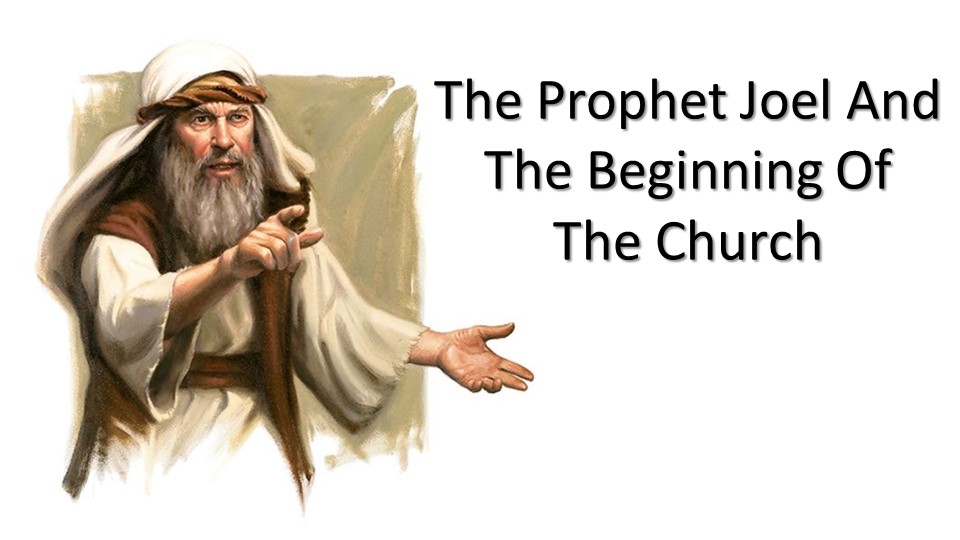
The Prophet Joel And The Beginning Of The Church

But this is what was spoken by the prophet Joel: “And it shall come to pass in the last days, says God, that I will pour out of My Spirit on all flesh; your sons and your daughters shall prophesy, your young men shall see visions, your old men shall dream dreams. And on My menservants and on My maidservants I will pour out My Spirit in those days; and they shall prophesy. I will show wonders in heaven above and signs in the earth beneath: blood and fire and vapor of smoke. The sun shall be turned into darkness, and the moon into blood, before the coming of the great and awesome day of the Lord. And it shall come to pass that whoever calls on the name of the Lord shall be saved.” (Acts 2:16-21)

The Prophet Joel And The Beginning Of The Church

Little is known about the prophet Joel who prophesied approximately eight hundred years before Christ. As a contemporary of Hosea and Amos, Joel faced a nation a century removed from the division of the land following the death of Solomon. The northern tribes would never recover from the onslaught of idol worship and be destroyed in less than eighty years. Judah would remain for another two hundred years but fall to the Babylonians. The prophets of Joel’s day saw the hearts of the people waxing worse in following the nations around them. Sin would destroy the people of God. The central message of the book of Joel was an invading locust swarm devastating the land. Some have suggested the locusts were an allegory of an invading army, but it seems more likely Joel is using an actual event of locusts that stripped the land, bringing drought and fires and utter destruction. Natural catastrophes were used by the messengers of God to remind the people of the wrath of the Lord with a call to repentance. Using the locust invasion as a backdrop, Joel proclaimed the coming of the day of the Lord.

For the people of Joel’s time, the message was very stern yet clear. There was no doubt the judgment of the Lord was coming upon a rebellious people. The day of the Lord is great and very terrible. Repentance is called for to return to a gracious and merciful God slow to anger and of great kindness. Great blessings will come upon the people if they turn to the Lord. Joel tells the people that afterward, the Lord will pour out His Spirit on all flesh. Their sons and daughters will prophesy, the old men dream dreams, and young men see visions. This was the prophetic language of the coming of the kingdom of God spoken about in Psalm 2, Isaiah 2, Daniel 2, and fulfilled in Acts 2 and Ephesians 2. Peter would use Joel 2 to explain the events of the coming of the church of Christ on the day of Pentecost.

Following the resurrection of Jesus, the apostles were commanded to tarry in Jerusalem until they had been endued with power from on high. When the Day of Pentecost had come, the twelve apostles received the baptism of the Holy Spirit, and they were all filled with the Holy Spirit and began to speak with other tongues as the Spirit gave them utterance. A sound from heaven, as of a mighty rushing wind filled the house where the apostles were sitting. When the sound occurred, a multitude came together and was confused by what they saw. They saw twelve Galileans speaking in multiple languages. Some thought the men were drunk. Standing up with the eleven, Peter raised his voice and began to explain the meaning of the events. He declared what was occurring was the fulfillment of Joel’s prophecy eight hundred years earlier. This is an example of “divine commentary” when Peter, under the direction of the Holy Spirit, declared the words of Joel were fulfilled that day in the city of Jerusalem. Homer Hailey writes, “It is concluded, therefore, that what took place on Pentecost marked the beginning of the complete fulfillment of Joel’s word.”

The New Testament church was not an afterthought of God to fill a space of time until Christ comes and establishes some earthly kingdom. Joel prophesied the day of the Lord would come with great signs, and Peter confirmed the prophet’s words pointed to the beginning of the church. The words of Joel looked beyond the condition of Israel in rebellion to a time God would bring Jew and Gentile together in the church of Christ where there was neither male nor female, slave or free, for all were one in Christ. Joel would not see the coming of the kingdom of Christ, but he prepared the faithful to accept the fulfillment of his words as the day of the Lord when God established His divine family, the church. The bridge of God’s grace reached eight hundred years to show the eternal purpose He accomplished in Christ Jesus our Lord.

Posted in Uncategorized | Leave a comment

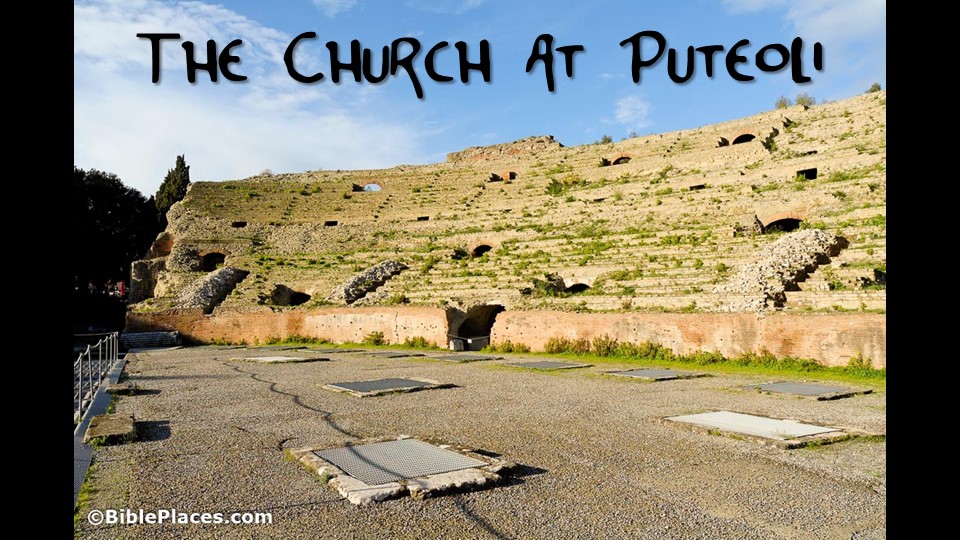
The Church At Puteoli

From there we circled round and reached Rhegium. And after one day, the south wind blew; and the next day we came to Puteoli, where we found brethren and were invited to stay with them seven days. And so we went toward Rome. (Acts 28:13-14)

The Church At Puteoli

Luke was a historian of the first rank detailing the early development of the church and the work of men like Peter and Paul throughout the Roman Empire. The gospel was first preached in Jerusalem by the twelve apostles, followed by many saints going throughout Judea, Samaria, and to the ends of the earth teaching about Jesus Christ. In the first part of Acts, Luke details much of the work of Peter and the missionary journeys of the apostle Paul. Antioch of Syria was a hub of evangelism with men like Paul, Barnabas, and Silas going on preaching trips establishing churches in Salamis, Paphos, Antioch of Pisidia, Iconium, Lystra, and Derbe. Through the letters of Paul, churches in Corinth, Ephesus, Colosse, Philippi, Thessalonica, Rome, and the churches of Galatia are detailed with the early struggles of the first-century disciples.

Many churches attributed their beginnings to the work of Paul and his companions. While much of the New Testament will focus on the work of Peter and Paul, there were many unsung heroes of scripture that quietly worked to establish churches throughout the world. On Paul’s journey to Rome, his party was shipwrecked in Malta, fifty miles south of Sicily. After three months, the group began the final journey to Rome, landing at Syracuse and then reaching Rhegium. The next day they arrived at Puteoli, five miles west of Naples, where Paul and his companions found brethren and remained seven days. It must have been heart-warming for the apostle Paul to find a church of Christ in the city of Puteoli. The brethren were very hospitable and kind to the Romans and Paul and his fellow workers, including Luke.

Preaching the gospel is done by men of note like Paul, Peter, Barnabas, Timothy, and Silas, but there is a lot of work done by men and women whose names will never be known. Where did the church in Puteoli have its beginnings? When did the first convert in this Roman town learn the truth? How many members did the group have, and what challenges did they face? Luke offers no details, but it can be easily imagined how refreshing it was for Paul to find brethren in this little town 170 miles south of Rome. He would have warmly remembered the week he spent with the Puteolian brethren. It would be wonderful to think that Paul would occasion to visit them again, but nothing is known.

Many churches throughout the ages have quietly gone about their work of teaching, preaching, and showing kindness to others the world will never know. Their beginnings were not inscribed in the works of Paul. They may never leave a story for historians to write about, but churches like the one found in Puteoli are bastions of divine glory for the small work they carry out. One day a group of Romans soldiers with prisoners in tow came to the town of Puteoli, and the brethren showed Paul and his companions the grace of God. They quickly passed from the eternal canvas of God’s word, and yet their legacy remains today. This should inspire all of the churches of Christ to do everything they can do – wherever they are – with the means they have available – to show the world Jesus Christ. One day a man of God in chains may show up and need some encouragement and hope. There can be little doubt the week in Puteoli invigorated the apostle Paul to keep fighting the fight. A small band of Christians did what they were called to do. Let the congregation I am a part of follow the example of brethren in Puteoli.

Posted in Uncategorized | 2 Comments

An Open Mouth And An Open Heart

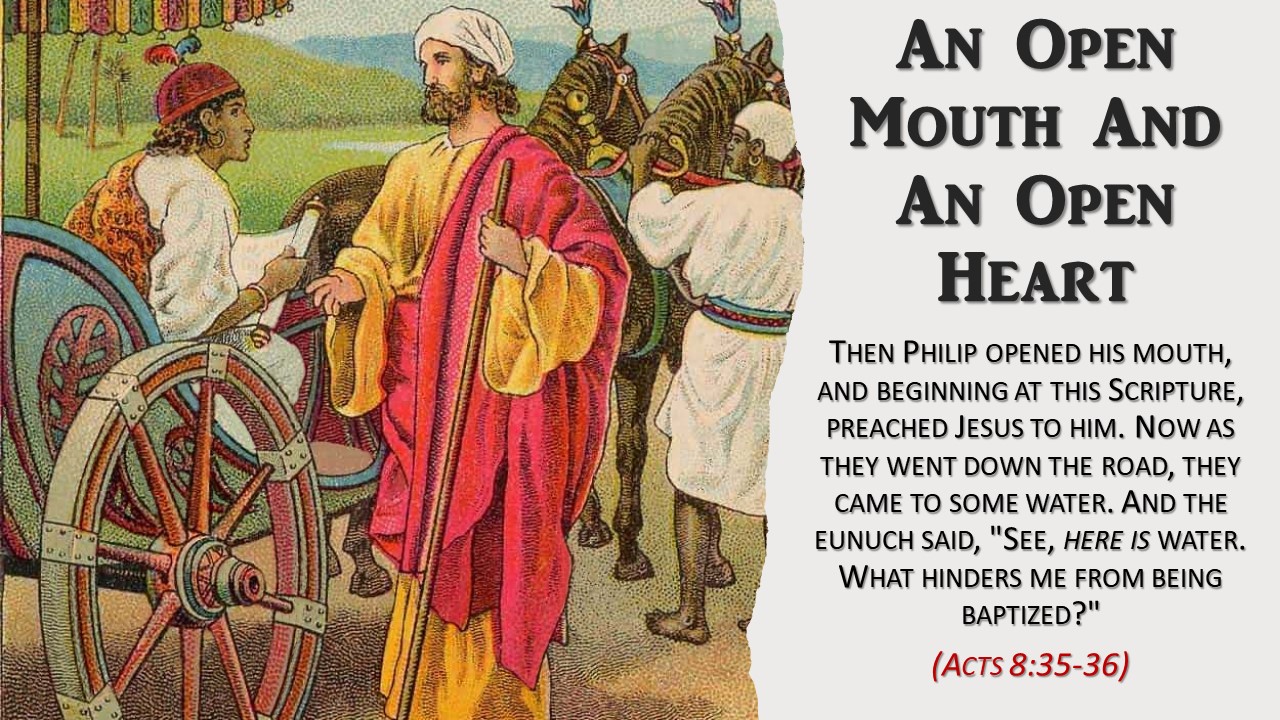
So Philip ran to him, and heard him reading the prophet Isaiah, and said, “Do you understand what you are reading?” And he said, “How can I, unless someone guides me?” And he asked Philip to come up and sit with him. The place in the Scripture which he read was this: “He was led as a sheep to the slaughter; and as a lamb before its shearer is silent, so he opened not his mouth. In his humiliation his justice was taken away, and who will declare his generation? For his life is taken from the earth.” So the eunuch answered Philip and said, “I ask you, of whom does the prophet say this, of himself or of some other man?” Then Philip opened his mouth, and beginning at this Scripture, preached Jesus to him. Now as they went down the road, they came to some water. And the eunuch said, “See, here is water. What hinders me from being baptized?” Then Philip said, “If you believe with all your heart, you may.” And he answered and said, “I believe that Jesus Christ is the Son of God.” So he commanded the chariot to stand still. And both Philip and the eunuch went down into the water, and he baptized him. (Acts 8:30-38)

An Open Mouth And An Open Heart

Stories of conversion are divine testimonies to the changing power of the word of God. There is nothing more thrilling to read than the manner the gospel moves in a man’s heart to accept the mercy and grace of God and the forgiveness of sins. Luke fills the Acts of the Apostles with story after story of first-century converts from three thousand in Jerusalem to towns and cities throughout the Roman Empire. Multitudes of men and women believe and obey the call of redemption through Jesus Christ. Evangelists like Phillip, a man full of faith, face the onslaught of persecution with the courage to go everywhere preaching the word. An angel of the Lord tells Phillip of an opportunity to teach a man from Ethiopia returning to his home after going to Jerusalem to worship. Phillip finds the Ethiopian along the road which goes down from Jerusalem to Gaza.

The man of Ethiopia was a person of great authority under Candace, the queen of the Ethiopians, who had charge of her treasury. He was a man of faith who believed in Jehovah God and spent many hours examining the scriptures from prophets like Isaiah. As the Ethiopian is reading Isaiah, Phillip approaches the chariot and asks him if he understood what he was reading. The treasurer was eager to have someone explain the text to him, and he invited Phillip to join him in his chariot. Sitting together with the scroll of Isaiah open before them, the evangelists opened his mouth and taught the Ethiopian the story of Jesus Christ. The record does not say how long they talked. As the story of the suffering servant opened up before the Ethiopian, his heart began to open to a message he had never heard before, and it thrilled him to his soul. Phillip told the story of Jesus of Nazareth, a man attested by God by miracles, wonders and signs, and His message of love and sacrifice. The evangelists wove the plan of God’s redemption throughout the scriptures to show that Jesus had risen from the dead and salvation was no longer found in keeping the Law of Moses. Instead, there was a new covenant through the blood of Christ.

There is no record of what Phillip told the Ethiopian, but there are bookends that fill the gap of his message that day. Phillip began at Isaiah 53 and preached Jesus. As the two men sat and talked of scripture, the Ethiopian understood that God now desired men to believe and be baptized. It was the Ethiopian who suggested they stop when they came to some water. His heart had opened to the story of Jesus that commanded water baptism for salvation, and he asked Phillip what hindered him from being baptized. Phillip responded the only thing at that point was to believe with all the heart the word of God, and the Ethiopian agreed. So the Ethiopian commanded his chariot to stop, and he and Phillip went down into the water, and Phillip baptized the man from Ethiopia.

The story of the Ethiopian treasurer is one of an open mouth teaching a man with an open heart. An angel sent a man to teach a lost sinner. The angel did not teach the man. In the plan of salvation, men must teach men. No divine being will come to earth to save a man. Later, Jesus would appear to Saul of Tarsus, but Saul was not saved until a man came to teach him the word. Cornelius was told by an angel what to do to have words of salvation. He sent to Joppa for Peter, and the apostles came and taught the household the word of God. Evangelism requires an open mouth willing to find opportunities to teach others.

Through the grace of God, an open heart will be receptive to the word of God. There could have many arguments the Ethiopian could have used to dissuade the teaching of Phillip about the Christ. It was the open heart of the man from Ethiopia to accept that he was the subject of Isaiah. In the story of Jesus, Phillip told the Ethiopian that he must be born again in the waters of baptism. The man from Ethiopia embraced the necessity of baptism without reservation. He commanded the chariot to stand still, and he wanted Phillip to baptize him immediately. The Ethiopian went on his way rejoicing because he was a Christian, bound to Christ through the waters of baptism. An open mouth taught an open heart, and that is where stories of conversion come from. Thank God for open mouths and open hearts.

Posted in Uncategorized | Leave a comment

Right God. Wrong God.

And in Lystra a certain man without strength in his feet was sitting, a cripple from his mother’s womb, who had never walked. This man heard Paul speaking. Paul, observing him intently and seeing that he had faith to be healed, said with a loud voice, “Stand up straight on your feet!” And he leaped and walked. Now when the people saw what Paul had done, they raised their voices, saying in the Lycaonian language, “The gods have come down to us in the likeness of men!” And Barnabas they called Zeus, and Paul, Hermes, because he was the chief speaker. Then the priest of Zeus, whose temple was in front of their city, brought oxen and garlands to the gates, intending to sacrifice with the multitudes. But when the apostles Barnabas and Paul heard this, they tore their clothes and ran in among the multitude, crying out and saying, “Men, why are you doing these things? We also are men with the same nature as you and preach to you that you should turn from these useless things to the living God, who made the heaven, the earth, the sea, and all things that are in them, who in bygone generations allowed all nations to walk in their own ways. Nevertheless, He did not leave Himself without witness, in that He did good, gave us rain from heaven and fruitful seasons, filling our hearts with food and gladness.” And with these sayings, they could scarcely restrain the multitudes from sacrificing to them. (Acts 14:8-18)

Right God. Wrong God.

The missionary journeys of Paul, Barnabas, and Silas established many churches and brought many souls to Christ. Their preaching was forceful and plain, and often facing persecution for the clarity of their message. Paul preached to Jews and Gentiles, often teaching in Synagogues and the marketplaces. With the accompanying signs of the Holy Spirit, Paul opened the word of God with proof of divine inspiration showing powers no man could do. These miracles confirmed the word bringing people to know the gospel. But the miracles did not always get the desired result, with people seeing the working of the Lord God and coming to see the saving power of Christ.

In the city of Lystra, a city of Lycaonia, a man who had been crippled in his feet since birth sat begging. Paul took any opportunity to preach to a crowd, and during one of those times, he observed the lamb man listening intently to his message. Few in the crowd took notice of this nobody among them. He had been forgotten by society as a cripple with little regard for his existence. He caught the eye of the apostle, who could tell this man was hungering for the truth. As Paul examined the man, he could tell he had the faith to be healed. He cried out to the crippled man from birth to stand up straight on his feet. And he did. This astonished the multitude to see a man crippled from birth immediately standing and walking and leaping about with joy. A great miracle had been done through the power of God. Paul had shown the city of Lystra something they had not seen before. What they witnessed was a sure testimony of Jesus Christ. What they did was not.

Seeing the man leaping about, the people raised their voices praising the power of the gods that came in the likeness of men. Instead of giving honor to God the Father, the people worshiped Paul and Barnabas, calling them gods. Barnabas, they called Zeus, and Paul, Hermes. The priest of Zeus brought oxen and garlands to the gates to offer sacrifices with the multitudes. Everyone in the city came to sacrifice to the gods in human form for the wondrous miracle that was done. The man who had been healed was ignored, and attention was given to Paul and Barnabas. While the festivities were going on, Paul and Barnabas tore their clothes, running in among the multitudes trying to stop the people from worshiping them. Paul pleaded with them to turn from the useless things to the living God and know the gospel of Jesus Christ. It was to no avail. The people would not listen. Paul and Barnabas could scarcely constrain the people. Shortly afterward, Jews from Antioch and Iconium came and dissuaded the crowds, who then took Paul out of the city, stoning him and leaving him for dead. One moment they worship him as Hermes, and the next, they are killing him.

The right God was shown to the people who embraced the wrong god. Paul would survive his stoning – not because he was a god – but through the providence of the true God. The evidence was clear and demonstrative for the city of Lystra to know the living God. A miracle of unparalleled power was done, and all they could see was the work of the wrong gods. The man had been crippled from birth, and everyone in the city knew this fact. No one could have imagined how such a man could be healed in an instant. When Paul spoke to him (without touching him), and the man stood and leaped about, the multitudes should have bowed on their knees to praise the work of the one true living God. Instead, they hardened their hearts and gave glory to their useless gods. When the Jews from Antioch and Iconium came and persuaded the people Paul was not a god, they stoned him.

There is an incredible amount of evidence of the one true God. Throughout the universe and the known world, the handprint of the Creator is everywhere. Creation testifies to a Creator. The Bible exalts the word of God as divine. No book has ever matched its power and glory, and no doctrine or faith will merit consideration compared to the Bible. The New Testament church is the kingdom of God ruled by His Son as King of Kings and Lord of Lords. No kingdom is greater than the church belonging to Christ. The message of the resurrection is the greatest miracle in the history of humanity and the redemption through the Son of God the greatest hope. Everything man needs to find eternity is found in Jesus Christ’s message, yet men still reject him for their own gods. Those gods can be a false religion, pleasures of the flesh, pride, riches, fame, and the mistaken belief there is no God. When the final day of judgment comes for all men, there will be two things known to all: the right God and the wrong God. Which one do you serve?

Posted in Uncategorized | Leave a comment

Spirit Fruit: Self-Control

But the fruit of the Spirit is love, joy, peace, longsuffering, kindness, goodness, faithfulness, gentleness, self-control. Against such there is no law. (Galatians 5:22-23)

Spirit Fruit: Self-Control

There are a lot of members of the “Self” family. Self-abnegation, self-complacency, self-conquest, self-deception, self-defense, self-denial, self-esteem, self-interest, selfishness, self-love, self-reliance, self-respect, and a host of other cousins of the grandfather of all, Self. The word implies controlling the emotions, impulses, and actions of the human spirit. One of the most challenging of the self characteristics is self-control or self-restraint. Shannon Fife said self-restraint is “feeling your oats without sowing them.” The New Testament defines the word as “having power over oneself, temperance, and self-mastery.” The final fruit of the Holy Spirit is self-control and yet one of the essential virtues of the Christian life.

Sin derives its nature from the lack of self-control. Eve was tempted to eat the fruit, but the sin was not in the temptation. The tragedy came when she saw the fruit was good to eat and to make her wise, and she refused to stay her feelings. It was not reckless abandonment as some may view sin, but because of her lack of self-restraint, she disobeyed the command of God. Sin was the fruit of her lack of self-control. Eating the forbidden fruit was a sin derived from a failure to control the impulses of the human spirit leading to the fall of man. Centuries later, Jesus would die as a man who completely controlled his emotions and desires and yet without sin. The epitome, perfection, and example of the Son of God was His ability to control self by the fruit of the Holy Spirit fully.

Paul describes self-control as a fruit of the Holy Spirit. It is not an easily mastered art in the human soul. Trying to rein in the emotions of a volatile spirit requires divine assistance. Exercising control of the human spirit without the Holy Spirit is trying to stop a runaway horse without a rein. It cannot be done. The strength and appeal of a sinful life is the lack of self-control. There are no boundaries when there is no control. Living in the Holy Spirit breaks the uncontrolled spirit of passion to be conformed to the image of Jesus Christ. A gentle spirit comes from a spirit under control. Showing love, joy, peace, longsuffering, kindness, goodness, and faithfulness is a fruit of the Holy Spirit measured by the power of self-restraint. Without self-control, love becomes hate, joy turns into fear, peace is turned into war, and so forth. All of the attributes of the works of the flesh come from the lack of self-control, such as sexual immorality, idolatry, hatred, outbursts of wrath, and selfish ambitions.

Self-control comes from righteousness and the knowledge of judgment to come. Doing those things that are right in the eyes of God will diminish the desire to serve self. Understanding there will be consequences to actions and emotions left unprotected, the heart will find strength against unrestrained spirits. The fear of punishment is a powerful inducement to measure the actions of self against the wrath of God. From the Holy Spirit, the fruit of self-control keeps the soul safe from the wiles of the devil. Self-control is a learned experience requiring great patience and a willingness to seek the help of the Divine. As a fruit of the Holy Spirit, self-control becomes a badge of identity for the Christian. It is the strength of divine power that controls the passions of the flesh, the lust of the eyes, and the pride of life. The lack of self-control can only be blamed on one person: self. God’s final judgment is very personal because the only person being judged is self – not a neighbor, friend, or family member. When all humanity gathers for the final day of judgment before the throne of the Lord God, everyone will be standing alone with self to answer for self and whether or not self-controlled the right person. How are you doing self?

Posted in Uncategorized | Leave a comment

The Humility Of Job

Then Job answered the Lord and said: “I know that You can do everything and that no purpose of Yours can be withheld from You. You asked, ‘Who is this who hides counsel without knowledge?’ Therefore I have uttered what I did not understand, things too wonderful for me, which I did not know. Listen, please, and let me speak; You said, ‘I will question you, and you shall answer Me.’ “I have heard of You by the hearing of the ear, but now my eye sees You. Therefore I abhor myself, and repent in dust and ashes.” (Job 42:1-6)

The Humility Of Job

If there is one man in scripture that is the definition of suffering, courage, faith, and patience, the man Job is at the top of the list. The Holy Spirit dedicated more than ten thousand words to tell his story. It began with a conversation between the Lord God and Satan. The story ends with a conversation between the Lord God and Job. In between the two bookends is a sad story of loss, grief unimaginable, suffering almost unbearable, and the counsel of friends that often was misguided, cruel, judgmental, and without mercy. Quietly sitting with the four older men was a younger man with deeper counsel and spiritual insight. As an epic drama, the book of Job is poetic yet formed as a debate on the character of God and the plight of man. No final analysis is derived from the discussions, but God is recognized as omnipotent, omniscient, full of justice, righteousness, and truth. One of the great mysteries of the book is while the calamity of events that came upon Job and his family were enormous, nothing is presented at the end of the story where God explains why those things that occurred to Job happened. And Job never asked. It did not matter. He trusted in God.

Job’s faith struggled. He did not quietly take the loss of his family and his health without bemoaning his birth, his place in life, and the unfair counsel of his friends. The faith of Job sought to argue with God – with respect – but argue nonetheless. He persistently appeals to God for help, answers, guidance, and mercy. When the friends ceased answering Job, Elihu spoke up in anger. His wrath was because Job justified himself rather than God, and Elihu was also angry with Job’s three friends, for they made God appear to be wrong by their inability to answer Job’s arguments. When Elihu finished, the Lord took up the baton against Job telling him to stand up and face the Creator’s wrath and a righteous God. The Lord’s rebuke was a blistering barrage of righteous indignation. It moved Job to say he was vile and worthless. The rebuke continued. Finally, at the end of the Divine declaration, Job realized his folly and sought the kind mercy of the Lord God, seeking His love filled with a heart of repentance.

It is hard to debate the voice of God proceeding from a whirlwind. Job did not try to excuse himself. He did not blame his three friends. His plight was not something he could seek mercy from God as a pitiful man of no degree. The voice of defiance was never heard. His heart was not filled with anger at God. There were many emotions Job could experience when it all came to an end, but the one thing Job possessed was a heart of humility. He did not understand why everything that happened to him came about. His friends were not evil men. They had tried to comfort their friend with whom they had sat for a week in silence. Human wisdom failed, but those three friends were there with Job, and that mattered to him. They brought some comfort because of their presence. Job appreciated the wisdom of youth as he listened to Elihu, a daysman sent by God. Foremost, the man from Uz heard the voice of God as he had never heard before. He knew he was in the presence of the Almighty. He approached God with a humble heart.

The catastrophes that happened to Job would destroy most men. He learned patience and humility. Job acknowledged that he was not in a place to accuse God. His heart was filled with remorse not to have greater faith and trust in the presence of his heavenly Father. Bad things happen to people, and God still rules. Long after Job died, the Son of God came and suffered more than Job could imagine. Where was God when His Son was being tortured? The same place He was when Job was suffering. The humility of Job came from a character of suffering to trust in God and His will – whether he understood the answers or not. Job said he spoke what he did not understand, and he repented. As Job looked back over the conversation with his friends, he was ashamed because he had not given glory to God. Humility begins by saying, “I know that You can do everything and that no purpose of Yours can be withheld from You.” That is a heart subject to the will of God in the face of bearing a cross for Jesus Christ.

Posted in Uncategorized | Leave a comment