
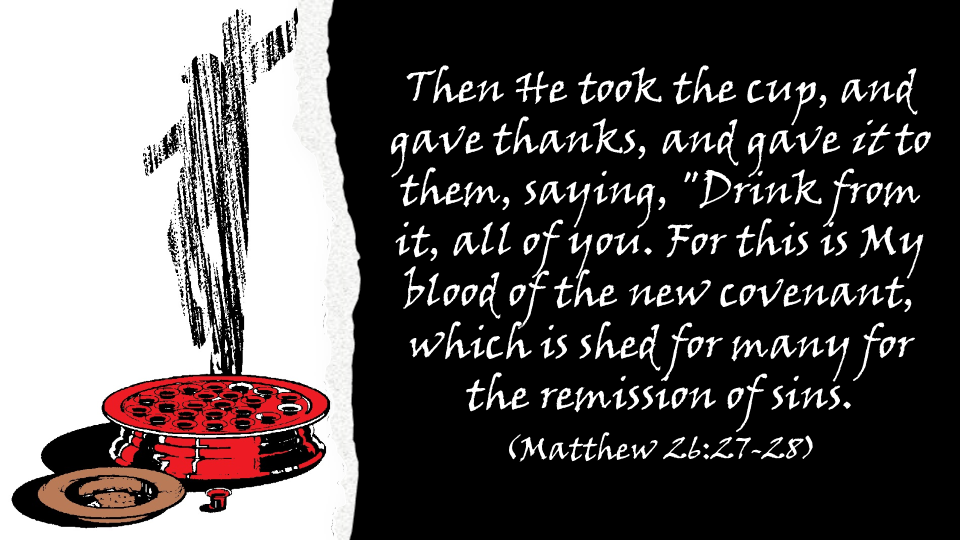
And as they were eating, Jesus took bread, blessed and broke it, and gave it to the disciples and said, “Take, eat; this is My body.” Then He took the cup, and gave thanks, and gave it to them, saying, “Drink from it, all of you. For this is My blood of the new covenant, which is shed for many for the remission of sins. (Matthew 26:26-28)
Baptism, Blood, And The Supper
The New Testament clearly defines the terms of salvation through the blood of Jesus Christ. From the beginning, blood has been given for the atonement of sin. Because life is in the blood, it became the medium of expiation. Blood was used in the Law of Moses to cleanse and sanctify, and all things used in the worship had to be cleansed by blood. A covenant between God and man was dedicated with blood. One comes into a covenant relationship with God by reaching the blood of Jesus Christ.
When Jesus instituted the Lord’s Supper, He told the eleven His blood would be shed for the remission of sins. This was accomplished in His death. In the death of Jesus, a sinner is washed in the blood and receives remission of sins. The command of baptism is the agency where the sinner washes away his sins through the blood of Jesus Christ. Baptism is necessary for salvation because that is the place where the blood cleanses the sinner. The blood of Jesus was shed for the forgiveness of sin, releasing one from sin by the blood. Baptism is necessary for salvation; without it, there can be no forgiveness of sin.
The early church taught the necessity of baptism, and the church today is under the same obligation to teach baptism as necessary to wash away sins. Jesus instituted a memorial feast commemorating His death, burial, and resurrection. The early church taught the necessity of the Lord’s Supper on the first day of the week to remember Jesus’s sacrifice. Paul rebuked the church in Corinth for their flippant disregard for the Supper, warning them that if anyone did not properly discern the Lord’s body, they would stand in judgment from the Lord.
It is possible to observe the Supper in an unworthy manner. The Corinthians did not gather together to observe the memorial properly, and Paul warned them of the consequences. Taking the Lord’s Supper requires a gathering together. Events of the past few years have mistakenly led some to believe they can remain at home and “worship” and take the Lord’s Supper. There is no authority for this, COVID or no COVID. Paul referred to the Supper as a “gathering together” on the first day of the week. The church teaches the necessity of the first day of the week and the taking of the Supper on the first day of the week by the authority of the New Testament.
There is no reluctance to teach the necessity of baptism, but for the last few decades, there has been a growing reluctance to teach the necessity of the Lord’s Supper. One cannot be a Christian without first having their sins washed away in the blood of Jesus. However, after a person is washed in the blood of Jesus, they are commanded to remember that blood in the taking of the Supper. Either the Lord’s Supper is commanded, or it is not. The Hebrew writer explains that a willful refusal to gather with the saints to remember the memorial of Jesus Christ tramples the Son of God underfoot, counts the blood of the covenant as a common thing, and insults the Holy Spirit. There is a certain expectation of judgment against those who do not assemble with the saints on the first day of the week.
Excuses abound on why people cannot assemble with the saints. Their jobs keep them too busy, or they have a slight headache (that miraculously goes away Monday morning), they’re on vacation, company comes to visit, or it’s a good day for shopping. There are multitudes of excuses why the Christians cannot assemble, and months go by or longer. The church looks the other way as they try to encourage them. While encouragement is a vital part of the restoration, seldom is the seriousness of the neglect to honor the blood of Jesus Christ given passing notice. Baptism is essential, and the Lord’s Supper is commanded because of one common factor: the blood of Jesus Christ.
A parallel between baptism and the Lord’s Supper is found in the Law of Moses, where circumcision is required to be a Jew, but keeping the Sabbath was an option. No one could be a Jew without circumcision. When a person made a covenant with the Lord, he was obligated to remember and keep the Sabbath day holy. One man found that picking up sticks on the Sabbath brought about his death. If the church teaches the necessity of baptism, they must teach the necessity of the Supper; as much as the same figure is found in circumcision and the Sabbath. Both circumcision and keeping the Sabbath were commanded. Baptism and the remembrance are commanded. Failure to remember the sacrifice of Jesus will jeopardize the soul and bring the wrath of God against the rebellious heart. What will the church teach?
 The Heaton File