
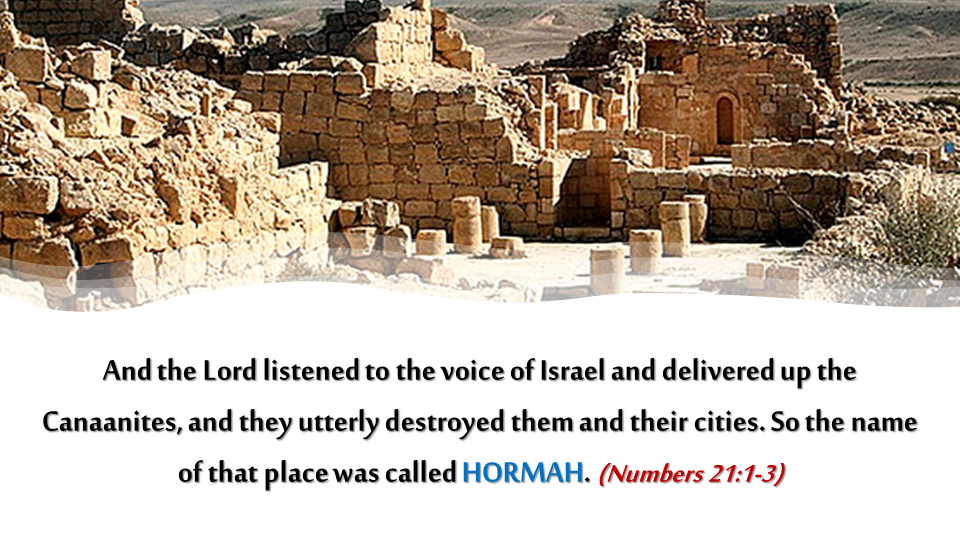
The king of Arad, the Canaanite, who dwelt in the South, heard that Israel was coming on the road to Atharim. Then he fought against Israel and took some of them prisoners. So Israel made a vow to the Lord, and said, “If You will indeed deliver this people into my hand, then I will utterly destroy their cities.” And the Lord listened to the voice of Israel and delivered up the Canaanites, and they utterly destroyed them and their cities. So the name of that place was called Hormah. (Numbers 21:1-3)
Lessons From Hormah
Israel spent forty years wandering in the wilderness as punishment for their rebellion at Kadesh Barnea. When they came to the land of Edom, the king refused to allow the Hebrews to pass through. The king of Arad attacked the people and took some prisoners. Israel made a vow to the Lord that if He would deliver the Canaanites into the hands of Israel, they would, in turn, utterly destroy the people and their cities. Heeding the vow of the people, God allowed Israel to kill all the people and raze their cities to the ground. Hormah is the word for the land’s destruction and the inhabitants’ banishment.
There are many examples of the story of Hormah in the Bible. On a human level, Israel marched against the king of Arad, the Canaanite, and slaughtered all the people: men, women, and children. The cities were burned, pillaged, and torn down. There was nothing to be left. Joshua would accomplish much of this destruction some years later. Still, the judgment of God had come upon these people for their wickedness and iniquity.
Hundreds of years earlier, God promised Abraham that his descendants would be given the land. The land couldn’t be given yet, for the iniquity of the Amorites was not yet complete. The Lord told Abraham the people of the land would be driven out, including the Kenites, Kenezzites, Kadmonites, Hittites, Perizzites, Rephaim, Amorites, Canaanites, Girgashites, and Jebusites. Later, the Lord told Moses that the Angel of the Lord would go against the Amorites and the Hittites, the Perizzites, the Canaanites, the Hivites, and the Jebusites to cut them off. When Israel destroyed the people of Arad, they completed the word of the Lord.
God keeps His promises. The promise to Abraham justified God’s righteous punishment for those who rejected Him. There would be many generations before the fulfillment of the word of the Lord came true, but it would not fail. The sinful nature of the people became so corrupt that God destroyed them. This is not unlike why God destroyed the world in the days of Noah. When Israel destroyed the people, they carried out the divine promise of God.
The people acted from the viewpoint of God’s wrath, not their own. It was not vengeance on the part of Israel to destroy the people. They first asked God’s blessing to attack the Canaanites because it was God’s will that must be accomplished. Killing all the people of the land came from the mind of the Lord against all ungodliness. As agents of God’s wrath, Israel acted under the banner of a righteous judge, executing judgment against those who were void of righteousness. It was clear Israel understood God’s role in the destruction of the people.
God is a God of wrath against ungodliness. It seems heartless to kill the Canaanites, but when a man understands what the wrath of God means, he will see the righteous judgment of the Lord. If a man commits horrible crimes against others, society deems him unfit to remain in the community. The Canaanites should not be thought to be good, righteous, loving people. They refused to retain God in their knowledge, worshipped idols, including human sacrifice, committed heinous crimes against one another, and lived immoral, decadent, sensual lives filled with sexual immorality. God’s wrath was complete when they were destroyed.
Hormah is a reminder of the promises of God, the righteous judgment of the Lord, and the reality of the eternal punishment of those who refuse to acknowledge God as Lord. Jesus told us about the day of judgment when all men bow before the great I AM to be judged according to their works. God has promised salvation to those who obey and condemnation to those who disobey. The promises of God always come true. Vengeance belongs to the Lord. There will be no one who will get away with evil in the sight of the Lord. All evil doers will be punished. Jesus said more about eternal punishment than any other. There is a place of everlasting Hell, which is fittingly called the lake of fire and brimstone. Hell is not temporary. Whether a person understands the meaning of eternal or not, they will when they find themselves in the darkness of perdition.
There are lessons to learn from Hormah. Believe and repent. Live for God. Obey His word. Now is the day of salvation.
 The Heaton File