
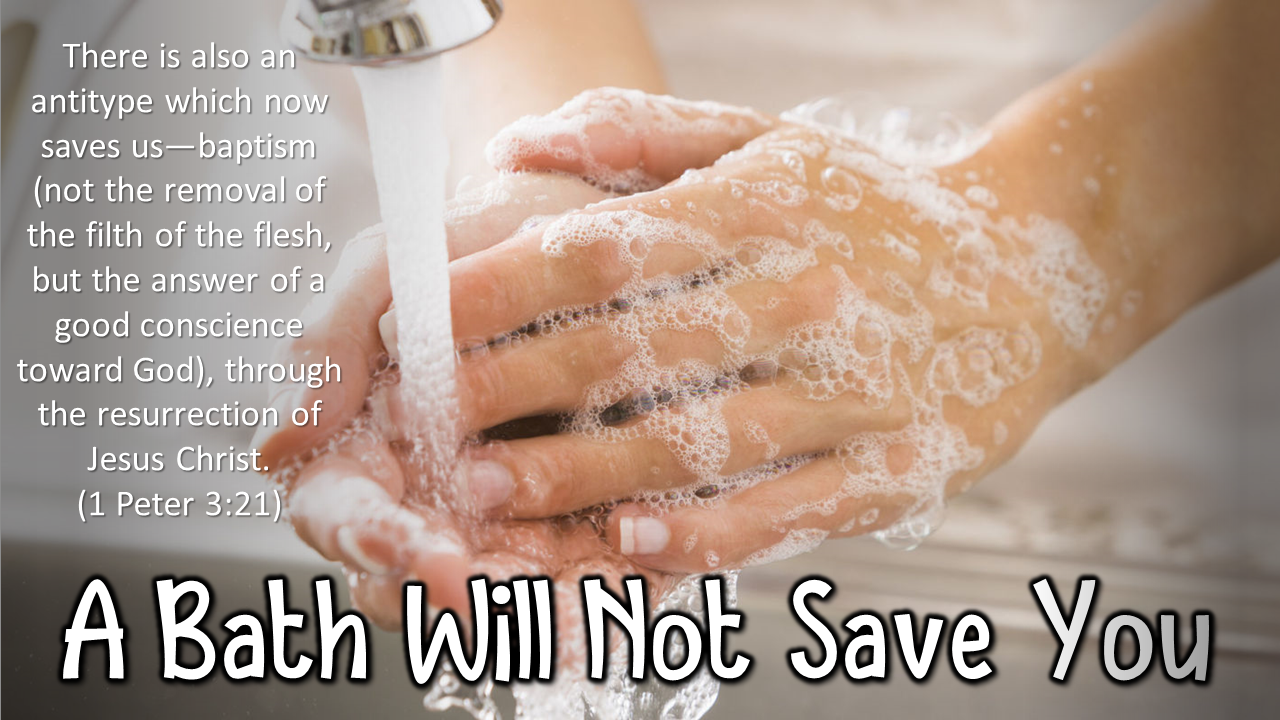
There is also an antitype which now saves us—baptism (not the removal of the filth of the flesh, but the answer of a good conscience toward God), through the resurrection of Jesus Christ. (1 Peter 3:21)
A Bath Will Not Save You
There is something that will save a man, and there is something that will not save a man. Peter shows that baptism will save, but taking a bath is not the same thing. One has the power to cleanse sins, and the other can only remove the filth of the flesh. When a man works by the sweat of his brow, he becomes dirty and covered with sweat. He may decide to bath to remove the dirt and sweat, and when he has done so, he is clean on the outside. Trying to look at baptism in the same way a man takes a bath has eternally different consequences. A man can bathe as fanatically as Adrian Monk, but he is only clean on the outside.
The act of baptism is not taking a bath. When Naaman was told to dip seven times in the Jordan River, the prophet did not suggest that all lepers should bathe in the muddy Jordan and be clean. There are no healing properties in the Jordan. Faith finally led Naaman to obey the word of the Lord, and he was cleansed of his leprosy. Many argue against baptism as essential for salvation because they think a man is taking a bath. Peter shows that salvation does not come from the removal of the filth of the flesh but the answer of a good conscience toward God.
Baptism is an act of the heart and mind struck down by God’s overwhelming grace and mercy. The Jews on the Day of Pentecost were pricked in their hearts for the murder of the Son of God. In the sermon Luke records of Peter, the apostle never mentions baptism. Peter’s sermon convinced the people to do something to save themselves. When pressed by the crowd to tell them what to do, Peter did not tell them to go and wash in the pool of Siloam. That is where the blind man was healed. He did not ask them to take a bath. Peter told the crowd to “repent and be baptized for the remission of your sins.”
In response to the command by Peter and the eleven to repent and be baptized for the remission of sins, three thousand people were moved by their good conscience to obey the word of the Lord. They answered with a good conscience toward God and were baptized. Peter did not contradict what he told the multitude on Pentecost with what he wrote the pilgrims of the Dispersion in his first epistle. One of the curious things missing from the conversion stories is the arguments people make today against baptism. Where in scripture does anyone say they will refuse baptism because they believe a sinner’s prayer can save them? Three thousand people did not argue with the words of the twelve.
When a man refuses to accept that baptism saves, he shows his evil conscience. There are only two kinds of minds: a good mind and an evil mind. Peter said that baptism saves. He parenthetically observes that he is not talking about bathing but about having a good conscience. The apostle said, “There is also an antitype which now saves us—baptism, through the resurrection of Jesus Christ.” If you reject this, you turn away from God’s grace. Believing baptism is not necessary for salvation comes from an evil heart of unbelief. When you accept the word of God, your good conscience will act accordingly. What hinders you from being saved?
 The Heaton File