
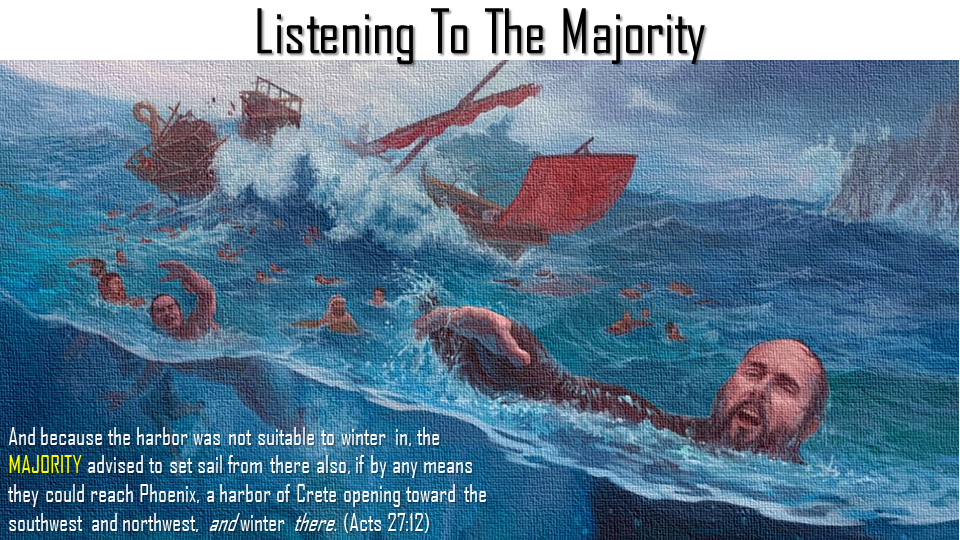
Now when much time had been spent, and sailing was now dangerous because the Fast was already over, Paul advised them, saying, “Men, I perceive that this voyage will end with disaster and much loss, not only of the cargo and ship, but also our lives.” Nevertheless the centurion was more persuaded by the helmsman and the owner of the ship than by the things spoken by Paul. And because the harbor was not suitable to winter in, the majority advised to set sail from there also, if by any means they could reach Phoenix, a harbor of Crete opening toward the southwest and northwest, and winter there. (Acts 27:9-12)
Listening To The Majority
Maritime travel in the first century was a hazardous undertaking. Ships were small and ill-equipped for the harsh conditions of the Mediterranean. Navigation was still primitive to a large degree, allowing for little guidance for sailors to measure their journey. Paul’s trip to Rome from Caesarea was complicated by the rigors of sea travel that almost cost him his life. They changed ships in Myra, a city of Lycia, bound for Rome. Under armed escort, Paul sailed with two hundred seventy-five people (including the gospel writer Luke). After many days, the ship arrived in Crete, in a place called Fair Havens, near the city of Lasea. The time of year was dangerous for ships to sail.
After staying in Fair Havens for some time, Paul warned the soldiers and the ship’s crew it would be best to remain in port until a suitable time was found to sail. He warned the trip could end in disaster and much loss, including their lives. The centurion decided to take the advice of the owner of the ship and set sail. Luke writes the majority of people on board agreed it would be best to sail immediately to reach Phoenix, a harbor of Crete, and to winter there. This decision would be a fateful decision for the ship’s owner and his cargo.
Beginning the voyage, the journey went well with a soft wind, and everyone felt assured the decision was good. Not long after they set sail, they were caught in a storm called Euroclydon. A Euroclydon is much like a hurricane or Levanter (a strong easterly Mediterranean wind). It caught the ship and tossed it about for more than two weeks. It was very perilous, but Paul assured the people that if everyone followed his instructions, no life would be lost. God assured Paul he would reach Rome, and those who traveled with him would not perish. The ship wrecked on the coast of Malta with no loss of life. Paul taught many the gospel in Malta and would eventually arrive in Rome.
The majority thought it was a good idea to sail. Paul had warned them it would be an unsafe journey. It seems clear Paul’s advice came from the word of the Lord, but his warning was ignored by the democracy of the more than two hundred people on board. After they were caught in the storm, Paul reminded the stricken crew they should have listened to him. Ignoring the word of the Lord would cost the owner his ship and cargo. When men do not listen to the word of the Lord, a price is paid.
Majority rule is a wonderful form of democracy, but the kingdom of God is a monarchy. Supreme authority is vested in one person under a monarchy. The kingdoms of men find the rule of a monarchy problematic. They also refuse to accept the rule of God in the spiritual realm. Jesus warned the wisdom of the majority is destruction. The masses follow the broad way, and most people will never see Heaven. That is a stark and difficult statement to accept, but it is true. Listening to the majority is never a good idea unless the majority is listening to God. That seldom happens.
Salvation is an individual choice, not measured by the decisions of the masses. The influence of the majority can sway the hearts of the individual, but ultimately, eternal life will be granted to each individual based upon the choices made by the individual, not the majority. Following what the majority says is seldom a wise choice. Going with the flow or following the path of least resistance is a dangerous path to walk. Following the majority is remaining silent when a word of caution should be said. If the people traveling with Paul had listened to his counsel from the word of the Lord, the journey would have turned out differently.
 The Heaton File